
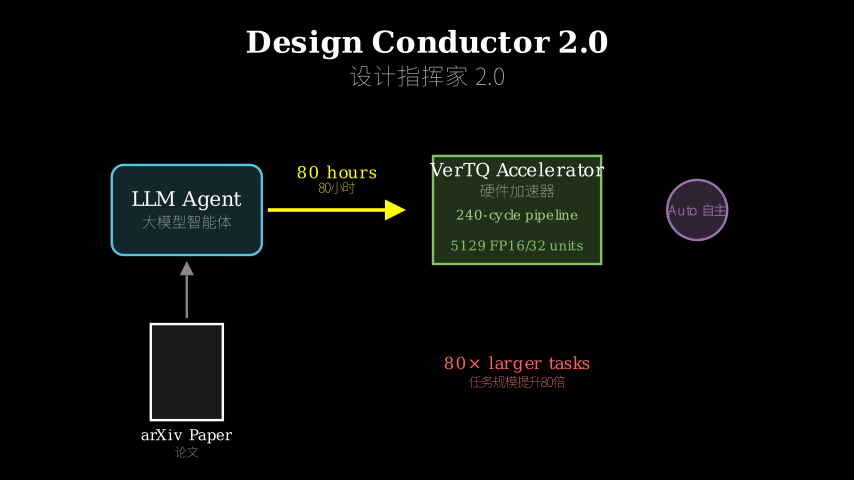
Paper: 2605.05170 Authors: The Verkor Team, Ravi Krishna, Suresh Krishna, David Chin Categories: cs.AR, cs.AI
The Gap
Prior work (Design Conductor 1.0, Dec 2025) showed LLM agents could autonomously design a 5-stage RISC-V CPU in 12 hours. But that system hit a complexity ceiling: it couldn’t handle designs with thousands of compute units, deep pipelines, or implementations derived from research papers rather than specifications. The gap is scale and abstraction — moving from toy demonstrations to production-grade accelerators that require understanding algorithmic papers, making architectural tradeoffs, and managing massive state spaces.
Problem: Agent-designed hardware stuck at toy complexity
   |
   v
Assumption: Frontier models (Apr 2026) + better harness = 80x scale jump
   |
   v
Method: Multi-agent system reads papers -> designs accelerator -> maps to FPGA
   |
   v
Evidence: VerTQ accelerator (5129 FP units, 240-cycle pipeline) from TurboQuant paper
   |
   v
Conclusion: Autonomous hardware design now handles production-scale complexity
The Increment
One sentence: Before this paper, AI agents designed simple CPUs from specs; after, they design production-scale accelerators from research papers.
Core Mechanism
Design Conductor 2.0 is a multi-agent orchestration system. One agent reads the TurboQuant paper and extracts the algorithm’s computational requirements. Another agent translates those requirements into a microarchitecture — deciding pipeline depth, parallelism, memory hierarchy. A third agent generates RTL (register-transfer level) code in Verilog. A verification agent runs simulations and catches bugs. A synthesis agent maps the design to FPGA and reports timing/area. The orchestrator coordinates these agents, passing intermediate artifacts between them and iterating when verification fails.
Paper (TurboQuant)
   |
   v
[Algorithm Agent] ---> computational graph, data dependencies
   |
   v
[Architecture Agent] ---> pipeline stages, FP unit allocation
   |
   v
[RTL Agent] ---> Verilog modules (5129 FP16/32 units)
   |
   v
[Verification Agent] <---> [RTL Agent] (iterate on bugs)
   |
   v
[Synthesis Agent] ---> FPGA bitstream (125 MHz, 5.7 mm^2 in 16FF)
Think of it like a construction company building a skyscraper. The algorithm agent is the structural engineer reading blueprints and calculating load requirements. The architecture agent is the general contractor deciding how many floors, where to place elevators, how to route utilities. The RTL agent is the crew pouring concrete and welding steel. The verification agent is the inspector catching code violations. The synthesis agent is the city planner checking zoning and issuing permits. The orchestrator is the project manager keeping everyone synchronized and handling change orders when inspections fail.
Key Concepts
-
RTL (Register-Transfer Level): Hardware description at the level of registers (storage) and combinational logic (operations between registers). It’s one abstraction above transistors, one below algorithmic pseudocode. Think of it as the “assembly language” of hardware — you specify what happens every clock cycle. Example:
always @(posedge clk) sum <= a + b;means “on every rising clock edge, store the sum of a and b into register sum.” -
Pipeline depth: Breaking a computation into sequential stages so multiple operations overlap in time. A 240-cycle pipeline means an operation takes 240 clock cycles to complete, but a new operation can start every cycle. Like an assembly line: each car takes hours to build, but one rolls off every minute. Deeper pipelines increase throughput but add latency and complexity (more state to manage, harder to verify).
-
Multi-agent harness: The scaffolding that lets multiple LLM instances collaborate. Each agent has a specialized prompt and tool access. The harness manages message passing, artifact storage, and retry logic. It’s not just “run multiple agents” — it’s the protocol that lets them build on each other’s work without stepping on toes. The harness decides when to fork agents in parallel vs. chain them sequentially.
Framework Shift
Before (Design Conductor 1.0):        After (Design Conductor 2.0):

Spec doc                              Research paper (TurboQuant)
   |                                     |
   v                                     v
Single agent                          Algorithm extraction agent
   |                                     |
   v                                     v
Simple CPU                            Architecture planning agent
(5 stages)                               |
   |                                     v
   v                                  RTL generation agent
Verification                             |
   |                                     v
   v                                  Verification agent (iterate)
Done (12 hours)                          |
                                         v
                                      Synthesis agent
                                         |
                                         v
                                      Production accelerator
                                      (5129 FP units, 240 stages)
                                         |
                                         v
                                      Done (80 hours)
From monolithic agent to specialized pipeline, the core shift is decomposition by expertise — each agent masters one phase rather than one agent fumbling through all phases.
Expert Assessment
Problem choice: Real gap. The Dec 2025 result was impressive but obviously hit a wall — you can’t scale a single-agent approach to designs with 5000+ compute units. This paper tackles the natural next question: can agents handle production complexity? The timing is opportunistic (riding April 2026 model releases) but the problem is genuine.
Method maturity: Mostly engineering, not algorithmic novelty. The multi-agent harness is solid systems work, but the core insight — “decompose by design phase” — is obvious in hindsight. The paper doesn’t explore alternative decompositions (e.g., by hardware module rather than design phase). The reliance on frontier models means results will age quickly as models improve. No ablation on which agents contribute most to success.
Experimental integrity: The VerTQ accelerator is real (FPGA-verified, area numbers from synthesis tools), but the paper only shows one full design. The other three designs mentioned in the abstract are barely described. No comparison to human-designed accelerators on the same algorithm. No analysis of design quality beyond “it works” — is the microarchitecture efficient? Are there obvious optimizations the agent missed? The 80-hour runtime is impressive but not contextualized (how long would a human team take?).
Writing quality: The paper front-loads results but buries the harness architecture in later sections. The reader wants to know *how the agents coordinate before seeing what they built. Section 4 (key new characteristics) reads like a feature list rather than principled design choices. The limitations section is refreshingly honest but too brief — this is where the paper should dig into failure modes and boundary conditions.
Verdict: weak accept — Solid engineering demonstration with real artifacts, but lacks depth in analysis and alternative exploration. Feels like a progress report rather than a research contribution.
Takeaways
Decompose by phase, not by module: When building complex systems with LLMs, split by workflow stage (design → implement → verify) rather than by component (memory controller, ALU, etc.). Each agent becomes an expert in one transformation rather than a generalist struggling with everything.
Verification as a first-class agent: Don’t bolt verification onto the end. Make it a peer agent that can reject work and force iteration. The paper’s verification agent caught bugs that would have been invisible until FPGA synthesis — by then, debugging is 10x harder.
Frontier models unlock scale, not capability: The 80x jump came from better models, not better algorithms. If you’re building agent systems today, assume your architecture will need to scale with model improvements. Design for composability and parallelism, not for squeezing performance from current models.
Concrete steal: The paper’s approach to reading research papers (extract computational graph, identify data dependencies, map to hardware primitives) transfers directly to other domains. If you’re building agents that implement algorithms from papers, this three-step decomposition is a template.
论文: 2605.05170 作者: The Verkor Team, Ravi Krishna, Suresh Krishna, David Chin 分类: cs.AR, cs.AI
缺口
前作(Design Conductor 1.0,2025 年 12 月)展示了 LLM 智能体能在 12 小时内自主设计一个 5 级流水线 RISC-V CPU。
但那个系统碰到了复杂度天花板:它无法处理有数千个计算单元、深度流水线、或从研究论文而非规格文档推导出的实现。
缺口在于规模和抽象层次——从玩具演示跃升到生产级加速器,后者需要理解算法论文、做架构权衡、管理海量状态空间。
问题:智能体设计的硬件卡在玩具复杂度
   |
   v
假设:前沿模型(2026 年 4 月)+ 更好的框架 = 80 倍规模跃升
   |
   v
方法:多智能体系统读论文 -> 设计加速器 -> 映射到 FPGA
   |
   v
证据:VerTQ 加速器(5129 个浮点单元,240 级流水线)从 TurboQuant 论文生成
   |
   v
结论:自主硬件设计现在能处理生产级复杂度
增量
一句话:这篇论文之前,AI 智能体从规格文档设计简单 CPU;
之后,它们从研究论文设计生产级加速器。
核心机制
Design Conductor 2.0 是一个多智能体编排系统。
一个智能体读 TurboQuant 论文并提取算法的计算需求。
另一个智能体把这些需求转译成微架构——决定流水线深度、并行度、存储层次。
第三个智能体生成 RTL(寄存器传输级)Verilog 代码。
验证智能体跑仿真抓 bug。
综合智能体把设计映射到 FPGA 并报告时序/面积。
编排器协调这些智能体,在它们之间传递中间产物,验证失败时迭代。
论文(TurboQuant)
   |
   v
[算法智能体] ---> 计算图、数据依赖
   |
   v
[架构智能体] ---> 流水线级数、浮点单元分配
   |
   v
[RTL 智能体] ---> Verilog 模块(5129 个 FP16/32 单元)
   |
   v
[验证智能体] <---> [RTL 智能体](迭代修 bug)
   |
   v
[综合智能体] ---> FPGA 比特流(125 MHz,16FF 工艺 5.7 mm^2)
把它想象成一家建筑公司盖摩天楼。
算法智能体是结构工程师,读图纸算承重需求。
架构智能体是总承包商,决定多少层、电梯放哪、管线怎么走。
RTL 智能体是施工队,浇混凝土焊钢筋。
验证智能体是检查员,抓违规。
综合智能体是城市规划局,查分区发许可证。
编排器是项目经理,让所有人同步,检查不过时处理变更单。
关键概念
- RTL(寄存器传输级):在寄存器(存储)和组合逻辑(寄存器间的操作)层面描述硬件。
它比晶体管高一层抽象,比算法伪代码低一层。
可以把它想成硬件的”汇编语言”——你指定每个时钟周期发生什么。
例子:always @(posedge clk) sum <= a + b; 意思是“每个时钟上升沿,把 a 和 b 的和存进寄存器 sum”。
- 流水线深度:把一个计算拆成顺序执行的多个阶段,让多个操作在时间上重叠。
240 级流水线意味着一个操作要 240 个时钟周期才完成,但每个周期都能启动一个新操作。
就像流水线:每辆车要几小时才造好,但每分钟都有一辆下线。
更深的流水线提高吞吐量但增加延迟和复杂度(更多状态要管理,更难验证)。
- 多智能体框架:让多个 LLM 实例协作的脚手架。
每个智能体有专门的提示词和工具访问权限。
框架管理消息传递、产物存储、重试逻辑。
这不只是”跑多个智能体”——而是让它们能在彼此工作基础上继续推进而不互相踩脚的协议。
框架决定何时并行分叉智能体 vs. 顺序串联它们。
框架转变
之前(Design Conductor 1.0):        之后(Design Conductor 2.0):

规格文档                              研究论文(TurboQuant)
   |                                     |
   v                                     v
单一智能体                            算法提取智能体
   |                                     |
   v                                     v
简单 CPU                              架构规划智能体
(5 级)                                 |
   |                                     v
   v                                  RTL 生成智能体
验证                                     |
   |                                     v
   v                                  验证智能体(迭代)
完成(12 小时)                          |
                                         v
                                      综合智能体
                                         |
                                         v
                                      生产级加速器
                                      (5129 个浮点单元,240 级)
                                         |
                                         v
                                      完成(80 小时)
从单体智能体到专业化流水线,核心转变是按专长分解——每个智能体精通一个阶段,而非一个智能体磕磕绊绊走完所有阶段。
专家评审
选题眼光:真缺口。
2025 年 12 月的结果令人印象深刻但明显撞墙了——单智能体方法无法扩展到 5000+ 计算单元的设计。
这篇论文解决自然的下一个问题:智能体能处理生产级复杂度吗?
时机是投机性的(搭 2026 年 4 月模型发布的顺风车)但问题是真实的。
方法成熟度:主要是工程,不是算法创新。
多智能体框架是扎实的系统工作,但核心洞见——“按设计阶段分解”——事后看很明显。
论文没探索其他分解方式(比如按硬件模块而非设计阶段)。
对前沿模型的依赖意味着结果会随模型改进快速过时。
没有消融实验看哪些智能体对成功贡献最大。
实验诚意:VerTQ 加速器是真的(FPGA 验证过,面积数字来自综合工具),但论文只展示了一个完整设计。
摘要提到的另外三个设计几乎没描述。
没有和人类设计的同算法加速器对比。
没有分析设计质量超越”能跑”——微架构高效吗?
智能体有没有漏掉明显的优化?
80 小时运行时间令人印象深刻但没有上下文(人类团队要多久?
)。
写作功力:论文前置结果但把框架架构埋在后面章节。
读者想在看到它们造了什么之前先知道智能体如何协调。
第 4 节(关键新特性)读起来像功能清单而非有原则的设计选择。
局限性一节令人耳目一新地诚实但太简短——这里才是论文应该深挖失败模式和边界条件的地方。
判决:弱接收——有真实产物的扎实工程演示,但缺乏分析深度和替代方案探索。
感觉像进度报告而非研究贡献。
要点总结
按阶段分解,不按模块:用 LLM 构建复杂系统时,按工作流阶段(设计 → 实现 → 验证)拆分而非按组件(内存控制器、ALU 等)。
每个智能体成为一种转换的专家,而非在所有事情上挣扎的通才。
验证作为一等公民智能体:不要把验证栓在末尾。
让它成为能拒绝工作、强制迭代的对等智能体。
论文的验证智能体抓到的 bug 在 FPGA 综合前是看不见的——到那时,调试难度是 10 倍。
前沿模型解锁规模,不是能力:80 倍跃升来自更好的模型,不是更好的算法。
如果你今天在构建智能体系统,假设你的架构需要随模型改进而扩展。
为可组合性和并行性设计,不是为从当前模型榨取性能。
具体可偷:论文读研究论文的方法(提取计算图、识别数据依赖、映射到硬件原语)直接迁移到其他领域。
如果你在构建从论文实现算法的智能体,这个三步分解是个模板。