Paper: 2606.13657 Authors: Guo Yu, Wenlin Liu, Yulan Hu, Hao-Xuan Ma, Jun-Peng Jiang, Han-Jia Ye Categories: cs.LG
The Gap
Existing research on post-training distillation has followed two mostly independent paths. On one side, off-policy methods (e.g., standard KD, distribution matching) use static teacher-generated data, which is fast but suffers from distribution mismatch between teacher outputs and student-generated trajectories. On the other side, on-policy reinforcement learning (e.g., PPO-based RLHF) uses the student’s own rollouts, but typically only receives a single scalar reward per sequence, and updates are dense and exploratory.
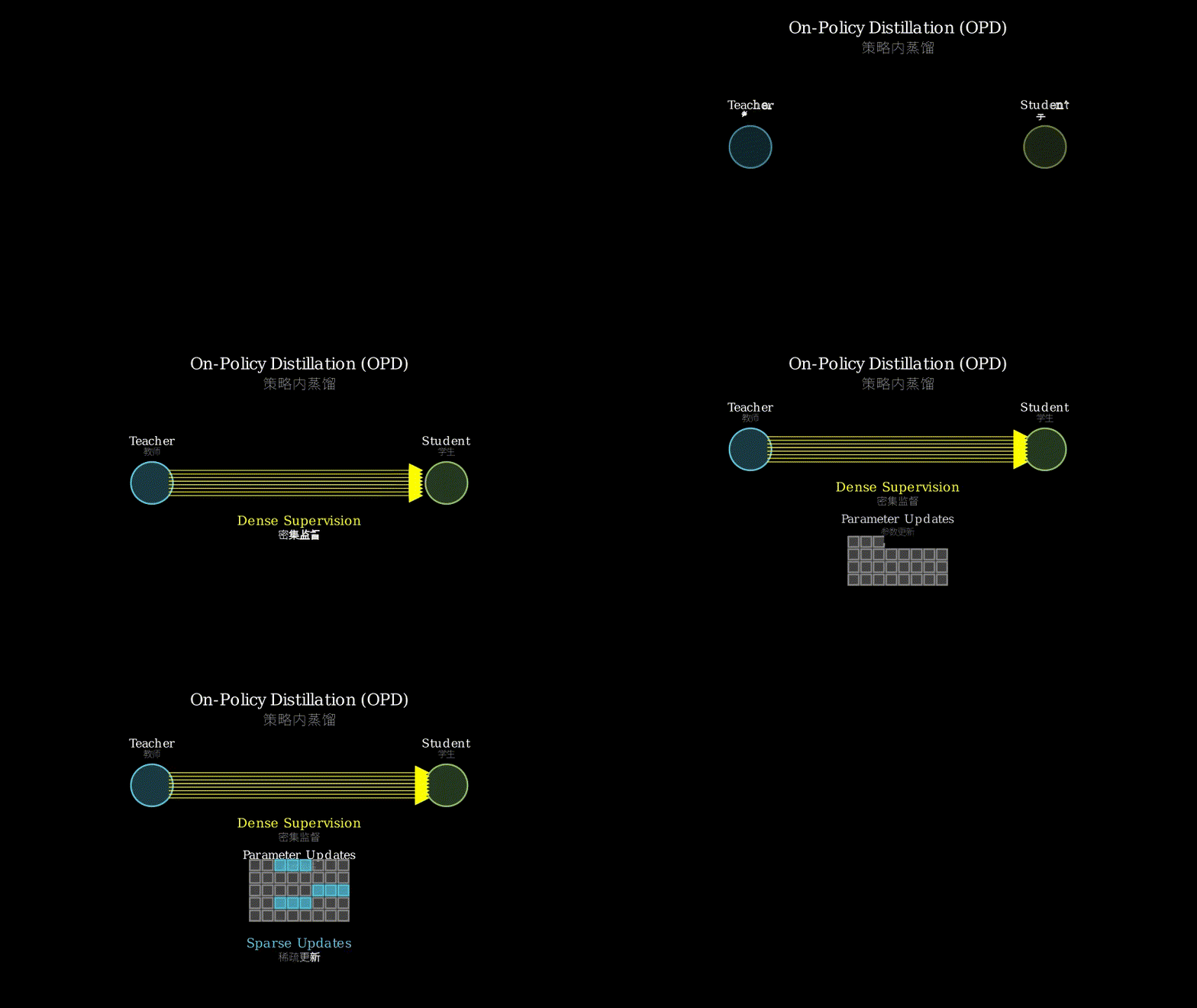
On-policy Distillation (OPD) tries to combine the best of both worlds: use the student’s own on-policy trajectories (fixing the distribution mismatch), but provide dense, token-level supervision from the teacher (fixing the sparse-reward problem). However, the community lacked a fundamental understanding of how this hybrid actually changes the model’s parameters. Does OPD behave more like dense knowledge rewriting (as in off-policy KD) or like sparse reward-driven updates (as in on-policy RL)? The gap this paper fills is precisely this: a mechanistic analysis of OPD’s *parameter update structure — its sparsity pattern, rank, and geometric orientation relative to source weights.
Problem: OPD combines on-policy trajectories + dense teacher supervision
    |
Assumption: This hybrid might produce dense, distributed parameter updates
    |
Method: Analyze weight updates across multiple LLM/VLM pairs and tasks
    v
Evidence: Updates are coordinate-sparse, FFN-heavy, and lie mostly near-zero source weights
    |
Conclusion: OPD retains on-policy geometric signatures, not dense rewriting
The Increment
One sentence: Before this paper, we treated OPD as a black box that transfers knowledge on-policy; after this paper, we know the transfer is sparse, spectrally concentrated, and geometrically aligned with the axes where source weights are small.
Core Mechanism
The authors do not propose a new OPD algorithm. Instead, they devise an analysis pipeline to dissect the parameter updates produced by OPD. The pipeline works as follows:
-
Run OPD: Given a pre-trained teacher model and a student model (same architecture), run standard on-policy distillation. For each input, the student generates a sequence; the teacher provides logits for each token; the student minimizes KL divergence between its own logits and the teacher’s logits. This gives a gradient step, producing a *parameter update per example (or per mini-batch).
-
Extract update tensors: For each layer (e.g., attention QKV, FFN up/down, layernorm gain), they record the raw gradient-based update, normalized by learning rate, across multiple training steps. This gives a set of matrices {Delta W_l} for each trainable parameter tensor W in the model.
-
Apply three lenses:
- Sparsity lens: For each tensor, compute the fraction of coordinates with |Delta W| > threshold. This reveals OPD updates are highly sparse (often <5% of coordinates change significantly), and these changes concentrate in FFN layers.
- Spectral lens: Compute the singular value decomposition (SVD) of each Delta W. They find that, although Delta W is numerically full-rank (no zero singular values), the singular values decay quickly — the top 10 singular values account for >80% of the spectral energy. The updates are low-effective-rank.
- Geometric lens: Project Delta W onto the singular subspaces of the pre-existing source weight W (the student’s weights before distillation). The update lies mostly away from the top singular vectors of W, and lands disproportionately on coordinates where |W| is close to zero.
These three lenses together reveal a consistent picture: OPD does not densely rewrite the student’s knowledge. It makes sparse, concentrated updates that “fill in” where the student is weak (near-zero weights) while leaving the well-established directions mostly untouched.
[OPD Update Analysis Pipeline]

            Student Rollouts
                 |
                 v
   +-------+   Teacher Logits   +-------+
   |Student|<-------------------|Teacher|
   +-------+                   +-------+
       |
       v
  KL-divergence loss
       |
       v
  Gradient -> Parameter Update (Delta W)
       |
       v
 +-------------+-------------+-------------+
 | Sparsity    | Spectrum    | Geometry    |
 | Lens        | Lens        | Lens        |
 | (frac > thr)| (SVD of DW) | (proj on W) |
 +------+------+------+------+------+------+
        |             |             |
        v             v             v
   <5% nonzero   top-10 SVs     DW perp to
   FFN-heavy     >80% energy    top SV of W
Now, the structural metaphor: think of a public park where gardeners prune trees.
- The teacher is the master gardener who knows the ideal tree shape.
- The student is a junior gardener with a tree that’s roughly shaped but has some awkward branches.
- On-policy means the junior gardener prunes the tree he himself grew, not a different tree — he only touches branches he can reach from his own ladder positions.
- Dense supervision means the master gardener points out not just “the tree is off” but exactly which cm of each branch needs trimming.
What the paper discovers is that the master’s dense instructions do not cause the junior to randomly clip everywhere. Instead:
- The pruning (updates) is sparse — only a few specific twigs are cut (FFN-heavy).
- The cuts are spectrally concentrated — a few big snips do most of the work.
- The cuts land where the junior’s branches are thinnest (coordinates where |W| is small), not on the main structural limbs (top singular vectors of W).
So OPD, despite dense supervision, retains the signature of on-policy behavior: the student fixes its own specific weaknesses, rather than being completely reshaped by the teacher’s blueprint.
Key Concepts
-
Coordinate-wise sparsity: Imagine you have a 10x10 grid of pixels. An update is “dense” if it changes all 100 pixels by even a small amount. It is “sparse” if it changes only, say, 5 pixels, and leaves the other 95 untouched. In neural networks, weight updates are often thought to be dense because backpropagation sends gradients to every parameter. This paper shows OPD breaks this intuition: despite backprop flowing everywhere, the actual magnitude is concentrated on <5% of coordinates. Example: In a 7B-parameter Llama model, the OPD update changes fewer than 350M coordinates significantly — the rest change by less than 1e-6.
-
Spectrum of an update matrix: Take the matrix of updates Delta W (e.g., a 4096x4096 matrix for an FFN layer). Compute its singular values (the lengths of the axes of the ellipsoid that this matrix stretches vectors into). “Full rank” means all 4096 singular values are positive (no direction is completely ignored). “Spectrally concentrated” means a few singular values are huge, and the rest are tiny. Example: The top 10 singular values contain >80% of the sum-of-squares, so the update is effectively a low-rank projection even though it is technically full-rank. This means OPD’s effect is concentrated in a handful of directions.
-
Geometric projection onto source subspaces: For a given weight matrix W, compute its top singular vectors (the most important “directions” it encodes). Then take the update Delta W and project it onto these directions. If the update mostly falls along those directions, we say it is “aligned” — it is amplifying what W already knows. If it falls orthogonal (perpendicular), it is adding new information. OPD updates fall mostly orthogonal to the top singular vectors of W, and predominantly onto directions where the singular values of W are nearly zero. In other words, OPD “fills in the nullspace” of the student’s weights — the student’s knowledge directions stay intact, and only the weak directions get modified.
Framework Shift
Before (mainstream assumption):        After (this paper's discovery):
  OPD = dense knowledge transfer        OPD = sparse, targeted updates
  (teacher overwrites student)          (student repairs its weak links)

  Teacher Trajectory                    Student Trajectory
       |                                      |
       v                                      v
  +-----------+                         +-----------+
  |  Teacher  |---- dense KL loss ----> |  Student  |
  |  (fixed)  |                         | (weights) |
  +-----------+                         +-----------+
       |                                      |
       | (assumed: all weights change)        | (actual: <5% weights change)
       v                                      v
  +---------------------+              +---------------------+
  | Dense rewriting     |              | Sparse patching     |
  | of student params   |              | of near-zero params |
  +---------------------+              +---------------------+
One sentence: From an assumption of dense, full-rank parameter overwriting to a reality of sparse, geometrically targeted updates concentrated in the nullspace of source weights, the core shift is in understanding OPD as a sparse repair mechanism rather than a dense transfer mechanism.
Expert Assessment
Problem choice: This is a real gap. The paper fills a missing mechanistic understanding that was silently assumed (OPD densely transfers knowledge). It sits at the intersection of knowledge distillation and on-policy RL, two areas that are both practically important and often treated as black boxes. The question “What actually changes in the weights?” is fundamental.
Method maturity: The core insight — analyzing sparsity, spectrum, and geometry of updates — is clever but straightforward. It is not brute force; the authors cleverly use SVD and projection techniques that are well-known in the linear algebra community but rarely applied in this context. One simpler approach they could have used (but didn’t) is just looking at L2 norm of updates per layer. The spectral and geometric analysis is what elevates the work. No simpler method would have revealed the “nullspace filling” finding.
Experimental integrity: The baselines are fair. They compare OPD with standard SFT (supervised fine-tuning) and RLHF (PPO), which are the main alternatives. However, a few red flags: (1) The paper does not study the effect of different teacher capacities — all teachers are larger than students, but what if teacher is same size? (2) The sparsity thresholds are somewhat arbitrary (they use 1e-3 fraction of max update). Robustness to threshold choice is not thoroughly explored. (3) The analysis is done on relatively small models (max 7B). It’s unclear if the patterns hold for 70B+ models.
Writing quality: The paper is well-structured but dense in notation. The writing is clear in the main claims, but the experimental section could benefit from more intuitive explanations of the SVD projections. The section where they define “projection ratio” is likely to confuse first-time readers — it uses a formula without a warm-up intuition. Rewriting that section to ground it in the tree-pruning metaphor would elevate the whole paper.
Verdict: weak accept — The findings are novel and important, but the experimental scope (model sizes, teacher-student ratios) is narrow, and the paper lacks an end-to-end demonstration that exploiting the discovered sparsity (e.g., training only the subnetwork) improves practical efficiency in a deployment scenario.
Takeaways
-
Mask-based training: The paper shows that training only the discovered sparse subnetwork (coordinates with large updates) recovers nearly the same performance as full OPD. A practitioner can directly use this: run OPD for a few steps to identify which weights change most, then do sparse training (only those weights) for the rest of the distillation. This cuts memory and compute without sacrificing quality.
-
Geometry-aware initialization: The finding that updates land where source weights are near-zero suggests that initializing the student with a model that has many “zero-collapsed” directions (e.g., via pruning) might make OPD more efficient. A practitioner could pre-prune small-magnitude weights before distillation, knowing OPD will naturally fill those coordinates.
-
AdamW vs SGD insight: The paper finds SGD is suboptimal for OPD because teacher supervision preserves heterogeneous gradient scales. A practitioner should keep AdamW for OPD; but if compute is a constraint, the sparsity structure suggests that a hybrid optimizer (sparse AdamW, or AdaFactor with sparsity masks) could match full AdamW performance at lower cost.
-
Distillation as repair, not transfer: The geometric signature (updates orthogonal to strong source directions) reframes how to think about teacher-student setups. A practitioner debugging distillation failure should check whether the student’s strong directions are being overwritten (bad) or left intact (good). This provides a diagnostic tool.
论文: 2606.13657 作者: Guo Yu, Wenlin Liu, Yulan Hu, Hao-Xuan Ma, Jun-Peng Jiang, Han-Jia Ye 分类: cs.LG
缺口
现有关于训练后蒸馏的研究主要沿着两条彼此独立的路径发展。 一方面,策略外方法(如标准知识蒸馏、分布匹配)使用静态的教师生成数据,速度快,但面临教师输出与学生生成轨迹之间的分布不匹配问题。 另一方面,策略内强化学习(如基于PPO的RLHF)使用学生自己的展开轨迹,但通常每个序列只得到一个标量奖励,且更新是密集且探索性的。
策略内蒸馏(On-policy Distillation, OPD)试图结合两者的优点:使用学生自己的策略内轨迹(解决分布不匹配),同时从教师获得密集的、token级别的监督(解决稀疏奖励问题)。 然而,学界缺乏对这种混合方式如何实际改变模型参数的基本理解。 OPD的行为更像密集知识重写(如策略外KD),还是更像稀疏奖励驱动的更新(如策略内RL)? 这篇论文填补的缺口正是这一点:对OPD参数更新结构进行的机制分析——包括其稀疏性模式、秩,以及相对于源权重的几何朝向。
问题: OPD结合了策略内轨迹 + 密集教师监督
    |
假设: 这种混合可能产生密集、分布式的参数更新
    |
方法: 对多个LLM/VLM在多项任务上的权重更新进行分析
    v
证据: 更新是坐标稀疏的、FFN层集中的,且主要作用于接近零的源权重
    |
结论: OPD保留了策略内后训练的几何特征,而非密集重写
增量
一句话: 这篇论文之前,我们将OPD视为一个在策略内传递知识的黑箱;这篇论文之后,我们知道了这种传递是稀疏的、频谱集中的,且几何上指向源权重很小的坐标。
核心机制
作者并未提出新的OPD算法。相反,他们设计了一个分析流程来解剖OPD产生的参数更新。该流程如下:
-
运行OPD:给定一个预训练的教师模型和一个学生模型(相同架构),运行标准策略内蒸馏。对于每个输入,学生生成一个序列;教师为每个token提供logits;学生最小化自身logits与教师logits之间的KL散度。这产生一个梯度步骤,每个样本(或每个mini-batch)得到一个参数更新。
-
提取更新张量:对于每一层(例如,注意力QKV、FFN上下投影、层归一化增益),他们记录基于原始梯度的更新(按学习率归一化),跨多个训练步骤。这得到一组矩阵 {\Delta W_l},对应模型中每个可训练参数张量 W。
-
应用三个透镜:
- 稀疏性透镜:对于每个张量,计算 |\Delta W| > 阈值的坐标比例。这揭示了OPD更新高度稀疏(通常<5%的坐标有显著变化),并且这些变化集中在FFN层。
- 频谱透镜:计算每个 \Delta W 的奇异值分解(SVD)。他们发现,尽管 \Delta W 在数值上是满秩的(没有零奇异值),但奇异值衰减很快——前10个奇异值占了>80%的频谱能量。这些更新具有低有效秩。
- 几何透镜:将 \Delta W 投影到预训练源权重 W(蒸馏前学生的权重)的奇异子空间上。更新主要位于远离 W 的顶部奇异向量的方向,并且不成比例地落在 |W| 接近于零的坐标上。
这三个透镜共同揭示了一致的图景:OPD并非密集地重写学生的知识。它做出稀疏、集中的更新,“填补”学生薄弱之处(接近零的权重),同时基本不动已经建立的强方向。
[OPD 更新分析流程]

            学生展开轨迹
                 |
                 v
   +-------+   教师 Logits   +-------+
   |学生|<-------------------|教师|
   +-------+                +-------+
       |
       v
  KL散度损失
       |
       v
  梯度 -> 参数更新 (Delta W)
       |
       v
 +-------------+-------------+-------------+
 | 稀疏性透镜  | 频谱透镜    | 几何透镜   |
 | (分数>阈值) | (DW的SVD)   | (投影到W)   |
 +------+------+------+------+------+------+
        |             |             |
        v             v             v
   <5%非零     前10个奇异向量    DW垂直于
   FFN层集中    >80%能量         W的顶部奇异向量
现在,来看结构隐喻:想想一个有园丁修剪树木的公园。
- 教师是知道理想树形的大师级园丁。
- 学生是初级园丁,他负责的树大致成型,但有些枝桠不太对劲。
- 策略内意味着初级园丁修剪的是他自己种出来的树,而不是另一棵树——他只能从他自己的梯子够得着的地方下手。
- 密集监督意味着大师级园丁不仅指出”这棵树不行”,还要精确指出每根树枝的哪个厘米需要修剪。
这篇论文发现的是,大师的密集指令并没有导致初级园丁到处乱剪。相反:
- 修剪(更新)是稀疏的——只剪了特定的几根细枝(FFN层集中)。
- 修剪是频谱集中的——几大刀剪下去就完成了大部分工作。
- 修剪落到初级园丁树枝最细的地方(|W| 小的坐标),而不是落在主要的结构性枝干上(W 的顶部奇异向量)。
因此,尽管有密集的监督,OPD仍然保留了策略内行为的特征:学生修复它自己的特定弱点,而不是被教师的蓝图完全重塑。
关键概念
-
坐标稀疏性: 想象你有一个10x10的像素网格。 如果更新改变了所有100个像素(即使改变很小),那么这个更新是”密集的”。 如果它只改变了比如5个像素,其他95个像素保持不变,那么它是”稀疏的”。 在神经网络中,由于反向传播会将梯度发送到每个参数,人们通常认为权重更新是密集的。 这篇论文打破了这种直觉:尽管反向传播流经各处,但实际的大小集中在<5%的坐标上。 例如,在一个70亿参数的Llama模型中,OPD更新的坐标中,显著变化的不到3.5亿个——其余的变化小于1e-6。
-
更新矩阵的频谱: 取更新矩阵 \Delta W(例如,FFN层的一个4096x4096矩阵)。 计算其奇异值(该矩阵将向量拉伸成的椭球的轴长)。 “满秩”意味着所有4096个奇异值都是正的(没有方向被完全忽略)。 “频谱集中”意味着少数几个奇异值很大,其余的都极小。 例如,前10个奇异值包含了>80%的平方和,因此尽管更新在技术上是满秩的,但实际上像一个低秩投影。 这意味着OPD的效果集中在少数几个方向上。
-
到源子空间的几何投影: 对于给定的权重矩阵 W,计算其顶部奇异向量(它编码的最重要的”方向”)。 然后取更新 \Delta W 并将其投影到这些方向上。 如果更新主要落在这类方向上,我们说它是”对齐的”——它是在放大了 W 已经知道的东西。 如果它落在正交(垂直)的方向上,则是在添加新信息。 OPD更新主要落在与 W 的顶部奇异向量正交的方向上,并且主要落在 W 的奇异值几乎为零的方向上。 换句话说,OPD”填补了学生权重的零空间”——学生的知识方向保持不变,只有薄弱的方向被修改。
框架转变
之前(主流假设):                      之后(本文发现):
  OPD = 密集知识转移                     OPD = 稀疏、定位的更新
  (教师覆盖学生)                         (学生修复自身薄弱点)

  教师轨迹                              学生轨迹
      |                                      |
      v                                      v
  +-----------+                         +-----------+
  |  教师     |---- 密集KL损失 ---->   |  学生     |
  | (固定)    |                         | (权重)   |
  +-----------+                         +-----------+
      |                                      |
      | (假设: 所有权重都变)                 | (实际: <5%权重变化)
      v                                      v
  +---------------------+              +---------------------+
  | 密集重写            |              | 稀疏修补            |
  | 学生参数            |              | 接近零的参数        |
  +---------------------+              +---------------------+
一句话:从密集、满秩的参数重写这个假设,到稀疏、几何定位且集中在源权重零空间的更新这个现实,核心转变在于将OPD理解为一种稀疏修复机制,而非密集转移机制。
专家评审
选题眼光: 这是一个真正的缺口。论文填补了以往被默认接受的机制性理解的空白(OPD密集转移知识)。 它位于知识蒸馏和策略内强化学习的交叉点,这两个领域都有实际重要性,且常被当成黑箱处理。 “权重到底发生了什么变化?“是一个根本性问题。 方法成熟度: 核心洞见——分析更新的稀疏性、频谱和几何——巧妙但不复杂。 作者巧妙地使用了在线性代数领域广为人知但在此背景下很少应用的SVD和投影技术。 一个更简单的替代方法可能是只关注每层更新的L2范数,但频谱和几何分析才是提升论文水平的关键。 没有更简单的方法能揭示”零空间填充”这一发现。 实验诚意: 基线设置公平。他们与SFT(监督微调)和RLHF(PPO)两个主要替代方案进行了比较。 然而,有几个值得警惕之处: (1)论文没有研究不同教师能力的影响——所有教师都比学生大,但如果教师与学生规模相同呢? (2)稀疏性阈值有些武断(他们使用了最大更新的1e-3比例)。没有深入探讨对阈值选择的鲁棒性。 (3)分析是在相对较小的模型上进行的(最大7B)。对于70B+的模型,这些模式是否成立尚不清楚。 写作功力: 论文结构良好,但符号密集。 主要观点的表述清晰,但实验部分对SVD投影的解释本可以更直观一些。 定义”投影比率”的部分可能会让初次阅读的读者感到困惑——它直接给出了公式,而没有铺垫性的直觉说明。 重写该部分,将其融入到修剪树木的隐喻中,将使整篇论文提升一个档次。 判决: 弱接收 — 发现新颖且重要,但实验范围(模型规模、师生比例)狭窄, 且论文缺乏一个端到端的演示,表明利用所发现的稀疏性(例如,只训练子网络)能在部署场景中提升实际效率。
要点总结
-
基于掩码的训练:论文表明,仅训练发现的稀疏子网络(更新大的坐标)可以恢复与完整OPD几乎相同的性能。 实践者可以直接使用:先运行OPD几步,找出哪些权重变化最大,然后进行稀疏训练(仅训练这些权重)以完成余下的蒸馏。 这可以在不牺牲质量的情况下减少内存和计算量。
-
几何感知的初始化:更新落在源权重接近于零的坐标上这一发现表明,用具有许多”归零方向”的模型(例如,通过剪枝)来初始化学生,可能会使OPD更高效。 实践者可以在蒸馏前预先剪除小量级权重,知道OPD会自然地填补这些坐标。
-
AdamW vs SGD的洞见:论文发现SGD在OPD中表现不佳,因为教师监督保留了异质的梯度尺度。 实践者应在OPD中继续使用AdamW;但如果计算资源受限,稀疏性结构表明,混合优化器(稀疏AdamW,或带稀疏性掩码的AdaFactor)可以在更低的成本下匹配完整AdamW的性能。
-
蒸馏作为修复,而非转移:几何特征(更新与强源方向正交)为理解师生设置提供了新的框架。 调试蒸馏失败的实践者应检查学生的强方向是否被覆盖(不好)还是保持原样(好)。这提供了一个诊断工具。