
Paper: 2603.21972 Authors: Xixi Wu, Qianguo Sun, Ruiyang Zhang, Chao Song, Junlong Wu, Yiyan Qi, Hong Cheng Categories: cs.LG, cs.CL
The Gap
LLMs have become decent at single-turn tasks, but turning them into autonomous agents that plan across dozens of steps while juggling multiple tools? That’s where things fall apart. Prior work either applies RL naively (treating multi-turn planning like a simple Q&A task) or relies on supervised fine-tuning that can’t handle the exploration needed for complex constraint satisfaction. The specific problem: we don’t have a practical, reproducible recipe for scaling RL in environments where agents must orchestrate tools across long horizons with multifaceted constraints.
Existing approaches like ReAct and Reflexion use prompting or supervised learning but plateau quickly on hard planning tasks. PPO and DPO have been applied to LLMs, but without systematic study of how design choices interact at scale. The gap isn’t “RL doesn’t work” — it’s “we don’t know which knobs to turn, and when.”
Problem: LLMs fail at long-horizon tool orchestration
   |
   v
Assumption: RL can work, but design space is underexplored
   |
   +---> Method: Decompose design into 5 axes, run controlled experiments
   |        (reward shaping, model scale, data mix, algorithm, env stability)
   |
   +---> Evidence: 7 empirical findings from TravelPlanner testbed
   |        - Scale-dependent reward/algorithm choices
   |        - ~1K samples sweet spot
   |        - Environmental stability critical
   |
   v
Conclusion: Distilled recipe achieves SOTA on TravelPlanner
The Increment
One sentence: Before this paper, scaling RL for LLM agents was trial-and-error guesswork; after, we have a systematic recipe showing which design choices matter at which scales.
Core Mechanism
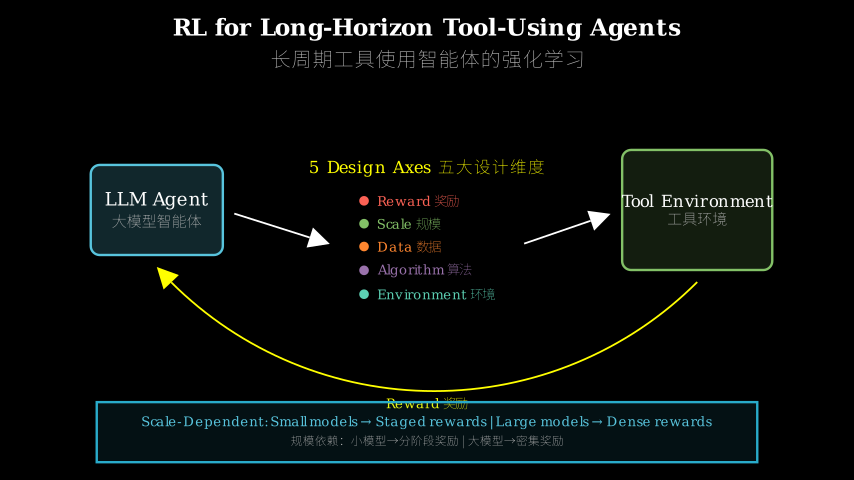
The method isn’t a new algorithm — it’s a controlled experimental framework. The authors decompose the RL design space into 5 orthogonal axes: (1) reward shaping (sparse vs dense vs staged), (2) model scaling (7B to 70B parameters), (3) data composition (difficulty mixture and volume), (4) algorithm selection (PPO, GRPO, DPO variants), and (5) environmental stability (preventing tool/constraint drift during training).
They use TravelPlanner as the testbed — a multi-turn planning task where agents must book transportation and accommodations while satisfying budget, date, and preference constraints. Each trajectory involves 20-30 tool calls across multiple APIs. The experimental protocol holds 4 axes constant while varying the 5th, measuring both in-domain success rate and out-of-domain generalization.
Data flows like this: start with seed trajectories from a base LLM, apply RL algorithm with specific reward structure, collect rollouts, update policy, repeat. The key insight emerges from cross-axis interactions: smaller models need staged rewards (breaking success into milestones) and exploration-heavy algorithms like GRPO, while larger models converge faster with simple dense rewards and standard PPO.
Experimental Framework:

  Axes of Variation:
  [Reward] --+
  [Scale]  --+
  [Data]   --+---> Controlled Experiments ---> 7 Empirical Findings
  [Algo]   --+         (TravelPlanner)              |
  [Env]    --+                                      v
                                              Distilled Recipe
                                                    |
                                                    v
                                            SOTA Performance
Think of this like tuning a complex espresso machine. You have 5 dials: grind size (reward), water temperature (model scale), bean amount (data volume), pressure profile (algorithm), and machine cleanliness (environment stability). Twisting one dial affects how others should be set. A coarse grind (sparse reward) needs high pressure (exploration algorithm) to extract flavor, but fine grind (dense reward) works with standard pressure. More beans (data) helps, but only up to a point — after ~1K shots, you’re just wasting coffee. And if your machine gunks up during the process (environment drift), even perfect dial settings produce bitter espresso.
The recipe they distill: for 7B models, use staged rewards + GRPO + ~1K mixed-difficulty samples + strict environment monitoring. For 70B models, dense rewards + PPO + same data budget suffices. The environmental stability piece is non-obvious but critical — they show that tool API changes or constraint drift during training causes catastrophic policy degradation.
Key Concepts
-
Staged Rewards: Instead of giving the agent a single success/failure signal at the end of a 30-step trajectory, break the task into milestones (e.g., “found valid flight” → “booked accommodation within budget” → “satisfied all constraints”). Each milestone gives partial credit. Why this matters: smaller models struggle with credit assignment across long horizons. Imagine teaching a kid to bake a cake by only saying “good” or “bad” after they finish — versus praising each correct step (mixing, pouring, baking). Staged rewards are the intermediate praise. The paper shows 7B models gain 15-20% success rate with staged rewards, while 70B models see minimal benefit (they already figure out credit assignment).
-
Environmental Stability: During RL training, the agent interacts with tools (APIs, databases, constraint checkers). If these tools change behavior mid-training — say, a flight API starts returning different date formats, or a budget checker gets stricter — the agent’s learned policy becomes misaligned. It’s like learning to drive, then someone secretly swaps your car’s brake and gas pedals overnight. The paper shows that even small environment drift (5% of tool responses changing) causes 30%+ performance drops. Solution: version-lock all tools during training, or explicitly model environment dynamics.
-
Difficulty Mixture: Not all training samples are equally useful. Too easy (all constraints satisfiable with obvious solutions) and the agent doesn’t learn to handle edge cases. Too hard (impossible constraints) and it learns to give up. The sweet spot: ~60% medium difficulty, 30% hard, 10% easy. Concrete example: in TravelPlanner, “medium” means 3-4 constraints with 2-3 valid solutions; “hard” means 5+ constraints with 1 solution or requiring backtracking. The paper shows this mixture, with ~1K total samples, maximizes both in-domain and out-of-domain performance. More data beyond 1K shows diminishing returns.
Framework Shift
Before (mainstream approach):        After (this paper):

  Prompt Engineering                   Systematic RL Recipe
         |                                     |
         v                            +--------+--------+
  LLM --> Task                        |  Design Space   |
         |                            | Decomposition   |
         v                            +--------+--------+
  Hope it works                                |
         |                            +--------v--------+
         v                            | Controlled Exps |
  Fails on hard tasks                 +--------+--------+
                                               |
                                      +--------v--------+
                                      | Scale-Dependent |
                                      |    Findings     |
                                      +--------+--------+
                                               |
                                               v
                                        Distilled Recipe
                                               |
                                               v
                                        SOTA Performance
One sentence: From “try RL and see what happens” to “here’s exactly which design choices matter at which model scales, backed by controlled experiments.”
Expert Assessment
Problem choice: This is a real gap. The field has been stuck in a local optimum where everyone knows RL should help LLM agents, but nobody wants to run the expensive experiments to figure out how. The authors picked TravelPlanner wisely — it’s hard enough to be non-trivial (current SOTA is ~60% success rate) but structured enough to enable controlled experiments. The problem sits at the intersection of RL scaling laws and LLM agent capabilities, which is exactly where the field needs clarity.
Method maturity: This is empirical science done right, not a clever algorithmic trick. The 5-axis decomposition is clean, and the experimental protocol is reproducible. However, there’s a risk of overfitting to TravelPlanner’s specific structure. The authors test out-of-domain generalization, but it’s still within the travel planning domain. Would these findings transfer to, say, code generation agents or robotics? Unclear. The environmental stability insight is genuinely novel — most RL papers assume stationary environments, but real-world tool APIs drift constantly.
Experimental integrity: Baselines are fair — they compare against leading LLMs (GPT-4, Claude) and prior RL methods (vanilla PPO, DPO). The ablation studies are thorough, isolating each axis. One red flag: the ~1K sample sweet spot might be specific to their compute budget and model family (Llama-based). Larger models or different architectures might have different data efficiency curves. The environmental stability experiments are convincing, but they only test synthetic drift — real API changes might be more adversarial.
Writing quality: The paper is dense but well-organized. The 7 takeaways are clearly stated upfront, which helps. However, Section 4 (experiments) buries some critical details in appendices — the exact reward functions and hyperparameters should be in the main text for reproducibility. The related work section is perfunctory; a deeper comparison with concurrent work on RL for LLMs (e.g., recent OpenAI and Anthropic papers) would strengthen positioning.
Verdict: Strong accept — This is the kind of systematic empirical work the field desperately needs. It won’t win a best paper award for algorithmic novelty, but it will be cited heavily by practitioners trying to build real agents.
Takeaways
For practitioners building LLM agents:
- Don’t blindly apply PPO to small models — use exploration-heavy algorithms (GRPO) with staged rewards. Save PPO for 70B+ models.
- Stop collecting massive RL datasets. ~1K well-curated samples with 60/30/10 difficulty split is enough. Beyond that, you’re wasting compute.
- Version-lock your tool APIs during training. Even small drift kills performance. If APIs must change, retrain from scratch or use domain adaptation techniques.
- Test out-of-domain generalization early. In-domain success rate is a vanity metric — agents that memorize training scenarios are useless in production.
For researchers:
- The scale-dependent findings suggest we need different RL algorithms for different model sizes, not one-size-fits-all solutions. This opens a research direction: can we design adaptive algorithms that automatically adjust exploration based on model capacity?
- Environmental stability is underexplored in LLM RL. Most papers assume stationary environments, but real-world deployment means constant API changes, user preference drift, and evolving constraints. We need RL methods robust to non-stationarity.
Transferable technique: The 5-axis decomposition framework itself is valuable. If you’re scaling any complex ML system (not just RL for LLMs), decompose the design space into orthogonal axes, run controlled experiments varying one axis at a time, and look for interaction effects. This is basic experimental design, but ML researchers often skip it in favor of end-to-end comparisons.
论文: 2603.21972 作者: Xixi Wu, Qianguo Sun, Ruiyang Zhang, Chao Song, Junlong Wu, Yiyan Qi, Hong Cheng 分类: cs.LG, cs.CL
缺口
大语言模型在单轮任务上已经相当不错,但要把它们变成能跨越几十步规划、同时操控多个工具的自主智能体?
这就是问题所在。
先前的工作要么天真地应用强化学习(把多轮规划当成简单问答任务),要么依赖监督微调,而监督微调无法处理复杂约束满足所需的探索。
具体问题是:我们没有一个实用的、可复现的配方,来在智能体必须跨长周期编排工具、满足多方面约束的环境中扩展强化学习。
现有方法如ReAct和Reflexion使用提示或监督学习,但在困难规划任务上很快遇到瓶颈。
PPO和DPO已被应用于大语言模型,但缺乏对设计选择如何在规模上相互作用的系统性研究。
缺口不是”强化学习不起作用”——而是”我们不知道该转动哪些旋钮,以及何时转动”。
问题: 大语言模型在长周期工具编排上失败
   |
   v
假设: 强化学习可行,但设计空间探索不足
   |
   +---> 方法: 将设计分解为5个轴,运行对照实验
   |        (奖励塑形、模型规模、数据混合、算法、环境稳定性)
   |
   +---> 证据: 来自TravelPlanner测试平台的7个实证发现
   |        - 规模依赖的奖励/算法选择
   |        - ~1K样本甜蜜点
   |        - 环境稳定性至关重要
   |
   v
结论: 提炼的配方在TravelPlanner上达到最优性能
增量
一句话: 这篇论文之前,为大语言模型智能体扩展强化学习是试错猜测;之后,我们有了系统性配方,显示哪些设计选择在哪些规模上重要。
核心机制
这个方法不是新算法——而是一个受控实验框架。
作者将强化学习设计空间分解为5个正交轴:(1)奖励塑形(稀疏vs密集vs分阶段),(2)模型规模(7B到70B参数),(3)数据组成(难度混合和数量),(4)算法选择(PPO、GRPO、DPO变体),(5)环境稳定性(防止训练期间工具/约束漂移)。
他们使用TravelPlanner作为测试平台——一个多轮规划任务,智能体必须预订交通和住宿,同时满足预算、日期和偏好约束。
每条轨迹涉及跨多个API的20-30次工具调用。
实验协议保持4个轴不变,同时改变第5个轴,测量域内成功率和域外泛化能力。
数据流动是这样的:从基础大语言模型的种子轨迹开始,应用具有特定奖励结构的强化学习算法,收集展开,更新策略,重复。
关键洞见来自跨轴交互:较小模型需要分阶段奖励(将成功分解为里程碑)和探索性强的算法如GRPO,而较大模型用简单的密集奖励和标准PPO收敛更快。
实验框架:

  变化轴:
  [奖励] --+
  [规模] --+
  [数据] --+---> 对照实验 ---> 7个实证发现
  [算法] --+    (TravelPlanner)      |
  [环境] --+                         v
                                提炼配方
                                    |
                                    v
                              最优性能
把这想象成调整一台复杂的意式咖啡机。
你有5个旋钮:研磨粗细(奖励)、水温(模型规模)、咖啡豆量(数据量)、压力曲线(算法)、机器清洁度(环境稳定性)。
转动一个旋钮会影响其他旋钮应该如何设置。
粗研磨(稀疏奖励)需要高压力(探索算法)来萃取风味,但细研磨(密集奖励)用标准压力就行。
更多咖啡豆(数据)有帮助,但只到某个点——超过~1K杯后,你只是在浪费咖啡。
如果你的机器在过程中积垢(环境漂移),即使完美的旋钮设置也会产生苦涩的咖啡。
他们提炼的配方:对于7B模型,使用分阶段奖励+GRPO+~1K混合难度样本+严格环境监控。
对于70B模型,密集奖励+PPO+相同数据预算就足够了。
环境稳定性这一块不明显但至关重要——他们展示工具API变化或训练期间约束漂移会导致灾难性的策略退化。
关键概念
- 分阶段奖励: 不是在30步轨迹结束时给智能体一个单一的成功/失败信号,而是将任务分解为里程碑(例如,“找到有效航班”→“在预算内预订住宿”→“满足所有约束”)。
每个里程碑给予部分奖励。
为什么这很重要:较小模型在长周期上难以进行信用分配。
想象教一个孩子烤蛋糕,只在他们完成后说”好”或”坏”——而不是表扬每个正确步骤(混合、倒入、烘烤)。
分阶段奖励就是中间表扬。
论文显示7B模型用分阶段奖励获得15-20%的成功率提升,而70B模型收益很小(它们已经能搞清楚信用分配)。
- 环境稳定性: 在强化学习训练期间,智能体与工具(API、数据库、约束检查器)交互。
如果这些工具在训练中途改变行为——比如,航班API开始返回不同的日期格式,或预算检查器变得更严格——智能体学到的策略就会错位。
这就像学开车,然后有人偷偷把你车的刹车和油门踏板对调了。
论文显示即使很小的环境漂移(5%的工具响应改变)也会导致30%以上的性能下降。
解决方案:在训练期间锁定所有工具版本,或显式建模环境动态。
- 难度混合: 并非所有训练样本都同样有用。
太简单(所有约束都能用明显解决方案满足),智能体学不会处理边缘情况。
太难(不可能的约束),它学会放弃。
甜蜜点:~60%中等难度,30%困难,10%简单。
具体例子:在TravelPlanner中,“中等”意味着3-4个约束,有2-3个有效解决方案;“困难”意味着5个以上约束,只有1个解决方案或需要回溯。
论文显示这种混合,总共~1K样本,最大化域内和域外性能。
超过1K的更多数据显示收益递减。
框架转变
之前(主流方法):                之后(本文方法):

  提示工程                        系统性强化学习配方
      |                                  |
      v                         +--------+--------+
  LLM --> 任务                  |   设计空间      |
      |                         |   分解          |
      v                         +--------+--------+
  希望它能工作                           |
      |                         +--------v--------+
      v                         |   对照实验      |
  在困难任务上失败               +--------+--------+
                                         |
                                +--------v--------+
                                | 规模依赖发现    |
                                +--------+--------+
                                         |
                                         v
                                    提炼配方
                                         |
                                         v
                                    最优性能
一句话: 从”试试强化学习看看会怎样”到”这里准确说明哪些设计选择在哪些模型规模上重要,有对照实验支持”。
专家评审
选题眼光: 这是真实的缺口。
该领域一直困在局部最优,每个人都知道强化学习应该能帮助大语言模型智能体,但没人想运行昂贵的实验来弄清楚如何做。
作者明智地选择了TravelPlanner——它足够难以至于非平凡(当前最优性能约60%成功率),但结构化程度足以支持对照实验。
这个问题位于强化学习扩展定律和大语言模型智能体能力的交叉点,这正是该领域需要清晰度的地方。
方法成熟度: 这是做得对的实证科学,不是巧妙的算法技巧。
5轴分解很干净,实验协议可复现。
然而,存在过拟合TravelPlanner特定结构的风险。
作者测试了域外泛化,但仍在旅行规划领域内。
这些发现能否迁移到,比如,代码生成智能体或机器人?
不清楚。
环境稳定性洞见是真正新颖的——大多数强化学习论文假设平稳环境,但现实世界的工具API持续漂移。
实验诚意: 基线公平——他们与领先的大语言模型(GPT-4、Claude)和先前的强化学习方法(原版PPO、DPO)比较。
消融研究很彻底,隔离了每个轴。
一个值得警惕之处:~1K样本甜蜜点可能特定于他们的计算预算和模型家族(基于Llama)。
更大的模型或不同架构可能有不同的数据效率曲线。
环境稳定性实验令人信服,但他们只测试了合成漂移——真实API变化可能更具对抗性。
写作功力: 论文密集但组织良好。
7条要点在开头清楚陈述,这很有帮助。
然而,第4节(实验)将一些关键细节埋在附录中——确切的奖励函数和超参数应该在正文中以便复现。
相关工作部分敷衍;与关于大语言模型强化学习的并行工作(例如OpenAI和Anthropic最近的论文)进行更深入比较会加强定位。
判决: 强接收——这是该领域迫切需要的系统性实证工作。
它不会因算法新颖性赢得最佳论文奖,但会被试图构建真实智能体的实践者大量引用。
要点总结
对于构建大语言模型智能体的实践者:
- 不要盲目地对小模型应用PPO——使用探索性强的算法(GRPO)配合分阶段奖励。
把PPO留给70B以上的模型。
- 停止收集海量强化学习数据集。
~1K精心策划的样本,60/30/10难度分布就够了。
超过这个量,你在浪费算力。
- 在训练期间锁定工具API版本。
即使很小的漂移也会杀死性能。
如果API必须改变,从头重新训练或使用领域适应技术。
- 尽早测试域外泛化。
域内成功率是虚荣指标——记住训练场景的智能体在生产中毫无用处。
对于研究者:
- 规模依赖发现表明我们需要针对不同模型大小的不同强化学习算法,而不是一刀切的解决方案。
这开启了一个研究方向:我们能否设计自适应算法,根据模型容量自动调整探索?
- 环境稳定性在大语言模型强化学习中探索不足。
大多数论文假设平稳环境,但现实世界部署意味着持续的API变化、用户偏好漂移和不断演变的约束。
我们需要对非平稳性鲁棒的强化学习方法。
可迁移技术: 5轴分解框架本身很有价值。
如果你在扩展任何复杂的机器学习系统(不仅仅是大语言模型的强化学习),将设计空间分解为正交轴,运行对照实验每次改变一个轴,并寻找交互效应。
这是基本的实验设计,但机器学习研究者经常跳过它,转而进行端到端比较。