Paper: 2605.30334 Authors: Yalun Dai, Yangyu Huang, Tongshen Yang, Yonghan Wang, Xin Zhang, Wenshan Wu, Qihao Zhao, Hao Li, Yuanyuan Gao, Kim-Hui Yap Categories: cs.AI, cs.CL
The Gap
Existing LLM training research has focused heavily on data selection—which samples to include or exclude. Methods like curriculum learning, importance sampling, and quality filtering all answer “what to train on.” But modern LLMs are trained for only 1-2 epochs, meaning each sample appears once or twice. In this regime, data ordering becomes critical: the sequence in which samples appear can dramatically affect convergence speed, stability, and final performance.
Prior work either ignores ordering (random shuffling), applies generic curriculum learning (easy-to-hard), or uses ad-hoc heuristics without systematic investigation. The gap: no principled framework exists for understanding how and why data organization matters when training budgets are tight and samples aren’t repeated.
Problem: LLMs trained 1-2 epochs → each sample seen once
   |
   v
Gap: Data selection studied extensively
     Data ordering remains ad-hoc and underexplored
   |
   v
Assumption: Sample-level scores (from selection methods)
            can guide ordering with minimal overhead
   |
   v
Method: Four design principles + two ordering algorithms
        (STR: Stratified Reordering, SAW: Sawtooth Scheduling)
   |
   v
Evidence: Experiments across scales (125M-7B params)
          Pre-training + SFT stages
          Consistent gains in stability and performance
   |
   v
Conclusion: Data ordering is a first-class design choice
            Reusing selection scores makes it nearly free
The Increment
One sentence: Before this paper, data ordering was an afterthought in LLM training; after, it’s a systematic design space with actionable principles and methods that improve training without extra computation.
Core Mechanism
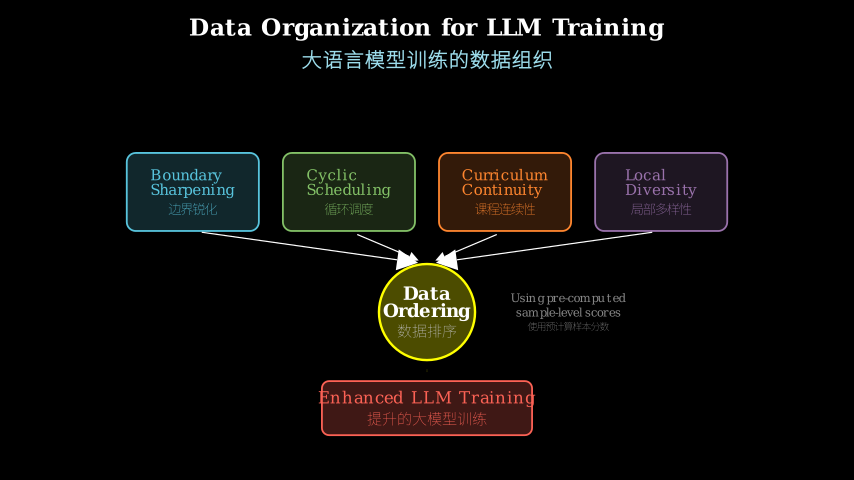
The method operates in two stages. First, it reuses sample-level scores already computed by data selection methods (quality scores, perplexity, diversity metrics). These scores are free—they’re byproducts of existing pipelines. Second, it applies ordering algorithms that arrange samples according to four principles:
- Boundary Sharpening: Place high-quality samples at epoch boundaries (start/end) to anchor learning and prevent forgetting.
- Cyclic Scheduling: Repeat quality patterns within epochs (e.g., high-low-high) to maintain consistent gradient signals.
- Curriculum Continuity: Avoid abrupt difficulty jumps; transition smoothly from easy to hard samples.
- Local Diversity: Ensure adjacent batches contain varied samples to prevent overfitting to narrow patterns.
Two algorithms implement these principles:
- STR (Stratified Reordering): Divides data into quality strata, then interleaves them to balance difficulty and diversity within local windows.
- SAW (Sawtooth Scheduling): Creates a sawtooth quality pattern—gradual ascent followed by sharp drops—to combine curriculum learning with periodic resets.
Input: Dataset D with pre-computed scores S
   |
   v
[Stratification Layer]
   Divide D into quality bins: D_high, D_mid, D_low
   |
   v
[Ordering Engine]
   STR: Interleave strata in fixed pattern
        [high, mid, low, high, mid, low, ...]
   SAW: Build sawtooth waves
        [low -> mid -> high | low -> mid -> high | ...]
   |
   v
Output: Ordered sequence D' fed to training loop
Think of it like meal planning for an athlete. You have ingredients (data samples) with nutritional scores (quality metrics). Random shuffling is like eating whatever’s in the fridge—it works, but it’s suboptimal. This paper says: arrange meals strategically. Start the day with protein (high-quality samples at boundaries) to set a strong foundation. Alternate between carbs and protein throughout the day (cyclic scheduling) to maintain energy. Gradually increase intensity (curriculum continuity) without shocking the system. And vary your diet (local diversity) so you don’t get bored or deficient. The ingredients are the same, but the sequence changes outcomes—energy levels, recovery, performance. STR is like a balanced meal plan with fixed ratios. SAW is like periodization in training: build up intensity, then reset with a recovery phase.
Key Concepts
-
Boundary Sharpening: Imagine training as a journey where the model’s “memory” fades over time. If you end an epoch on low-quality samples, the model’s final state is polluted—it carries noise into the next epoch. If you start an epoch on junk, the model begins from a weak foundation. Boundary sharpening places high-quality samples at epoch start and end, like bookends that anchor learning. Concretely: if you have 1M samples and the top 10% are high-quality, you’d place 50k at the start, 50k at the end, and distribute the rest in between. This ensures the model always begins and concludes training phases on solid ground.
-
Cyclic Scheduling: Training dynamics aren’t monotonic—loss doesn’t decrease smoothly. Models benefit from periodic resets where they revisit easier samples after struggling with hard ones. Cyclic scheduling creates a repeating quality pattern (e.g., high-medium-low-high-medium-low) so the model alternates between consolidation (easy samples) and exploration (hard samples). It’s like interval training: sprint, recover, sprint, recover. Without cycles, a long stretch of hard samples can destabilize training; a long stretch of easy samples wastes compute.
-
Local Diversity: If consecutive batches are too similar (e.g., all samples about “cooking recipes”), the model overfits to that narrow distribution and forgets broader patterns. Local diversity ensures that within any sliding window of batches (say, 100 batches), you see a mix of topics, difficulties, and styles. Concretely: if you have samples scored by topic clusters, you’d avoid placing all “cluster A” samples together. Instead, you’d interleave clusters so every local window has variety. This prevents the model from getting stuck in local minima.
Framework Shift
Before (mainstream approach):        After (this paper):

[Data Selection]                     [Data Selection]
      |                                    |
      v                                    v
  Random Shuffle                       Principled Ordering
      |                                /   |   \
      v                               /    |    \
  Training Loop                  STR    SAW   Custom
                                  \      |      /
                                   \     |     /
                                    v    v    v
                                  Training Loop

Focus: WHAT to train on             Focus: WHAT + HOW (sequence)
Ordering: Afterthought              Ordering: First-class design
Cost: Zero                          Cost: Still ~zero (reuse scores)
One sentence: From treating data as an unordered set to treating it as a carefully sequenced curriculum, the core shift is recognizing that when the model sees a sample matters as much as whether it sees it.
Expert Assessment
Problem choice: This is a real gap, not manufactured. The field has obsessed over data selection while ignoring ordering, despite clear evidence (from curriculum learning, active learning) that sequence matters. The timing is right—LLMs are now trained for 1-2 epochs, making ordering critical. The problem sits at the intersection of data efficiency and training dynamics, both hot areas.
Method maturity: The principles are sensible but not groundbreaking—boundary sharpening and curriculum continuity are intuitive extensions of existing ideas. The novelty is in systematization: formalizing guidelines and showing they generalize across scales and stages. STR and SAW are simple, which is good—they’re practical. But I’d like to see more exploration of adaptive ordering (adjusting on-the-fly based on training signals) rather than static schedules.
Experimental integrity: Baselines are fair (random, curriculum learning, reverse curriculum). The experiments span multiple scales (125M to 7B), datasets (pre-training and SFT), and metrics (loss, perplexity, downstream tasks). The results are consistent but not dramatic—gains are 1-3% in most cases, which is meaningful but not transformative. One red flag: the paper doesn’t deeply investigate why certain orderings work. The principles are validated empirically, but the mechanistic understanding is shallow. What’s happening in the loss landscape? How do gradients differ?
Writing quality: The paper is well-structured and clear. The principles are articulated crisply. However, Section 4 (experiments) is dense and could benefit from more visual summaries—tables dominate, and it’s hard to extract the big picture. The related work section is thorough but reads like a literature dump. If I were rewriting, I’d add a “failure modes” section: when does ordering not help? Are there datasets or architectures where it’s neutral or harmful?
Verdict: Weak accept — Solid empirical work with practical value, but limited theoretical depth and incremental novelty. It’s a useful contribution that practitioners will adopt, but it won’t reshape the field.
Takeaways
-
Reuse existing scores: If you’re already computing quality metrics for data selection, use them for ordering too. It’s nearly free and often helps.
-
Anchor with quality: Place your best samples at epoch boundaries. This is the lowest-hanging fruit—easy to implement, consistently beneficial.
-
Avoid monotonic curricula: Don’t just go easy-to-hard. Introduce cycles (high-low-high) to prevent forgetting and maintain gradient diversity.
-
Local diversity matters: When batching data, ensure adjacent batches aren’t too similar. A simple heuristic: shuffle within quality strata rather than globally.
-
Transferable insight: The principles (boundary sharpening, cyclic scheduling) apply beyond LLMs—think continual learning, reinforcement learning, or any setting where data arrives sequentially and can’t be repeated indefinitely.
论文: 2605.30334 作者: Yalun Dai, Yangyu Huang, Tongshen Yang, Yonghan Wang, Xin Zhang, Wenshan Wu, Qihao Zhao, Hao Li, Yuanyuan Gao, Kim-Hui Yap 分类: cs.AI, cs.CL
缺口
现有的大语言模型训练研究主要聚焦于数据选择——选哪些样本、排除哪些样本。
课程学习、重要性采样、质量过滤等方法都在回答”训练什么”。
但现代大语言模型只训练1-2个epoch,意味着每个样本只出现一两次。
在这种情况下,数据排序变得至关重要:样本出现的顺序会显著影响收敛速度、稳定性和最终性能。
此前的工作要么忽略排序(随机打乱),要么套用通用的课程学习(从易到难),要么使用临时拼凑的启发式方法,缺乏系统性研究。
缺口在于:当训练预算紧张、样本不重复时,没有原则性框架来理解数据组织如何以及为何重要。
问题:大语言模型训练1-2个epoch → 每个样本只见一次
   |
   v
缺口:数据选择研究充分
     数据排序仍是临时方案,缺乏系统探索
   |
   v
假设:样本级别的分数(来自选择方法)
     可以用极小开销指导排序
   |
   v
方法:四条设计原则 + 两种排序算法
     (STR: 分层重排, SAW: 锯齿调度)
   |
   v
证据:跨尺度实验(125M-7B参数)
     预训练 + 监督微调阶段
     稳定性和性能持续提升
   |
   v
结论:数据排序是一等公民的设计选择
     复用选择分数使其几乎零成本
增量
一句话: 这篇论文之前,数据排序是大语言模型训练中的事后考虑;之后,它成为一个系统化的设计空间,有可操作的原则和方法,能在不增加计算的情况下改善训练。
核心机制
方法分两个阶段运作。
首先,它复用数据选择方法已经计算好的样本级别分数(质量分数、困惑度、多样性指标)。
这些分数是免费的——它们是现有流程的副产品。
其次,它应用排序算法,根据四条原则安排样本:
-
边界锐化:在epoch边界(开始/结束)放置高质量样本,锚定学习并防止遗忘。
-
循环调度:在epoch内重复质量模式(如高-低-高),保持一致的梯度信号。
-
课程连续性:避免难度突变;从易到难平滑过渡。
-
局部多样性:确保相邻批次包含多样化样本,防止过拟合到狭窄模式。
两种算法实现这些原则:
-
STR(分层重排):将数据分成质量层级,然后交错排列,在局部窗口内平衡难度和多样性。
-
SAW(锯齿调度):创建锯齿状质量模式——逐渐上升后急剧下降——结合课程学习和周期性重置。
输入:数据集 D 及预计算分数 S
   |
   v
[分层模块]
   将 D 分成质量区间:D_高, D_中, D_低
   |
   v
[排序引擎]
   STR: 按固定模式交错层级
        [高, 中, 低, 高, 中, 低, ...]
   SAW: 构建锯齿波
        [低 -> 中 -> 高 | 低 -> 中 -> 高 | ...]
   |
   v
输出:有序序列 D' 送入训练循环
把它想象成运动员的饮食计划。
你有食材(数据样本)和营养分数(质量指标)。
随机打乱就像随便吃冰箱里的东西——能用,但不是最优。
这篇论文说:战略性地安排饮食。
一天开始吃蛋白质(边界处的高质量样本)打好基础。
全天交替碳水和蛋白质(循环调度)保持能量。
逐渐增加强度(课程连续性)不冲击系统。
饮食多样化(局部多样性)避免厌倦或营养不良。
食材相同,但顺序改变结果——能量水平、恢复、表现。
STR像固定比例的均衡饮食计划。
SAW像训练中的周期化:积累强度,然后用恢复期重置。
关键概念
- 边界锐化:把训练想象成一段旅程,模型的”记忆”随时间衰减。
如果你在低质量样本上结束一个epoch,模型的最终状态被污染——它把噪声带入下一个epoch。
如果你在垃圾样本上开始一个epoch,模型从弱基础起步。
边界锐化在epoch开始和结束处放置高质量样本,像书挡一样锚定学习。
具体来说:如果你有100万样本,前10%是高质量的,你会在开始放5万,结束放5万,其余分布在中间。
这确保模型总是在坚实的基础上开始和结束训练阶段。
- 循环调度:训练动态不是单调的——损失不会平滑下降。
模型受益于周期性重置,在挣扎于困难样本后重访简单样本。
循环调度创建重复的质量模式(如高-中-低-高-中-低),让模型在巩固(简单样本)和探索(困难样本)之间交替。
这像间歇训练:冲刺、恢复、冲刺、恢复。
没有循环,长时间的困难样本会破坏训练稳定性;长时间的简单样本浪费算力。
- 局部多样性:如果连续批次太相似(如全是”烹饪食谱”的样本),模型会过拟合到那个狭窄分布,忘记更广泛的模式。
局部多样性确保在任何批次的滑动窗口内(比如100个批次),你能看到主题、难度和风格的混合。
具体来说:如果你有按主题聚类评分的样本,你会避免把所有”聚类A”样本放在一起。
相反,你会交错聚类,让每个局部窗口都有多样性。
这防止模型陷入局部最小值。
框架转变
之前(主流方法):                之后(本文方法):

[数据选择]                        [数据选择]
      |                                 |
      v                                 v
  随机打乱                          原则性排序
      |                             /   |   \
      v                            /    |    \
  训练循环                      STR   SAW   自定义
                                 \     |     /
                                  \    |    /
                                   v   v   v
                                  训练循环

焦点:训练什么                    焦点:训练什么 + 如何(顺序)
排序:事后考虑                    排序:一等公民的设计
成本:零                          成本:仍然~零(复用分数)
一句话:从把数据当作无序集合到把它当作精心排序的课程,核心转变是认识到模型何时看到样本和是否看到样本同样重要。
专家评审
选题眼光:这是真缺口,不是人造的。
该领域痴迷于数据选择,却忽略了排序,尽管有明确证据(来自课程学习、主动学习)表明顺序很重要。
时机恰当——大语言模型现在训练1-2个epoch,使排序变得关键。
问题位于数据效率和训练动态的交叉点,都是热门领域。
方法成熟度:原则合理但不算突破——边界锐化和课程连续性是现有想法的直观延伸。
新颖性在于系统化:形式化指导原则并展示它们在尺度和阶段间的泛化能力。
STR和SAW很简单,这是好事——它们实用。
但我想看到更多自适应排序的探索(根据训练信号实时调整),而不是静态调度。
实验诚意:基线公平(随机、课程学习、反向课程)。
实验跨越多个尺度(125M到7B)、数据集(预训练和监督微调)和指标(损失、困惑度、下游任务)。
结果一致但不戏剧化——大多数情况下提升1-3%,有意义但不是变革性的。
一个警示:论文没有深入研究某些排序为何有效。
原则通过实验验证,但机制理解浅薄。
损失景观发生了什么?梯度有何不同?
写作功力:论文结构良好,表达清晰。
原则阐述简洁。
然而,第4节(实验)密集,需要更多视觉总结——表格占主导,难以提取大局。
相关工作部分详尽但读起来像文献堆砌。
如果我重写,我会加一个”失效模式”部分:排序何时不起作用?有没有数据集或架构对它中性或有害?
判决:弱接收 — 扎实的实证工作,有实用价值,但理论深度有限,新颖性渐进。
这是实践者会采用的有用贡献,但不会重塑领域。
要点总结
- 复用现有分数:如果你已经为数据选择计算质量指标,也用它们来排序。
几乎零成本,通常有帮助。
- 用质量锚定:在epoch边界放置最好的样本。
这是最容易摘的果实——易于实现,持续有益。
- 避免单调课程:不要只是从易到难。
引入循环(高-低-高)防止遗忘并保持梯度多样性。
- 局部多样性重要:批处理数据时,确保相邻批次不太相似。
简单启发式:在质量层级内打乱,而不是全局打乱。
- 可迁移洞见:原则(边界锐化、循环调度)适用于大语言模型之外——想想持续学习、强化学习,或任何数据顺序到达且无法无限重复的场景。