Paper: 2603.16870 Authors: Ruisi Wang, Zhongang Cai, Fanyi Pu, Junxiang Xu, Wanqi Yin, Maijunxian Wang, Ran Ji, Chenyang Gu, Bo Li, Ziqi Huang Categories: cs.CV, cs.AI
The Gap
Video generation models can solve reasoning tasks—they can generate videos showing logical sequences, physical interactions, and causal relationships. Prior work attributed this to “Chain-of-Frames” (CoF): the model reasons by processing frames sequentially, like reading a comic strip panel by panel. This makes intuitive sense but was never rigorously validated.
The problem: CoF is an assumption, not a proven mechanism. No one actually looked inside the diffusion process to see where reasoning happens. The boundary this paper addresses is the gap between observed capability (models can reason) and understood mechanism (how they actually do it).
Observation: Video models exhibit reasoning
        |
        v
Prior assumption: CoF (reasoning across frames)
        |
        v
This paper's challenge: Where does reasoning actually happen?
        |
        v
Method: Probe diffusion denoising steps + layer activations
        |
        v
Evidence: Reasoning emerges along denoising steps (CoS)
        |
        v
Conclusion: Diffusion process itself is the reasoning engine
The Increment
One sentence: Before this paper, we thought video models reasoned by chaining frames together; after, we know they reason by iteratively refining solutions through denoising steps.
Core Mechanism
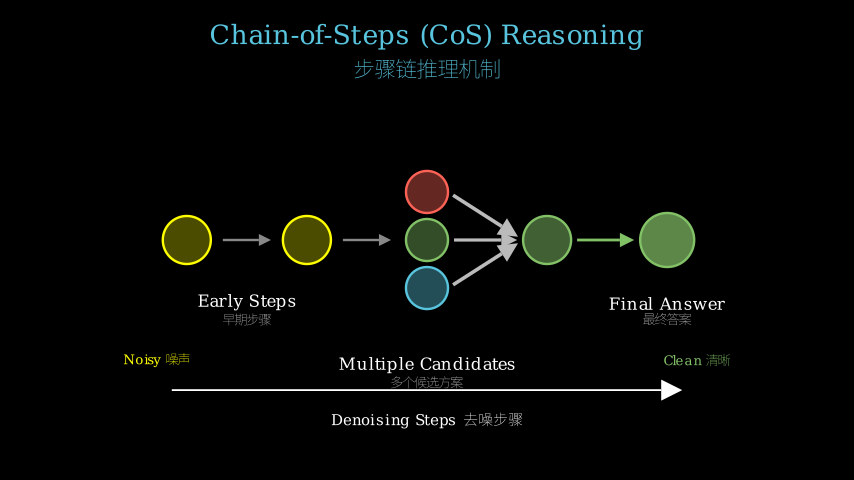
The paper reveals that reasoning in video diffusion models happens along the denoising trajectory, not across video frames. During generation, the model starts with pure noise and progressively denoises it over multiple steps (typically 50-100 steps). At early denoising steps, the model explores multiple candidate solutions—like sketching different possibilities. At later steps, it converges toward a final answer, refining and correcting as it goes.
Within each denoising step, the Diffusion Transformer exhibits functional specialization across its layers. Early layers encode dense perceptual structure (what objects are where), middle layers execute reasoning operations (how things should interact), and later layers consolidate the latent representation (committing to specific outputs). This creates a hierarchical processing pipeline within every single denoising step.
The paper identifies three emergent behaviors that enable this reasoning: (1) working memory—the model maintains persistent references across denoising steps, (2) self-correction—it can recover from incorrect intermediate solutions in later steps, and (3) perception before action—early steps establish semantic grounding before later steps perform structured manipulation.
Denoising Timeline (50 steps):
Step 1-10 (Early):        Step 11-40 (Middle):      Step 41-50 (Late):
[Explore candidates]  ->  [Refine + correct]    ->  [Converge to answer]
  * Multiple ideas          * Eliminate bad paths      * Final solution
  * Rough structure         * Self-correction          * Detail refinement

Within EACH step, transformer layers specialize:
Input -> [Early Layers] -> [Middle Layers] -> [Late Layers] -> Output
         (Perception)      (Reasoning)        (Consolidation)
         What is where?    How to interact?   Commit to output
Think of it like a sculptor working on a block of marble. The sculptor doesn’t create the statue frame-by-frame like a flip book. Instead, they work through multiple passes over the entire piece. In early passes, they rough out several possible forms, exploring different compositions. In middle passes, they eliminate bad ideas and refine the chosen form, sometimes correcting mistakes from earlier passes. In final passes, they add fine details and polish.
Within each pass (each chisel stroke), there’s a micro-process: the sculptor’s eyes scan the surface (perception), their brain decides where to strike (reasoning), and their hands execute the cut (consolidation). The reasoning doesn’t happen in the sequence of strokes across the statue’s surface—it happens in the iterative refinement across multiple passes, with each pass building on the previous one’s insights.
Key Concepts
-
Chain-of-Steps (CoS) vs Chain-of-Frames (CoF): CoF assumes reasoning unfolds spatially/temporally across video frames—frame 1 informs frame 2, which informs frame 3. CoS reveals reasoning actually unfolds iteratively through denoising steps—step 1 explores possibilities, step 2 refines them, step 3 corrects errors. The key difference: CoF is about spatial/temporal sequence, CoS is about iterative refinement. Imagine solving a puzzle: CoF would be placing pieces left-to-right, row-by-row. CoS is more like starting with a rough arrangement, then repeatedly adjusting all pieces until they fit perfectly.
-
Functional Specialization in Transformer Layers: Not all layers in a transformer do the same thing. Early layers act like sensory organs—they extract low-level features and spatial relationships. Middle layers are the “thinking” part—they perform logical operations, manipulate representations, and make decisions. Late layers are like motor output—they consolidate decisions into concrete outputs. This isn’t designed in; it emerges from training. It’s like how your brain’s visual cortex has early areas for edges and colors, middle areas for object recognition, and later areas for semantic understanding—except this happens within a single forward pass of the model.
-
Working Memory in Diffusion Models: The model maintains information across denoising steps, similar to how you hold a phone number in your head while dialing. At step 10, the model might establish “there’s a ball on the left.” At step 30, it still “remembers” this and uses it to reason about what happens next. This isn’t explicit memory storage—it’s implicit in the latent representation that gets refined step-by-step. The model doesn’t have a separate memory module; the evolving latent itself is the memory.
Framework Shift
Before (Chain-of-Frames):        After (Chain-of-Steps):

Frame 1 -> Frame 2 -> Frame 3    Step 1:  [Noisy video]
  |          |          |                   Explore ideas
  v          v          v                        |
Reason   Reason    Reason                        v
across   across    across                  Step 25: [Less noisy]
frames   frames    frames                   Refine + correct
                                                  |
Sequential processing                             v
of spatial/temporal units                   Step 50: [Clean video]
                                             Final answer

                                          Iterative refinement
                                          of entire solution
From sequential spatial reasoning to iterative refinement reasoning, the core shift is treating the diffusion process itself as the computational substrate for reasoning, not just a rendering engine.
Expert Assessment
Problem choice: This is a real gap. The field has been celebrating emergent reasoning in video models without understanding the mechanism. Challenging the CoF assumption is valuable because it’s intuitive but unvalidated. However, the problem sits in the “understanding” category rather than “advancing capabilities”—it’s more science than engineering.
Method maturity: This is primarily an analysis paper, not a new method. The probing experiments are clever—they intervene at different denoising steps and layers to see where reasoning happens. The training-free ensemble strategy (using different random seeds) is a nice proof-of-concept but feels like an afterthought. The core contribution is the insight, not a novel architecture. That’s fine, but it means the impact depends entirely on whether the insight is correct and generalizable.
Experimental integrity: The paper needs strong evidence to overturn the CoF assumption. I’d want to see: (1) controlled experiments isolating denoising steps vs. frame sequence, (2) ablations showing that disrupting denoising steps breaks reasoning more than disrupting frame order, (3) quantitative metrics beyond qualitative analysis. The abstract mentions “qualitative analysis and targeted probing experiments”—the word “qualitative” is a yellow flag. If the evidence is mostly visualizations and cherry-picked examples, the claims are weaker.
Writing quality: The abstract is clear and well-structured. The framing (CoF vs. CoS) is memorable and communicates the core idea effectively. However, the paper introduces many concepts (working memory, self-correction, perception before action, layer specialization) without clearly showing which are central and which are secondary observations. A tighter narrative would strengthen the paper. The section on “self-evolved functional specialization” could be its own paper—bundling it here dilutes focus.
Verdict: Weak accept—the CoS insight is valuable and challenges an implicit assumption in the field, but the contribution is primarily analytical rather than constructive, and the evidence needs to be rigorous to support such a strong claim.
Takeaways
The big steal: Iterative refinement processes can be reasoning engines. If you’re building any system that generates outputs through multiple passes (not just diffusion models—think iterative optimization, progressive rendering, multi-draft writing), consider that the iteration itself might be where “thinking” happens, not in the sequential processing of output components.
Practical technique: Ensemble latent trajectories with different random seeds. This is embarrassingly simple but potentially effective. If your diffusion model can explore multiple solution paths in early steps, running multiple seeds and combining them might improve reasoning without retraining. Worth testing in any diffusion-based system.
Architectural insight: Layer specialization is a lens for understanding transformers. When debugging or interpreting transformer behavior, probe early/middle/late layers separately. Early layers for “what’s there,” middle layers for “what should happen,” late layers for “commit to output.” This applies beyond video models—it’s a general principle for understanding deep networks.
Conceptual reframe: Don’t assume the obvious mechanism. Video models reason, so we assumed they reason across frames (the obvious spatial/temporal structure). This paper shows reasoning happens in a completely different dimension (denoising steps). When you see emergent behavior, resist the urge to explain it with the most intuitive mechanism—probe systematically instead.
论文: 2603.16870 作者: Ruisi Wang, Zhongang Cai, Fanyi Pu, Junxiang Xu, Wanqi Yin, Maijunxian Wang, Ran Ji, Chenyang Gu, Bo Li, Ziqi Huang 分类: cs.CV, cs.AI
缺口
视频生成模型能解决推理任务——它们能生成展示逻辑序列、物理交互和因果关系的视频。
此前的工作将此归因于”帧链”(Chain-of-Frames, CoF):模型通过顺序处理帧来推理,就像逐格阅读连环画。
这听起来很直观,但从未被严格验证。
问题在于:CoF 是一个假设,而非被证实的机制。
没人真正深入扩散过程内部,看看推理到底在哪里发生。
本文要解决的边界是观察到的能力(模型能推理)与理解的机制(它们实际如何推理)之间的鸿沟。
观察:视频模型展现推理能力
        |
        v
先前假设:CoF(跨帧推理)
        |
        v
本文质疑:推理实际在哪里发生?
        |
        v
方法:探测扩散去噪步骤 + 层激活
        |
        v
证据:推理沿去噪步骤涌现(CoS)
        |
        v
结论:扩散过程本身就是推理引擎
增量
一句话: 这篇论文之前,我们以为视频模型通过串联帧来推理;之后,我们知道它们通过去噪步骤迭代精炼解决方案来推理。
核心机制
论文揭示,视频扩散模型中的推理发生在去噪轨迹上,而非跨视频帧。
在生成过程中,模型从纯噪声开始,通过多个步骤(通常50-100步)逐步去噪。
在早期去噪步骤,模型探索多个候选解——就像草拟不同的可能性。
在后期步骤,它向最终答案收敛,边走边精炼和纠正。
在每个去噪步骤内部,扩散变换器在其层间展现功能特化。
早期层编码密集的感知结构(物体在哪里),中间层执行推理操作(事物应如何交互),后期层整合潜在表示(承诺特定输出)。
这在每个去噪步骤内创建了一个层次化处理管道。
论文识别出三种使能推理的涌现行为:(1)工作记忆——模型在去噪步骤间保持持久引用,(2)自我纠正——它能在后续步骤中从错误的中间解中恢复,(3)先感知后行动——早期步骤建立语义基础,后期步骤执行结构化操作。
去噪时间线(50步):
步骤1-10(早期):      步骤11-40(中期):    步骤41-50(后期):
[探索候选]        ->    [精炼+纠正]       ->   [收敛到答案]
  * 多个想法              * 排除坏路径            * 最终解
  * 粗略结构              * 自我纠正              * 细节精炼

在每个步骤内,变换器层特化:
输入 -> [早期层] -> [中间层] -> [后期层] -> 输出
        (感知)     (推理)      (整合)
        什么在哪?  如何交互?   承诺输出
把它想象成雕塑家在大理石块上工作。
雕塑家不会像翻页书那样逐帧创建雕像。
相反,他们对整个作品进行多次处理。
在早期处理中,他们粗略勾勒几种可能的形态,探索不同的构图。
在中期处理中,他们排除坏想法并精炼选定的形态,有时纠正早期处理的错误。
在最后处理中,他们添加精细细节并打磨。
在每次处理(每次凿击)中,都有一个微观过程:雕塑家的眼睛扫描表面(感知),大脑决定在哪里敲击(推理),手执行切割(整合)。
推理不发生在雕像表面的凿击序列中——它发生在多次处理的迭代精炼中,每次处理都建立在前一次的洞察之上。
关键概念
- 步骤链(CoS)vs 帧链(CoF): CoF 假设推理在视频帧间空间/时间地展开——帧1告知帧2,帧2告知帧3。
CoS 揭示推理实际上通过去噪步骤迭代展开——步骤1探索可能性,步骤2精炼它们,步骤3纠正错误。
关键区别:CoF 关于空间/时间序列,CoS 关于迭代精炼。
想象解拼图:CoF 是从左到右、逐行放置拼块。
CoS 更像是先粗略排列,然后反复调整所有拼块直到完美契合。
- 变换器层的功能特化: 变换器中并非所有层都做同样的事。
早期层像感觉器官——它们提取低级特征和空间关系。
中间层是”思考”部分——它们执行逻辑操作、操纵表示、做决策。
后期层像运动输出——它们将决策整合成具体输出。
这不是设计出来的;它从训练中涌现。
就像你大脑的视觉皮层有早期区域处理边缘和颜色,中期区域识别物体,后期区域理解语义——只不过这发生在模型的单次前向传播中。
- 扩散模型中的工作记忆: 模型在去噪步骤间维护信息,类似于你在拨号时在脑中保持电话号码。
在步骤10,模型可能建立”左边有个球”。
在步骤30,它仍然”记得”这个并用它推理接下来会发生什么。
这不是显式的内存存储——它隐含在逐步精炼的潜在表示中。
模型没有单独的内存模块;演化的潜在本身就是内存。
框架转变
之前(帧链):                之后(步骤链):

帧1 -> 帧2 -> 帧3             步骤1:[噪声视频]
  |      |      |                      探索想法
  v      v      v                          |
跨帧   跨帧   跨帧                          v
推理   推理   推理                    步骤25:[较少噪声]
                                      精炼+纠正
空间/时间单元的                            |
顺序处理                                   v
                                     步骤50:[干净视频]
                                      最终答案

                                    整个解的
                                    迭代精炼
从顺序空间推理到迭代精炼推理,核心转变是将扩散过程本身视为推理的计算基底,而非仅仅是渲染引擎。
专家评审
选题眼光: 这是真缺口。
该领域一直在庆祝视频模型中的涌现推理,却不理解其机制。
挑战 CoF 假设很有价值,因为它直观但未经验证。
然而,这个问题属于”理解”类别而非”推进能力”类别——更偏科学而非工程。
方法成熟度: 这主要是一篇分析论文,而非新方法。
探测实验很巧妙——它们在不同去噪步骤和层进行干预,看推理在哪里发生。
无训练集成策略(使用不同随机种子)是个不错的概念验证,但感觉像事后补充。
核心贡献是洞察,而非新架构。
这没问题,但意味着影响完全取决于洞察是否正确且可推广。
实验诚意: 论文需要强有力的证据来推翻 CoF 假设。
我想看到:(1)隔离去噪步骤 vs 帧序列的对照实验,(2)显示破坏去噪步骤比破坏帧顺序更能打破推理的消融实验,(3)超越定性分析的定量指标。
摘要提到”定性分析和针对性探测实验”——“定性”这个词是黄色警告。
如果证据主要是可视化和精选案例,主张就更弱。
写作功力: 摘要清晰且结构良好。
框架(CoF vs CoS)令人难忘,有效传达核心思想。
然而,论文引入了许多概念(工作记忆、自我纠正、先感知后行动、层特化),没有清楚显示哪些是核心的,哪些是次要观察。
更紧凑的叙事会增强论文。
关于”自演化功能特化”的部分可以是独立论文——把它捆绑在这里稀释了焦点。
判决: 弱接收——CoS 洞察有价值且挑战了该领域的隐含假设,但贡献主要是分析性而非建设性的,证据需要严格才能支持如此强的主张。
要点总结
最大收获:迭代精炼过程可以是推理引擎。
如果你在构建任何通过多次处理生成输出的系统(不仅是扩散模型——想想迭代优化、渐进渲染、多稿写作),考虑迭代本身可能是”思考”发生的地方,而非输出组件的顺序处理。
实用技术:用不同随机种子集成潜在轨迹。
这简单得令人尴尬,但可能有效。
如果你的扩散模型能在早期步骤探索多条解路径,运行多个种子并组合它们可能在不重新训练的情况下改善推理。
值得在任何基于扩散的系统中测试。
架构洞察:层特化是理解变换器的透镜。
在调试或解释变换器行为时,分别探测早期/中期/后期层。
早期层看”有什么”,中期层看”应该发生什么”,后期层看”承诺输出”。
这超越视频模型——它是理解深度网络的通用原则。
概念重构:不要假设显而易见的机制。
视频模型能推理,所以我们假设它们跨帧推理(显而易见的空间/时间结构)。
本文显示推理发生在完全不同的维度(去噪步骤)。
当你看到涌现行为时,抵制用最直观的机制解释它的冲动——系统地探测。