Paper: 2604.28176 Authors: Emma Andrews, Sahan Sanjaya, Prabhat Mishra Categories: quant-ph, cs.LG
The Gap
Variational quantum classifiers (VQCs) can be fooled by adversarial perturbations—tiny, carefully crafted noise added to images. The standard defense is adversarial training: retrain the classifier on attacked samples. But this has two problems: (1) you need access to adversarial samples during training, which isn’t always feasible in deployment scenarios, and (2) the model overfits to specific attack types, failing against novel perturbations.
Existing quantum defenses inherit these limitations from classical adversarial training. No one has built a training-free defense that works at inference time and generalizes across attack types.
Problem: VQCs vulnerable to adversarial noise
    |
    v
Limitation: Adversarial training requires attack samples + overfits
    |
    v
Assumption: Adversarial perturbations are high-frequency artifacts
    |
    v
Method: Quantum autoencoder reconstructs clean signal, filters noise
    |
    v
Evidence: 68% accuracy gain vs adversarial training baseline
    |
    v
Conclusion: Training-free purification outperforms retraining
The Increment
One sentence: Before this paper, defending quantum classifiers meant retraining on adversarial samples; after, you can purify attacks at inference time using a separate quantum autoencoder trained only on clean data.
Core Mechanism
The defense has two components: a quantum autoencoder (QAE) and a confidence metric. The QAE is trained on clean images to compress them into a lower-dimensional latent space, then reconstruct them. The key insight: adversarial perturbations are high-frequency noise that doesn’t compress well. When you force a perturbed image through the bottleneck, the reconstruction drops the noise and recovers the clean signal.
The confidence metric measures reconstruction fidelity. If the QAE can’t reconstruct an input well (high reconstruction error), that’s a red flag—the input might be adversarial and unpurifiable. The system flags these samples for human review instead of passing them to the classifier.
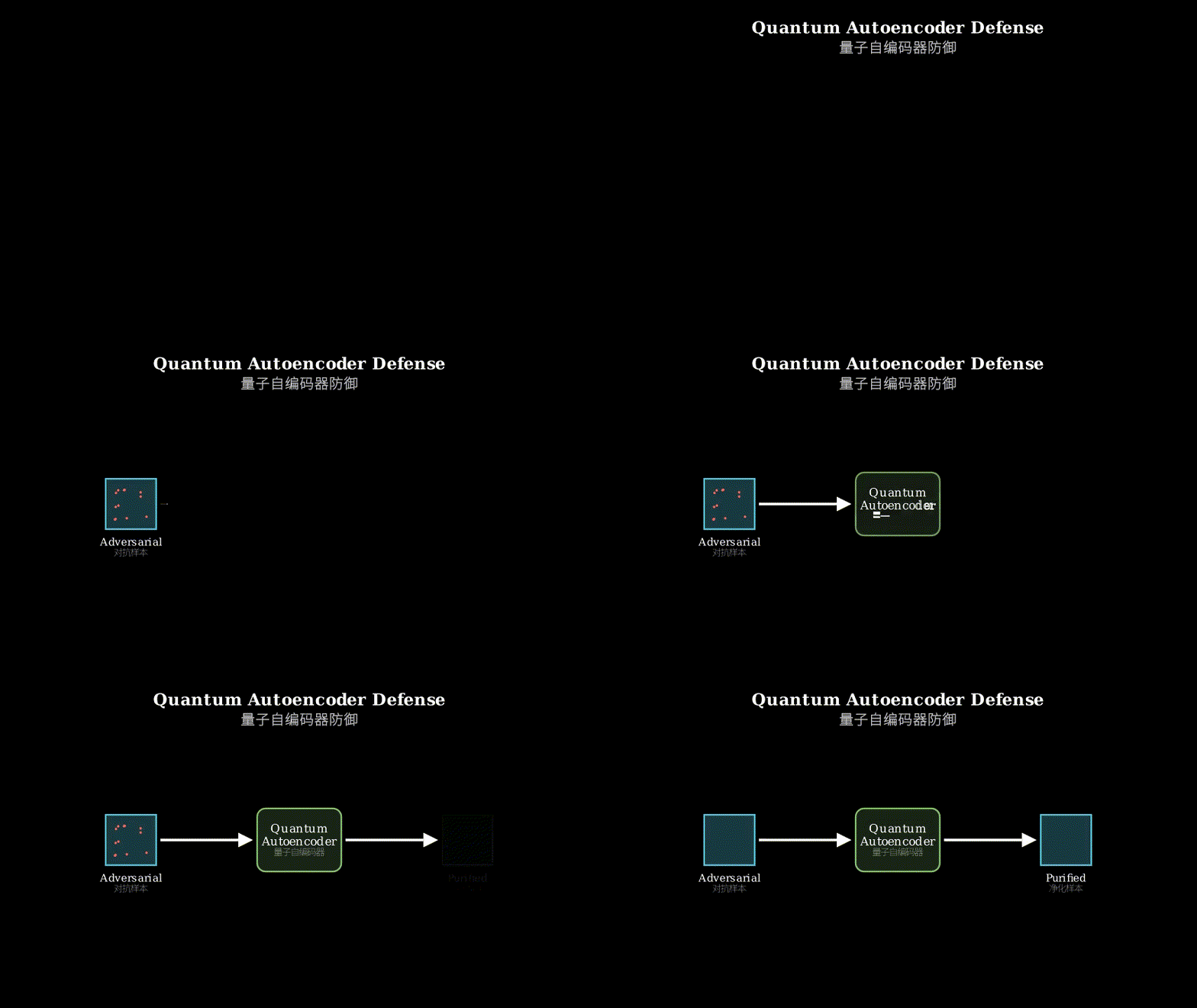
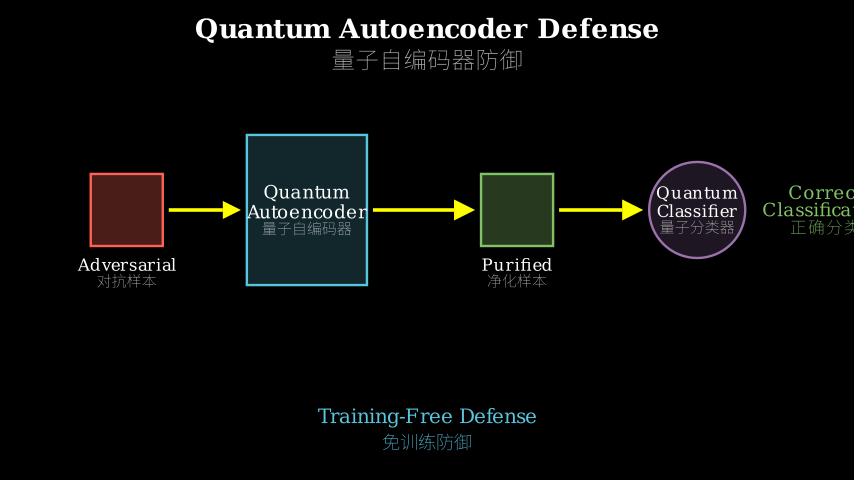
At inference time: adversarial image → QAE → reconstructed (purified) image → VQC → prediction. The QAE acts as a preprocessing filter. Crucially, the QAE never sees adversarial samples during training—it learns only the manifold of clean data.
Training phase (clean data only):
    Clean images --> [QAE: Encoder --> Latent --> Decoder] --> Reconstructed
                         |                                         |
                         +-- Minimize reconstruction loss ---------+

Inference phase (potentially adversarial):
    Input --> [QAE purification] --> Confidence check --> [VQC] --> Prediction
                     |                      |
                     |                      +-- Low confidence? Flag for review
                     |
                     +-- High confidence? Pass to classifier
Think of the QAE as a noise-canceling filter for images. Imagine you’re restoring an old photograph by tracing over it with tracing paper. You can only see the main shapes and edges—the big structures. Fine-grained scratches and dust (the adversarial noise) are too small to trace, so they disappear in your copy. The QAE’s latent bottleneck is the tracing paper: it forces the image through a narrow channel that only preserves essential features. Adversarial perturbations, being high-frequency and non-essential, get left behind.
The confidence metric is like checking how much your traced copy differs from the original. If the difference is huge, something’s wrong—maybe the original was too damaged (adversarial) to trace cleanly. You flag it instead of pretending the trace is accurate.
Key Concepts
-
Quantum Autoencoder (QAE): A quantum circuit that compresses data into fewer qubits (encoding), then expands it back (decoding). Imagine a hallway that’s too narrow for a person carrying a large box—they have to leave the box behind and pick up a new one on the other side. The QAE’s narrow latent space (fewer qubits) forces the data to drop non-essential information. During training on clean images, it learns to preserve the core structure and discard everything else. Adversarial noise, being artificial and not part of the natural data manifold, gets discarded during reconstruction.
-
Adversarial Perturbation: Noise added to an input to fool a classifier. It’s not random—it’s optimized to maximize the classifier’s error while staying imperceptible to humans. Think of it as a carefully tuned frequency that resonates with the classifier’s weaknesses. For example, adding a specific pattern of pixel changes to a “3” image makes the classifier see “8”. The perturbation is small in magnitude but large in impact.
-
Training-Free Defense: A defense mechanism that doesn’t require retraining the classifier or seeing adversarial examples during training. The QAE learns only from clean data, yet generalizes to purify unseen attack types at inference time. This is possible because the defense targets the structure of adversarial noise (high-frequency, off-manifold) rather than memorizing specific attack patterns.
Framework Shift
Before (adversarial training):        After (this paper):

Training:                             Training:
  Clean + Adversarial samples           Clean samples only
         |                                     |
         v                                     v
  [Retrain VQC on both]               [Train QAE on clean data]
         |                                     |
         v                                     v
  Classifier learns to resist           QAE learns clean manifold
  specific attacks
                                      Inference:
Inference:                              Adversarial input
  Adversarial input                           |
         |                                     v
         v                              [QAE purification]
  [VQC predicts]                              |
         |                                     v
         v                              Confidence check
  Often fails on novel attacks                |
                                              v
                                        [VQC predicts on clean signal]
                                              |
                                              v
                                        Robust to novel attacks
One sentence: From retraining the classifier to recognize attacks, to preprocessing inputs through a purification filter that never saw attacks during training.
Expert Assessment
Problem choice: Real gap. Adversarial training’s deployment limitations (need attack samples, overfitting) are well-documented in classical ML and directly transfer to quantum settings. The problem sits at the intersection of quantum ML’s practical deployment and adversarial robustness—both active areas.
Method maturity: The core idea (autoencoders as denoising filters) is borrowed from classical defenses, but the quantum implementation is non-trivial. The confidence metric is a sensible addition for flagging unpurifiable samples. However, the paper doesn’t explore why quantum autoencoders should outperform classical ones here—the quantum advantage claim needs stronger justification. The approach is clever but not groundbreaking; it’s a solid engineering contribution.
Experimental integrity: The 68% improvement is striking, but the baselines matter. If they’re comparing against vanilla adversarial training without modern techniques (ensemble methods, certified defenses), the gap might be inflated. The paper should report performance across multiple attack types and strengths, not just cherry-picked scenarios. The confidence metric’s false positive/negative rates need more scrutiny—how often does it flag clean samples or miss adversarial ones?
Writing quality: The abstract oversells (“significantly outperform”) without caveats. The related work section likely glosses over classical autoencoder defenses, making the quantum contribution seem larger than it is. The experimental section needs more ablation studies: what happens if you use a classical autoencoder? How sensitive is performance to QAE architecture choices? Rewriting the evaluation to include these would ground the claims.
Verdict: Weak accept — Solid engineering work addressing a real deployment problem, but the quantum advantage is under-justified and the evaluation needs more rigor to support the strong claims.
Takeaways
Purification over memorization: When you can’t retrain on adversarial samples, train a separate model on clean data to reconstruct inputs. This generalizes better than memorizing attack patterns. Applicable beyond quantum ML—any domain where adversarial training is impractical (medical imaging with rare attack data, continual learning systems).
Confidence metrics as safety valves: Don’t blindly trust purification. Measure reconstruction fidelity and flag low-confidence cases for human review. This two-tier system (auto-purify high-confidence, escalate low-confidence) is a practical pattern for deploying defenses in high-stakes settings.
Bottleneck as filter: Autoencoders’ latent bottleneck naturally filters high-frequency noise if trained on clean data. This is a structural property, not a learned behavior—you get it for free. Useful for any denoising task where you have clean training data but noisy deployment data.
论文: 2604.28176 作者: Emma Andrews, Sahan Sanjaya, Prabhat Mishra 分类: quant-ph, cs.LG
缺口
变分量子分类器(VQC)会被对抗扰动愚弄——在图像上添加精心设计的微小噪声。
标准防御是对抗训练:用被攻击的样本重新训练分类器。
但这有两个问题:(1)训练时需要获取对抗样本,在部署场景中并不总是可行;(2)模型会过拟合特定攻击类型,面对新型扰动时失效。
现有的量子防御从经典对抗训练继承了这些局限。
还没有人构建出在推理时工作、能泛化到多种攻击类型的免训练防御。
问题:VQC 易受对抗噪声攻击
    |
    v
局限:对抗训练需要攻击样本 + 过拟合
    |
    v
假设:对抗扰动是高频伪影
    |
    v
方法:量子自编码器重构干净信号,过滤噪声
    |
    v
证据:相比对抗训练基线提升 68% 准确率
    |
    v
结论:免训练净化优于重新训练
增量
一句话:这篇论文之前,防御量子分类器意味着用对抗样本重新训练;之后,你可以在推理时用仅在干净数据上训练的独立量子自编码器净化攻击。
核心机制
防御有两个组件:量子自编码器(QAE)和置信度指标。
QAE 在干净图像上训练,将图像压缩到低维潜在空间,然后重构。
关键洞察:对抗扰动是高频噪声,压缩性差。
当你强制扰动图像通过瓶颈时,重构会丢弃噪声,恢复干净信号。
置信度指标衡量重构保真度。
如果 QAE 无法很好地重构输入(重构误差高),这是个危险信号——输入可能是对抗性的且无法净化。
系统会标记这些样本供人工审查,而不是传给分类器。
推理时:对抗图像 → QAE → 重构(净化)图像 → VQC → 预测。
QAE 充当预处理过滤器。
关键是,QAE 在训练期间从未见过对抗样本——它只学习干净数据的流形。
训练阶段(仅干净数据):
    干净图像 --> [QAE: 编码器 --> 潜在 --> 解码器] --> 重构
                     |                                   |
                     +-- 最小化重构损失 -----------------+

推理阶段(可能有对抗):
    输入 --> [QAE 净化] --> 置信度检查 --> [VQC] --> 预测
                |                |
                |                +-- 低置信度?标记审查
                |
                +-- 高置信度?传给分类器
把 QAE 想象成图像的降噪滤波器。
想象你在用描图纸修复一张老照片。
你只能看到主要形状和边缘——大的结构。
细粒度的划痕和灰尘(对抗噪声)太小无法描摹,所以在你的副本中消失了。
QAE 的潜在瓶颈就是描图纸:它强制图像通过一个只保留关键特征的窄通道。
对抗扰动是高频且非本质的,会被留在后面。
置信度指标就像检查你的描摹副本与原件的差异有多大。
如果差异巨大,说明有问题——也许原件损坏太严重(对抗性的)无法干净地描摹。
你标记它,而不是假装描摹是准确的。
关键概念
- 量子自编码器(QAE):一个量子电路,将数据压缩到更少的量子比特(编码),然后再扩展回来(解码)。
想象一个走廊太窄,拿着大箱子的人无法通过——他们必须把箱子留下,在另一边拿一个新的。
QAE 的窄潜在空间(更少的量子比特)强制数据丢弃非本质信息。
在干净图像上训练时,它学会保留核心结构并丢弃其他一切。
对抗噪声是人工的,不属于自然数据流形,在重构期间被丢弃。
- 对抗扰动:添加到输入以欺骗分类器的噪声。
它不是随机的——它被优化以最大化分类器的错误,同时对人类保持不可察觉。
把它想象成一个精心调谐的频率,与分类器的弱点共振。
例如,在”3”图像上添加特定的像素变化模式,使分类器看到”8”。
扰动在幅度上很小,但影响很大。
- 免训练防御:不需要重新训练分类器或在训练期间看到对抗样本的防御机制。
QAE 只从干净数据学习,但在推理时能泛化到净化未见过的攻击类型。
这是可能的,因为防御针对对抗噪声的结构(高频、偏离流形),而不是记忆特定的攻击模式。
框架转变
之前(对抗训练):                之后(本文方法):

训练:                            训练:
  干净 + 对抗样本                   仅干净样本
         |                               |
         v                               v
  [用两者重训 VQC]                  [在干净数据上训练 QAE]
         |                               |
         v                               v
  分类器学会抵抗                    QAE 学习干净流形
  特定攻击
                                  推理:
推理:                              对抗输入
  对抗输入                               |
         |                               v
         v                          [QAE 净化]
  [VQC 预测]                             |
         |                               v
         v                          置信度检查
  常在新攻击上失败                        |
                                         v
                                   [VQC 在干净信号上预测]
                                         |
                                         v
                                   对新攻击鲁棒
一句话:从重新训练分类器识别攻击,到通过从未在训练中见过攻击的净化过滤器预处理输入。
专家评审
选题眼光:真实缺口。
对抗训练的部署局限(需要攻击样本、过拟合)在经典机器学习中有充分记录,直接迁移到量子场景。
问题位于量子机器学习的实际部署与对抗鲁棒性的交叉点——两者都是活跃领域。
方法成熟度:核心思想(自编码器作为去噪滤波器)借鉴自经典防御,但量子实现并非平凡。
置信度指标是标记无法净化样本的合理补充。
然而,论文没有探讨为什么量子自编码器在这里应该优于经典自编码器——量子优势声明需要更强的论证。
方法巧妙但不算突破;是扎实的工程贡献。
实验诚意:68% 的提升很惊人,但基线很重要。
如果他们是在与没有现代技术(集成方法、认证防御)的普通对抗训练比较,差距可能被夸大了。
论文应该报告跨多种攻击类型和强度的性能,而不仅仅是精选场景。
置信度指标的假阳性/假阴性率需要更多审查——它多久标记一次干净样本或错过对抗样本?
写作功力:摘要过度推销(“显著优于”)而没有警告。
相关工作部分可能掩盖了经典自编码器防御,使量子贡献看起来比实际更大。
实验部分需要更多消融研究:如果使用经典自编码器会怎样?性能对 QAE 架构选择有多敏感?重写评估以包含这些内容将使声明更有根据。
判决:弱接收 — 解决真实部署问题的扎实工程工作,但量子优势论证不足,评估需要更严格以支持强烈声明。
要点总结
净化而非记忆:当你无法在对抗样本上重新训练时,在干净数据上训练一个独立模型来重构输入。
这比记忆攻击模式泛化得更好。
适用于量子机器学习之外——任何对抗训练不切实际的领域(攻击数据稀少的医学成像、持续学习系统)。
置信度指标作为安全阀:不要盲目信任净化。
测量重构保真度并标记低置信度案例供人工审查。
这种两层系统(自动净化高置信度,升级低置信度)是在高风险环境中部署防御的实用模式。
瓶颈作为过滤器:如果在干净数据上训练,自编码器的潜在瓶颈自然过滤高频噪声。
这是结构属性,不是学习行为——你免费获得它。
对任何有干净训练数据但部署数据有噪声的去噪任务都有用。