Paper: 2603.05459 Authors: Klaywert Danillo Ferreira de Souza, David Eduardo Pereira, Cláudio E. C. Campelo, Larissa Lucena Vasconcelos Categories: cs.CL, cs.DB
The Gap
Existing debate corpora fall into two camps: written debates from online forums (Reddit CMV, Kialo) that miss prosodic cues and spontaneous speech patterns, or parliamentary/competitive debates (Hansard, IQ2) that follow rigid formats unlike everyday argumentation. The few spoken debate datasets focus on multi-party interactions, making speaker attribution and argument flow analysis messy. None bridge the gap between naturalistic spoken language and structured argument analysis with quality metrics.
Problem: Debate corpora either written OR spoken, never both with full NLP stack
   |
   v
Assumption: Individual debates can be semi-structured to balance naturalness + analyzability
   |
   v
Method: Collect spoken monologues -> Multi-layer annotation (ASR + diarization + argument mining + quality)
   |
   v
Evidence: DEBISS corpus with 4 annotation layers enables multiple downstream tasks
   |
   v
Conclusion: Spoken + structured + quality-assessed debates fill the corpus gap
The Increment
One sentence: Before DEBISS, you chose between written debates with argument structure or spoken debates with prosody—now you get both plus quality assessment in individual semi-structured formats.
Core Mechanism
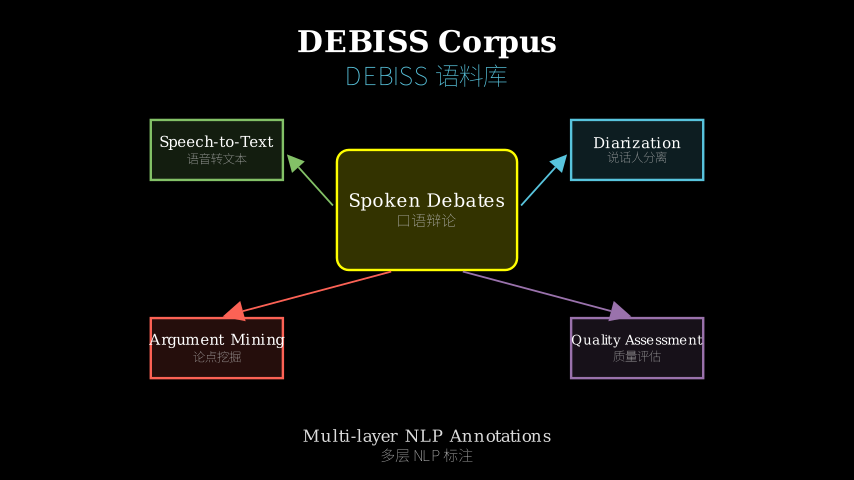
DEBISS isn’t a new algorithm—it’s a corpus construction methodology. The authors collected individual spoken debates where one person argues a position in a semi-structured format (not free-form rambling, not rigid tournament rules). Each debate recording flows through four annotation pipelines in sequence.
First, automatic speech recognition converts audio to text transcripts. Second, speaker diarization segments identify when the debater speaks versus silence or other speakers. Third, argument mining annotators label claims, premises, and argumentative relations following established schemes. Fourth, quality assessors rate debater performance on dimensions like coherence, persuasiveness, and logical soundness.
Raw Audio Recording
   |
   v
[ASR Engine] --> Transcript Text
   |
   v
[Diarization] --> Speaker Segments (who spoke when)
   |
   v
[Argument Mining] --> Claims + Premises + Relations
   |
   v
[Quality Assessment] --> Performance Scores
   |
   v
DEBISS Entry (4-layer annotation)
Think of DEBISS like preparing a musical score from a live jazz performance. The raw audio is the performance itself—spontaneous, with all the timing and emotional inflection. ASR is like transcribing the notes onto staff paper. Diarization marks which instrument plays when (though here it’s mostly one “instrument”—the debater). Argument mining is the harmonic analysis—identifying chord progressions, motifs, and how musical phrases relate. Quality assessment is the critic’s review—rating technique, creativity, and overall impact. Each layer adds interpretive structure without losing the original performance’s richness.
Key Concepts
-
Semi-structured debate format: Imagine a podcast interview versus a scripted speech versus a shouting match. Semi-structured sits in the middle—the debater knows the topic and has time to prepare, but delivers arguments spontaneously without reading a script. There’s a loose framework (opening position, supporting points, conclusion) but no rigid turn-taking or time limits enforced mid-speech. This captures how people actually argue when they’re trying to be coherent but not performing for judges. Example: You’re explaining to your family why you’re switching careers—you’ve thought it through, you have reasons, but you’re not reading from notes.
-
Argument mining annotation: This isn’t sentiment analysis (“positive/negative”) or topic modeling (“this paragraph is about economics”). It’s identifying the logical skeleton of reasoning. A claim is a statement the debater wants you to believe (“Remote work increases productivity”). A premise is evidence or reasoning supporting that claim (“Studies show 25% fewer distractions at home”). Relations show how premises support claims or how claims attack other claims. Think of it like diagramming sentences in grammar class, but for logic instead of syntax. The goal: make implicit reasoning explicit so machines can trace argument flow.
-
Multi-layer annotation: Each debate isn’t just transcribed or just argument-mined—it has all four layers simultaneously. This is like having a movie with the film, the screenplay, the director’s commentary, and the critic’s review all aligned. Researchers can study how prosodic features (from audio) correlate with argument strength (from mining) and persuasiveness (from quality scores). Or train models that predict quality from transcript features. The layers aren’t independent datasets—they’re synchronized views of the same debate, enabling cross-layer analysis impossible with single-annotation corpora.
Framework Shift
Before (mainstream approach):        After (this paper):

Written debates (Reddit/Kialo):      Spoken individual debates:
  Text only                            Audio + Transcript
  Argument structure                   Argument structure
  No prosody                           Prosody preserved
  Multi-party chaos                    Single speaker clarity
                                       Quality metrics
     OR
                                   All layers synchronized:
Spoken debates (Parliament):         [Audio Layer]
  Audio + Transcript                      |
  No argument mining                 [Text Layer]
  Rigid format                            |
  No quality metrics               [Argument Layer]
                                          |
                                   [Quality Layer]
From fragmented single-purpose corpora to integrated multi-layer debate datasets, the core shift is treating spoken argumentation as a phenomenon requiring simultaneous acoustic, linguistic, logical, and evaluative analysis.
Expert Assessment
Problem choice: This is a real infrastructure gap, not manufactured. The field has plenty of written argument corpora and plenty of speech corpora, but almost nothing that combines both with argument structure and quality labels. It’s unglamorous work—corpus building doesn’t win best paper awards—but it’s foundational. The timing is right as argument mining matures beyond written text.
Method maturity: There’s no methodological innovation here, which is fine—this is a resource paper. The authors apply existing tools (ASR, diarization, argument annotation schemes) in a new combination. The semi-structured format is a reasonable design choice, though they don’t justify why this format over others. The annotation process seems standard but details are sparse—inter-annotator agreement numbers would strengthen credibility.
Experimental integrity: This isn’t an experimental paper, so there are no baselines or ablations to scrutinize. The red flag is the abstract’s vagueness—“broad range of NLP task annotations” sounds impressive but what’s actually in the corpus? How many debates? What languages? What topics? The paper needs to show corpus statistics, annotation guidelines, and sample entries. Without seeing the data, it’s hard to assess quality.
Writing quality: The abstract reads like a grant proposal, not a technical paper. “The process of debating is essential in our daily lives” is filler. The authors should cut the motivation paragraph and immediately state: “We present DEBISS, a corpus of X debates with Y hours of audio, annotated for speech recognition, diarization, argument structure, and quality.” The related work section (not in this abstract) likely needs expansion to position this against existing debate corpora more precisely.
Verdict: weak accept — Addresses a real gap with solid execution, but the paper needs to show its work with detailed corpus statistics and annotation protocols before it’s truly useful.
Takeaways
If you’re building a specialized corpus in any domain, steal the multi-layer annotation strategy. Don’t just collect data for one task—think about what complementary annotations would enable cross-layer research. For speech + NLP work, the semi-structured format is clever: structured enough to analyze systematically, natural enough to capture real language phenomena. The quality assessment layer is underrated—most corpora stop at descriptive annotations, but adding evaluative judgments (even subjective ones with inter-rater reliability) opens up new research questions about what makes communication effective, not just what it contains.
论文: 2603.05459 作者: Klaywert Danillo Ferreira de Souza, David Eduardo Pereira, Cláudio E. C. Campelo, Larissa Lucena Vasconcelos 分类: cs.CL, cs.DB
缺口
现有辩论语料库分两类:在线论坛的书面辩论(Reddit CMV、Kialo)缺失韵律线索和自发言语模式,或者议会/竞技辩论(Hansard、IQ2)遵循与日常论证不同的刚性格式。
少数口语辩论数据集聚焦多方互动,导致说话人归属和论证流分析混乱。
没有语料库在自然口语和结构化论证分析之间架桥,更没有质量度量。
问题:辩论语料要么书面要么口语,从未同时具备完整NLP技术栈
   |
   v
假设:个人辩论可以半结构化,平衡自然性与可分析性
   |
   v
方法:收集口语独白 -> 多层标注(ASR + 分段 + 论证挖掘 + 质量)
   |
   v
证据:DEBISS语料库的4层标注支持多个下游任务
   |
   v
结论:口语 + 结构化 + 质量评估的辩论填补语料空白
增量
一句话: DEBISS之前你只能在”有论证结构的书面辩论”和”有韵律的口语辩论”之间二选一,现在你两者兼得,外加个人半结构化格式的质量评估。
核心机制
DEBISS不是新算法,而是语料库构建方法论。
作者收集个人口语辩论,一个人以半结构化格式论证立场(不是自由漫谈,也不是严格赛制规则)。
每段辩论录音依次流经四条标注流水线。
首先,自动语音识别将音频转为文本转录。
其次,说话人分段识别辩手何时发言,何时沉默或其他说话人出现。
第三,论证挖掘标注员按既定方案标记主张、前提和论证关系。
第四,质量评估员在连贯性、说服力、逻辑严密性等维度给辩手表现打分。
原始音频录音
   |
   v
[ASR引擎] --> 转录文本
   |
   v
[说话人分段] --> 说话人片段(谁何时说话)
   |
   v
[论证挖掘] --> 主张 + 前提 + 关系
   |
   v
[质量评估] --> 表现分数
   |
   v
DEBISS条目(4层标注)
把DEBISS想象成从现场爵士演奏准备乐谱。
原始音频是演奏本身——自发的,带着所有时机和情感起伏。
ASR像把音符转录到五线谱上。
说话人分段标记哪件乐器何时演奏(虽然这里主要是一件”乐器”——辩手)。
论证挖掘是和声分析——识别和弦进行、动机以及乐句如何关联。
质量评估是评论家的评论——评价技巧、创造力和整体影响。
每一层添加解释性结构,同时不丢失原始演奏的丰富性。
关键概念
- 半结构化辩论格式: 想象播客访谈、照本宣科的演讲、吵架三者的区别。
半结构化处于中间——辩手知道话题并有时间准备,但自发地表达论证而不读稿。
有松散框架(开场立场、支撑要点、结论)但没有严格的轮流发言或中途强制时限。
这捕捉了人们试图保持连贯但不为评委表演时的真实论证方式。
例子:你向家人解释为什么换职业——你想清楚了,有理由,但不是照着笔记念。
- 论证挖掘标注: 这不是情感分析(“正面/负面”)或主题建模(“这段讲经济”)。
而是识别推理的逻辑骨架。
主张是辩手想让你相信的陈述(“远程工作提高生产力”)。
前提是支持该主张的证据或推理(“研究显示在家干扰少25%”)。
关系显示前提如何支持主张,或主张如何攻击其他主张。
就像语法课上的句子成分分析,但针对逻辑而非句法。
目标:让隐含推理显性化,使机器能追踪论证流。
- 多层标注: 每场辩论不只是转录或只是论证挖掘——同时具备全部四层。
这像一部电影同时有影片、剧本、导演评论和影评人评论,全部对齐。
研究者可以研究韵律特征(来自音频)如何关联论证强度(来自挖掘)和说服力(来自质量分数)。
或训练模型从转录特征预测质量。
这些层不是独立数据集——它们是同一场辩论的同步视图,支持单标注语料库无法实现的跨层分析。
框架转变
之前(主流方法):                  之后(本文方法):

书面辩论(Reddit/Kialo):          口语个人辩论:
  仅文本                           音频 + 转录
  论证结构                         论证结构
  无韵律                           保留韵律
  多方混乱                         单说话人清晰
                                   质量度量
     或
                                所有层同步:
口语辩论(议会):                  [音频层]
  音频 + 转录                         |
  无论证挖掘                      [文本层]
  刚性格式                            |
  无质量度量                      [论证层]
                                      |
                                  [质量层]
从碎片化的单用途语料库到集成的多层辩论数据集,核心转变是将口语论证视为需要同时进行声学、语言、逻辑和评价分析的现象。
专家评审
选题眼光: 这是真实的基础设施缺口,不是人造的。
该领域有大量书面论证语料库和大量语音语料库,但几乎没有结合两者并带论证结构和质量标签的。
这是不起眼的工作——语料库构建拿不到最佳论文奖——但它是基础性的。
随着论证挖掘在书面文本之外成熟,时机恰当。
方法成熟度: 这里没有方法论创新,这没问题——这是资源论文。
作者将现有工具(ASR、说话人分段、论证标注方案)以新组合应用。
半结构化格式是合理的设计选择,尽管他们没有论证为何选这种格式而非其他。
标注过程看起来标准,但细节稀少——标注员间一致性数字会增强可信度。
实验诚意: 这不是实验论文,所以没有基线或消融研究可审查。
危险信号是摘要的含糊——“广泛的NLP任务标注”听起来厉害,但语料库里实际有什么?多少场辩论?什么语言?什么话题?论文需要展示语料库统计、标注指南和样本条目。
看不到数据就难以评估质量。
写作功力: 摘要读起来像项目申请书,不像技术论文。
“辩论过程在日常生活中至关重要”是凑字数。
作者应该删掉动机段落,直接陈述:“我们呈现DEBISS,包含X场辩论Y小时音频,标注了语音识别、说话人分段、论证结构和质量。
“相关工作部分(不在此摘要中)可能需要扩展,更精确地定位这个语料库相对现有辩论语料库的位置。
判决: 弱接收——用扎实执行解决真实缺口,但论文需要用详细的语料库统计和标注协议展示其工作,才真正有用。
要点总结
如果你在任何领域构建专门语料库,偷走多层标注策略。
不要只为一个任务收集数据——思考什么互补标注能支持跨层研究。
对于语音+NLP工作,半结构化格式很聪明:足够结构化以系统分析,足够自然以捕捉真实语言现象。
质量评估层被低估——大多数语料库止步于描述性标注,但添加评价性判断(即使是有评分者间信度的主观判断)开启关于什么使交流有效(而非仅包含什么)的新研究问题。