Paper: 2611.34928 — Diverse Alternative Reasoning Traces for Hard Math Problems Authors: Lukas Aichberger, Adam Golinski, Arno Blaas, Arwen Bradley, Jacob Springer, Mehrdad Farajtabar, Michael Kirchhof, Sinead Williamson Categories: cs.AI, cs.CL, cs.LG Reading scope: Original arXiv v1 HTML, main sections 1–7 and Appendices A–G, with untruncated text extraction. Original Figures 1 and 5 were visually inspected. Experiments were not reproduced; external code, datasets, and cited works were not independently audited.
The Problem
A math model can name a useful formula and still fail to finish the problem. The paper shows this with a trigonometry question: an angle has sine 3/5 and cosine 4/5; find the tangent of half that angle. The rejected solution starts with a half-angle identity, then wanders into unnecessary expansions involving the two component angles. The excerpt does not show its rejected final answer (Appendix A.2).
That failure matters when collecting training data. A common approach asks the model to write complete solutions, checks their final answers, and retains the ones that pass. Independent Monte Carlo sampling repeats the attempt with random choices, hoping to find a successful route. A question that rarely succeeds can remain absent from the training corpus even while easier questions contribute many examples.
DART revisits the failed solution. It keeps a prefix, replaces a selected step, and lets a new ending grow from there. This is principally an offline training-data mining method: the dataset already contains reference answers, which help guide the replacement.
The Explanation
Change the next move
DART first generates a solution greedily, choosing the most likely next piece of text at each point. Math-Verify compares its final answer with the known answer. An accepted solution goes straight into the training collection. A rejected one enters the branching procedure (§2).
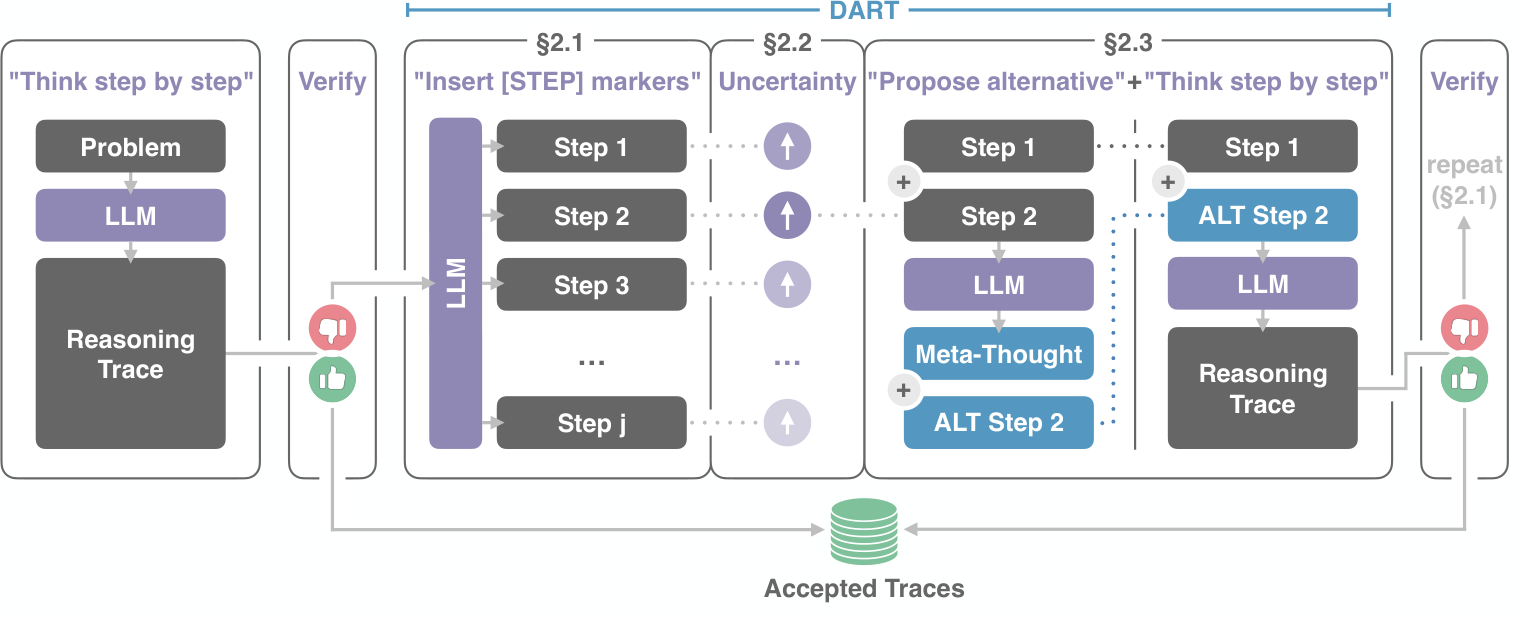
Original Figure 1. The planning note helps propose a replacement. The continuation receives the retained prefix and replacement; the reference-answer guidance is described in §2.3.
The model marks meaningful step boundaries in the rejected text. The original words are supplied unchanged while it decides where to put the markers. It is segmenting the solution, rather than rewriting or correcting it (§2.1).
DART then ranks non-final steps. For each step, it adds up how unlikely the original text was, piece by piece, under the model. These small pieces are called tokens. It divides that sum of negative log-likelihoods by the step’s position: an uncertain early move gets more weight because changing it can redirect more of the remaining solution. The score sums over tokens, so step length also affects it. It does not certify that the selected step is wrong, or that the retained prefix is correct (§2.2).
At a selected position, a separate proposal prompt shows the problem, the retained prefix, the original step, and any earlier replacement candidates at that position. It asks for a different approach. Main DART also supplies the reference answer and requests a short planning note, called a meta-thought, before the new step. Updating the candidate history can produce different proposals even with greedy decoding. The prompt encourages conceptual diversity; it does not guarantee it (§2.3; Appendix C.1).
The old selected step and its entire suffix are discarded. The planning note is discarded too. A new greedy continuation receives only the problem’s original step-by-step instruction, the retained prefix, and the replacement. It has no direct access to the reference-answer prompt or planning note. Their guidance can still influence the solution through the replacement.
In the trigonometry example, DART replaces the first step, so there is no earlier reasoning prefix to retain. The new step computes the tangent of the full angle: divide 3/5 by 4/5 to obtain 3/4. The continuation then uses the half-angle identity: subtract 4/5 from 1, and divide the resulting 1/5 by 3/5. The final answer is 1/3, matching the reference (Appendix C.2).
This is a useful redirection, but the example does not establish a wholly new proof. The continuation returns to an identity already present in the rejected solution. What changed was the path taken after the intervention.
The new final answer is checked. If it passes, the completed solution joins the training collection. Supervised fine-tuning then teaches the base model to imitate accepted solutions paired with the original problem and step-by-step instruction. The special mining prompt and planning notes are excluded (§5).
Count recovered questions and the work needed
The main cost comparison uses 6,200 shared DeepMath problems that the initial greedy attempt did not solve, with Llama-3.1-8B-Instruct doing the mining. MC generates eight independent full solutions per problem. DART selects up to four non-final steps and proposes two alternatives at each, for up to eight completed solutions. Both have a 4,096-token allowance for each completed solution; DART’s retained prefix and replacement count toward it (§4).
| Quantity on the same 6,200 problems | MC sampling | DART |
|---|---|---|
| Problems with at least one accepted solution | 2,168 | 2,971 |
| Total accepted solutions | 3,987 | 7,921 |
| Estimated generation FLOPs, in units of 10¹⁸ | 1.380 | 1.917 |
Source: Figure 5 and Appendix E, Table 2. FLOPs count arithmetic operations; these estimates cover dominant generation matrix multiplications.
Recovery rises from about 35% to 48%. That is roughly 13 percentage points, or 37% more recovered problems relative to MC. It comes with 39% higher estimated cost per attempted problem. Matching the number of completed solutions does not match computation.
The cost per recovered problem is nearly unchanged. Cost per accepted solution falls about 30%, because DART also gets more accepted versions from each recovered question: approximately 2.67 versus 1.84. Broader question coverage and higher yield together explain the almost twofold accepted-solution count. Those solutions were not semantically deduplicated (§4; Appendix E).
A component study helps separate the proposal’s effects. On MATH-500, 440 of 500 initial greedy traces terminated normally, and 224 passed. Among the normally terminated failures, DART recovers 170 additional questions at the largest evaluated step-level budget; MC that samples a replacement and then continues greedily recovers 148. Including the original 224 successes gives total coverage of 394 versus 372. The 60 nonterminating greedy traces are excluded from this component recovery analysis (§2.3; Appendix C.3).
Removing both reference-answer guidance and the planning note still recovers 158 questions. Without answer guidance but with the note, recovery is 155. This supports a benefit from the proposal procedure beyond supplying the answer, while showing that the planning note does not automatically improve every configuration. The methods also recover partly different questions; these results do not establish dominance at arbitrary sampling budgets.
Test the resulting training data
The authors mine training corpora from 16,384 OpenMathInstruct-2 problems or 8,192 DeepMath problems, then fine-tune Llama-3.1-8B-Instruct from the same base checkpoint. Each method keeps accepted greedy solutions and adds the accepted solutions it mines (§5; Appendix F).
The evaluation metric needs care. Greedy OR pass@32 counts a question as solved if a separate greedy solution passes, or if any of 32 stochastic solutions passes. It measures success available through multiple attempts, rather than the correctness of one default response.
| Training source | Evaluation set | MC (%) | DART (%) |
|---|---|---|---|
| OpenMathInstruct-2 | MATH-500 | 87.09 | 87.96 |
| OpenMathInstruct-2 | AIME 2022+2023 | 21.66 | 24.25 |
| OpenMathInstruct-2 | AIME 2024+2025 | 23.05 | 28.12 |
| DeepMath | MATH-500 | 87.47 | 87.92 |
| DeepMath | AIME 2022+2023 | 22.88 | 24.89 |
| DeepMath | AIME 2024+2025 | 23.02 | 23.73 |
Source: Table 1. Each point estimate uses a checkpoint selected on that evaluation set.
DART’s point estimates exceed MC’s in all six settings and rank highest among the compared methods in five. STaR slightly leads on OpenMath-to-MATH-500: 88.12 versus 87.96. STaR and RFT also receive reference answers during mining, so these comparisons include other answer-guided methods. At evaluation, the model receives the original task prompt without the mining guidance.
The data therefore has downstream value in this setup. To understand what produced that value, three distinctions matter.
Core Concepts
Question coverage versus example count. Ten accepted versions of the same trigonometry question still cover one question. Recovery counts questions with at least one accepted solution; yield counts all accepted solutions. DART improves both in the cost study. Neither count measures how different the proofs are.
Guidance during mining versus direct access during continuation. The known 1/3 helps the proposal stage choose a replacement. Removing the answer prompt before continuation does not erase that influence from the replacement text. This information boundary makes sense for constructing supervised examples from labeled data; it does not make the mining procedure answer-free.
An accepted answer versus a checked proof. Math-Verify checks the final result. A solution reaching 1/3 can still contain an invalid or unnecessary intermediate step. The acceptance signal is useful for mining, while process correctness remains a separate quality question.
The Insight
DART makes a failed solution a starting point for another training example. Its useful contribution concerns which questions enter the corpus, as well as how many examples are collected.
A corpus can grow while leaving the model’s hardest questions uncovered. Targeted branching changes that coverage in the studied setting: known answers, an automated final-answer checker, and an 8B model doing mathematical reasoning. The evidence supports keeping rejected attempts available for reuse under those conditions.
A Critical Reading
The proposal comparison is informative because step-level MC uses the same greedy continuation, and the ablations remove answer guidance and planning separately. But the branching score is a heuristic. The reported roughly 40% improvement in the rank of the first accepted solution comes from 125 questions with both accepted and rejected recorded completions. It is a ranking result on that subset, not a 40% saving in global search cost (§2.2).
The difficulty plots also need their construction preserved. Their strata and MC results use the same 512-solution sampling pool. In the hardest stratum, every recorded MC attempt failed, so zero MC recovery follows from how the stratum was defined. It does not show that MC could never solve those questions (§4; Appendix D).
The cost estimate includes proposal and continuation generation with cache reuse. It excludes the shared first greedy attempt, step decomposition, verifier and CPU work, communication, other overhead, training, and evaluation. The 30% lower cost per accepted solution concerns estimated dominant matrix multiplications, rather than elapsed time, energy, or money (Appendix E).
The post-training comparisons hold the base model, two-epoch recipe, and seed 42 fixed. Corpus size, composition, token count, and training volume vary together. The gains describe the complete mining-and-training pipeline; they do not isolate proof diversity from additional data or training (§5; Appendix F).
Each Table 1 checkpoint is selected using the very evaluation set on which its result is displayed. MATH-500 also informed method development; AIME did not inform the prompt or ranking, but did inform checkpoint selection. The paper’s 95% ranges resample 32 traces without replacement from recorded pools, holding questions and the chosen checkpoint fixed. They do not resample questions or rerun generation and training, and exclude seed and checkpoint-selection uncertainty. These are exploratory, evaluation-selected point estimates (§5; Appendix F).
Finally, the empirical scope is mainly one model and math reasoning. Exact-string deduplication leaves near-duplicate contamination possible. Stronger evidence for general deployment would require other models and domains, more training seeds, and evaluation questions kept out of method and checkpoint selection (§6).
What You Can Use
If you maintain a labeled math-training corpus with a reliable answer checker, save failed solutions as possible branch points. A small pilot can compare independent sampling with a limited number of replacements, recording recovered questions separately from accepted-solution yield. Measure complete runtime alongside generation work, and inspect intermediate reasoning and duplicate solutions before treating the collection as teaching material.
For the trigonometry question, the reusable object was the failed attempt and a place to redirect it. For your own corpus, the practical question is whether that intervention brings previously uncovered questions into training. A comparison with matched training-token budgets and a checkpoint chosen before held-out evaluation would help separate better data from simply training more. These are follow-up checks to run, rather than results established by this paper.
论文: 2611.34928 — Diverse Alternative Reasoning Traces for Hard Math Problems 作者: Lukas Aichberger, Adam Golinski, Arno Blaas, Arwen Bradley, Jacob Springer, Mehrdad Farajtabar, Michael Kirchhof, Sinead Williamson 分类: cs.AI, cs.CL, cs.LG 阅读范围: 原始 arXiv v1 HTML,完整阅读正文第 1–7 节与附录 A–G,文本提取未截断。 已目视检查原图 1 与图 5。 本文依据论文讲解,没有复现实验,也没有独立审计外部代码、数据集或引用文献。
问题
数学模型会说出一个有用的公式,仍可能解不出题。 论文给了一道三角题:一个角的正弦是 3/5,余弦是 4/5,求它一半角度的正切。 那份未通过核验的解答,开头已经写到半角恒等式,随后却绕进两个分角的不必要展开。 附录 A.2 没有展示它最后交出的错误答案。
这会影响训练材料的收集。 一种常见做法,是让模型写完整解答,检查最后的答案,把通过的留下。 独立蒙特卡洛采样,就是让模型带着随机选择从头多试几遍,希望碰到一条成功的路。 容易的题可以攒下很多解答,很少答对的题却可能一直进不了训练集。
DART 回到那份失败的解答,从某一步另开一条路。 它保留此前的文字,替换选中的一步,再续写新的结尾。 这里要先交代一个前提:它主要在离线收集训练数据,题库里已经有参考答案,生成替代步骤时会用到这个答案。
翻译
从下一步改道
DART 先用模型每次都选最可能文本的方式,写出一份完整解答。 这叫贪心生成。 Math-Verify 把最终结果与参考答案核对,通过的直接收入训练材料,未通过的才进入改道流程,见第 2 节。
论文原图 1。 策略短评帮助提出替代步骤;续写接收保留的前文和新步骤。 参考答案怎样引导候选,见第 2.3 节。
先把失败解答切成有意义的步骤。 原文逐段送给模型,模型只判断哪里该放分界标记,不重新写那些句子。 因此,这一步做的是切分,没有纠错,见第 2.1 节。
接着给非最后一步排优先级。 模型处理文字时,会把它切成小片段,也就是 token。 DART 累加每一步里这些片段的负对数概率:原来的文字越难被模型预测,分数就越高。 再把这个总分除以步骤的位置序号,靠前的步骤更容易得到高分,因为从这里改道,后面有更长一段可以重走。 这是求和,步骤长短也会影响分数。 它不能证明选中的步骤就是错处,也不能证明保留下来的前文全部正确,见第 2.2 节。
选好位置后,另一个提示词把题目、保留的前文、原步骤,以及这个位置此前生成的替代候选一起交给模型,要求换一种思路。 完整的 DART 还会提供参考答案,并让模型先写几句策略短评,再给出新步骤。 论文把这段短评叫作 meta-thought。 候选历史会随生成更新,所以即使每次仍用贪心生成,后续候选也可能不同。 提示词鼓励思路不同,没有保证它们真的不同,见第 2.3 节与附录 C.1。
然后删掉原步骤和它后面的全部旧解答,也删掉策略短评。 新的续写只接收原来的解题指令、保留的前文和替代步骤。 它不能直接看见参考答案提示词或那段短评,但新步骤仍然带着前面引导的影响。
回到三角题,附录 C.2 替换的是第一步,因此没有更早的推理文字需要保留。 新步骤先算整个角的正切:3/5 除以 4/5,得到 3/4。 后面的续写再用半角恒等式:1 减去 4/5,得到 1/5;再除以 3/5,得到 1/3。 这次最终结果与参考答案一致。
这个例子说明,改动一步可以把后续解答带回有用的路上。 它没有证明模型找出了一份完全不同的证明。 新的续写又用到了旧解答已经提过的半角恒等式,变化发生在干预之后怎样往下走。
新解答经过最终答案核验,通过的收入训练材料。 随后做监督微调,也就是让起始模型照着这些合格样本学习。 训练输入是原题与逐步解题指令,目标是留下的完整解答;采样时的特殊提示词和策略短评不放进去,见第 5 节。
数找回多少题,也数花了多少功夫
主要成本对照使用 6,200 道共同的 DeepMath 题目,起始贪心解答都没有解出它们,采集模型是 Llama-3.1-8B-Instruct。 独立采样每题从头写八份解答。 DART 最多选四个非末尾步骤,每处生成两个候选,最多得到八份完整解答。 两边每份完整解答的文本额度都是 4,096 个 token;DART 保留的前文和替代步骤也计入这个额度,见第 4 节。
| 同一批 6,200 道题上的数量 | 独立采样 | DART |
|---|---|---|
| 至少得到一份合格解答的题目 | 2,168 | 2,971 |
| 合格解答总数 | 3,987 | 7,921 |
| 估算生成运算量,单位为 10¹⁸ FLOPs | 1.380 | 1.917 |
来源:图 5 与附录 E 的表 2。FLOPs 统计算术运算;这里估算的是生成阶段主要的矩阵乘法。
找回的题目比例从约 35% 升到 48%。 差距约为 13 个百分点;相对独立采样,找回的题多了 37%。 代价也增加了:每尝试一道题的估算生成成本高了 39%。 完整解答的份数相近,计算量仍然可以不同。
摊到每道找回的题上,估算成本几乎不变。 摊到每份合格解答上,成本约降 30%。 这是因为 DART 除了找回更多题,每道找回的题还产出更多合格版本,约为 2.67 份,对照组为 1.84 份。 两项收益叠加,才解释了合格解答总数接近翻倍。 这些解答没有按思路做语义去重,见第 4 节与附录 E。
组件实验进一步检查,究竟是哪部分在帮忙。 MATH-500 的 500 道题中,440 份起始贪心解答正常结束,224 份通过核验。 在正常结束却没答对的题里,DART 在最大已测步骤级额度下找回 170 道;对照方法随机生成替代步骤、随后同样贪心续写,找回 148 道。 加上最初答对的 224 道,总覆盖为 394 对 372。 另有 60 份起始解答未正常结束,这项组件恢复分析没有把它们纳入,见第 2.3 节与附录 C.3。
同时去掉参考答案引导和策略短评,仍能找回 158 道。 不提供答案、但保留短评时,找回 155 道。 因此,收益不全来自先看了答案;加上策略短评也没有在每种设置里都带来提升。 两种方法还会找到部分彼此没找到的题,不能据此断言,无论给多少次尝试,DART 都占优。
再看这些材料能否教会模型
作者分别从 16,384 道 OpenMathInstruct-2 题目和 8,192 道 DeepMath 题目采集训练材料,再从相同起始权重微调 Llama-3.1-8B-Instruct。 各方法都保留通过核验的贪心解答,再加入自己采集到的合格解答,见第 5 节与附录 F。
这里的评测指标必须读准。 Greedy OR pass@32 的意思是:单独那份贪心解答通过,或者另采样的 32 份解答中至少一份通过,这道题就算成功。 它衡量多次尝试能找到成功解答的能力,不能直接当成默认回答一次就答对的比例。
| 训练题库 | 评测集 | 独立采样(%) | DART(%) |
|---|---|---|---|
| OpenMathInstruct-2 | MATH-500 | 87.09 | 87.96 |
| OpenMathInstruct-2 | AIME 2022+2023 | 21.66 | 24.25 |
| OpenMathInstruct-2 | AIME 2024+2025 | 23.05 | 28.12 |
| DeepMath | MATH-500 | 87.47 | 87.92 |
| DeepMath | AIME 2022+2023 | 22.88 | 24.89 |
| DeepMath | AIME 2024+2025 | 23.02 | 23.73 |
来源:表 1。每个点估计都采用在该评测集上选出的模型检查点。
六项对照中,DART 的点估计都高于独立采样,在全部参比方法中有五项最高。 剩下一项是用 OpenMath 材料训练后测 MATH-500,STaR 略高,88.12 对 87.96。 STaR 与 RFT 在采集训练材料时也能看参考答案,因此这些比较包含了其他答案引导方法。 正式评测时,模型只收到原来的解题提示,不收到采集阶段的引导。
这些训练材料在这个设置里确实产生了后续收益。 要读懂收益来自哪里,还需要拆清三件事。
核心概念
覆盖题目与解答份数。 同一道三角题得到十份合格解答,仍只覆盖一道题。 找回率数的是“哪些题至少有一份能用的解答”,产出量数的是“合格解答一共有多少份”。 DART 在成本实验里同时提高了这两项,但它们都没有衡量证明思路究竟有多不同。
采集时受引导与续写时直接看答案。 已知的 1/3 会帮助候选阶段选择新步骤。 续写前拿走答案提示词,不能拿走新步骤已经受到的影响。 这种信息边界适合在带答案的题库里制造监督样本;采集过程仍然用到了答案。
答案合格与证明正确。 Math-Verify 核对最终结果。 一份得到 1/3 的解答,中间仍可能有无效或多余的步骤。 这个信号能帮助筛选材料,过程质量还需要另查。
洞见
DART 把失败的解答变成下一份训练样本的起点。 它的价值关系到哪些题终于能进入训练集,也关系到能收集多少份解答。
训练集可以越攒越大,模型最难的那些题却一直缺席。 在论文研究的条件下,定点改道补上了部分缺口:题库有参考答案,系统能自动核验最终结果,执行者是一个处理数学推理的 8B 模型。 这份证据支持在这些条件下留下失败尝试,供后续重新利用。
博导审稿
候选对照做得有用:步骤级独立采样也使用相同的贪心续写,消融又分别拿走答案引导和策略短评。 但步骤评分终究是启发式规则。 论文提到,首个合格解答的平均排序位置改善约 40%,这个结果只来自 125 道同时有合格与不合格候选的题。 它比较的是这批记录里的排序效果,不能改写成全局搜索成本节省 40%,见第 2.2 节。
难度图也要连同构造方法一起看。 难度分层和独立采样的结果,使用同一个 512 份解答的采样池。 最难那层本来就挑出了这批独立采样一次也没成功的题,所以对照组在这一层零恢复,是分层定义带来的结果。 这不能证明独立采样永远解不出这些题,见第 4 节与附录 D。
成本估算计入了候选生成、续写以及缓存复用。 它没有计入双方共同的首次贪心尝试、步骤切分、核验器与 CPU 工作、通信、其他开销、训练或评测。 “每份合格解答便宜 30%”说的是主要矩阵乘法的估算运算量,没有测出运行时间、能耗或费用,见附录 E。
训练对照固定了起始模型、两个训练轮次和随机种子 42。 训练材料的规模、组成、文本量与总训练量一起变了。 因此,分数支持的是整套采集与训练流程,不能单独归功于证明更多样,也不能排除多了数据和训练的贡献,见第 5 节与附录 F。
表 1 的每个检查点,都是用它最后展示成绩的那个评测集选出来的。 MATH-500 还参与了方法开发;AIME 没有参与提示词和排序规则的选择,却参与了检查点选择。 论文的 95% 范围,是从已记录的解答池里不放回抽取 32 份解答得到的,题目和检查点都固定。 它没有重新抽题,也没有重跑生成与训练,不包含训练种子和检查点选择的不确定性。 这些是探索性的、按评测集选优后的点估计,见第 5 节与附录 F。
实证范围也主要是一个模型与数学推理。 按题目原文完全相同来去重,还不能排除近似重复题造成的污染。 要形成更广泛的部署依据,还需要换模型、换领域、增加训练种子,并让最终评测题目不参与方法或检查点选择,见第 6 节。
启发
如果你维护带答案的数学训练题库,而且有可靠的结果核验器,可以把失败解答留下,作为后续改道的起点。 先做一个小规模对照,比较从头独立采样与有限次数的步骤替换,把找回的题目数和合格解答份数分开记录。 除了生成运算量,还应实测完整运行时间,并抽查中间推理与重复解答,再把材料交给模型学习。
开头那道三角题,留下来供利用的是一次失败尝试,以及一个可以改道的位置。 到了自己的题库,值得检查的是:这个干预有没有把原来缺席的题带进训练集。 进一步对齐训练文本预算,并在留出评测前选定检查点,有助于区分材料更好与训练更多。 这些是可以接着做的核验,论文尚未给出这些对照的结果。