
Paper: 2602.24288 Authors: Fan Shu, Yite Wang, Ruofan Wu, Boyi Liu, Zhewei Yao, Yuxiong He, Feng Yan Categories: cs.AI, cs.CL
The Gap
Current LLM benchmarks for data science suffer from two critical flaws. First, they rely on subjective human or model-based judges to evaluate outputs, making results non-reproducible and vulnerable to evaluator bias. Benchmarks like DS-1000 or MATH check only final answers, ignoring whether the model followed the correct process—like grading a math exam by answer key alone, missing whether the student used valid reasoning. Second, there’s a chicken-and-egg problem: we lack large-scale, accurately labeled training data for multi-step data science tasks, yet models need exactly this data to improve. Existing benchmarks like HumanEval focus on code correctness but don’t capture the full complexity of real data science workflows involving data exploration, feature engineering, model selection, and iterative refinement.
The Increment
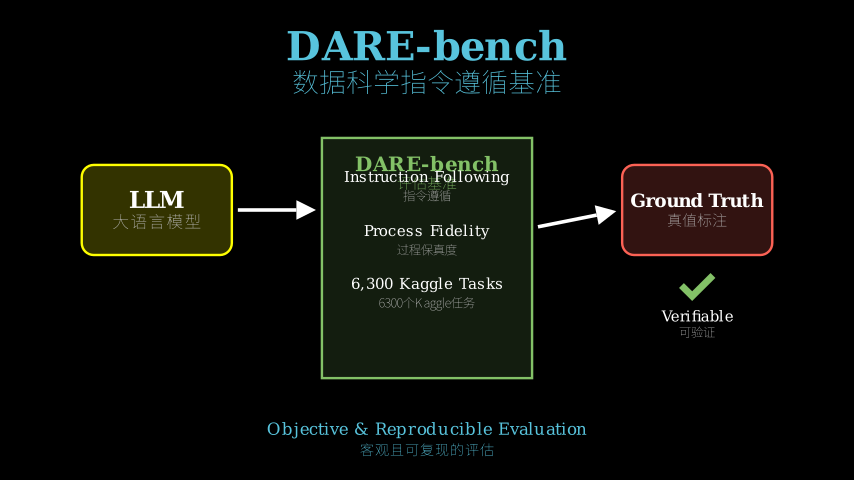
Before: Benchmarks evaluate data science tasks with subjective judges and sparse training data. After: DARE-bench provides 6,300 Kaggle-derived tasks with verifiable ground truth for both objective evaluation and large-scale training.
Think of DARE-bench as a driving test with telemetry. Traditional benchmarks are like checking if you arrived at the destination (outcome-only evaluation). DARE-bench is like a driving instructor with a dashboard monitoring your speed, lane position, turn signals, and brake timing throughout the journey. The benchmark has three components that map to this analogy: (1) Task specification (the route and traffic rules)—clear instructions derived from real Kaggle competitions; (2) Process checkpoints (telemetry sensors)—intermediate verification points that check if you’re following correct procedures, not just reaching the end; (3) Ground truth labels (the instructor’s answer key)—objectively verifiable outcomes from actual Kaggle solutions, eliminating subjective judgment.
The authors extracted tasks from Kaggle competitions where ground truth is inherently available—competition leaderboards provide objective performance metrics. Each task includes the dataset, problem description, evaluation metric, and verifiable solution. This creates a closed-loop evaluation system: models generate code, execute it, and produce predictions that can be scored against held-out test sets using the competition’s own metric (accuracy, F1, RMSE, etc.).
Key Concepts
Process Fidelity vs. Outcome Accuracy
Most benchmarks ask: “Did you get the right answer?” DARE-bench asks: “Did you get there the right way?” Imagine two students solving . Student A writes immediately. Student B writes but forgets the constant. Traditional benchmarks might mark both wrong if they check only the final symbolic form. Process-aware evaluation would recognize that Student A understands integration while Student B made a minor notation error.
In data science, this distinction matters enormously. A model might achieve 85% accuracy by accidentally overfitting to test data leakage, or by correctly implementing cross-validation and feature engineering. DARE-bench tracks intermediate steps: Did the model split data properly? Did it handle missing values before training? Did it use appropriate evaluation metrics? This is “instruction fidelity”—following the recipe, not just producing something edible.
Verifiable Ground Truth
Why is “verifiable” important? Consider asking an LLM to “analyze customer churn.” A human judge might score the response based on vibes—does it sound insightful? A model-based judge (like GPT-4-as-a-judge) might prefer verbose explanations. Neither is reproducible. Verifiable ground truth means: run the model’s generated code, make predictions on a held-out test set, compute a metric (say, AUC), and compare to a threshold. No ambiguity. No drift in evaluation standards over time.
DARE-bench achieves this by sourcing tasks from Kaggle, where competitions already define success objectively. If the task is “predict house prices,” success is measured by RMSE on a hidden test set. The benchmark inherits this objectivity. It’s like using a standardized ruler instead of asking people to estimate lengths by eye.
Kaggle-Derived Task Diversity
Kaggle competitions span tabular data, time series, NLP, computer vision, and recommendation systems. By deriving 6,300 tasks from this ecosystem, DARE-bench covers a representative slice of real-world data science. This isn’t synthetic data or toy problems—these are tasks that practitioners actually cared enough about to compete on.
The diversity matters for generalization. A model that excels on tabular classification but fails on time series forecasting hasn’t truly mastered data science instruction following. DARE-bench’s breadth prevents overfitting to narrow task distributions, similar to how ImageNet’s 1,000 classes prevent vision models from memorizing a handful of categories.
Expert Assessment
Problem significance: This is a high-impact problem. The LLM-for-data-science space is exploding—tools like GitHub Copilot, Cursor, and specialized agents are being deployed widely. Yet we’re flying blind without rigorous benchmarks. The affected community includes ML practitioners, AI researchers, and enterprises investing in LLM-powered analytics tools. The lack of objective evaluation has real consequences: companies might deploy underperforming models, researchers can’t reliably compare methods, and progress is hard to measure.
Method maturity: This is deployment-ready as a benchmark, but the paper reveals the field itself is immature. Even GPT-4-mini achieves mediocre performance, suggesting current models aren’t ready for autonomous data science work. The benchmark’s design is solid—using Kaggle tasks is clever because ground truth comes for free. However, there’s a limitation the authors don’t emphasize enough: Kaggle tasks are competition-style, often with clean datasets and clear objectives. Real-world data science involves ambiguous requirements, messy data, and stakeholder negotiation—aspects DARE-bench doesn’t capture. It’s a controlled environment, like testing self-driving cars on closed tracks rather than chaotic city streets.
Another limitation: the benchmark focuses on single-task episodes. Real data science involves iterative refinement—you train a model, analyze errors, engineer new features, retrain. DARE-bench’s tasks are more atomic. The authors acknowledge this implicitly by providing “agentic tools,” but the evaluation doesn’t deeply probe multi-turn iterative workflows.
Experimental rigor: The baselines are fair and comprehensive—testing models from GPT-4 to smaller open-source options. The evaluation is objective by design (verifiable ground truth), which is the paper’s main strength. The Kaggle-derived dataset is representative of competition-style tasks, though as noted, it may not fully represent production data science.
One red flag: the paper shows massive improvements from fine-tuning (8x for RL on Qwen3-4B), which is impressive but raises questions. Is the benchmark leaking information? Are the training and test sets sufficiently separated? The authors claim proper splits, but such dramatic gains warrant scrutiny. It’s possible the tasks share structural similarities that make transfer learning unusually effective—not necessarily a flaw, but worth investigating.
Verdict: Weak accept — DARE-bench fills a real gap with a well-executed benchmark, but the paper oversells the generality (Kaggle tasks ≠ all data science) and doesn’t deeply probe why fine-tuning gains are so extreme.
Takeaways
Verifiable evaluation beats vibes: The shift from human/model judges to objective metrics is transferable to any domain where ground truth can be established. If you’re building benchmarks for code generation, theorem proving, or even creative tasks with measurable outcomes (e.g., “generate a recipe that uses these ingredients and stays under 500 calories”), prioritize verifiable checks over subjective scoring.
Process matters as much as outcomes: Instruction fidelity—tracking whether intermediate steps are correct—is underutilized in LLM evaluation. This applies beyond data science. In legal document generation, did the model cite relevant statutes? In medical diagnosis, did it consider differential diagnoses? Outcome-only evaluation misses these process failures.
Real-world task sources reduce synthetic bias: Sourcing tasks from Kaggle rather than hand-crafting them ensures the benchmark reflects actual practitioner needs. This principle applies elsewhere: use GitHub issues for software engineering benchmarks, Stack Overflow for debugging tasks, or customer support tickets for dialogue systems. Real data has a texture that synthetic tasks lack.
Fine-tuning on process-rich data yields outsized gains: The 8x improvement from RL fine-tuning suggests that models have latent capabilities unlocked by task-specific training. For practitioners, this means: if your LLM struggles on a domain, don’t just prompt-engineer—consider fine-tuning on high-quality, process-annotated examples. The gains may be larger than expected, especially for smaller models where the capability exists but isn’t surfaced by pretraining alone.
论文: 2602.24288 作者: Fan Shu, Yite Wang, Ruofan Wu, Boyi Liu, Zhewei Yao, Yuxiong He, Feng Yan 分类: cs.AI, cs.CL
缺口
当前数据科学领域的大语言模型基准存在两个致命缺陷。其一,评估依赖主观的人类或模型评判,导致结果不可复现且易受评估者偏见影响。像DS-1000或MATH这类基准只检查最终答案,忽略模型是否遵循了正确流程——就像数学考试只对答案不看解题步骤,无法判断学生推理是否有效。其二,存在先有鸡还是先有蛋的困境:我们缺乏大规模、准确标注的多步骤数据科学任务训练数据,而模型恰恰需要这类数据才能提升。现有基准如HumanEval关注代码正确性,但未能捕捉真实数据科学工作流的全部复杂性——数据探索、特征工程、模型选择、迭代优化等环节。
增量
之前: 基准用主观评判和稀疏训练数据评估数据科学任务。之后: DARE-bench提供6300个源自Kaggle的可验证真值任务,同时支持客观评估和大规模训练。
把DARE-bench想象成带遥测系统的驾驶考试。传统基准像是只检查你是否到达目的地(仅看结果)。DARE-bench则像配备仪表盘的驾驶教练,全程监控你的车速、车道位置、转向灯使用和刹车时机。基准包含三个组件,对应这个比喻:(1)任务规格(路线和交通规则)——源自真实Kaggle竞赛的清晰指令;(2)过程检查点(遥测传感器)——验证你是否遵循正确流程的中间节点,而非只看终点;(3)真值标签(教练的标准答案)——来自实际Kaggle解决方案的客观可验证结果,消除主观判断。
作者从Kaggle竞赛中提取任务,这些竞赛天然具备真值——排行榜提供客观性能指标。每个任务包含数据集、问题描述、评估指标和可验证解决方案。这构成了闭环评估系统:模型生成代码、执行代码、产生预测,然后用竞赛自身的指标(准确率、F1、RMSE等)对照保留测试集打分。
关键概念
过程保真度与结果准确性
多数基准问:“你答对了吗?”DARE-bench问:“你用对方法了吗?”想象两个学生求解。学生甲直接写出。学生乙写但忘了常数项。传统基准若只检查最终符号形式,可能都判错。过程感知评估会识别出甲理解积分,而乙只是符号疏漏。
在数据科学中,这种区分极为重要。模型可能因意外过拟合测试数据泄漏达到85%准确率,也可能通过正确实施交叉验证和特征工程达到同样分数。DARE-bench追踪中间步骤:模型是否正确划分数据?是否在训练前处理缺失值?是否使用了恰当的评估指标?这就是”指令保真度”——遵循配方,而非只是做出能吃的东西。
可验证真值
为何”可验证”重要?假设让大语言模型”分析客户流失”。人类评判可能凭感觉打分——听起来有洞见吗?模型评判(如GPT-4充当裁判)可能偏好冗长解释。两者都不可复现。可验证真值意味着:运行模型生成的代码,在保留测试集上做预测,计算指标(比如AUC),与阈值比较。没有歧义。评估标准不会随时间漂移。
DARE-bench通过从Kaggle获取任务实现这点,竞赛本身已客观定义成功。若任务是”预测房价”,成功由隐藏测试集上的RMSE衡量。基准继承了这种客观性。就像用标准尺子而非让人目测长度。
Kaggle衍生任务的多样性
Kaggle竞赛涵盖表格数据、时间序列、自然语言处理、计算机视觉和推荐系统。从这个生态系统衍生6300个任务,DARE-bench覆盖了真实世界数据科学的代表性切片。这不是合成数据或玩具问题——这些是从业者真正在意到愿意竞赛的任务。
多样性对泛化至关重要。擅长表格分类但在时间序列预测上失败的模型,并未真正掌握数据科学指令遵循。DARE-bench的广度防止过拟合狭窄任务分布,类似ImageNet的1000个类别防止视觉模型记忆少数几个类别。
专家评审
问题重要性: 这是高影响力问题。大语言模型用于数据科学的领域正在爆发——GitHub Copilot、Cursor和专用智能体等工具被广泛部署。然而我们在没有严格基准的情况下盲飞。受影响群体包括机器学习从业者、AI研究者和投资大语言模型驱动分析工具的企业。缺乏客观评估有实际后果:公司可能部署性能不佳的模型,研究者无法可靠比较方法,进展难以衡量。
方法成熟度: 作为基准已可部署,但论文揭示该领域本身尚不成熟。即使GPT-4-mini也只达到中等性能,表明当前模型尚未准备好自主数据科学工作。基准设计扎实——使用Kaggle任务很巧妙,因为真值免费获得。然而有个作者未充分强调的局限:Kaggle任务是竞赛风格,通常数据集干净、目标明确。真实世界数据科学涉及模糊需求、混乱数据和利益相关者协商——DARE-bench未捕捉这些方面。这是受控环境,像在封闭赛道而非混乱城市街道测试自动驾驶。
另一局限:基准聚焦单任务片段。真实数据科学涉及迭代优化——训练模型、分析错误、设计新特征、重新训练。DARE-bench的任务更原子化。作者通过提供”智能体工具”隐含承认这点,但评估未深入探查多轮迭代工作流。
实验严谨性: 基线公平且全面——测试从GPT-4到较小开源选项的模型。评估因设计而客观(可验证真值),这是论文主要优势。Kaggle衍生数据集代表竞赛风格任务,虽如前述可能未完全代表生产数据科学。
一个警示:论文显示微调带来巨大提升(Qwen3-4B的强化学习提升8倍),令人印象深刻但引发疑问。基准是否泄漏信息?训练集和测试集是否充分分离?作者声称适当划分,但如此戏剧性的增益值得审视。可能任务共享结构相似性使迁移学习异常有效——不一定是缺陷,但值得调查。
判决: 弱接收——DARE-bench用精心执行的基准填补真实空白,但论文夸大了普适性(Kaggle任务≠全部数据科学),且未深入探究微调增益为何如此极端。
要点总结
可验证评估胜过感觉判断: 从人类/模型评判转向客观指标的转变可迁移到任何能建立真值的领域。若你在构建代码生成、定理证明甚至有可测量结果的创意任务基准(如”用这些食材生成500卡路里以下的食谱”),优先考虑可验证检查而非主观打分。
过程与结果同等重要: 指令保真度——追踪中间步骤是否正确——在大语言模型评估中利用不足。这超越数据科学适用。在法律文档生成中,模型是否引用相关法规?在医疗诊断中,是否考虑鉴别诊断?仅看结果的评估会遗漏这些过程失败。
真实世界任务源减少合成偏差: 从Kaggle而非手工制作获取任务,确保基准反映实际从业者需求。这一原则适用其他场景:用GitHub问题构建软件工程基准,用Stack Overflow构建调试任务,用客户支持工单构建对话系统。真实数据有合成任务缺乏的质感。
在过程丰富数据上微调产生超额收益: 强化学习微调带来8倍提升表明,模型具有被任务特定训练解锁的潜在能力。对从业者而言:若你的大语言模型在某领域挣扎,别只做提示工程——考虑在高质量、过程标注样本上微调。收益可能超出预期,尤其对较小模型,其能力存在但未被预训练单独激发。