Paper: 2603.19232 Authors: Yuqing Wang, Chuofan Ma, Zhijie Lin, Yi Jiang, Xiaohan Ding, Hengshuang Zhao, Jiaya Jia Categories: cs.CV
The Gap
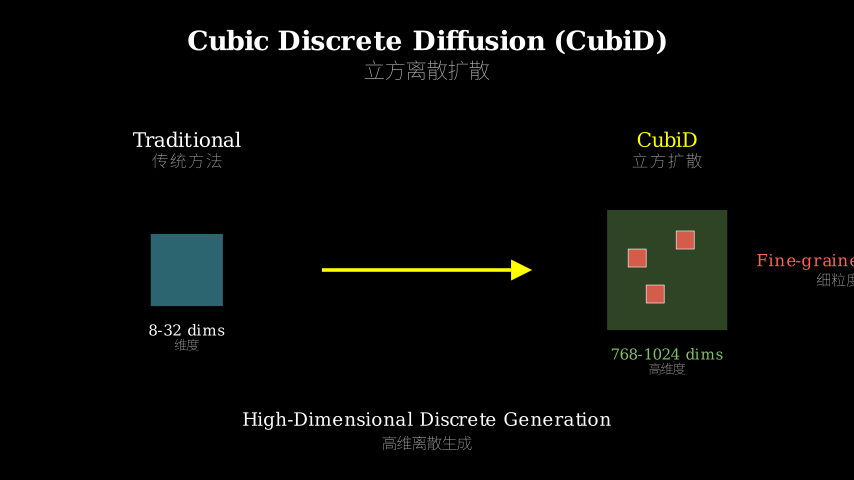
Visual generation with discrete tokens has become increasingly popular because it enables a unified token prediction paradigm shared with language models. This promises seamless multimodal architectures where the same model can handle both text and images. However, there’s a fundamental limitation: current discrete generation methods are stuck with low-dimensional latent tokens (typically 8-32 dimensions).
This low dimensionality sacrifices semantic richness. Meanwhile, high-dimensional pretrained representations (768-1024 dims) used in understanding tasks capture much richer information. The gap is clear: we need high-dimensional representations for understanding, but discrete generation has been limited to low dimensions.
Current State:
  Understanding tasks  -->  High-dim representations (768-1024d)
                            [Rich semantics, good for comprehension]

  Generation tasks     -->  Low-dim discrete tokens (8-32d)
                            [Limited semantics, easier to generate]

  Problem: Can't use same tokens for both tasks
           No unified multimodal architecture possible
The Increment
One sentence: Before CubiD, discrete visual generation was limited to low-dimensional tokens; after CubiD, we can generate directly in high-dimensional representation spaces while preserving their semantic richness.
Core Mechanism
CubiD introduces Cubic Discrete Diffusion, which performs fine-grained masking throughout high-dimensional discrete representations. Unlike previous methods that treat each spatial position as an atomic unit, CubiD can mask and predict any dimension at any position independently.
The key innovation is the masking strategy: given a representation of shape (h, w, d) where d is the high dimension (e.g., 768), CubiD randomly masks individual dimensions across all positions. During generation, the model predicts masked dimensions from partial observations, learning correlations both within positions (across dimensions) and across positions (spatial relationships).
Traditional Discrete Generation:
  Position 1: [d1, d2, ..., d32]  <-- mask entire position
  Position 2: [d1, d2, ..., d32]  <-- or keep entire position

CubiD Approach:
  Position 1: [d1, ?, d3, ?, ..., d768]  <-- fine-grained masking
  Position 2: [?, d2, ?, d4, ..., ?]     <-- any dim can be masked

  Predict: masked dims from observed dims
  Steps: T (fixed, regardless of d)
Think of it like a jigsaw puzzle where traditional methods can only add or remove entire pieces, while CubiD can work with fragments of pieces. This fine-grained control allows the model to learn much richer patterns because it sees many more partial configurations during training.
Key Concepts
-
High-dimensional discrete tokens: Instead of compressing visual information into 8-32 dimensions, CubiD works with 768-1024 dimensional representations. Each dimension captures different semantic aspects (edges, textures, objects, relationships). The discretization (quantization) makes these continuous representations into discrete tokens that can be predicted like language tokens.
-
Fine-grained masking: Traditional masked prediction masks entire spatial positions. CubiD masks individual dimensions within positions. If you have a 16×16 grid with 768-dim features, traditional methods have 256 mask decisions; CubiD has 256×768 = 196,608 mask decisions. This exponentially increases the model’s ability to learn correlations.
-
Fixed generation steps: Despite working with much higher dimensions, CubiD maintains a fixed number of generation steps T (e.g., 64 steps), where T ≪ h×w×d. This is possible because the model predicts multiple dimensions in parallel at each step, unlike autoregressive methods that would need h×w×d sequential steps.
Framework Shift
Before (low-dim discrete):          After (CubiD high-dim):

Encode: Image → 8-32d tokens        Encode: Image → 768d tokens
        [semantic loss]                     [semantic preservation]

Generate: Mask full positions       Generate: Mask any dimension
          Predict position-by-pos             Predict dim-by-dim
          Limited correlations                Rich correlations

Decode: Tokens → Image              Decode: Tokens → Image

Tasks: Generation only              Tasks: Generation + Understanding
       (separate tokens needed)            (same tokens for both)
One sentence: From coarse position-level masking in low dimensions to fine-grained dimension-level masking in high dimensions, enabling unified tokens for multimodal tasks.
Expert Assessment
Problem choice: This addresses a real architectural gap. The field has been moving toward unified multimodal models, but the token mismatch between understanding (high-dim) and generation (low-dim) has been a genuine blocker. The problem is well-motivated.
Method maturity: The approach is elegant—extending discrete diffusion to high dimensions through fine-grained masking is a natural evolution rather than a complex hack. The fixed-step generation is particularly clever, avoiding the quadratic scaling that would make this impractical.
Experimental integrity: Strong results on ImageNet-256 with clear scaling behavior from 900M to 3.7B parameters. The validation that discretized tokens preserve representation capabilities is crucial—without this, the whole premise falls apart. The baselines appear fair, comparing against both discrete and continuous methods.
Writing quality: The paper clearly articulates the dimensionality limitation and why it matters. The technical exposition could be clearer about the exact masking schedule and prediction mechanism. The related work section effectively positions this against prior discrete generation methods.
Verdict: strong accept — First method to enable discrete generation in high-dimensional representation spaces while maintaining semantic richness, with solid experimental validation and clear path toward unified multimodal architectures.
Takeaways
-
Unified token paradigm: If you’re building multimodal systems, CubiD shows you can use the same high-dimensional discrete tokens for both understanding and generation. This simplifies architecture design significantly.
-
Fine-grained masking: The technique of masking individual dimensions rather than entire positions is transferable to other domains. Anywhere you have high-dimensional structured data, this masking strategy could improve correlation learning.
-
Scaling validation: The clear scaling behavior from 900M to 3.7B parameters suggests this approach will benefit from larger models, making it a good foundation for future research.
-
Representation preservation: The validation that discretization doesn’t destroy representation quality is methodologically important. This testing approach (checking if discrete tokens maintain understanding capabilities) should be standard for any discrete generation method.
论文: 2603.19232 作者: Yuqing Wang, Chuofan Ma, Zhijie Lin, Yi Jiang, Xiaohan Ding, Hengshuang Zhao, Jiaya Jia 分类: cs.CV
缺口
使用离散token进行视觉生成越来越流行,因为它能实现与语言模型共享的统一token预测范式。这预示着无缝的多模态架构,同一模型可以同时处理文本和图像。然而存在一个根本性限制:当前的离散生成方法被困在低维潜在token中(通常是8-32维)。
这种低维度牺牲了语义丰富性。与此同时,理解任务中使用的高维预训练表征(768-1024维)能捕获更丰富的信息。差距很明显:我们需要高维表征来理解,但离散生成一直局限于低维度。
当前状态:
  理解任务  -->  高维表征 (768-1024维)
                [丰富语义,适合理解]

  生成任务  -->  低维离散token (8-32维)
                [有限语义,更易生成]

  问题:无法对两类任务使用相同token
        无法实现统一的多模态架构
增量
一句话:CubiD之前,离散视觉生成局限于低维token;CubiD之后,我们可以直接在高维表征空间中生成,同时保留其语义丰富性。
核心机制
CubiD引入了立方离散扩散(Cubic Discrete Diffusion),在高维离散表征中执行细粒度掩码。与之前将每个空间位置视为原子单元的方法不同,CubiD可以独立地掩码和预测任何位置的任何维度。
关键创新是掩码策略:给定形状为(h, w, d)的表征,其中d是高维度(如768),CubiD在所有位置随机掩码单个维度。在生成过程中,模型从部分观察预测被掩码的维度,学习位置内(跨维度)和跨位置(空间关系)的相关性。
传统离散生成:
  位置1:[d1, d2, ..., d32]  <-- 掩码整个位置
  位置2:[d1, d2, ..., d32]  <-- 或保留整个位置

CubiD方法:
  位置1:[d1, ?, d3, ?, ..., d768]  <-- 细粒度掩码
  位置2:[?, d2, ?, d4, ..., ?]     <-- 任何维度都可被掩码

  预测:从观察到的维度预测被掩码的维度
  步数:T(固定,与d无关)
可以把它想象成拼图游戏,传统方法只能添加或移除整块拼图,而CubiD可以处理拼图的碎片。这种细粒度控制让模型能学习更丰富的模式,因为它在训练期间看到了更多的部分配置。
关键概念
-
高维离散token:CubiD不是将视觉信息压缩到8-32维,而是使用768-1024维表征。每个维度捕获不同的语义方面(边缘、纹理、物体、关系)。离散化(量化)将这些连续表征转换为离散token,可以像语言token一样被预测。
-
细粒度掩码:传统的掩码预测掩盖整个空间位置。CubiD掩盖位置内的单个维度。如果你有一个16×16网格,每个位置有768维特征,传统方法有256个掩码决策;CubiD有256×768 = 196,608个掩码决策。这指数级地增加了模型学习相关性的能力。
-
固定生成步数:尽管处理更高的维度,CubiD保持固定的生成步数T(如64步),其中T ≪ h×w×d。这是可能的,因为模型在每一步并行预测多个维度,不像自回归方法需要h×w×d个顺序步骤。
框架转变
之前(低维离散):                之后(CubiD高维):

编码:图像 → 8-32维token          编码:图像 → 768维token
      [语义损失]                        [语义保留]

生成:掩码完整位置                  生成:掩码任意维度
      逐位置预测                          逐维度预测
      有限相关性                          丰富相关性

解码:token → 图像                 解码:token → 图像

任务:仅生成                        任务:生成 + 理解
      (需要单独的token)                  (两者使用相同token)
一句话:从低维度的粗粒度位置级掩码到高维度的细粒度维度级掩码,实现多模态任务的统一token。
专家评审
选题眼光:这解决了一个真实的架构缺口。该领域一直在向统一的多模态模型发展,但理解(高维)和生成(低维)之间的token不匹配一直是真正的障碍。问题动机充分。
方法成熟度:方法优雅——通过细粒度掩码将离散扩散扩展到高维是自然的演进,而非复杂的技巧。固定步数生成特别巧妙,避免了会使其不切实际的二次缩放。
实验诚意:在ImageNet-256上取得强劲结果,从900M到3.7B参数有清晰的缩放行为。验证离散化token保留表征能力至关重要——没有这个,整个前提就崩溃了。基线看起来公平,与离散和连续方法都进行了比较。
写作功力:论文清楚地阐述了维度限制及其重要性。技术阐述在确切的掩码调度和预测机制方面可以更清晰。相关工作部分有效地将其定位于先前的离散生成方法。
判决:强接收 — 首个在高维表征空间中实现离散生成同时保持语义丰富性的方法,具有可靠的实验验证和通向统一多模态架构的清晰路径。
要点总结
-
统一token范式:如果你在构建多模态系统,CubiD表明你可以对理解和生成使用相同的高维离散token。这大大简化了架构设计。
-
细粒度掩码:掩码单个维度而非整个位置的技术可迁移到其他领域。任何有高维结构化数据的地方,这种掩码策略都可以改善相关性学习。
-
缩放验证:从900M到3.7B参数的清晰缩放行为表明这种方法将受益于更大的模型,使其成为未来研究的良好基础。
-
表征保留:验证离散化不会破坏表征质量在方法论上很重要。这种测试方法(检查离散token是否保持理解能力)应该成为任何离散生成方法的标准。