
Paper: 2603.09970 Authors: Manya Wadhwa, Tiasa Singha Roy, Harvey Lederman, Junyi Jessy Li, Greg Durrett Categories: cs.CL
The Gap
Existing LLM benchmarks test knowledge retrieval, reasoning chains, and instruction following—but they miss a fundamental aspect of human intelligence: associative creativity. Prior work on creativity either focuses on divergent thinking tasks (generating many ideas) without measuring connection quality, or on constrained creative writing that’s hard to evaluate objectively. The Remote Associates Test (RAT) exists but only tests recognition of single connections, not generation of multiple diverse pathways. No benchmark systematically evaluates whether models can generate many distinct, meaningful connections between concepts—the core of hypothesis generation, scientific discovery, and creative problem-solving.
Problem: LLMs lack creativity benchmarks
   |
   v
Assumption: Creativity = associative reasoning
            (connecting distant concepts meaningfully)
   |
   v
Method: CREATE benchmark
        - Generate concept connection paths
        - Score: specificity + diversity + quantity
   |
   v
Evidence: Frontier models show variance
          Thinking models don't always win
   |
   v
Conclusion: Associative creativity is measurable
            and remains challenging for LLMs
The Increment
One sentence: Before this paper, we had no way to objectively measure whether LLMs can generate multiple creative connections between concepts; after it, we have a benchmark showing that even GPT-4 and Claude struggle to produce diverse, high-quality associative paths.
Core Mechanism
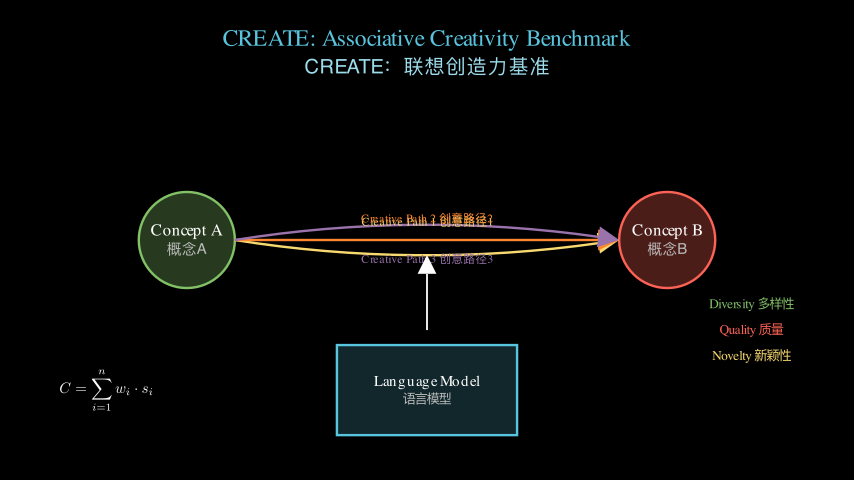
CREATE asks models to generate multiple “paths” connecting two concepts using their parametric knowledge. Each path is a sequence of intermediate concepts (e.g., “coffee → caffeine → alertness → productivity → work”). The benchmark scores paths on two dimensions: specificity (how distinctive and tight the connection is) and diversity (how different paths are from each other). Models receive higher scores for producing more paths that are both specific and diverse.
The evaluation uses a combination of automated metrics and human judgment. Specificity is measured by having annotators rate connection strength and distinctiveness. Diversity is computed using embedding-based similarity between paths—penalizing redundant connections. The final “creative utility” score combines these factors, rewarding models that explore different regions of the conceptual space rather than generating variations on the same theme.
Input: Concept A ----------> Concept B
         |                        ^
         v                        |
    Model generates paths:

    Path 1: A -> X1 -> Y1 -> B   (specific, novel)
    Path 2: A -> X2 -> Y2 -> B   (specific, diverse from Path 1)
    Path 3: A -> X1 -> Y3 -> B   (specific, but similar to Path 1)

         |
         v
    Scoring:
    - Specificity: How tight/distinctive each connection?
    - Diversity: How different are paths from each other?
    - Quantity: How many valid paths generated?
         |
         v
    Creative Utility = f(specificity, diversity, quantity)
Think of CREATE like asking a chef to create multiple recipes connecting two ingredients—say, chocolate and salmon. A creative chef doesn’t just make five variations of chocolate-salmon mousse (low diversity). Instead, they might propose: (1) chocolate mole sauce with grilled salmon, (2) salmon roe with dark chocolate ganache, (3) smoked salmon with cocoa-rubbed spices, (4) salmon tartare with cacao nibs, (5) chocolate-beet puree with poached salmon. Each path uses different intermediate “concepts” (mole spices, roe texture, smoking technique, raw preparation, earthy vegetables) to bridge the gap. The benchmark rewards chefs who explore different culinary territories (diversity) while maintaining coherent flavor logic (specificity), not those who generate many similar ideas.
Key Concepts
-
Associative Reasoning: The cognitive ability to find meaningful connections between seemingly unrelated concepts. Unlike logical reasoning (A→B→C where each step follows strict rules), associative reasoning operates in a vast, loosely-structured knowledge space where many paths exist but only some are insightful. Example: Connecting “ocean” to “democracy” through “waves → collective movement → voting patterns” is associative—it’s not logically necessary, but it reveals a meaningful parallel. The challenge for LLMs is that this requires both broad knowledge access and the ability to evaluate which connections are distinctive versus trivial.
-
Specificity vs. Diversity Trade-off: Specificity measures how tight and distinctive a single connection is (avoiding generic bridges like “both are things”). Diversity measures how different multiple connections are from each other (avoiding redundant exploration). The tension: models can easily generate many paths by making small variations (high quantity, low diversity) or generate one perfect path (high specificity, low quantity). Creative utility requires balancing both—like a scientist proposing multiple distinct hypotheses rather than variations of one idea. This is why the benchmark uses a multiplicative scoring function that penalizes either extreme.
-
Parametric Knowledge Paths: Unlike retrieval-augmented systems that can look up connections, CREATE tests whether models can generate paths using only their training-encoded knowledge. A path like “coffee → Ethiopia → highlands → altitude → thin air → breathing → meditation” requires the model to traverse its internal knowledge graph without external search. This is harder than it sounds because the model must: (1) recall relevant facts at each step, (2) evaluate which facts lead toward the target concept, (3) avoid getting stuck in local loops, and (4) track which conceptual territories it has already explored to maintain diversity.
Framework Shift
Before (mainstream approach):        After (this paper):

Creativity = Open-ended generation   Creativity = Structured exploration

User: "Write something creative"    User: "Connect A to B (many ways)"
  |                                    |
  v                                    v
Model: [generates text]              Model: [generates paths]
  |                                    |
  v                                    v
Eval: Subjective human rating        Eval: Specificity + Diversity metrics
      (hard to scale)                      (objective, scalable)

Focus: Output quality                Focus: Search space coverage
       (single artifact)                    (multiple distinct solutions)
One sentence: From evaluating creative outputs subjectively to measuring creative search objectively, the core shift is treating creativity as navigating a knowledge space rather than generating novel text.
Expert Assessment
Problem choice: This is a real gap. Creativity benchmarks have been notoriously difficult because they conflate generation quality with creative thinking. By focusing specifically on associative reasoning—a well-defined cognitive process—the authors sidestep the “what is creativity?” debate while capturing something genuinely important. The task sits at an interesting intersection: simple enough to evaluate objectively, complex enough to challenge frontier models. Smart positioning.
Method maturity: The approach is elegant but not groundbreaking—it’s essentially structured divergent thinking with automated diversity metrics. The specificity scoring still requires human annotation (a bottleneck), and the diversity metric using embeddings is reasonable but crude (semantically different paths might have similar embeddings). The multiplicative scoring function feels somewhat arbitrary—why not other aggregation methods? That said, the simplicity is a feature: the benchmark is immediately usable and interpretable.
Experimental integrity: The baselines are fair and comprehensive (GPT-4, Claude, Gemini, plus thinking models like o1). The finding that thinking models don’t consistently outperform is interesting and well-documented. However, I’m skeptical about one thing: the paper doesn’t deeply explore whether models are actually doing associative reasoning or just pattern-matching common conceptual bridges from training data. A stronger analysis would test on concept pairs unlikely to co-occur in training corpora. The human evaluation is solid but limited in scale (understandable given cost).
Writing quality: The paper is clear and well-structured, but the related work section is thin—it doesn’t engage deeply with cognitive science literature on creativity or with prior work on knowledge graph reasoning. The results section could be tightened; there’s repetition between main results and ablations. If I were revising, I’d expand the analysis of failure modes: show us examples where models get stuck, where they generate trivial paths, where diversity collapses. The paper tells us models struggle but doesn’t give enough insight into why.
Verdict: weak accept — Solid contribution with a useful benchmark, but the evaluation methodology has room for improvement and the insights into model behavior are somewhat surface-level.
Takeaways
For benchmark designers: The “specificity + diversity + quantity” framework is generalizable. You can apply this to any task requiring multiple distinct solutions—code generation (multiple implementations), experimental design (multiple hypotheses), problem decomposition (multiple approaches). The key insight: don’t just count outputs, measure coverage of the solution space.
For prompt engineers: The paper shows that standard creative prompting techniques (temperature sampling, “think creatively” instructions) give marginal improvements. This suggests that associative creativity might require architectural changes, not just better prompts. If you need diverse outputs, explicitly track and penalize similarity to previous generations in your sampling strategy.
For model developers: The finding that thinking models don’t dominate is revealing. It suggests that chain-of-thought reasoning helps with logical tasks but doesn’t automatically improve exploration of conceptual spaces. This points to a specific capability gap: models need better mechanisms for maintaining diversity during generation, perhaps through explicit memory of explored regions or diversity-aware beam search.
Steal this: The evaluation framework itself. If you’re building any system that generates multiple solutions, adopt the specificity-diversity-quantity triad. It’s simple, interpretable, and captures what matters: not just generating many things, but generating many different good things.
论文: 2603.09970 作者: Manya Wadhwa, Tiasa Singha Roy, Harvey Lederman, Junyi Jessy Li, Greg Durrett 分类: cs.CL
缺口
现有的大语言模型基准测试知识检索、推理链条和指令遵循能力——但它们遗漏了人类智能的一个基本方面:联想创造力。
此前关于创造力的研究要么关注发散思维任务(生成许多想法)而不衡量连接质量,要么关注难以客观评估的受限创意写作。
远程联想测试(RAT)虽然存在,但只测试对单一连接的识别,而非生成多条不同路径的能力。
没有基准系统性地评估模型能否生成许多不同的、有意义的概念连接——这正是假设生成、科学发现和创造性问题解决的核心。
问题:大语言模型缺乏创造力基准
   |
   v
假设:创造力 = 联想推理
      (有意义地连接遥远概念)
   |
   v
方法:CREATE 基准
      - 生成概念连接路径
      - 评分:特异性 + 多样性 + 数量
   |
   v
证据:前沿模型表现差异大
      思考型模型并非总是获胜
   |
   v
结论:联想创造力可测量
      且对大语言模型仍具挑战性
增量
一句话: 这篇论文之前,我们无法客观衡量大语言模型能否生成多条创造性概念连接;
之后,我们有了一个基准,显示即使 GPT-4 和 Claude 也难以产生多样化、高质量的联想路径。
核心机制
CREATE 要求模型使用其参数化知识生成连接两个概念的多条”路径”。
每条路径是一系列中间概念(例如,“咖啡 → 咖啡因 → 警觉性 → 生产力 → 工作”)。
基准在两个维度上对路径评分:特异性(连接的独特性和紧密度)和多样性(路径之间的差异程度)。
模型生成更多既特异又多样的路径时获得更高分数。
评估结合了自动化指标和人工判断。
特异性通过标注者评估连接强度和独特性来衡量。
多样性使用基于嵌入的路径间相似度计算——惩罚冗余连接。
最终的”创造性效用”分数结合这些因素,奖励那些探索概念空间不同区域而非生成同一主题变体的模型。
输入:概念 A ----------> 概念 B
       |                    ^
       v                    |
  模型生成路径:

  路径1:A -> X1 -> Y1 -> B   (特异,新颖)
  路径2:A -> X2 -> Y2 -> B   (特异,与路径1多样)
  路径3:A -> X1 -> Y3 -> B   (特异,但与路径1相似)

       |
       v
  评分:
  - 特异性:每个连接多紧密/独特?
  - 多样性:路径之间多不同?
  - 数量:生成了多少有效路径?
       |
       v
  创造性效用 = f(特异性, 多样性, 数量)
把 CREATE 想象成要求厨师创造多个连接两种食材的菜谱——比如巧克力和三文鱼。
有创造力的厨师不会只做五种巧克力三文鱼慕斯的变体(低多样性)。
相反,他们可能提出:(1)巧克力摩尔酱配烤三文鱼,(2)三文鱼子配黑巧克力甘纳许,(3)烟熏三文鱼配可可粉香料,(4)三文鱼鞑靼配可可碎粒,(5)巧克力甜菜泥配水煮三文鱼。
每条路径使用不同的中间”概念”(摩尔香料、鱼子质地、烟熏技术、生食处理、土味蔬菜)来架起桥梁。
基准奖励那些探索不同烹饪领域(多样性)同时保持连贯风味逻辑(特异性)的厨师,而非生成许多相似想法的厨师。
关键概念
- 联想推理:在看似无关的概念之间找到有意义连接的认知能力。
不同于逻辑推理(A→B→C,每步遵循严格规则),联想推理在一个庞大、松散结构的知识空间中运作,其中存在许多路径但只有部分具有洞察力。
例如:通过”海浪 → 集体运动 → 投票模式”将”海洋”连接到”民主”是联想性的——这不是逻辑必然,但揭示了一个有意义的平行关系。
对大语言模型的挑战在于,这既需要广泛的知识访问能力,也需要评估哪些连接是独特的而非平凡的能力。
- 特异性与多样性的权衡:特异性衡量单个连接的紧密度和独特性(避免”两者都是事物”这样的泛泛桥梁)。
多样性衡量多个连接之间的差异程度(避免冗余探索)。
张力在于:模型可以通过小变化轻松生成许多路径(高数量,低多样性),或生成一条完美路径(高特异性,低数量)。
创造性效用需要平衡两者——就像科学家提出多个不同假设而非一个想法的变体。
这就是为什么基准使用乘法评分函数来惩罚任一极端。
- 参数化知识路径:不同于可以查找连接的检索增强系统,CREATE 测试模型能否仅使用训练编码的知识生成路径。
像”咖啡 → 埃塞俄比亚 → 高地 → 海拔 → 稀薄空气 → 呼吸 → 冥想”这样的路径要求模型在没有外部搜索的情况下遍历其内部知识图谱。
这比听起来更难,因为模型必须:(1)在每一步回忆相关事实,(2)评估哪些事实通向目标概念,(3)避免陷入局部循环,(4)跟踪已探索的概念领域以保持多样性。
框架转变
之前(主流方法):                之后(本文方法):

创造力 = 开放式生成              创造力 = 结构化探索

用户:"写点有创意的东西"        用户:"连接 A 到 B(多种方式)"
  |                                  |
  v                                  v
模型:[生成文本]                   模型:[生成路径]
  |                                  |
  v                                  v
评估:主观人工评分                 评估:特异性 + 多样性指标
      (难以扩展)                       (客观,可扩展)

焦点:输出质量                     焦点:搜索空间覆盖
      (单一产物)                       (多个不同解决方案)
一句话:从主观评估创造性输出到客观测量创造性搜索,核心转变是将创造力视为导航知识空间而非生成新颖文本。
专家评审
选题眼光:这是真实的缺口。
创造力基准一直很难设计,因为它们混淆了生成质量和创造性思维。
通过专注于联想推理——一个定义明确的认知过程——作者绕过了”什么是创造力?“的争论,同时捕捉到真正重要的东西。
任务处于有趣的交叉点:足够简单可以客观评估,足够复杂可以挑战前沿模型。
定位聪明。
方法成熟度:方法优雅但并非开创性——本质上是带自动化多样性指标的结构化发散思维。
特异性评分仍需人工标注(瓶颈),使用嵌入的多样性指标合理但粗糙(语义不同的路径可能有相似嵌入)。
乘法评分函数感觉有些武断——为什么不用其他聚合方法?
话虽如此,简单性是一个特点:基准立即可用且可解释。
实验诚意:基线公平且全面(GPT-4、Claude、Gemini,加上 o1 等思考型模型)。
思考型模型并非始终优于其他模型的发现很有趣且有充分记录。
然而,我对一点持怀疑态度:论文没有深入探讨模型是否真的在进行联想推理,还是只是从训练数据中模式匹配常见概念桥梁。
更强的分析会测试训练语料中不太可能共现的概念对。
人工评估扎实但规模有限(考虑到成本可以理解)。
写作功力:论文清晰且结构良好,但相关工作部分单薄——没有深入探讨创造力认知科学文献或知识图谱推理的先前工作。
结果部分可以精简;
主要结果和消融实验之间有重复。
如果我修订,我会扩展失败模式分析:展示模型卡住的例子、生成平凡路径的例子、多样性崩溃的例子。
论文告诉我们模型表现吃力,但没有充分洞察原因。
判决:弱接收 — 扎实的贡献和有用的基准,但评估方法有改进空间,对模型行为的洞察有些表面。
要点总结
对基准设计者:“特异性 + 多样性 + 数量”框架可推广。
你可以将其应用于任何需要多个不同解决方案的任务——代码生成(多种实现)、实验设计(多个假设)、问题分解(多种方法)。
关键洞察:不要只计数输出,要测量解决方案空间的覆盖度。
对提示工程师:论文显示标准创意提示技术(温度采样、“创造性思考”指令)带来边际改进。
这表明联想创造力可能需要架构变化,而非更好的提示。
如果你需要多样化输出,在采样策略中明确跟踪并惩罚与先前生成的相似性。
对模型开发者:思考型模型并非占主导地位的发现很有启发性。
这表明思维链推理有助于逻辑任务,但不会自动改善概念空间的探索。
这指向一个特定能力缺口:模型需要更好的机制在生成过程中保持多样性,也许通过明确记忆已探索区域或多样性感知束搜索。
偷走这个:评估框架本身。
如果你正在构建任何生成多个解决方案的系统,采用特异性-多样性-数量三元组。
它简单、可解释,并捕捉重要之处:不只是生成许多东西,而是生成许多不同的好东西。