Paper: 2604.14121 Authors: Zipeng Ling, Shuliang Liu, Shenghong Fu, Yuehao Tang, Seonil Son, Yao Wan, Xuming Hu Categories: cs.CL
The Gap
Chain-of-Thought (CoT) prompting made LLMs show their work, but the reasoning traces are messy. Prior work focused on either filtering bad traces or using ground-truth labels to guide generation. The filtering approach (self-consistency, majority voting) only picks from existing flawed candidates. The label-guidance approach seems intuitive but—counterintuitively—the authors show it doesn’t improve reasoning quality at all.
The real problem: reasoning traces contain two types of flaws. Step Internal Flaws (hallucinations, logical errors within a step) and Step-wise Flaws (overthinking with redundant steps, underthinking with missing steps). These flaws vary by sample, so one-size-fits-all filtering fails. No prior method addresses both flaw types simultaneously while synthesizing new, higher-quality traces.
Problem: LLM reasoning traces have internal + structural flaws
    |
    v
Assumption: Consensus across multiple traces = reliable knowledge
    |
    v
Method: Build knowledge graph from consensus, generate via topology
    |
    v
Evidence: +10% accuracy, better trace quality across dimensions
    |
    v
Conclusion: Graph-based synthesis > filtering or label-guidance
The Increment
One sentence: Before CRAFT, we chose the least-bad reasoning trace from a flawed set; after CRAFT, we synthesize a new trace from the consensus knowledge across multiple candidates.
Core Mechanism
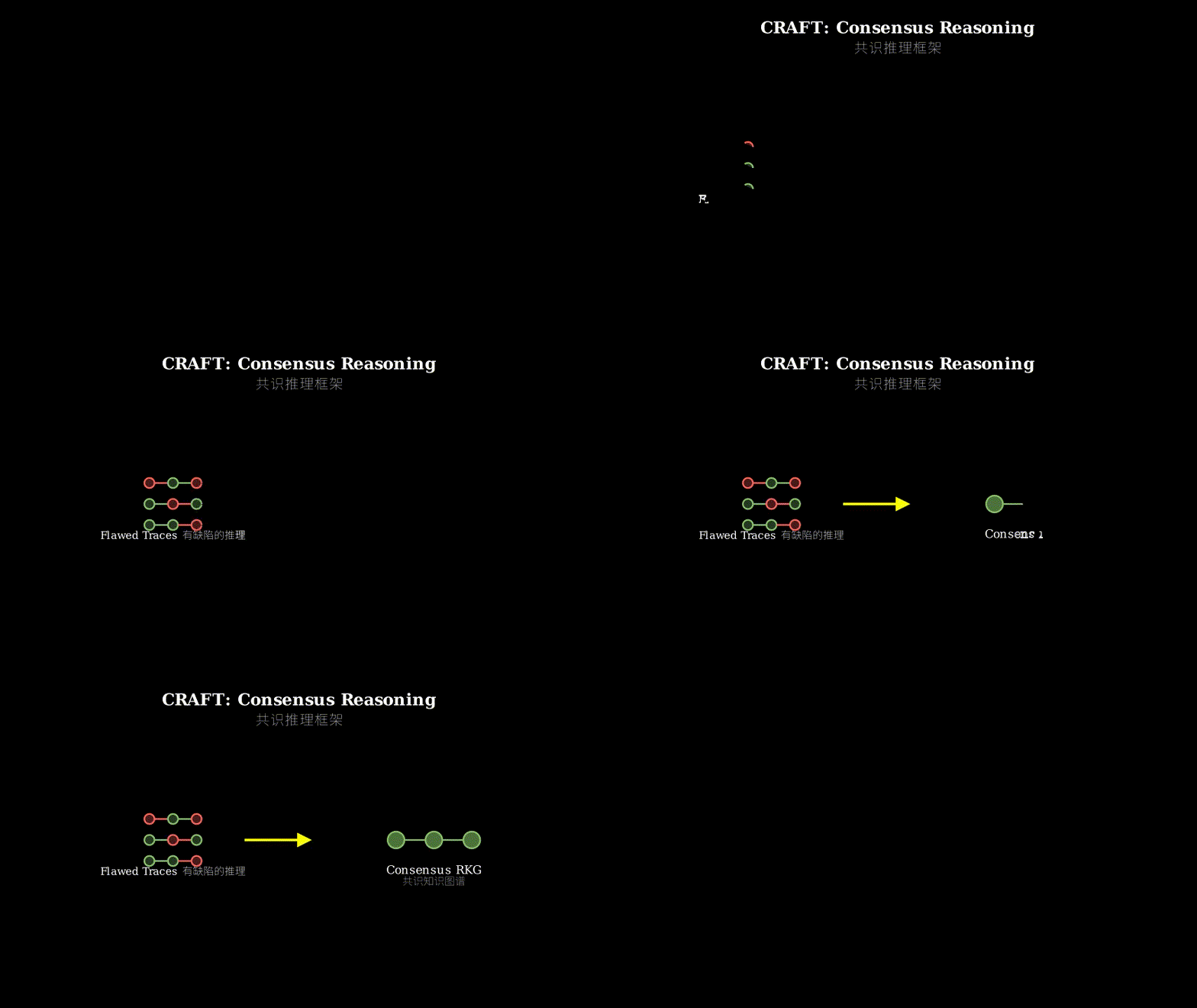
CRAFT operates in three stages. First, generate multiple candidate reasoning traces for a question using standard CoT prompting. Second, extract consensus knowledge: parse each trace into reasoning steps, identify which steps appear consistently across candidates (consensus steps), and organize them into a Reasoning Knowledge Graph (RKG) where nodes are steps and edges represent logical dependencies. Third, synthesize a new trace by traversing the RKG topologically—start from the question node, follow edges to consensus steps in logical order, and generate the final answer.
The RKG acts as a filter and scaffold simultaneously. It filters out sample-specific flaws (steps that appear in only one or two traces are likely hallucinations or overthinking). It scaffolds generation by providing a dependency structure—the model knows which steps must come before others, preventing underthinking (skipped steps) and overthinking (redundant loops).
Input Question
    |
    v
[Generate N candidate traces via CoT]
    |
    +---> Trace 1: Step A -> Step B -> Step C -> Answer
    +---> Trace 2: Step A -> Step D -> Step C -> Answer
    +---> Trace 3: Step A -> Step B -> Step E -> Answer
    |
    v
[Extract Consensus Steps]
    |
    v
Reasoning Knowledge Graph (RKG):
    Question
       |
       v
    Step A (appears in all 3)
      / \
     v   v
  Step B  Step D (both appear 2x)
     |     |
     v     v
    Step C (appears 2x)
       |
       v
    Answer
    |
    v
[Topological Generation: traverse graph to synthesize trace]
    |
    v
Final Trace: Question -> Step A -> Step B -> Step C -> Answer
Think of CRAFT like Wikipedia’s edit history for a single article. Multiple editors (candidate traces) write different versions of the same story (reasoning chain). Some add unnecessary tangents (overthinking), some skip crucial context (underthinking), some make factual errors (internal flaws). CRAFT is the consensus engine: it identifies which sentences appear across multiple versions (consensus steps = reliable knowledge), maps how those sentences logically connect (RKG = article structure), then generates a clean final version by following that structure (topological generation = synthesized trace). The final article isn’t just the most popular version—it’s a new synthesis built from the stable, agreed-upon parts.
Key Concepts
-
Consensus Steps: A reasoning step that appears in multiple candidate traces, indicating it’s likely correct and necessary. Not about exact string matching—CRAFT uses semantic similarity to identify when different phrasings express the same logical step. Example: “Calculate the area of the rectangle” and “Find the product of length and width” are the same consensus step. This filters out hallucinations (appear in only one trace) and overthinking (redundant steps unique to one candidate).
-
Reasoning Knowledge Graph (RKG): A directed graph where nodes are consensus steps and edges represent logical dependencies between steps. Built by analyzing which steps consistently follow others across traces. Unlike a simple chain, the graph can have branches (multiple valid next steps) and merges (multiple paths leading to the same step). This structure prevents underthinking—you can’t skip a step if the graph shows it’s a prerequisite for later steps.
-
Topological Generation: Traversing the RKG in dependency order to synthesize a new trace. Start at the question node, follow edges to steps whose prerequisites are satisfied, generate text for each step in order. This isn’t template filling—the LLM generates natural language at each node, but the graph constrains the logical flow. Like following a recipe where you can’t add eggs before cracking them, but you can choose how to describe each action.
Framework Shift
Before (filtering/voting):          After (CRAFT):

Question                            Question
   |                                   |
   v                                   v
Generate N traces              Generate N traces
   |                                   |
   +-> Trace 1 (flawed)               v
   +-> Trace 2 (flawed)          Extract consensus
   +-> Trace 3 (flawed)               |
   |                                   v
   v                            Build RKG (graph)
Pick best trace                       |
(still flawed)                        v
                               Synthesize new trace
                               (cleaner, structured)
From selecting the least-bad option to constructing a better option from shared knowledge, the core shift is from voting to synthesis.
Expert Assessment
Problem choice: Real gap. The “correct answer, wrong reasoning” phenomenon is well-documented but under-addressed. Most work optimizes for final accuracy, ignoring trace quality. This matters for interpretability, debugging, and downstream tasks that consume reasoning traces. The counterintuitive finding that ground-truth labels don’t help is valuable—it suggests the problem isn’t lack of supervision but lack of structure.
Method maturity: Clever insight with reasonable execution. The consensus extraction is straightforward (semantic similarity + frequency threshold), and topological generation is standard graph traversal. The innovation is in the combination—using graph structure to guide generation. One concern: the method assumes consensus = correctness, which breaks down when all candidates share the same systematic error. The paper doesn’t deeply explore this failure mode.
Experimental integrity: Baselines are fair (self-consistency, majority voting, label-guided generation). Results are consistent across logical (PrOntoQA, ProofWriter) and mathematical (GSM8K, MATH) benchmarks. The +10% average improvement is substantial. However, the trace quality evaluation relies on GPT-4 as a judge, which introduces bias—GPT-4 might prefer traces that match its own reasoning style. Human evaluation on a subset would strengthen claims.
Writing quality: The abstract and introduction are crisp. The method section is clear but could use more failure case analysis. The related work section is thorough but reads like a literature dump—cutting 30% would improve flow. The biggest missed opportunity: no ablation on the consensus threshold (how many traces must agree for a step to be “consensus”?). This is a critical hyperparameter left unexplored.
Verdict: weak accept — Solid contribution with practical impact, but method assumptions need more scrutiny and evaluation could be more rigorous.
Takeaways
Consensus as a denoising signal: When you have multiple imperfect solutions to the same problem, the parts they agree on are usually correct. This applies beyond reasoning traces—code generation (multiple implementations of the same function), data cleaning (multiple annotators), even design (multiple mockups). Build a graph of shared components, synthesize from that.
Graph topology as a generation constraint: Instead of generating text autoregressively with only local context, use a graph to enforce global structure. Each node is a generation target, edges are dependencies. This prevents the model from wandering off-topic or skipping necessary steps. Applicable to long-form writing, procedural instructions, proof generation.
The label-guidance null result: Providing ground-truth labels during reasoning doesn’t help. This suggests the bottleneck isn’t knowing the right answer but maintaining coherent step-by-step logic. Implications for training: focus on process supervision (rewarding correct intermediate steps) rather than outcome supervision (rewarding correct final answers).
论文: 2604.14121 作者: Zipeng Ling, Shuliang Liu, Shenghong Fu, Yuehao Tang, Seonil Son, Yao Wan, Xuming Hu 分类: cs.CL
缺口
思维链(CoT)提示让大模型展示推理过程,但生成的推理轨迹很混乱。
此前的工作要么过滤坏轨迹,要么用真实标签引导生成。
过滤方法(自洽性、多数投票)只能从现有的有缺陷候选中挑选。
标签引导方法看似直观,但作者反直觉地证明它完全不能改善推理质量。
真正的问题:推理轨迹包含两类缺陷。
步骤内部缺陷(幻觉、单步内的逻辑错误)和步骤间缺陷(过度思考产生冗余步骤、思考不足遗漏步骤)。
这些缺陷因样本而异,所以一刀切的过滤方法失效。
没有先前方法能同时解决两类缺陷,并合成新的高质量轨迹。
问题:大模型推理轨迹有内部缺陷 + 结构缺陷
    |
    v
假设:多条轨迹的共识部分 = 可靠知识
    |
    v
方法:从共识构建知识图谱,通过拓扑生成
    |
    v
证据:准确率 +10%,轨迹质量多维度提升
    |
    v
结论:基于图的合成 > 过滤或标签引导
增量
一句话: CRAFT 之前,我们从有缺陷的集合中选最不坏的推理轨迹;
CRAFT 之后,我们从多个候选的共识知识中合成新轨迹。
核心机制
CRAFT 分三个阶段运作。
第一,用标准 CoT 提示为问题生成多条候选推理轨迹。
第二,提取共识知识:把每条轨迹解析成推理步骤,识别哪些步骤在候选中一致出现(共识步骤),将它们组织成推理知识图谱(RKG),节点是步骤,边表示逻辑依赖。
第三,通过拓扑遍历 RKG 合成新轨迹——从问题节点开始,按逻辑顺序沿边访问共识步骤,生成最终答案。
RKG 同时充当过滤器和脚手架。
它过滤掉样本特定的缺陷(只在一两条轨迹中出现的步骤很可能是幻觉或过度思考)。
它通过提供依赖结构来搭建脚手架——模型知道哪些步骤必须先行,防止思考不足(跳过步骤)和过度思考(冗余循环)。
输入问题
    |
    v
[通过 CoT 生成 N 条候选轨迹]
    |
    +---> 轨迹1: 步骤A -> 步骤B -> 步骤C -> 答案
    +---> 轨迹2: 步骤A -> 步骤D -> 步骤C -> 答案
    +---> 轨迹3: 步骤A -> 步骤B -> 步骤E -> 答案
    |
    v
[提取共识步骤]
    |
    v
推理知识图谱 (RKG):
    问题
       |
       v
    步骤A (3条都有)
      / \
     v   v
  步骤B  步骤D (都出现2次)
     |     |
     v     v
    步骤C (出现2次)
       |
       v
    答案
    |
    v
[拓扑生成:遍历图谱合成轨迹]
    |
    v
最终轨迹: 问题 -> 步骤A -> 步骤B -> 步骤C -> 答案
把 CRAFT 想象成维基百科单篇文章的编辑历史。
多个编辑(候选轨迹)为同一个故事(推理链)写不同版本。
有的加了不必要的离题内容(过度思考),有的跳过关键上下文(思考不足),有的犯事实错误(内部缺陷)。
CRAFT 是共识引擎:它识别哪些句子在多个版本中出现(共识步骤 = 可靠知识),映射这些句子如何逻辑连接(RKG = 文章结构),然后按照这个结构生成干净的最终版本(拓扑生成 = 合成轨迹)。
最终文章不是最流行的版本——而是从稳定的、达成共识的部分构建的新合成品。
关键概念
- 共识步骤: 在多条候选轨迹中出现的推理步骤,表明它很可能正确且必要。
不是精确字符串匹配——CRAFT 用语义相似度识别不同措辞表达同一逻辑步骤的情况。
例如:“计算矩形面积”和”求长乘宽的积”是同一个共识步骤。
这过滤掉幻觉(只在一条轨迹中出现)和过度思考(某个候选独有的冗余步骤)。
- 推理知识图谱(RKG): 有向图,节点是共识步骤,边表示步骤间的逻辑依赖。
通过分析哪些步骤在轨迹中一致地跟随其他步骤来构建。
不同于简单链条,图可以有分支(多个有效的下一步)和合并(多条路径通向同一步骤)。
这个结构防止思考不足——如果图显示某步骤是后续步骤的前提,你就不能跳过它。
- 拓扑生成: 按依赖顺序遍历 RKG 来合成新轨迹。
从问题节点开始,沿边访问前提条件已满足的步骤,按顺序为每个步骤生成文本。
这不是模板填充——大模型在每个节点生成自然语言,但图约束了逻辑流程。
就像遵循食谱,你不能在打鸡蛋之前就加鸡蛋,但可以选择如何描述每个动作。
框架转变
之前(过滤/投票):              之后(CRAFT):

问题                            问题
   |                               |
   v                               v
生成 N 条轨迹                  生成 N 条轨迹
   |                               |
   +-> 轨迹1 (有缺陷)              v
   +-> 轨迹2 (有缺陷)         提取共识
   +-> 轨迹3 (有缺陷)              |
   |                               v
   v                          构建 RKG (图)
选最好的轨迹                       |
(仍有缺陷)                         v
                              合成新轨迹
                           (更干净、有结构)
从选择最不坏的选项到从共享知识构建更好的选项,核心转变是从投票到合成。
专家评审
选题眼光: 真实缺口。
“答案对了,推理错了”现象有充分记录但解决不足。
大多数工作优化最终准确率,忽略轨迹质量。
这对可解释性、调试和消费推理轨迹的下游任务很重要。
真实标签不起作用这个反直觉发现很有价值——说明问题不是缺乏监督,而是缺乏结构。
方法成熟度: 巧妙洞察,执行合理。
共识提取很直接(语义相似度 + 频率阈值),拓扑生成是标准图遍历。
创新在于组合——用图结构引导生成。
一个担忧:方法假设共识 = 正确,当所有候选共享同一系统性错误时就失效了。
论文没有深入探讨这种失败模式。
实验诚意: 基线公平(自洽性、多数投票、标签引导生成)。
结果在逻辑(PrOntoQA、ProofWriter)和数学(GSM8K、MATH)基准上一致。
平均 +10% 的提升很可观。
但轨迹质量评估依赖 GPT-4 作为评判者,引入偏差——GPT-4 可能偏好匹配自己推理风格的轨迹。
在子集上做人工评估会加强论证。
写作功力: 摘要和引言简洁。
方法部分清晰但可以多分析失败案例。
相关工作部分详尽但读起来像文献堆砌——删掉 30% 会改善流畅度。
最大的错失机会:没有对共识阈值做消融实验(多少条轨迹必须同意才算”共识”?)。
这是个关键超参数却没探索。
判决: 弱接收 — 扎实贡献,有实际影响,但方法假设需要更多审视,评估可以更严格。
要点总结
共识作为去噪信号: 当你有多个不完美的解决方案时,它们一致的部分通常是正确的。
这超越推理轨迹——代码生成(同一函数的多个实现)、数据清洗(多个标注者)、甚至设计(多个原型)。
构建共享组件的图,从中合成。
图拓扑作为生成约束: 不要只用局部上下文自回归生成文本,用图来强制全局结构。
每个节点是生成目标,边是依赖关系。
这防止模型跑题或跳过必要步骤。
适用于长文写作、程序指令、证明生成。
标签引导的零结果: 在推理过程中提供真实标签没有帮助。
这说明瓶颈不是知道正确答案,而是维持连贯的逐步逻辑。
对训练的启示:专注于过程监督(奖励正确的中间步骤)而非结果监督(奖励正确的最终答案)。