Paper: 2602.24210 Authors: Haritz Puerto, Haonan Li, Xudong Han, Timothy Baldwin, Iryna Gurevych Categories: cs.CL, cs.AI
Abstract
This paper addresses a critical privacy concern in AI reasoning models: the unintended leakage of sensitive information through reasoning traces. The authors propose a novel training approach that teaches models to follow instructions not only in their final outputs but also throughout their reasoning processes. By fine-tuning models on a specially designed instruction-following dataset with explicit reasoning constraints and introducing a decoupled generation strategy using separate LoRA adapters, they achieve substantial improvements across privacy and instruction-following benchmarks. Testing on six models ranging from 1.7B to 14B parameters, the method demonstrates gains of up to 20.9 points in instruction-following and 51.9 percentage points in privacy preservation, though with some trade-offs in task utility.
Key Contributions
- Introduction of a training paradigm that extends instruction-following capabilities to reasoning traces, not just final answers
- Creation of a new instruction-following dataset with explicit constraints on reasoning behavior
- Development of a decoupled generation strategy using separate LoRA adapters for reasoning and answer generation
- Comprehensive evaluation across six models from two families (1.7B-14B parameters) on both instruction-following and privacy benchmarks
- Demonstration of significant privacy improvements (up to 51.9 percentage points) while maintaining reasonable task performance
Methodology and Technical Approach
The core innovation lies in treating reasoning traces as controllable outputs subject to instruction constraints. Traditional reasoning models generate chain-of-thought explanations that may inadvertently expose private information, even when the final answer is sanitized. The authors address this by:
Instruction-Following Dataset: They construct a dataset where reasoning traces must adhere to specific constraints (e.g., “do not mention personal names in your reasoning”). This creates training examples where models learn to self-censor during the thinking process itself.
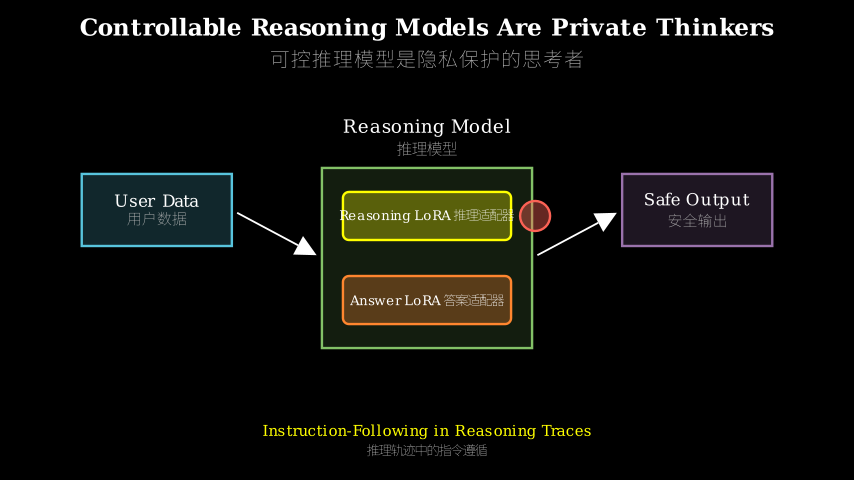
Decoupled Generation Architecture: The method employs separate LoRA adapters for two distinct phases:
- A reasoning adapter that generates privacy-aware intermediate thoughts
- An answer adapter that produces the final response
This architectural separation allows the model to maintain different behavioral patterns for internal reasoning versus external communication, similar to how humans might think through sensitive information privately before formulating a public response.
Training Objective: The fine-tuning process optimizes for both instruction adherence in reasoning traces and answer quality, creating a multi-objective learning problem that balances privacy preservation with task utility.
Experimental Results and Analysis
The evaluation spans two model families with varying scales, tested on instruction-following benchmarks (IFEval, FollowBench) and privacy benchmarks (PrivQA, Confaide). Key findings include:
Privacy Gains: Models show dramatic improvements in privacy preservation, with the best results achieving 51.9 percentage point increases. This suggests that explicit training on reasoning-level constraints can effectively prevent information leakage that occurs during the thinking process.
Instruction-Following: Improvements of up to 20.9 points demonstrate that the approach successfully teaches models to respect constraints throughout their generation process, not just in final outputs.
Performance Trade-offs: The authors honestly report that enhanced privacy control can reduce task utility. This reflects a fundamental tension: overly restrictive reasoning may limit the model’s ability to fully process information needed for optimal task performance. The trade-off varies by model size and task complexity.
Scaling Behavior: Results across the 1.7B to 14B parameter range reveal how model capacity affects the ability to simultaneously maintain privacy constraints and task performance, with larger models generally handling the dual objectives more effectively.
Implications for Privacy-Aware AI Systems
This work opens important directions for developing AI agents that can be trusted with sensitive data. The key insight—that reasoning traces are controllable through instruction-following training—challenges the assumption that model internals are inherently opaque and unmanageable.
For AI Safety: The decoupled architecture provides a mechanism for implementing differential privacy policies at different stages of generation, potentially enabling fine-grained control over information flow.
For Practical Deployment: Organizations deploying reasoning models in privacy-sensitive contexts (healthcare, finance, legal) can leverage these techniques to reduce liability while maintaining functionality.
Research Directions: The observed trade-offs between privacy and utility suggest fertile ground for future work on optimization strategies that better balance these competing objectives, perhaps through multi-task learning or adaptive constraint mechanisms.
The availability of code and data at the provided GitHub repository enables reproducibility and further exploration of controllable reasoning for privacy preservation.
Takeaways
- Reasoning traces in language models can be trained to follow explicit privacy constraints, not just final answers
- Decoupling reasoning and answer generation through separate LoRA adapters enables better control over information flow
- Significant privacy improvements (up to 51.9 percentage points) are achievable through instruction-following training on reasoning traces
- There exists a trade-off between privacy preservation and task utility that varies with model size and task complexity
- Improving instruction-following capabilities in reasoning processes represents a promising direction for building privacy-aware AI agents
- The approach generalizes across multiple model families and scales (1.7B-14B parameters)
- Future privacy-preserving AI systems should consider controllability at all stages of generation, not just final outputs
论文: 2602.24210 作者: Haritz Puerto, Haonan Li, Xudong Han, Timothy Baldwin, Iryna Gurevych 分类: cs.CL, cs.AI
摘要
本文针对AI推理模型中的一个关键隐私问题:通过推理轨迹无意泄露敏感信息。作者提出了一种新颖的训练方法,教导模型不仅在最终输出中遵循指令,而且在整个推理过程中都遵循指令。通过在专门设计的带有明确推理约束的指令遵循数据集上微调模型,并引入使用独立LoRA适配器的解耦生成策略,他们在隐私和指令遵循基准测试中取得了显著改进。在1.7B到14B参数的六个模型上测试,该方法在指令遵循方面实现了高达20.9分的提升,在隐私保护方面提升了51.9个百分点,尽管在任务效用方面存在一些权衡。
主要贡献
- 提出了一种训练范式,将指令遵循能力扩展到推理轨迹,而不仅仅是最终答案
- 创建了一个新的指令遵循数据集,对推理行为有明确约束
- 开发了使用独立LoRA适配器进行推理和答案生成的解耦生成策略
- 在两个模型家族的六个模型(1.7B-14B参数)上进行了全面评估,涵盖指令遵循和隐私基准测试
- 展示了显著的隐私改进(高达51.9个百分点),同时保持合理的任务性能
方法论与技术路径
核心创新在于将推理轨迹视为受指令约束的可控输出。传统推理模型生成的思维链解释可能会无意中暴露私密信息,即使最终答案已经过净化处理。作者通过以下方式解决这个问题:
指令遵循数据集: 他们构建了一个数据集,其中推理轨迹必须遵守特定约束(例如,“在推理中不要提及个人姓名”)。这创建了训练样本,使模型学会在思考过程本身进行自我审查。
解耦生成架构: 该方法为两个不同阶段使用独立的LoRA适配器:
- 推理适配器,生成隐私感知的中间思考
- 答案适配器,产生最终响应
这种架构分离允许模型在内部推理与外部交流之间保持不同的行为模式,类似于人类在公开表述之前可能会私下思考敏感信息的方式。
训练目标: 微调过程同时优化推理轨迹中的指令遵守和答案质量,创建了一个平衡隐私保护与任务效用的多目标学习问题。
实验结果与分析
评估涵盖两个不同规模的模型家族,在指令遵循基准(IFEval、FollowBench)和隐私基准(PrivQA、Confaide)上进行测试。主要发现包括:
隐私提升: 模型在隐私保护方面显示出显著改进,最佳结果实现了51.9个百分点的提升。这表明对推理级别约束的显式训练可以有效防止在思考过程中发生的信息泄露。
指令遵循: 高达20.9分的改进表明该方法成功地教会模型在整个生成过程中尊重约束,而不仅仅是在最终输出中。
性能权衡: 作者坦诚地报告,增强的隐私控制可能会降低任务效用。这反映了一个基本张力:过度限制性的推理可能会限制模型充分处理最佳任务性能所需信息的能力。这种权衡因模型大小和任务复杂度而异。
规模化行为: 1.7B到14B参数范围内的结果揭示了模型容量如何影响同时维持隐私约束和任务性能的能力,较大的模型通常能更有效地处理双重目标。
对隐私感知AI系统的启示
这项工作为开发可信赖处理敏感数据的AI代理开辟了重要方向。关键洞察——推理轨迹可以通过指令遵循训练进行控制——挑战了模型内部本质上不透明且难以管理的假设。
对AI安全的意义: 解耦架构提供了一种在生成的不同阶段实施差分隐私策略的机制,可能实现对信息流的细粒度控制。
对实际部署的意义: 在隐私敏感环境(医疗、金融、法律)中部署推理模型的组织可以利用这些技术来降低责任风险,同时保持功能性。
研究方向: 观察到的隐私与效用之间的权衡为未来工作提供了肥沃的土壤,可以研究更好平衡这些竞争目标的优化策略,也许通过多任务学习或自适应约束机制。
提供的GitHub仓库中的代码和数据使得可重现性和进一步探索用于隐私保护的可控推理成为可能。
要点总结
- 语言模型中的推理轨迹可以被训练遵循明确的隐私约束,而不仅仅是最终答案
- 通过独立的LoRA适配器解耦推理和答案生成,能够更好地控制信息流
- 通过对推理轨迹的指令遵循训练,可以实现显著的隐私改进(高达51.9个百分点)
- 隐私保护与任务效用之间存在权衡,这种权衡随模型大小和任务复杂度而变化
- 提高推理过程中的指令遵循能力代表了构建隐私感知AI代理的一个有前景的方向
- 该方法在多个模型家族和规模(1.7B-14B参数)上具有通用性
- 未来的隐私保护AI系统应该考虑在生成的所有阶段的可控性,而不仅仅是最终输出