
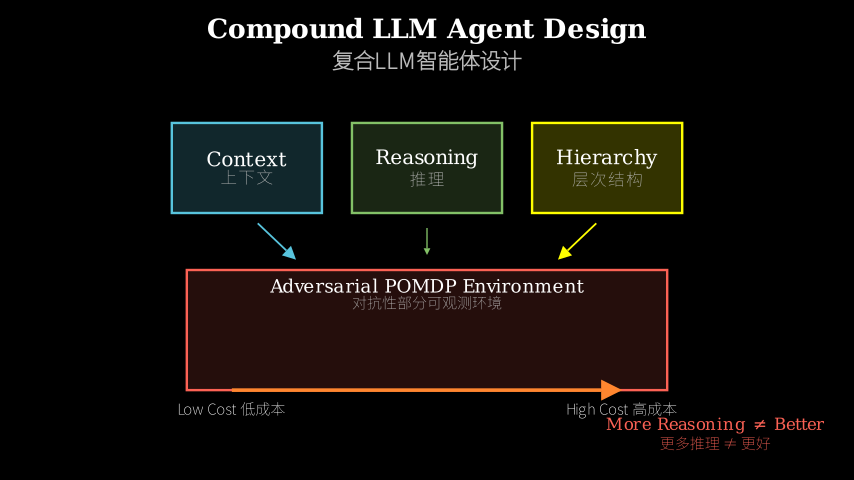
Paper: 2605.16205 Authors: Igor Bogdanov, Chung-Horng Lung, Thomas Kunz, Jie Gao, Adrian Taylor, Marzia Zaman Categories: cs.AI, cs.CL, cs.LG, cs.MA, eess.SY
The Gap
Compound LLM agents are being deployed in adversarial sequential decision-making environments, but practitioners face a design space with three orthogonal dimensions: context representation (what the agent sees), deliberation (how it reasons), and hierarchy (how tasks decompose). Prior work treats these as independent levers to pull—add chain-of-thought for better reasoning, add hierarchy for task decomposition, add state tracking for better context. No one has systematically measured which combinations actually improve performance versus merely burn tokens in a controlled adversarial POMDP setting where failure mitigation is the only goal.
Problem: Compound LLM agents in adversarial POMDPs
   |
   v
Gap: Design choices (context/deliberation/hierarchy) studied in isolation
   |
   v
Assumption: These dimensions interact—combinations may interfere
   |
   v
Method: Controlled ablation study (5 model families, 12 configs, 3475 episodes)
        + Token-level cost accounting in CybORG CAGE-2 cyber defense
   |
   v
Evidence: (1) Programmatic state abstraction: +76% return, best RPTS
          (2) Deliberation cascade: -3.4x return, +2.7x tokens
          (3) Hierarchy alone > Hierarchy + deliberation
   |
   v
Conclusion: In structured adversarial POMDPs, invest in infrastructure
            (state abstraction, clean decomposition) over per-agent reasoning
The Increment
One sentence: Before this paper, practitioners assumed more reasoning and deeper hierarchies would improve compound LLM agents; after, we know that combining deliberation with hierarchy creates destructive interference in adversarial POMDPs, and programmatic state abstraction delivers better returns per token than self-questioning tools.
Core Mechanism
The study manipulates three design dimensions independently and in combination. Context representation varies between raw observations (the agent sees everything the environment emits) and a deterministic state-tracking layer that compresses history into a structured belief state. Deliberation adds self-questioning, self-critique, and self-improvement tools, optionally with chain-of-thought prompting. Hierarchy decomposes the task: a monolithic ReAct agent handles everything, or a coordinator delegates to specialized sub-agents (reconnaissance, analysis, action execution).
All configurations run in CybORG CAGE-2, a cyber defense simulator modeled as a POMDP with non-positive rewards—agents mitigate damage rather than maximize gain. The evaluation spans 3,475 episodes across five model families (GPT-4o, Claude 3.5 Sonnet, Gemini 1.5 Pro, Llama 3.1 405B, Qwen 2.5 72B) with token-level cost accounting. Each configuration’s return per token spent (RPTS) reveals which design choices pay off.
Raw Obs -----> LLM Agent -----> Action
                  ^
                  |
            [Deliberation Tools]
            [Self-Q, Critique, Improve]

vs.

Raw Obs -> State Tracker -> Compressed State -> LLM Agent -> Action
           [Deterministic]                         ^
                                                   |
                                              [Optional Tools]

vs.

Compressed State -> Coordinator LLM
                        |
                        +---> Recon Sub-Agent
                        +---> Analysis Sub-Agent
                        +---> Action Sub-Agent
                              [Each with optional deliberation]
Think of this like designing a restaurant kitchen. Context representation is whether chefs see every ingredient delivery (raw observations) or a prep station that pre-organizes ingredients into mise en place (state abstraction). Deliberation is whether each chef stops to question their own decisions, critique their technique, and revise their plan before acting. Hierarchy is whether one chef handles the entire dish (monolithic) or a head chef delegates to stations (hierarchy).
The study finds that mise en place (state abstraction) is the highest-leverage investment—it reduces cognitive load and improves output quality. Adding deliberation to every station chef (deliberation cascade) creates bottlenecks: each chef second-guesses themselves, coordination overhead explodes, and the kitchen slows down without improving dish quality. The best setup is a well-organized prep station with a clean delegation structure, where each station chef executes their specialized task without overthinking.
Key Concepts
-
Deliberation Cascade: When a hierarchical agent system distributes deliberation tools (self-questioning, self-critique, self-improvement) across multiple sub-agents, performance degrades relative to hierarchy alone. Each sub-agent’s reasoning overhead compounds, coordination becomes brittle, and the system uses 1.8-2.7× more tokens while achieving up to 3.4× worse mean return. It’s like a relay race where every runner stops mid-stride to question whether they’re running correctly—the handoffs break down and the team finishes last despite each runner being “more thoughtful.”
-
Return Per Token Spent (RPTS): A cost-efficiency metric that divides cumulative episode return by total tokens consumed. In adversarial POMDPs with non-positive rewards, RPTS reveals which design choices mitigate failure most economically. A configuration with -50 mean return using 10K tokens (RPTS = -0.005) is more cost-effective than -40 return using 20K tokens (RPTS = -0.002). This metric prevents the trap of celebrating absolute performance gains that come from brute-force token expenditure.
-
Programmatic State Abstraction: A deterministic layer that sits between raw environment observations and the LLM agent, compressing partial observability into a structured belief state. Instead of feeding the agent “host 192.168.1.5 sent TCP SYN to port 22, host 192.168.1.7 sent ICMP echo request…” it provides “3 hosts active, 2 suspicious connections, 1 known compromised.” This is not learned—it’s hand-coded domain logic that exploits the structure of the POMDP. The LLM reasons over the compressed state, not raw sensor data.
Framework Shift
Before (mainstream approach):        After (this paper):

LLM Agent                            State Tracker (deterministic)
    |                                        |
    v                                        v
[Self-Question]                        LLM Coordinator
    |                                   /    |    \
    v                                  /     |     \
[Self-Critique]                   Sub-A  Sub-B  Sub-C
    |                              (no deliberation tools)
    v                                  |     |     |
[Self-Improve]                         v     v     v
    |                                Actions (specialized)
    v
Action

Assumption: More reasoning = better    Finding: Infrastructure + clean
            decisions                           decomposition > per-agent
                                               reasoning depth
From “make each agent think harder” to “give agents better information and clearer responsibilities,” the core shift is that structured environments reward architectural investment over cognitive depth.
Expert Assessment
Problem choice: This is a real gap. The compound LLM agent design space is exploding, and practitioners are combining techniques without understanding their interactions. The choice to study adversarial POMDPs (cyber defense) is smart—it’s a domain where failure is costly and token budgets matter. The non-positive reward structure forces honest accounting; you can’t hide poor design behind inflated scores.
Method maturity: The experimental design is solid. Controlled ablation across five model families with token-level cost accounting is rare and valuable. The deliberation cascade finding is genuinely surprising—most researchers assume more reasoning helps. However, the study is limited to one environment (CybORG CAGE-2). The generalization claim to “structured adversarial POMDPs” is plausible but not proven. A second domain (e.g., adversarial planning, competitive games) would strengthen the case.
Experimental integrity: Baselines are fair. The authors test all combinations rather than cherry-picking. Token accounting is transparent. One concern: the state-tracking layer is hand-coded for CybORG. How much domain expertise does this require? If state abstraction is the winning move but requires expert-level environment modeling, the practical barrier is high. The paper acknowledges this but doesn’t quantify the engineering effort.
Writing quality: The paper is dense but well-structured. The deliberation cascade concept is clearly defined and illustrated. The weakest section is the related work—it reads like a literature dump rather than positioning the contribution. Rewriting it to emphasize the gap (no prior work studies these three dimensions jointly in adversarial POMDPs) would sharpen the narrative. The results section could benefit from a decision tree: “If you have budget for one improvement, do X. If you have budget for two, do X and Y.”
Verdict: weak accept — The deliberation cascade finding is novel and the experimental rigor is above average, but the single-environment limitation and unclear generalization boundary prevent a strong accept. This is a valuable empirical contribution that will inform practitioner decisions, but it’s not a paradigm shift.
Takeaways
-
Invest in state abstraction first: If you’re building LLM agents for structured environments (games, simulations, cyber defense), write a deterministic layer that compresses observations into a belief state. This delivers the highest return per token spent. Don’t feed raw logs to the LLM—give it a dashboard.
-
Hierarchy without deliberation: If you decompose tasks across sub-agents, don’t give each sub-agent self-questioning tools. Let the coordinator reason, let the sub-agents execute. Deliberation cascades are real and expensive.
-
Cost-efficiency metrics matter: Track return per token spent, not just absolute performance. A configuration that scores 10% better but uses 3× more tokens is often a bad trade in production.
-
The “more reasoning = better” heuristic breaks in adversarial POMDPs: Chain-of-thought and self-critique help in knowledge tasks (math, coding, question-answering). In sequential decision-making under partial observability with adversarial dynamics, they can hurt. The environment punishes hesitation and coordination overhead.
-
Transferable design principle: In domains where you can exploit structure (known state space, deterministic transitions, clear task boundaries), invest in programmatic infrastructure over LLM reasoning depth. Save the LLM’s cognitive budget for the irreducibly uncertain parts.
论文: 2605.16205 作者: Igor Bogdanov, Chung-Horng Lung, Thomas Kunz, Jie Gao, Adrian Taylor, Marzia Zaman 分类: cs.AI, cs.CL, cs.LG, cs.MA, eess.SY
缺口
复合LLM智能体正被部署到对抗性序列决策环境中,但实践者面临一个三维设计空间:上下文表示(智能体看到什么)、深思(如何推理)、层级(任务如何分解)。
先前工作将这些维度视为独立的调节杆——加入思维链改善推理,加入层级实现任务分解,加入状态跟踪改善上下文。
没有人在受控的对抗性POMDP环境中系统性地测量过哪些组合真正提升性能,哪些只是烧token,尤其是在失败缓解是唯一目标的场景中。
问题:对抗性POMDP中的复合LLM智能体
   |
   v
缺口:设计选择(上下文/深思/层级)被孤立研究
   |
   v
假设:这些维度会相互作用——组合可能产生干扰
   |
   v
方法:受控消融研究(5个模型家族,12种配置,3475轮)
      + CybORG CAGE-2网络防御中的token级成本核算
   |
   v
证据:(1) 程序化状态抽象:+76%回报,最佳RPTS
      (2) 深思级联:-3.4倍回报,+2.7倍token
      (3) 纯层级 > 层级+深思
   |
   v
结论:在结构化对抗性POMDP中,投资基础设施
      (状态抽象、清晰分解)而非单智能体推理
增量
一句话:这篇论文之前,实践者认为更多推理和更深层级会改善复合LLM智能体;
之后,我们知道在对抗性POMDP中将深思与层级结合会产生破坏性干扰,程序化状态抽象比自我提问工具带来更好的每token回报。
核心机制
研究独立且组合地操纵三个设计维度。
上下文表示在原始观测(智能体看到环境发出的一切)和确定性状态跟踪层(将历史压缩为结构化信念状态)之间变化。
深思添加自我提问、自我批评和自我改进工具,可选地配合思维链提示。
层级分解任务:单体ReAct智能体处理一切,或协调器委派给专门的子智能体(侦察、分析、行动执行)。
所有配置在CybORG CAGE-2中运行,这是一个建模为POMDP的网络防御模拟器,奖励非正——智能体缓解损害而非最大化收益。
评估跨越3475轮,涵盖五个模型家族(GPT-4o、Claude 3.5 Sonnet、Gemini 1.5 Pro、Llama 3.1 405B、Qwen 2.5 72B),带有token级成本核算。
每种配置的每token回报(RPTS)揭示哪些设计选择值得投入。
原始观测 -----> LLM智能体 -----> 行动
                  ^
                  |
            [深思工具]
            [自问、批评、改进]

vs.

原始观测 -> 状态跟踪器 -> 压缩状态 -> LLM智能体 -> 行动
           [确定性]                      ^
                                         |
                                    [可选工具]

vs.

压缩状态 -> 协调器LLM
                |
                +---> 侦察子智能体
                +---> 分析子智能体
                +---> 行动子智能体
                      [每个可选配深思]
把这想象成设计餐厅厨房。
上下文表示是厨师看到每次食材配送(原始观测)还是预备台将食材预先整理成备料(状态抽象)。
深思是每个厨师是否停下来质疑自己的决定、批评自己的技术、修改计划后再行动。
层级是一个厨师处理整道菜(单体)还是主厨委派给各个工位(层级)。
研究发现备料(状态抽象)是最高杠杆的投资——它减少认知负荷并提升产出质量。
给每个工位厨师添加深思(深思级联)制造瓶颈:每个厨师自我怀疑,协调开销爆炸,厨房变慢但菜品质量没有改善。
最佳设置是组织良好的预备台加上清晰的委派结构,每个工位厨师执行专门任务而不过度思考。
关键概念
- 深思级联:当层级智能体系统在多个子智能体间分配深思工具(自我提问、自我批评、自我改进)时,性能相对于纯层级下降。
每个子智能体的推理开销叠加,协调变得脆弱,系统使用1.8-2.7倍token同时达到最多3.4倍更差的平均回报。
这就像接力赛中每个跑者都在跑步途中停下来质疑自己是否跑得正确——交接棒崩溃,团队垫底,尽管每个跑者都”更深思熟虑”。
- 每token回报(RPTS):一个成本效率指标,将累积回合回报除以消耗的总token数。
在奖励非正的对抗性POMDP中,RPTS揭示哪些设计选择最经济地缓解失败。
一个使用10K token达到-50平均回报的配置(RPTS = -0.005)比使用20K token达到-40回报的配置(RPTS = -0.002)更具成本效益。
这个指标防止陷入庆祝来自暴力token支出的绝对性能提升的陷阱。
- 程序化状态抽象:一个位于原始环境观测和LLM智能体之间的确定性层,将部分可观测性压缩为结构化信念状态。
它不是给智能体喂”主机192.168.1.5向端口22发送TCP SYN,主机192.168.1.7发送ICMP回显请求…”,而是提供”3台主机活跃,2个可疑连接,1个已知被攻陷”。
这不是学习得来的——是手工编码的领域逻辑,利用POMDP的结构。
LLM对压缩状态推理,而非原始传感器数据。
框架转变
之前(主流方法):                之后(本文方法):

LLM智能体                         状态跟踪器(确定性)
    |                                     |
    v                                     v
[自我提问]                           LLM协调器
    |                                /    |    \
    v                               /     |     \
[自我批评]                      子智能体A B C
    |                           (无深思工具)
    v                               |     |     |
[自我改进]                          v     v     v
    |                            行动(专门化)
    v
行动

假设:更多推理 = 更好决策          发现:基础设施 + 清晰分解
                                      > 单智能体推理深度
从”让每个智能体更努力思考”到”给智能体更好的信息和更清晰的职责”,核心转变是结构化环境奖励架构投资而非认知深度。
专家评审
选题眼光:这是真缺口。
复合LLM智能体设计空间正在爆炸,实践者在不理解技术交互的情况下组合它们。
选择研究对抗性POMDP(网络防御)很聪明——这是失败代价高昂且token预算重要的领域。
非正奖励结构强制诚实核算;
你无法用虚高分数掩盖糟糕设计。
方法成熟度:实验设计扎实。
跨五个模型家族的受控消融加上token级成本核算既罕见又有价值。
深思级联发现真正令人惊讶——大多数研究者假设更多推理有帮助。
然而,研究局限于一个环境(CybORG CAGE-2)。
对”结构化对抗性POMDP”的泛化声明合理但未被证明。
第二个领域(如对抗性规划、竞争游戏)会加强论证。
实验诚意:基线公平。
作者测试所有组合而非挑选。
Token核算透明。
一个担忧:状态跟踪层是为CybORG手工编码的。
这需要多少领域专业知识?
如果状态抽象是制胜招数但需要专家级环境建模,实践门槛就很高。
论文承认这点但未量化工程努力。
写作功力:论文密集但结构良好。
深思级联概念定义清晰且有图示。
最弱的部分是相关工作——读起来像文献堆砌而非定位贡献。
重写它以强调缺口(没有先前工作在对抗性POMDP中联合研究这三个维度)会锐化叙事。
结果部分可以受益于决策树:“如果你有预算做一项改进,做X。
如果有预算做两项,做X和Y。
”
判决:弱接收 — 深思级联发现新颖且实验严谨性高于平均水平,但单环境局限和不清晰的泛化边界阻止强接收。
这是有价值的经验贡献,会告知实践者决策,但不是范式转变。
要点总结
- 优先投资状态抽象:如果你在为结构化环境(游戏、模拟、网络防御)构建LLM智能体,编写一个确定性层将观测压缩为信念状态。
这带来最高的每token回报。
不要给LLM喂原始日志——给它一个仪表板。
- 无深思的层级:如果你跨子智能体分解任务,不要给每个子智能体自我提问工具。
让协调器推理,让子智能体执行。
深思级联真实存在且代价高昂。
- 成本效率指标重要:跟踪每token回报,而非仅绝对性能。
一个得分高10%但使用3倍token的配置在生产中通常是糟糕交易。
- “更多推理=更好”启发式在对抗性POMDP中失效:思维链和自我批评在知识任务(数学、编码、问答)中有帮助。
在部分可观测性下带有对抗性动态的序列决策中,它们可能有害。
环境惩罚犹豫和协调开销。
- 可迁移的设计原则:在你能利用结构的领域(已知状态空间、确定性转移、清晰任务边界),投资程序化基础设施而非LLM推理深度。
把LLM的认知预算留给不可约简的不确定部分。