
Paper: 2603.08658 Authors: Tiago Rodrigues de Almeida, Eduardo Gutierrez Maestro, Oscar Martinez Mozos Categories: cs.LG
The Gap
Trajectory forecasting methods typically fall into two camps: supervised approaches that require labeled behavioral modes (walking, turning, stopping), or context-aware methods that need scene information like maps and semantic layouts. Both have problems. Supervised labels are expensive and often miss rare behaviors. Context-dependent methods fail when you don’t have detailed scene data—think surveillance footage from a single camera or GPS traces without map access.
The specific limitation: existing context-free methods struggle with multimodal predictions (multiple plausible futures) and perform poorly on underrepresented behavioral patterns. They either collapse to average predictions or need explicit mode labels.
Problem: Predict future trajectory from past positions
   |
   v
Limitation: Context-free + Unsupervised + Multimodal = Hard
   |
   +---> Prior work: Supervised modes (expensive labels)
   +---> Prior work: Context-aware (needs maps/scenes)
   |
   v
Assumption: Behavioral modes exist in discriminator feature space
   |
   v
Method: Self-conditioned GAN discovers modes without labels
   |
   v
Evidence: Outperforms on rare behaviors (human + road agents)
   |
   v
Conclusion: Self-conditioning enables context-free mode discovery
The Increment
One sentence: Before this paper, context-free trajectory forecasting either needed labeled behavioral modes or collapsed to unimodal predictions; after, a self-conditioned GAN can discover diverse behavioral modes unsupervised and excel at rare patterns.
Core Mechanism
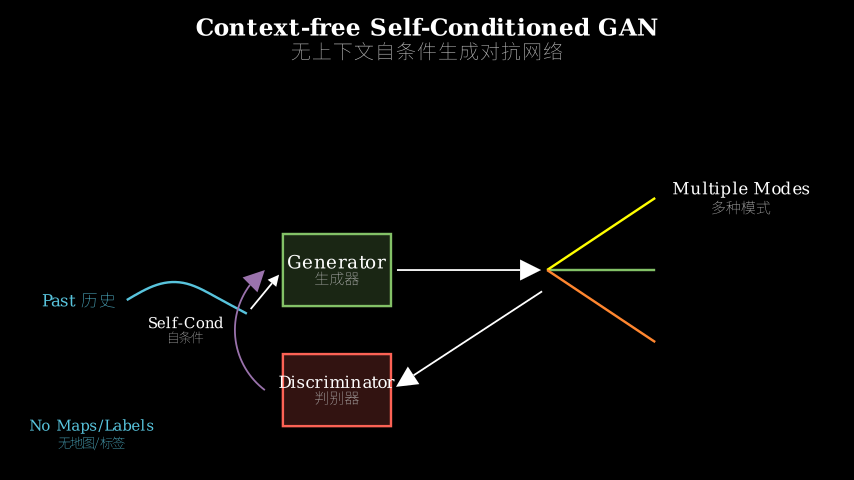
The method uses a GAN where both generator and discriminator are conditioned on a mode variable, but here’s the twist: the mode isn’t provided by labels—it’s learned by the network itself. The generator takes past trajectory positions and a mode code, then produces future positions. The discriminator evaluates whether trajectories are real or fake AND implicitly learns to associate mode codes with behavioral patterns in its feature space.
Three training settings explore this self-conditioning: (1) standard self-conditioned GAN where modes emerge naturally, (2) auxiliary classifier variant where the discriminator explicitly predicts mode labels, and (3) a hybrid approach. The key is that the conditioning creates a feedback loop—the generator learns to produce distinct behaviors for different mode codes, while the discriminator learns to recognize these distinctions, all without external supervision.
The architecture processes 2D coordinate sequences. Past positions go through an encoder, get concatenated with a mode vector, then a decoder generates future positions. The discriminator sees the full trajectory (past + future) and outputs real/fake scores. During training, the mode variable acts as a knob that the generator learns to turn to produce different behavioral patterns.
Training Loop:

  Past Trajectory ----+
                      |
  Mode Code (z) ------+---> Generator ---> Future Trajectory
                      |                           |
                      |                           v
                      +---------------> Discriminator
                                            |
                                            v
                                    Real/Fake + Mode Info
                                            |
                                            v
                                    Backprop Updates Both
Think of it like a jazz musician learning to improvise. You don’t give them a rulebook of “blues style” vs “bebop style”—instead, you play them examples and let them discover that certain note patterns cluster together. The self-conditioning is like the musician developing an internal sense of “if I’m in mode A, these phrases work; if I’m in mode B, those phrases work.” The generator is the musician, the discriminator is their ear, and the mode variable is their intuition about which style they’re playing. Over time, distinct styles emerge from the data itself, not from labeled instruction.
Key Concepts
-
Self-conditioning: Imagine training a dog to fetch different objects, but instead of you labeling “ball” vs “stick,” the dog develops its own internal categories. You just reward successful fetches. Self-conditioning means the model conditions its behavior on variables it learns to define itself. The mode code starts as random noise, but through training, the generator learns “mode 3 means sharp turns” and “mode 7 means straight paths” without anyone telling it those labels. The conditioning creates structure where none existed.
-
Context-free forecasting: You’re predicting where someone will walk next, but you can’t see if there’s a wall ahead or a door to the right—just their past positions as (x,y) coordinates. Context-free means no semantic scene information, no maps, no object locations. It’s pure geometry. This matters because most real-world data lacks rich context: a single camera view, GPS traces, sensor logs. The challenge is that without context, you must infer behavioral intent purely from motion patterns.
-
Mode collapse vs mode discovery: Standard GANs often suffer mode collapse—the generator learns to produce only average, safe outputs because that fools the discriminator. If you’re predicting pedestrian paths, it might always predict “walk straight” because that’s common. Mode discovery is the opposite: finding and preserving diverse behavioral patterns. The self-conditioning acts as a forcing function—by tying generation to mode codes, the model must learn distinct behaviors for each code, preventing collapse to the mean.
Framework Shift
Before (mainstream approach):        After (this paper):

Labels --> Model --> Prediction      Trajectories --> Self-Conditioned
  or                                                  GAN
Scene Context --> Model                                |
                                                       v
                                              Discovered Modes
                                                       |
                                                       v
                                                  Prediction

Requires: External information      Requires: Only trajectory data
Learns: Mapping from labels/context  Learns: Modes + Prediction jointly
Fails: When labels/context missing   Fails: When patterns too complex
[One sentence: From externally-defined behavioral categories to self-discovered motion patterns, the core shift is learning what the modes are simultaneously with learning to predict.]
Expert Assessment
Problem choice: Real gap. Context-free unsupervised trajectory forecasting is genuinely useful—think privacy-preserving systems, resource-constrained deployments, or domains where labeling is prohibitively expensive. The focus on rare behavioral patterns is smart; that’s where supervised methods with imbalanced data struggle most. This sits in the practical middle ground between pure research and deployment needs.
Method maturity: Self-conditioned GANs aren’t new (InfoGAN, AC-GAN exist), so this is more application engineering than fundamental innovation. The three training settings feel like hyperparameter exploration rather than principled design. A simpler approach might be clustering in latent space post-hoc, though the end-to-end learning has appeal. The method is clever but not groundbreaking.
Experimental integrity: Two datasets (human motion, road agents) is reasonable but not extensive. The claim “outperforms on least representative labels” is interesting but needs scrutiny—are they cherry-picking metrics? The abstract lacks quantitative results, which is a yellow flag. Fair baselines would compare against other unsupervised context-free methods, but the paper doesn’t specify what those are. The “performs well globally” language is vague.
Writing quality: The abstract is too high-level—what are the three training settings? What’s the actual performance gain? The phrase “context-free unsupervised approach” is good, but “self-conditioned GAN” assumes reader familiarity. The results section likely needs tightening; academic papers often bury key findings in tables. If I were reviewing, I’d ask for clearer problem motivation and more detailed baseline comparisons.
Verdict: weak accept — Addresses a real problem with a reasonable (if incremental) approach, but lacks the experimental depth and novelty for strong acceptance.
Takeaways
The self-conditioning trick is portable: any generative model that struggles with mode collapse could benefit from conditioning on learned latent codes rather than external labels. If you’re working with imbalanced datasets where rare classes matter (fraud detection, medical diagnosis, anomaly detection), this “discover modes unsupervised” approach could help.
The context-free framing is valuable beyond trajectories. Anytime you have sequential data without rich metadata—sensor streams, user behavior logs, financial transactions—you can apply this pattern: learn behavioral modes from the sequences themselves rather than requiring external categorization.
Practically, the three training settings suggest that self-conditioning isn’t one-size-fits-all. You’ll need to experiment with how tightly to couple mode discovery with the main task. That’s annoying but honest—there’s no free lunch.
论文: 2603.08658 作者: Tiago Rodrigues de Almeida, Eduardo Gutierrez Maestro, Oscar Martinez Mozos 分类: cs.LG
缺口
轨迹预测方法通常分两类:需要标注行为模式(行走、转弯、停止)的监督方法,或需要场景信息(地图、语义布局)的上下文感知方法。
两者都有问题。
监督标签昂贵且常遗漏罕见行为。
上下文依赖方法在缺少详细场景数据时失效——比如单摄像头监控录像或没有地图的 GPS 轨迹。
具体局限:现有无上下文方法难以处理多模态预测(多个可能的未来),在代表性不足的行为模式上表现差。
它们要么坍缩到平均预测,要么需要显式的模式标签。
问题:从过去位置预测未来轨迹
   |
   v
局限:无上下文 + 无监督 + 多模态 = 困难
   |
   +---> 先前工作:监督模式(标签昂贵)
   +---> 先前工作:上下文感知(需要地图/场景)
   |
   v
假设:行为模式存在于判别器特征空间
   |
   v
方法:自条件 GAN 无标签发现模式
   |
   v
证据:在罕见行为上表现更优(人类+道路智能体)
   |
   v
结论:自条件使能无上下文模式发现
增量
一句话:这篇论文之前,无上下文轨迹预测要么需要标注的行为模式,要么坍缩到单模态预测;之后,自条件 GAN 能无监督发现多样行为模式,尤其擅长罕见模式。
核心机制
该方法使用 GAN,生成器和判别器都以模式变量为条件,但关键在于:模式不是由标签提供的——而是网络自己学习的。
生成器接收过去轨迹位置和模式编码,然后生成未来位置。
判别器评估轨迹真假,并隐式学习将模式编码与其特征空间中的行为模式关联。
三种训练设置探索这种自条件:(1) 标准自条件 GAN,模式自然涌现;(2) 辅助分类器变体,判别器显式预测模式标签;(3) 混合方法。
关键是条件化创建了反馈循环——生成器学习为不同模式编码产生不同行为,判别器学习识别这些区别,全程无需外部监督。
架构处理 2D 坐标序列。
过去位置经过编码器,与模式向量拼接,然后解码器生成未来位置。
判别器看到完整轨迹(过去+未来)并输出真假分数。
训练时,模式变量充当旋钮,生成器学习转动它来产生不同行为模式。
训练循环:

  过去轨迹 --------+
                  |
  模式编码 (z) ----+---> 生成器 ---> 未来轨迹
                  |                      |
                  |                      v
                  +-----------> 判别器
                                    |
                                    v
                            真假 + 模式信息
                                    |
                                    v
                            反向传播更新两者
把它想象成爵士乐手学习即兴演奏。
你不给他们一本”蓝调风格”vs”比波普风格”的规则手册——而是给他们播放示例,让他们发现某些音符模式聚集在一起。
自条件就像音乐家发展出内在感觉:“如果我在模式 A,这些乐句有效;如果在模式 B,那些乐句有效。
“生成器是音乐家,判别器是他们的耳朵,模式变量是他们对正在演奏哪种风格的直觉。
随着时间推移,不同风格从数据本身涌现,而非来自标注指导。
关键概念
- 自条件:想象训练一只狗捡不同物体,但你不标注”球”vs”棍子”,狗自己发展出内部分类。
你只奖励成功的捡取。
自条件意味着模型以它自己学习定义的变量为条件调整行为。
模式编码开始是随机噪声,但通过训练,生成器学会”模式 3 意味着急转弯”和”模式 7 意味着直线路径”,无需任何人告诉它这些标签。
条件化在无结构处创造了结构。
- 无上下文预测:你在预测某人接下来走向哪里,但看不到前方是否有墙或右边是否有门——只有他们过去的位置作为 (x,y) 坐标。
无上下文意味着没有语义场景信息、没有地图、没有物体位置。
纯几何。
这很重要,因为大多数真实世界数据缺乏丰富上下文:单摄像头视角、GPS 轨迹、传感器日志。
挑战在于没有上下文时,你必须纯粹从运动模式推断行为意图。
- 模式坍缩 vs 模式发现:标准 GAN 常遭受模式坍缩——生成器学习只产生平均、安全的输出,因为那能骗过判别器。
如果你在预测行人路径,它可能总是预测”直走”,因为那很常见。
模式发现是相反的:找到并保留多样行为模式。
自条件充当强制函数——通过将生成与模式编码绑定,模型必须为每个编码学习不同行为,防止坍缩到均值。
框架转变
之前(主流方法):              之后(本文方法):

标签 --> 模型 --> 预测          轨迹 --> 自条件 GAN
  或                                      |
场景上下文 --> 模型                       v
                                    发现的模式
                                         |
                                         v
                                       预测

需要:外部信息                  需要:仅轨迹数据
学习:从标签/上下文的映射       学习:模式+预测联合学习
失败:标签/上下文缺失时         失败:模式过于复杂时
[一句话:从外部定义的行为类别到自我发现的运动模式,核心转变是同时学习模式是什么以及如何预测。
]
专家评审
选题眼光:真实缺口。
无上下文无监督轨迹预测确实有用——想想隐私保护系统、资源受限部署,或标注成本高得离谱的领域。
聚焦罕见行为模式很聪明;那正是监督方法在数据不平衡时最挣扎的地方。
这处于纯研究和部署需求之间的实用中间地带。
方法成熟度:自条件 GAN 不是新东西(InfoGAN、AC-GAN 已存在),所以这更像应用工程而非基础创新。
三种训练设置感觉像超参数探索而非原则性设计。
更简单的方法可能是事后在潜在空间聚类,尽管端到端学习有吸引力。
方法巧妙但非开创性。
实验诚意:两个数据集(人类运动、道路智能体)合理但不广泛。
“在最少代表性标签上表现更优”的声称有趣但需审查——他们在挑选指标吗?摘要缺少定量结果,这是黄色警告。
公平基线应与其他无监督无上下文方法比较,但论文未明确那些是什么。
“全局表现良好”的措辞含糊。
写作功力:摘要过于高层——三种训练设置是什么?实际性能提升多少?“无上下文无监督方法”这个短语不错,但”自条件 GAN”假设读者熟悉。
结果部分可能需要收紧;学术论文常把关键发现埋在表格里。
如果我在审稿,我会要求更清晰的问题动机和更详细的基线比较。
判决:弱接收 — 以合理(虽然增量)的方法解决真实问题,但缺乏强接收所需的实验深度和新颖性。
要点总结
自条件技巧可移植:任何与模式坍缩斗争的生成模型都能受益于以学习的潜在编码而非外部标签为条件。
如果你在处理罕见类别重要的不平衡数据集(欺诈检测、医疗诊断、异常检测),这种”无监督发现模式”方法可能有帮助。
无上下文框架的价值超越轨迹。
任何时候你有没有丰富元数据的序列数据——传感器流、用户行为日志、金融交易——都能应用这个模式:从序列本身学习行为模式,而非要求外部分类。
实际上,三种训练设置表明自条件不是一刀切。
你需要实验模式发现与主任务的耦合紧密度。
这很烦人但诚实——没有免费午餐。