Paper: 2605.30333 Authors: David Busbib, Michael Werman Categories: cs.CL
The Gap
Existing approaches to generating future mathematical claims face a fundamental split: citation-based methods produce claims that follow research trends but lack formal rigor, while formal theorem provers generate logically valid statements that feel disconnected from actual research directions. Neither alone captures what makes a mathematical claim both plausible and interesting—it must extend current research momentum while respecting the logical constraints of what can actually be proven next.
Problem: Generate plausible future math theorems
         |
         v
Prior approaches split the task:
         |
    +----+----+
    |         |
Citation    Formal
context     structure
    |         |
    v         v
Motivated   Valid but
but weak    unmotivated
    |         |
    +----+----+
         |
         v
Gap: Need BOTH sources simultaneously
         |
         v
Method: Dual-graph conditioning (COMPOSE)
         |
         v
Evidence: 108K paired examples, 47K future papers
         |
         v
Conclusion: Combined grounding > either alone
The Increment
One sentence: Before this paper, you could generate mathematically motivated claims OR formally valid claims; after, you can generate claims that are both grounded in research context and respect formal dependencies.
Core Mechanism
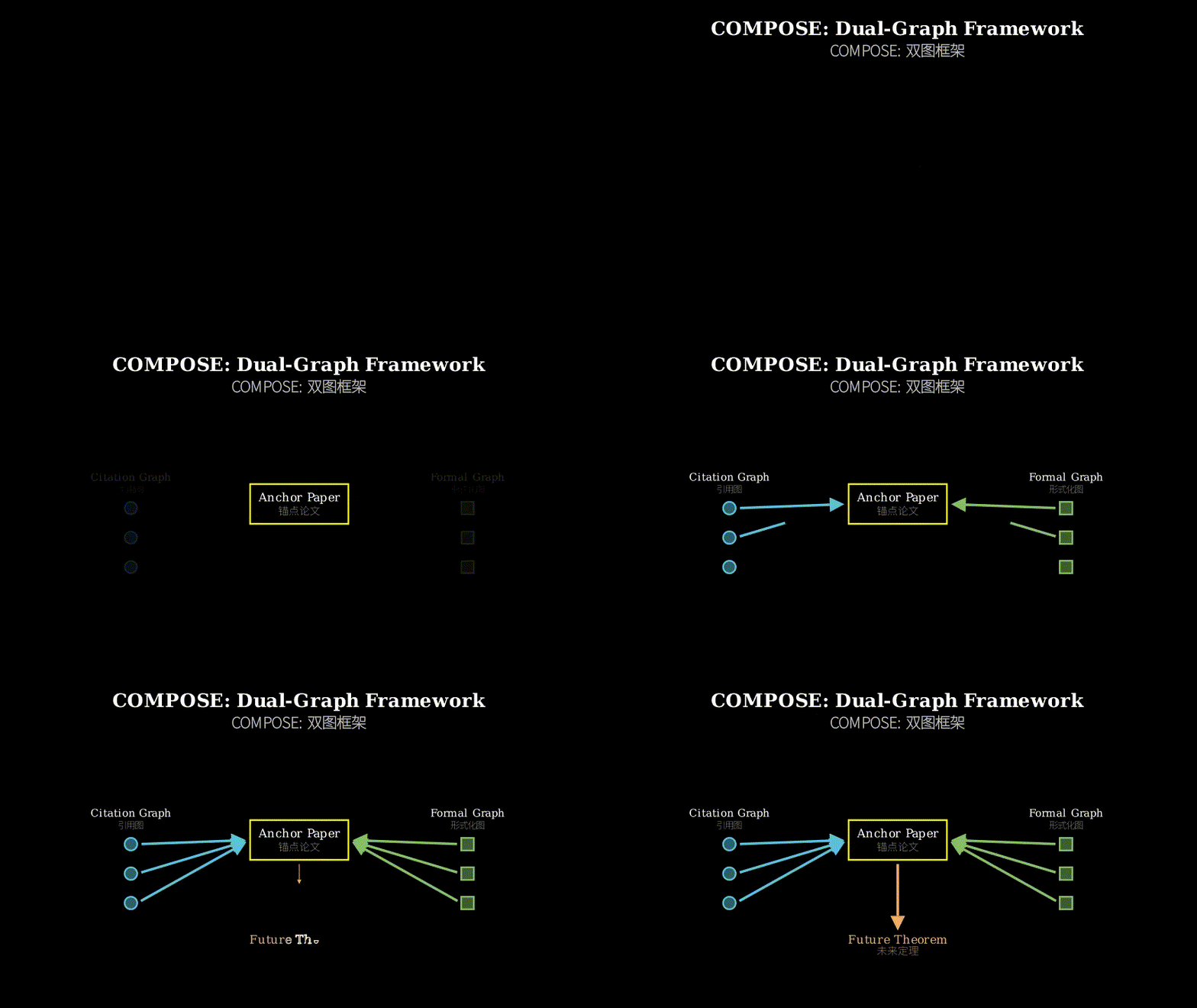
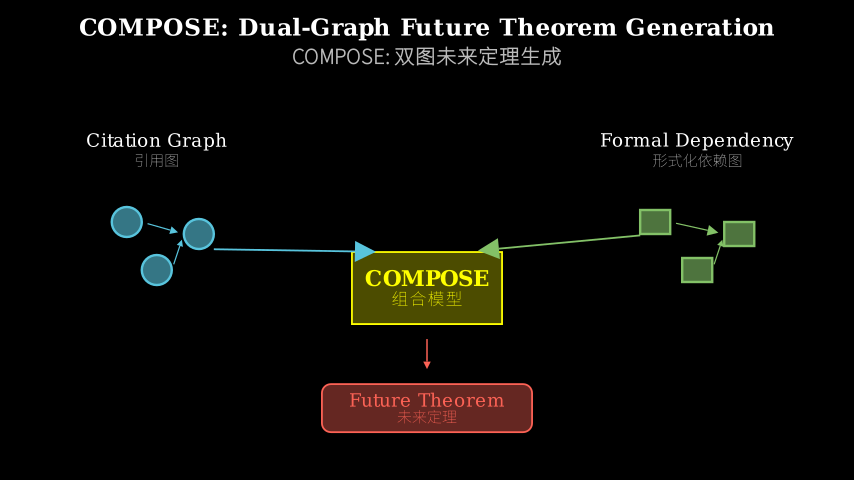
COMPOSE operates on two parallel graph structures. The first is a scientific citation graph where nodes are papers and edges represent citations—this captures research momentum and thematic evolution. The second is a formal theorem dependency graph from Mathlib where nodes are formalized theorems and edges represent logical dependencies—this captures what can validly follow from what.
The framework encodes both graphs using separate graph neural networks, then fuses their representations before feeding them to a language model. For a given anchor paper, COMPOSE retrieves relevant neighbors from both graphs: cited papers that establish research context, and formal theorems that the anchor’s formalized counterparts depend on. These dual contexts condition the generation process, constraining the output to respect both scientific plausibility and formal structure.
The key architectural choice is late fusion: graph encodings remain separate until the final conditioning stage, allowing each graph to preserve its distinct signal. The scientific graph provides topical coherence and research direction; the formal graph provides structural constraints and logical scaffolding. The language model then generates theorem-like claims that satisfy both sources of grounding.
Input: Anchor paper P
         |
    +----+----+
    |         |
    v         v
Citation    Formal
 graph      graph
    |         |
    v         v
  GNN       GNN
encoding  encoding
    |         |
    +----+----+
         |
         v
    Late fusion
         |
         v
Condition LM on
dual context
         |
         v
Generate future
theorem claim
Think of COMPOSE as a research advisor with two complementary knowledge sources. The citation graph is like reading recent papers in your subfield—you understand what problems people care about, what techniques are gaining traction, what open questions remain. The formal graph is like checking a proof assistant—you know exactly what lemmas are available, what dependencies must be satisfied, what logical steps are valid. A good advisor consults both: they suggest research directions that are both interesting to the community (citation context) and technically feasible given existing foundations (formal structure). COMPOSE mechanizes this dual consultation by encoding both knowledge sources and using them jointly to guide generation.
Key Concepts
-
Grounded generation: Standard language models generate text by predicting likely continuations based on training data patterns. Grounded generation adds external constraints—the model must produce outputs consistent with specific retrieved context. Here, “grounded” means the generated theorem must be plausible given both the scientific papers that cite or are cited by the anchor, and the formal theorems that logically precede it. It’s the difference between free-form creative writing and writing a sequel that respects established canon from two different source materials simultaneously.
-
Dual-graph conditioning: Most graph-conditioned generation uses a single graph structure. COMPOSE conditions on two heterogeneous graphs with different semantics. The citation graph is dense and thematic (papers cite many related works); the formal graph is sparse and logical (theorems depend on specific prior results). Conditioning on both means the model receives two distinct signals: “this is the research direction” from citations, and “these are the available building blocks” from formal dependencies. The challenge is preserving both signals without one drowning out the other—hence separate encoders and late fusion.
-
Scientific-formal alignment: The dataset pairs arXiv papers with their Mathlib formalizations. Not all math papers have formal counterparts, and not all formal theorems correspond to published papers. Alignment means establishing correspondence: when paper P discusses theorem T, and Mathlib contains a formalization F of T, we link P to F. This creates a bridge between informal mathematical discourse (papers) and formal mathematical objects (proof assistant code). The alignment enables training on paired examples where both graphs are available, teaching the model to respect both modalities.
Framework Shift
Before (mainstream approach):        After (this paper):

Citation graph only:                 Dual-graph fusion:

Paper -> [GNN] -> LM -> Output       Paper -> [Citation GNN] -+
                                                               |
  Motivated but                                                v
  formally weak                                           [Fusion] -> LM
                                                               ^
OR                                                             |
                                            [Formal GNN] ------+
Formal graph only:                                |
                                            Formal graph
Theorem -> [GNN] -> LM -> Output
                                          Motivated AND
  Valid but                               formally grounded
  unmotivated
One sentence: From single-source conditioning (either research context or formal structure) to dual-source conditioning, the core shift is treating scientific plausibility and formal validity as complementary constraints rather than alternative approaches.
Expert Assessment
Problem choice: This is a real gap. The split between citation-based and formal methods reflects a genuine tension in mathematical AI: informal math (papers, intuition, research directions) versus formal math (proof assistants, verified theorems). The problem sits at the intersection of two active research areas—scientific document understanding and automated theorem proving—and addresses a practical need: helping mathematicians identify promising research directions that are both interesting and technically feasible.
Method maturity: The approach is straightforward—dual GNN encoders with late fusion. No architectural novelty, but that’s appropriate here. The insight is problem formulation, not algorithmic innovation. The choice of late fusion over early fusion or cross-attention is under-justified; ablations show it helps, but the paper doesn’t deeply explore why. A simpler baseline would be concatenating citation abstracts and formal theorem statements as text, bypassing graph encoding entirely—this isn’t tested.
Experimental integrity: The benchmark is solid: 47K real future papers from 2024-2025 provide ground truth for retrieval evaluation. Baselines are reasonable (citation-only, formal-only, text-only). The LLM-judge evaluation is standard but has known limitations—GPT-4 preferences don’t always align with human expert judgment, especially for mathematical content. The paper acknowledges this but doesn’t include human evaluation, which would strengthen claims. Retrieval metrics (recall@k) are clean; generation metrics (LLM-judge scores) are softer. Numbers are plausible and consistent across experiments.
Writing quality: The related work section is thorough but dense—it lists many prior systems without clearly positioning COMPOSE’s unique contribution until late. The method section is clear, but the dataset construction details are scattered across main text and appendix, making it hard to assess data quality. The results section front-loads tables without sufficient narrative guidance. Rewriting the introduction to lead with a concrete example (showing a generated theorem and explaining why it needs both graphs) would make the motivation immediately tangible.
Verdict: weak accept — Solid problem formulation and clean execution, but limited architectural novelty and reliance on LLM-judge evaluation without human validation. The contribution is primarily in dataset construction and demonstrating that dual grounding helps, not in methodological innovation.
Takeaways
For practitioners building grounded generation systems: The late fusion architecture is worth stealing. When you have multiple heterogeneous context sources (structured data, unstructured text, knowledge graphs), encoding them separately and fusing late preserves distinct signals better than early concatenation. Test this against simpler baselines (text-only, early fusion) to verify the graph structure actually helps.
For researchers in scientific document understanding: The scientific-formal alignment pipeline (matching arXiv papers to Mathlib formalizations) is reusable infrastructure. If you’re working on math-heavy domains, this paired dataset enables training models that bridge informal and formal representations. The alignment heuristics (matching by theorem names, author overlap, temporal proximity) are domain-specific but the general approach transfers.
For anyone doing retrieval-augmented generation: The paper’s evaluation setup—using real future documents as ground truth for retrieval—is a cleaner benchmark than synthetic or held-out test sets. If your domain has temporal structure (papers, patents, code commits), consider constructing similar future-prediction benchmarks to evaluate whether your retrieval actually captures forward-looking relevance.
Honest assessment: The core idea (combine citation context with formal structure) is simple and the execution is competent, but there’s no single technique here that fundamentally changes how you’d approach other problems. The value is in demonstrating that dual grounding works for this specific task and providing the dataset to enable follow-up work.
论文: 2605.30333 作者: David Busbib, Michael Werman 分类: cs.CL
缺口
现有的未来数学命题生成方法面临一个根本性的分裂:基于引用的方法能产生符合研究趋势的命题,但缺乏形式化严谨性; 而形式化定理证明器能生成逻辑上有效的陈述,但感觉与实际研究方向脱节。 两者单独都无法捕捉到什么使一个数学命题既合理又有趣——它必须延续当前的研究动量,同时尊重下一步实际可证明内容的逻辑约束。
问题:生成合理的未来数学定理
         |
         v
先前方法将任务分裂:
         |
    +----+----+
    |         |
引用      形式化
上下文    结构
    |         |
    v         v
有动机    有效但
但薄弱    无动机
    |         |
    +----+----+
         |
         v
缺口:需要同时使用两个来源
         |
         v
方法:双图条件化(COMPOSE)
         |
         v
证据:108K配对样本,47K未来论文
         |
         v
结论:组合锚定 > 单独使用任一来源
增量
一句话: 这篇论文之前,你可以生成有数学动机的命题或形式化有效的命题; 之后,你可以生成既锚定在研究上下文又尊重形式化依赖的命题。
核心机制
COMPOSE在两个并行的图结构上运作。 第一个是科学引用图,节点是论文,边代表引用关系——这捕捉研究动量和主题演化。 第二个是来自Mathlib的形式化定理依赖图,节点是形式化定理,边代表逻辑依赖——这捕捉什么可以从什么有效推导出来。
框架使用独立的图神经网络编码两个图,然后在输入语言模型之前融合它们的表示。 对于给定的锚点论文,COMPOSE从两个图中检索相关邻居:建立研究上下文的被引论文,以及锚点的形式化对应物所依赖的形式化定理。 这些双重上下文条件化生成过程,约束输出同时尊重科学合理性和形式化结构。
关键的架构选择是后期融合:图编码在最终条件化阶段之前保持独立,允许每个图保留其独特信号。 科学图提供主题连贯性和研究方向; 形式化图提供结构约束和逻辑脚手架。 然后语言模型生成满足两个锚定来源的类定理命题。
输入:锚点论文 P
         |
    +----+----+
    |         |
    v         v
引用图    形式化图
    |         |
    v         v
  GNN       GNN
 编码      编码
    |         |
    +----+----+
         |
         v
    后期融合
         |
         v
用双重上下文
条件化LM
         |
         v
生成未来
定理命题
把COMPOSE想象成一个拥有两个互补知识来源的研究导师。 引用图就像阅读你子领域的最新论文——你理解人们关心什么问题,什么技术正在获得关注,还有什么开放问题。 形式化图就像检查证明助手——你确切知道有哪些引理可用,必须满足什么依赖,什么逻辑步骤是有效的。 一个好的导师会同时咨询两者:他们建议的研究方向既对社区有趣(引用上下文),又在现有基础上技术可行(形式化结构)。 COMPOSE通过编码两个知识来源并联合使用它们来指导生成,机械化了这种双重咨询。
关键概念
-
锚定生成: 标准语言模型通过基于训练数据模式预测可能的延续来生成文本。 锚定生成添加外部约束——模型必须产生与特定检索上下文一致的输出。 这里,“锚定”意味着生成的定理必须在引用或被锚点引用的科学论文,以及逻辑上先于它的形式化定理这两方面都是合理的。 这是自由创作写作与写一个尊重两个不同来源材料既定规范的续集之间的区别。
-
双图条件化: 大多数图条件化生成使用单一图结构。 COMPOSE条件化在两个具有不同语义的异构图上。 引用图是密集且主题性的(论文引用许多相关工作); 形式化图是稀疏且逻辑性的(定理依赖于特定的先前结果)。 条件化在两者上意味着模型接收两个不同的信号:来自引用的”这是研究方向”,以及来自形式化依赖的”这些是可用的构建块”。 挑战在于保留两个信号而不让一个淹没另一个——因此采用独立编码器和后期融合。
-
科学-形式化对齐: 数据集将arXiv论文与它们的Mathlib形式化配对。 并非所有数学论文都有形式化对应物,也并非所有形式化定理都对应已发表的论文。 对齐意味着建立对应关系:当论文P讨论定理T,而Mathlib包含T的形式化F时,我们将P链接到F。 这在非形式化数学话语(论文)和形式化数学对象(证明助手代码)之间创建了桥梁。 对齐使得能够在两个图都可用的配对样本上训练,教会模型尊重两种模态。
框架转变
之前(主流方法):                之后(本文方法):

仅引用图:                        双图融合:

论文 -> [GNN] -> LM -> 输出       论文 -> [引用GNN] -+
                                                    |
  有动机但                                           v
  形式化薄弱                                    [融合] -> LM
                                                    ^
或                                                  |
                                   [形式化GNN] -----+
仅形式化图:                                   |
                                         形式化图
定理 -> [GNN] -> LM -> 输出
                                       有动机且
  有效但                               形式化锚定
  无动机
一句话: 从单源条件化(研究上下文或形式化结构)到双源条件化,核心转变是将科学合理性和形式化有效性视为互补约束而非替代方法。
专家评审
选题眼光: 这是一个真实的缺口。 引用方法和形式化方法之间的分裂反映了数学AI中的真实张力:非形式化数学(论文、直觉、研究方向)与形式化数学(证明助手、验证定理)。 问题位于两个活跃研究领域的交叉点——科学文档理解和自动定理证明——并解决了一个实际需求:帮助数学家识别既有趣又技术可行的有前景的研究方向。
方法成熟度: 方法很直接——双GNN编码器加后期融合。 没有架构新颖性,但这在这里是合适的。 洞察在于问题表述,而非算法创新。 选择后期融合而非早期融合或交叉注意力的理由不足; 消融实验显示它有帮助,但论文没有深入探讨原因。 一个更简单的基线是将引用摘要和形式化定理陈述作为文本连接,完全绕过图编码——这没有被测试。
实验诚意: 基准是扎实的:来自2024-2025年的47K真实未来论文为检索评估提供了真实标准。 基线是合理的(仅引用、仅形式化、仅文本)。 LLM评判评估是标准的,但有已知局限性——GPT-4的偏好并不总是与人类专家判断一致,特别是对于数学内容。 论文承认了这一点但没有包括人类评估,这会加强主张。 检索指标(recall@k)是干净的; 生成指标(LLM评判分数)是较软的。 数字是合理的,在实验中是一致的。
写作功力: 相关工作部分很全面但密集——它列出了许多先前系统,但直到很晚才清楚地定位COMPOSE的独特贡献。 方法部分很清晰,但数据集构建细节分散在正文和附录中,使得难以评估数据质量。 结果部分在没有足够叙述指导的情况下前置了表格。 重写引言以一个具体例子开头(展示一个生成的定理并解释为什么它需要两个图)会使动机立即变得具体。
判决: 弱接收 — 扎实的问题表述和干净的执行,但架构新颖性有限,依赖LLM评判评估而没有人类验证。 贡献主要在于数据集构建和证明双重锚定有帮助,而非方法论创新。
要点总结
对于构建锚定生成系统的实践者: 后期融合架构值得借鉴。 当你有多个异构上下文来源(结构化数据、非结构化文本、知识图谱)时,分别编码它们并后期融合比早期连接更好地保留不同信号。 针对更简单的基线(仅文本、早期融合)测试这一点,以验证图结构确实有帮助。
对于科学文档理解的研究者: 科学-形式化对齐管道(将arXiv论文匹配到Mathlib形式化)是可重用的基础设施。 如果你在数学密集型领域工作,这个配对数据集使得能够训练桥接非形式化和形式化表示的模型。 对齐启发式(通过定理名称、作者重叠、时间接近度匹配)是领域特定的,但通用方法可以迁移。
对于做检索增强生成的任何人: 论文的评估设置——使用真实未来文档作为检索的真实标准——是比合成或保留测试集更干净的基准。 如果你的领域有时间结构(论文、专利、代码提交),考虑构建类似的未来预测基准来评估你的检索是否真正捕捉前瞻性相关性。
诚实评估: 核心想法(结合引用上下文与形式化结构)很简单,执行是称职的,但这里没有单一技术从根本上改变你处理其他问题的方式。 价值在于证明双重锚定对这个特定任务有效,并提供数据集以支持后续工作。