
Paper: 2603.11048 Authors: Susung Hong, Brian Curless, Ira Kemelmacher-Shlizerman, Steve Seitz Categories: cs.CV, cs.AI, cs.CL, cs.MA, cs.NE
The Gap
Video generation has made impressive strides in technical quality—realism, temporal coherence, motion dynamics. But these systems optimize for perceptual fidelity, not creative content. When it comes to comedy, prior work hits a wall: humor is subjective, context-dependent, and lacks clear optimization targets. You can’t just maximize “funniness” like you minimize reconstruction error. Previous attempts at creative content generation either relied on template-filling (rigid, unfunny) or single-pass LLM generation (no refinement, no quality control). Multi-agent systems existed but weren’t applied to iterative creative refinement with learned subjective metrics.
Problem: Comedy generation needs subjective quality evaluation
   |
   v
Assumption: Real viewer preferences can train humor critics
   |
   v
Method: Multi-agent studio simulation + YouTube-trained critics
   |
   v
Evidence: Outputs approach professional sketch quality
   |
   v
Conclusion: Learned subjective metrics enable creative AI systems
The Increment
One sentence: Before this paper, automated video generation optimized technical quality but couldn’t iteratively refine creative content using learned subjective metrics; after, we have a multi-agent system that mimics production workflows and uses viewer-preference-trained critics to generate comedy sketches.
Core Mechanism
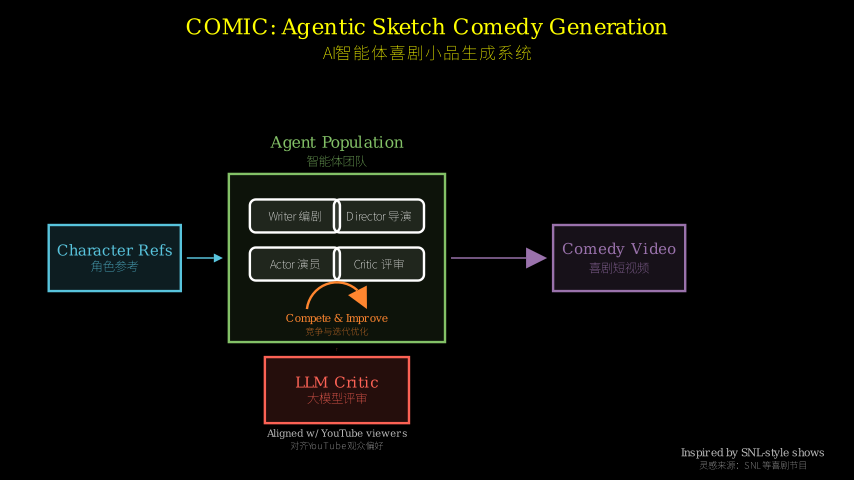
The system deploys a population of specialized AI agents, each representing a role in a production studio: writers, directors, critics, editors. The process unfolds in iterative rounds. First, multiple writer agents independently generate sketch concepts from character references. These compete in a tournament where critic agents—trained on a corpus of YouTube comedy videos and their engagement metrics—evaluate humor quality. Winning concepts advance to script development, where writer agents flesh out full scripts with dialogue, stage directions, and comedic beats.
The scripts then feed into a video generation pipeline that produces visual content. Here’s where it gets interesting: the critic agents evaluate the generated videos, providing feedback that flows back to earlier stages. This creates a refinement loop. Poor-performing sketches get revised or discarded. High-performing elements get amplified in subsequent generations. The critics aren’t using hand-coded rules—they’ve learned what makes comedy work by analyzing thousands of YouTube videos, correlating content features with viewer engagement (likes, comments, watch time).
The key architectural choice is competition plus iteration. By generating multiple candidates and selecting winners, the system explores a wider creative space than single-pass generation. By iterating with feedback, it refines ideas rather than settling for first drafts. The learned critics provide the selection pressure that drives quality improvement.
Character Refs --> [Writer Agents] --> Sketch Ideas (multiple)
                         |                    |
                         |                    v
                         |            [Critic Agents]
                         |                    |
                         |                    v
                         |            Selected Ideas
                         |                    |
                         v                    v
                   [Script Dev] <------ Feedback Loop
                         |
                         v
                   Full Scripts
                         |
                         v
                   [Video Gen]
                         |
                         v
                   Generated Videos
                         |
                         v
                   [Critic Eval] -----> Refinement Signal
Think of this like a TV writers’ room crossed with natural selection. In a real writers’ room, multiple people pitch ideas (variation), the showrunner picks what resonates (selection), those ideas get developed into scripts (refinement), and audience feedback guides future decisions (fitness function). COMIC automates this entire workflow. The writer agents are the pitching writers, generating diverse concepts. The critic agents are the showrunner, using learned taste to pick winners. The iteration loop is the development process, where scripts get punched up based on what’s working. The YouTube-trained critics are the audience proxy, providing the selection pressure that evolves better comedy over generations. Without the critics, you’d have random variation with no direction. Without iteration, you’d have one-shot generation with no refinement. The metaphor isn’t decorative—each component of the method maps directly to a role in the creative process.
Key Concepts
-
Learned Subjective Metrics: Traditional ML optimizes objective functions—minimize loss, maximize accuracy. But creative tasks need subjective quality assessment. How do you teach an AI what’s funny? COMIC’s approach: analyze a large corpus of comedy videos on YouTube, extract features (timing, setup-punchline structure, character dynamics, visual gags), and correlate these with viewer engagement signals (likes, comments, retention). The critic agents learn a function mapping content features to “funniness” as revealed by real human preferences. This is different from hand-coded heuristics (too rigid) or human-in-the-loop evaluation (doesn’t scale). It’s learning taste from data. Concrete example: if videos with rapid-fire dialogue and physical comedy get higher engagement than slow-burn observational humor, the critics learn to favor that style. The metric isn’t perfect—humor is cultural and contextual—but it’s grounded in actual viewer behavior rather than arbitrary rules.
-
Multi-Agent Competition: Instead of one AI generating one output, COMIC spawns multiple writer agents that independently create sketch concepts. These compete in a tournament evaluated by critics. Why does this work? Diversity plus selection. A single agent might get stuck in local optima—generating variations on the same mediocre idea. Multiple agents explore different regions of the creative space. Some will fail spectacularly, but a few will stumble on genuinely funny concepts. The critics provide selection pressure, amplifying what works and discarding what doesn’t. This mirrors evolutionary algorithms but applied to creative content. The competition isn’t just for efficiency—it’s fundamental to quality. Without it, you’d need one agent to be consistently brilliant. With it, you need the population to occasionally produce brilliance, which is much easier.
-
Iterative Refinement with Feedback Loops: Most generative systems are one-shot: input → model → output. COMIC adds cycles: output → evaluation → feedback → revised input → improved output. After generating videos, critics evaluate them and provide signals that flow back to script development. Poor jokes get rewritten. Weak character moments get strengthened. This is how human writers work—first drafts are rarely final. The feedback loop transforms the system from a generator into an optimizer. Each iteration climbs toward higher quality. The trick is having critics that provide useful gradients—signals that actually improve subsequent outputs. That’s why the YouTube-trained critics matter: they’ve learned what changes make comedy better, not just what makes it different.
Framework Shift
Before (mainstream approach):        After (this paper):

Input --> [Single Model] --> Video   Characters --> [Agent Population]
          (optimize for                              |
           technical quality)                        v
                                                [Competition]
                                                     |
                                                     v
                                                [Selection]
                                                     |
                                                     v
                                                [Refinement] <--+
                                                     |          |
                                                     v          |
                                                  Video    [Critics]
                                                            (learned
                                                             metrics)
From single-pass technical optimization to multi-agent iterative creative refinement, the core shift is treating content generation as an evolutionary process guided by learned subjective quality metrics rather than a direct mapping problem.
Expert Assessment
Problem choice: This is a real gap, not manufactured. Comedy generation sits at the intersection of multiple hard problems: subjective quality evaluation, narrative structure, timing, cultural context. It’s also commercially relevant—content creation is expensive and labor-intensive. The problem sits at the frontier of creative AI, where technical quality is solved but creative quality remains elusive. Good choice.
Method maturity: The multi-agent architecture feels slightly overengineered—do you really need separate writer/director/editor agents, or is this anthropomorphizing for the sake of it? The real contribution is the YouTube-trained critics. That’s the clever insight. The rest is scaffolding. I’d want to see ablations showing that the multi-agent competition actually outperforms simpler approaches like generate-N-and-rerank. The iterative refinement is solid, but the paper doesn’t clarify how many iterations are needed or when to stop. Feels like there’s room for simpler baselines.
Experimental integrity: The abstract claims “approaching the quality of professionally produced sketches” and “state-of-the-art performance in video generation.” These are strong claims that need careful validation. How are they measuring “approaching professional quality”? Human evaluations? If so, what’s the evaluation protocol? Are raters comparing COMIC outputs to actual SNL sketches, or just rating them in isolation? For the video generation claim, what baselines are they comparing against? The paper needs to show fair comparisons with human-written sketches and existing video generation methods. Without seeing the full paper, I’m cautious about these claims. The YouTube-trained critics are interesting, but do they actually correlate with independent human judgments of humor? That’s the key validation.
Writing quality: The abstract is clear and ambitious, which is good. But it’s light on technical details—how exactly do the agents interact? What’s the architecture of the critics? How is the YouTube corpus processed? The phrase “loosely based on real production studio roles” is vague. Are the role distinctions meaningful, or just labels? The paper would benefit from being more precise about what each agent does and why that division of labor matters. The related work section probably needs to carefully position this against prior work in creative AI, multi-agent systems, and video generation to avoid overclaiming novelty.
Verdict: Weak accept — interesting problem and the learned subjective metrics are a genuine contribution, but the multi-agent architecture needs stronger justification and the experimental validation needs to be rigorous to support the strong claims.
Takeaways
Steal the learned subjective metrics approach: Training critics on real user engagement data (YouTube likes, comments, retention) to evaluate subjective quality is applicable far beyond comedy. Product design, music generation, storytelling—any domain where quality is subjective and you have user feedback data. The key insight: don’t hand-code quality metrics, learn them from revealed preferences.
Competition beats single-shot for creative tasks: Generate multiple candidates, evaluate with learned metrics, select winners. This is more robust than trying to make one model consistently brilliant. Applicable to any creative generation task: writing, design, music, architecture.
Iterative refinement needs good critics: Feedback loops only work if the critics provide useful gradients. If your evaluation metric is noisy or misaligned, iteration makes things worse. Invest in training critics that actually correlate with human judgment before building refinement loops.
Multi-agent systems for workflow simulation: The idea of mapping AI agents to human roles (writer, director, critic) is interesting for complex creative tasks. But be honest about whether the role distinctions are load-bearing or just anthropomorphic window dressing. Test if the multi-agent architecture actually outperforms simpler approaches.
论文: 2603.11048 作者: Susung Hong, Brian Curless, Ira Kemelmacher-Shlizerman, Steve Seitz 分类: cs.CV, cs.AI, cs.CL, cs.MA, cs.NE
缺口
视频生成在技术质量上取得了令人印象深刻的进展——真实感、时间连贯性、运动动态。
但这些系统优化的是感知保真度,而非创意内容。
在喜剧领域,先前的工作遇到了瓶颈:幽默是主观的、依赖语境的,缺乏明确的优化目标。
你无法像最小化重建误差那样最大化”搞笑度”。
之前的创意内容生成尝试要么依赖模板填充(僵硬、不好笑),要么依赖单次LLM生成(无精炼、无质量控制)。
多智能体系统已经存在,但未被应用于带有学习型主观指标的迭代创意精炼。
问题:喜剧生成需要主观质量评估
   |
   v
假设:真实观众偏好可以训练幽默评论家
   |
   v
方法:多智能体工作室模拟 + YouTube训练的评论家
   |
   v
证据:输出接近专业小品质量
   |
   v
结论:学习型主观指标使创意AI系统成为可能
增量
一句话: 这篇论文之前,自动化视频生成优化技术质量但无法使用学习型主观指标迭代精炼创意内容;之后,我们有了一个模拟制作工作流程的多智能体系统,使用观众偏好训练的评论家来生成喜剧小品。
核心机制
该系统部署了一群专门的AI智能体,每个代表制作工作室中的一个角色:编剧、导演、评论家、编辑。
流程在迭代轮次中展开。
首先,多个编剧智能体从角色参考独立生成小品概念。
这些概念在锦标赛中竞争,由评论家智能体评估——这些评论家在YouTube喜剧视频语料库及其参与度指标上训练过——评估幽默质量。
获胜的概念进入剧本开发阶段,编剧智能体将其充实为包含对话、舞台指示和喜剧节奏的完整剧本。
然后剧本进入视频生成管道,产生视觉内容。
有趣的地方来了:评论家智能体评估生成的视频,提供反馈流回早期阶段。
这创建了一个精炼循环。
表现不佳的小品被修改或丢弃。
表现优秀的元素在后续生成中被放大。
评论家不使用手工编码的规则——它们通过分析数千个YouTube视频学习了什么让喜剧有效,将内容特征与观众参与度(点赞、评论、观看时长)关联起来。
关键的架构选择是竞争加迭代。
通过生成多个候选并选择获胜者,系统探索了比单次生成更广阔的创意空间。
通过带反馈的迭代,它精炼想法而非满足于初稿。
学习型评论家提供了驱动质量提升的选择压力。
角色参考 --> [编剧智能体] --> 小品创意(多个)
                  |                    |
                  |                    v
                  |            [评论家智能体]
                  |                    |
                  |                    v
                  |            选中的创意
                  |                    |
                  v                    v
              [剧本开发] <------ 反馈循环
                  |
                  v
              完整剧本
                  |
                  v
              [视频生成]
                  |
                  v
              生成的视频
                  |
                  v
              [评论家评估] -----> 精炼信号
把这想象成电视编剧室与自然选择的结合。
在真实的编剧室里,多人提出创意(变异),节目统筹挑选有共鸣的(选择),这些创意被发展成剧本(精炼),观众反馈指导未来决策(适应度函数)。
COMIC自动化了整个工作流程。
编剧智能体是提案编剧,生成多样化的概念。
评论家智能体是节目统筹,使用学习到的品味挑选获胜者。
迭代循环是开发过程,剧本根据有效的内容被打磨。
YouTube训练的评论家是观众代理,提供进化出更好喜剧的选择压力。
没有评论家,你只有无方向的随机变异。
没有迭代,你只有无精炼的一次性生成。
这个比喻不是装饰性的——方法的每个组件都直接映射到创意过程中的一个角色。
关键概念
- 学习型主观指标: 传统机器学习优化客观函数——最小化损失、最大化准确率。
但创意任务需要主观质量评估。
如何教AI什么是搞笑?COMIC的方法:分析YouTube上的大量喜剧视频语料库,提取特征(时机、铺垫-笑点结构、角色动态、视觉笑料),并将这些与观众参与信号(点赞、评论、留存率)关联。
评论家智能体学习一个函数,将内容特征映射到由真实人类偏好揭示的”搞笑度”。
这不同于手工编码的启发式规则(太僵硬)或人在回路中的评估(无法扩展)。
这是从数据中学习品味。
具体例子:如果快节奏对话和肢体喜剧的视频比慢节奏观察式幽默获得更高参与度,评论家就学会偏好那种风格。
这个指标不完美——幽默是文化性和语境性的——但它基于实际观众行为而非任意规则。
- 多智能体竞争: 不是一个AI生成一个输出,COMIC生成多个编剧智能体独立创建小品概念。
这些在由评论家评估的锦标赛中竞争。
为什么有效?多样性加选择。
单个智能体可能陷入局部最优——生成同一个平庸想法的变体。
多个智能体探索创意空间的不同区域。
有些会失败得很惨,但少数会偶然发现真正有趣的概念。
评论家提供选择压力,放大有效的、丢弃无效的。
这类似进化算法但应用于创意内容。
竞争不仅仅是为了效率——它对质量至关重要。
没有它,你需要一个智能体始终出色。
有了它,你需要群体偶尔产生出色作品,这容易得多。
- 带反馈循环的迭代精炼: 大多数生成系统是一次性的:输入→模型→输出。
COMIC添加了循环:输出→评估→反馈→修订输入→改进输出。
生成视频后,评论家评估它们并提供流回剧本开发的信号。
糟糕的笑话被重写。
薄弱的角色时刻被加强。
这是人类编剧的工作方式——初稿很少是最终稿。
反馈循环将系统从生成器转变为优化器。
每次迭代都向更高质量攀登。
诀窍是拥有提供有用梯度的评论家——实际改进后续输出的信号。
这就是为什么YouTube训练的评论家很重要:它们学会了什么变化让喜剧更好,而不仅仅是让它不同。
框架转变
之前(主流方法):              之后(本文方法):

输入 --> [单一模型] --> 视频    角色 --> [智能体群体]
         (优化技术质量)                    |
                                          v
                                      [竞争]
                                          |
                                          v
                                      [选择]
                                          |
                                          v
                                      [精炼] <--+
                                          |     |
                                          v     |
                                       视频  [评论家]
                                             (学习型
                                              指标)
从单次技术优化到多智能体迭代创意精炼,核心转变是将内容生成视为由学习型主观质量指标引导的进化过程,而非直接映射问题。
专家评审
选题眼光: 这是真缺口,不是人造的。
喜剧生成位于多个难题的交叉点:主观质量评估、叙事结构、时机、文化语境。
它也具有商业相关性——内容创作昂贵且劳动密集。
这个问题位于创意AI的前沿,技术质量已解决但创意质量仍难以捉摸。
好选择。
方法成熟度: 多智能体架构感觉略微过度设计——你真的需要独立的编剧/导演/编辑智能体吗,还是这只是为了拟人化?真正的贡献是YouTube训练的评论家。
那是巧妙的洞见。
其余是脚手架。
我想看消融实验显示多智能体竞争实际上优于更简单的方法,如生成N个然后重新排序。
迭代精炼是可靠的,但论文没有阐明需要多少次迭代或何时停止。
感觉有更简单基线的空间。
实验诚意: 摘要声称”接近专业制作小品的质量”和”视频生成的最先进性能”。
这些是需要仔细验证的强烈主张。
他们如何衡量”接近专业质量”?人类评估?如果是,评估协议是什么?评分者是将COMIC输出与实际SNL小品比较,还是只是孤立评分?对于视频生成声明,他们与什么基线比较?论文需要展示与人类编写的小品和现有视频生成方法的公平比较。
在没有看到完整论文的情况下,我对这些主张持谨慎态度。
YouTube训练的评论家很有趣,但它们实际上与独立的人类幽默判断相关吗?这是关键验证。
写作功力: 摘要清晰且雄心勃勃,这很好。
但技术细节不足——智能体究竟如何交互?评论家的架构是什么?YouTube语料库如何处理?“松散基于真实制作工作室角色”这个短语很模糊。
角色区分有意义吗,还是只是标签?论文将受益于更精确地说明每个智能体做什么以及为什么这种劳动分工重要。
相关工作部分可能需要仔细将此定位于创意AI、多智能体系统和视频生成的先前工作,以避免过度声称新颖性。
判决: 弱接收 — 有趣的问题,学习型主观指标是真正的贡献,但多智能体架构需要更强的论证,实验验证需要严格以支持强烈主张。
要点总结
偷走学习型主观指标方法: 在真实用户参与数据(YouTube点赞、评论、留存率)上训练评论家来评估主观质量,这适用于远超喜剧的领域。
产品设计、音乐生成、讲故事——任何质量主观且你有用户反馈数据的领域。
关键洞见:不要手工编码质量指标,从揭示的偏好中学习它们。
竞争胜过创意任务的单次尝试: 生成多个候选,用学习型指标评估,选择获胜者。
这比试图让一个模型始终出色更稳健。
适用于任何创意生成任务:写作、设计、音乐、建筑。
迭代精炼需要好的评论家: 反馈循环只有在评论家提供有用梯度时才有效。
如果你的评估指标有噪声或不对齐,迭代会让事情变得更糟。
在构建精炼循环之前,投资训练实际与人类判断相关的评论家。
工作流程模拟的多智能体系统: 将AI智能体映射到人类角色(编剧、导演、评论家)的想法对复杂创意任务很有趣。
但要诚实对待角色区分是承重的还是只是拟人化的装饰。
测试多智能体架构是否实际优于更简单的方法。