
Paper: 2604.26904 Authors: Fei Bai, Huatong Song, Shuang Sun, Daixuan Cheng, Yike Yang, Chuan Hao, Renyuan Li, Feng Chang, Yuan Wei, Ran Tao Categories: cs.CL, cs.AI, cs.LG
The Gap
Existing agent research focuses on web navigation or API calls, but personal productivity agents need to manipulate local files, maintain workspace state across sessions, and execute multi-step workflows. Prior work either uses hand-crafted tasks (doesn’t scale), real user data (privacy issues, hard to verify), or simple synthetic tasks (doesn’t capture complexity). The core problem: no systematic way to generate diverse, verifiable training data for file-manipulating agents at scale, and no integrated pipeline from data synthesis to training to evaluation.
Problem: Claw-style agents need diverse, verifiable training data
   |
   v
Assumption: Can synthesize realistic tasks from persona intents + skill operations
   |
   v
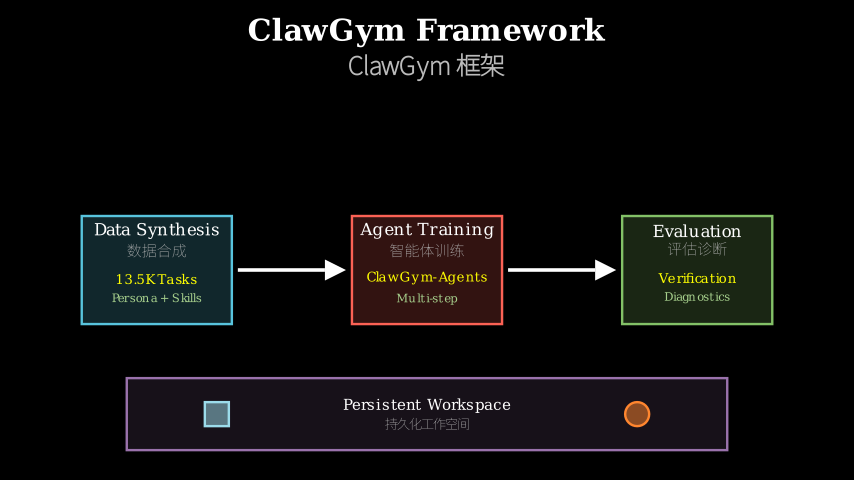
Method: ClawGym framework (data synthesis + training + evaluation)
   |
   +---> ClawGym-SynData: 13.5K tasks with mock workspaces
   +---> ClawGym-Agents: SFT + lightweight RL pipeline
   +---> ClawGym-Bench: 200 human-reviewed instances
   |
   v
Evidence: Agents trained on synthetic data perform well on benchmark
   |
   v
Conclusion: Synthetic data + integrated pipeline enables scalable agent development
The Increment
One sentence: Before this paper, building file-manipulating agents required either unscalable hand-crafted tasks or unverifiable real data; after, you can synthesize diverse verifiable tasks and train agents end-to-end in a unified framework.
Core Mechanism
ClawGym has three components. First, data synthesis: start with persona descriptions (e.g., “software engineer organizing project files”), generate high-level intents, decompose into skill-grounded operations (file edits, tool calls), create mock workspace states, and add hybrid verification (rule-based + LLM judges). Second, agent training: collect black-box rollout trajectories from strong models, fine-tune smaller models via supervised learning, then optionally apply reinforcement learning using per-task sandboxes for parallel rollouts. Third, evaluation: a benchmark of 200 tasks filtered through automated checks and human-LLM review to ensure quality and difficulty calibration.
Data Synthesis Pipeline:
Persona --> Intent --> Skill Operations --> Mock Workspace + Verification
   |          |              |                      |
 "engineer" "organize"  [mv, edit, grep]      files/ + rules/LLM

Training Pipeline:
Strong Model Rollouts --> SFT on Trajectories --> Optional RL (sandboxed)
        |                        |                        |
   GPT-4 demos            smaller model            reward from verification

Evaluation:
ClawGym-Bench (200 tasks) <-- Auto Filter + Human-LLM Review
Think of ClawGym as a flight simulator for personal assistants. Real flight training is expensive and dangerous (real user data has privacy issues and is hard to verify). So you build a simulator: generate diverse flight scenarios (persona-driven tasks), create realistic cockpit states (mock workspaces), add automatic scoring (hybrid verification). Trainee pilots (agents) practice in the simulator (SFT on synthetic rollouts), get feedback (RL with sandboxed execution), then take a standardized test (ClawGym-Bench). The key insight: if your simulator is realistic enough and your scoring is reliable, pilots trained in simulation can fly real planes. Here, “realistic enough” comes from grounding tasks in actual skills (file operations, tool usage) and “reliable scoring” comes from hybrid verification that catches both rule violations and semantic errors.
Key Concepts
-
Persona-driven synthesis: Instead of randomly generating tasks, start with a persona (role + context, like “data scientist cleaning datasets”). The persona constrains what tasks make sense and what files should exist in the workspace. This is like method acting for data generation—the persona gives you a consistent worldview that makes tasks coherent rather than arbitrary. Example: a “student writing essays” persona naturally leads to tasks like “merge notes from multiple sources into one document,” and the workspace contains .txt files with lecture notes, not random binary blobs.
-
Hybrid verification: Checking if an agent solved a task correctly is hard. Rule-based checks (did file X get created? does it contain string Y?) are precise but brittle. LLM judges are flexible but noisy. Hybrid verification uses both: rules for structural requirements (file exists, has correct extension), LLM for semantic correctness (does the summary capture key points?). It’s like grading an essay with a rubric (rules) plus a human reader (LLM)—the rubric catches formatting errors, the reader catches content issues.
-
Skill-grounded operations: Tasks decompose into atomic operations drawn from a predefined skill library (file manipulation, text editing, shell commands). This grounds synthesis in what agents can actually do, preventing impossible or vague tasks. Think of it as Lego blocks—you can build many structures, but each piece has defined connection points. A task like “analyze sales data” becomes [read CSV, filter rows, compute statistics, write report], where each step is a known operation the agent has been trained on.
Framework Shift
Before (mainstream approach):        After (this paper):

Hand-craft tasks                     Synthesize from personas
    |                                    |
    v                                    v
Train on small dataset               Train on 13.5K diverse tasks
    |                                    |
    v                                    v
Evaluate on held-out tasks           Evaluate on calibrated benchmark
    |                                    |
[Doesn't scale]                      [Scales + verifiable]

OR

Use real user data                   Mock workspaces + verification
    |                                    |
    v                                    v
Privacy issues                       No privacy issues
Hard to verify                       Hybrid verification
From artisanal task curation to industrial data synthesis, the core shift is treating task generation as a structured pipeline with explicit quality controls rather than a manual bottleneck.
Expert Assessment
Problem choice: Real gap. Personal productivity agents are under-researched compared to web agents, and the data bottleneck is genuine. The problem sits at the intersection of agent research and practical deployment—timely given recent interest in coding assistants and local AI tools.
Method maturity: Solid engineering, not groundbreaking science. Persona-driven synthesis is clever but not novel (similar ideas in dialogue systems). The RL pipeline is explicitly “lightweight”—parallelized rollouts in sandboxes is good engineering, but the RL formulation itself is standard. The real contribution is integration: showing that synthetic data + SFT + optional RL works end-to-end for this domain.
Experimental integrity: Benchmark construction is the weak point. 200 instances is small, and “human-LLM review” is vague—how much was human vs LLM? What was inter-annotator agreement? The paper doesn’t report agent performance numbers in the abstract, which is suspicious. Baselines are missing—no comparison to agents trained on real data or other synthetic methods. The claim that “relevant resources will be soon released” suggests the work is incomplete.
Writing quality: Abstract is too high-level. Phrases like “hybrid verification mechanisms” and “persona-driven intents” sound impressive but need unpacking. The related work section (not in abstract) likely buries key comparisons. If I were reviewing, I’d ask: what’s the performance gap between your agents and GPT-4? How does synthetic data compare to real data when both are available?
Verdict: weak accept — Useful engineering contribution with practical value, but lacks scientific depth and experimental rigor. The framework will help practitioners, but the paper oversells novelty and under-delivers on evaluation.
Takeaways
Steal the persona-driven synthesis pattern: When generating synthetic data for any domain, start with personas that constrain the distribution. This prevents mode collapse (all tasks look similar) and ensures diversity that matches real use cases. Applicable beyond agents—think synthetic user queries for search, synthetic bug reports for testing, synthetic code reviews for training.
Hybrid verification is underused: Most synthetic data pipelines use either rules or LLM judges, not both. Combining them—rules for structure, LLM for semantics—is simple but effective. Use this for any task where correctness has both formal and informal aspects.
Sandbox parallelization for RL: Running RL rollouts in isolated per-task environments (Docker containers, VMs) lets you parallelize without interference. This is obvious in hindsight but often overlooked. If your RL environment has side effects (file writes, network calls), sandbox it and scale horizontally.
What not to steal: The paper doesn’t justify why you need RL on top of SFT. If SFT on strong model rollouts already works, RL might be premature optimization. Don’t cargo-cult the full pipeline—start with SFT, add RL only if you have evidence it helps.
论文: 2604.26904 作者: Fei Bai, Huatong Song, Shuang Sun, Daixuan Cheng, Yike Yang, Chuan Hao, Renyuan Li, Feng Chang, Yuan Wei, Ran Tao 分类: cs.CL, cs.AI, cs.LG
缺口
现有智能体研究聚焦于网页导航或 API 调用,但个人生产力智能体需要操作本地文件、跨会话维护工作区状态、执行多步工作流。
此前的工作要么用手工设计的任务(无法规模化),要么用真实用户数据(隐私问题、难以验证),要么用简单合成任务(无法捕捉复杂性)。
核心问题:没有系统化的方法来大规模生成多样、可验证的文件操作智能体训练数据,也没有从数据合成到训练到评估的集成管线。
问题:Claw 风格智能体需要多样、可验证的训练数据
   |
   v
假设:可以从角色意图 + 技能操作合成真实任务
   |
   v
方法:ClawGym 框架(数据合成 + 训练 + 评估)
   |
   +---> ClawGym-SynData:13.5K 任务 + 模拟工作区
   +---> ClawGym-Agents:监督微调 + 轻量级强化学习
   +---> ClawGym-Bench:200 个人工审核实例
   |
   v
证据:在合成数据上训练的智能体在基准测试上表现良好
   |
   v
结论:合成数据 + 集成管线使可扩展的智能体开发成为可能
增量
一句话: 这篇论文之前,构建文件操作智能体要么依赖无法规模化的手工任务,要么依赖无法验证的真实数据;之后,你可以合成多样可验证的任务,并在统一框架中端到端训练智能体。
核心机制
ClawGym 有三个组件。
第一,数据合成:从角色描述开始(如”整理项目文件的软件工程师”),生成高层意图,分解为基于技能的操作(文件编辑、工具调用),创建模拟工作区状态,添加混合验证(基于规则 + LLM 评判)。
第二,智能体训练:从强模型收集黑盒推演轨迹,通过监督学习微调小模型,然后可选地应用强化学习,使用每任务沙盒进行并行推演。
第三,评估:一个包含 200 个任务的基准测试,通过自动过滤和人工-LLM 审核来确保质量和难度校准。
数据合成管线:
角色 --> 意图 --> 技能操作 --> 模拟工作区 + 验证
   |       |          |              |
 "工程师" "整理"  [mv, edit, grep]  files/ + 规则/LLM

训练管线:
强模型推演 --> 在轨迹上监督微调 --> 可选强化学习(沙盒化)
     |              |                    |
  GPT-4 演示     小模型              从验证获得奖励

评估:
ClawGym-Bench(200 任务)<-- 自动过滤 + 人工-LLM 审核
把 ClawGym 想象成个人助理的飞行模拟器。
真实飞行训练既昂贵又危险(真实用户数据有隐私问题且难以验证)。
所以你构建一个模拟器:生成多样的飞行场景(角色驱动的任务),创建真实的驾驶舱状态(模拟工作区),添加自动评分(混合验证)。
学员飞行员(智能体)在模拟器中练习(在合成推演上监督微调),获得反馈(带沙盒执行的强化学习),然后参加标准化测试(ClawGym-Bench)。
关键洞察:如果你的模拟器足够真实且评分足够可靠,在模拟中训练的飞行员可以驾驶真实飞机。
这里,“足够真实”来自将任务基于实际技能(文件操作、工具使用),“可靠评分”来自混合验证,既能捕捉规则违反也能捕捉语义错误。
关键概念
- 角色驱动合成: 不是随机生成任务,而是从一个角色开始(角色 + 上下文,如”清理数据集的数据科学家”)。
角色约束了什么任务有意义、工作区应该存在什么文件。
这就像数据生成的方法派表演——角色给你一个一致的世界观,使任务连贯而非任意。
例如:“写论文的学生”角色自然导向”将多个来源的笔记合并到一个文档”这样的任务,工作区包含讲座笔记的 .txt 文件,而非随机二进制块。
- 混合验证: 检查智能体是否正确解决任务很难。
基于规则的检查(文件 X 是否被创建?是否包含字符串 Y?)精确但脆弱。
LLM 评判灵活但有噪声。
混合验证两者都用:规则用于结构要求(文件存在、有正确扩展名),LLM 用于语义正确性(摘要是否捕捉关键点?)。
这就像用评分标准(规则)加人工阅卷(LLM)给作文打分——标准捕捉格式错误,阅卷人捕捉内容问题。
- 技能基础操作: 任务分解为从预定义技能库中抽取的原子操作(文件操作、文本编辑、shell 命令)。
这将合成基于智能体实际能做的事情,防止不可能或模糊的任务。
把它想象成乐高积木——你可以构建许多结构,但每块积木都有定义好的连接点。
像”分析销售数据”这样的任务变成 [读 CSV、过滤行、计算统计、写报告],其中每一步都是智能体训练过的已知操作。
框架转变
之前(主流方法):                之后(本文方法):

手工设计任务                      从角色合成
    |                                |
    v                                v
在小数据集上训练                  在 13.5K 多样任务上训练
    |                                |
    v                                v
在保留任务上评估                  在校准基准上评估
    |                                |
[无法规模化]                      [可规模化 + 可验证]

或者

使用真实用户数据                  模拟工作区 + 验证
    |                                |
    v                                v
隐私问题                          无隐私问题
难以验证                          混合验证
从手工任务策展到工业化数据合成,核心转变是将任务生成视为带有显式质量控制的结构化管线,而非手工瓶颈。
专家评审
选题眼光: 真实缺口。
个人生产力智能体相比网页智能体研究不足,数据瓶颈是真实存在的。
问题位于智能体研究和实际部署的交叉点——考虑到最近对编码助手和本地 AI 工具的兴趣,时机恰当。
方法成熟度: 扎实的工程,不是突破性科学。
角色驱动合成很巧妙但不新颖(对话系统中有类似想法)。
强化学习管线明确是”轻量级”的——沙盒中的并行推演是好工程,但强化学习本身的形式化是标准的。
真正的贡献是集成:展示合成数据 + 监督微调 + 可选强化学习在这个领域端到端有效。
实验诚意: 基准构建是弱点。
200 个实例很小,“人工-LLM 审核”很模糊——多少是人工,多少是 LLM?标注者间一致性如何?论文摘要中没有报告智能体性能数字,这很可疑。
缺少基线——没有与在真实数据或其他合成方法上训练的智能体比较。
“相关资源即将发布”的声明表明工作不完整。
写作功力: 摘要过于高层。
像”混合验证机制”和”角色驱动意图”这样的短语听起来令人印象深刻但需要展开。
相关工作部分(不在摘要中)可能埋藏了关键比较。
如果我在审稿,我会问:你的智能体和 GPT-4 之间的性能差距是多少?当两者都可用时,合成数据与真实数据相比如何?
判决: 弱接收 — 有实用价值的工程贡献,但缺乏科学深度和实验严谨性。
框架会帮助实践者,但论文夸大了新颖性,评估不足。
要点总结
偷走角色驱动合成模式: 为任何领域生成合成数据时,从约束分布的角色开始。
这防止模式坍缩(所有任务看起来相似)并确保与真实用例匹配的多样性。
适用于智能体之外——想想搜索的合成用户查询、测试的合成 bug 报告、训练的合成代码审查。
混合验证被低估: 大多数合成数据管线要么用规则要么用 LLM 评判,不是两者都用。
结合它们——规则用于结构,LLM 用于语义——简单但有效。
用于任何正确性既有形式方面又有非形式方面的任务。
强化学习的沙盒并行化: 在隔离的每任务环境(Docker 容器、虚拟机)中运行强化学习推演,让你可以并行化而不互相干扰。
这在事后看来很明显但经常被忽视。
如果你的强化学习环境有副作用(文件写入、网络调用),将其沙盒化并水平扩展。
不要偷什么: 论文没有证明为什么在监督微调之上需要强化学习。
如果在强模型推演上监督微调已经有效,强化学习可能是过早优化。
不要盲目照搬完整管线——从监督微调开始,只有在有证据表明有帮助时才添加强化学习。