
Paper: 2603.00889 Authors: Xinyu Zhu, Yihao Feng, Yanchao Sun, Xianzhi Du, Pingzhi Li, Olli Saarikivi, Yun Zhu, Yu Meng Categories: cs.CL, cs.AI
The Gap
The current frontier in LLM reasoning relies on massive post-training with high-quality reasoning data—think OpenAI’s o1 or DeepSeek-R1. These models excel because they’ve been trained on extensive Chain-of-Thought (CoT) trajectories showing step-by-step problem solving. But the open-source community faces a chicken-and-egg problem: you need good reasoning data to train reasoning models, but you need reasoning models to generate good reasoning data.
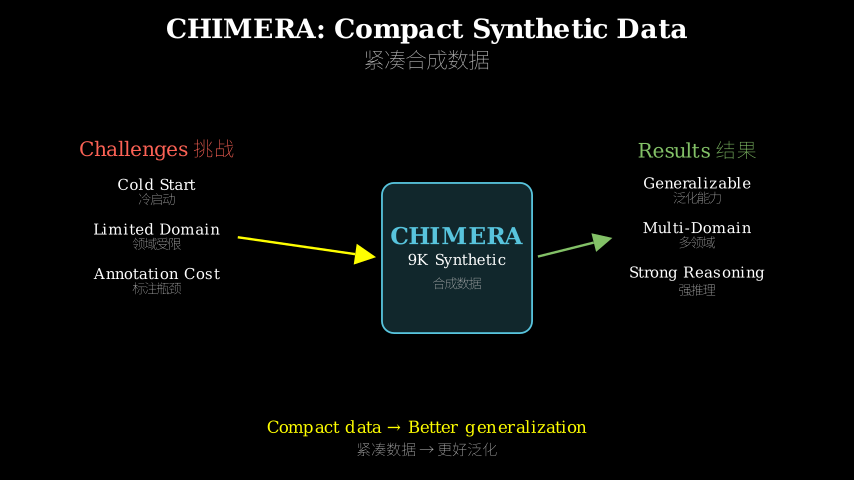
Specifically, three bottlenecks block progress: (1) Cold-start: existing open datasets lack the detailed, long-form reasoning traces needed to bootstrap a reasoning policy from scratch; (2) Domain poverty: most open reasoning datasets are math-heavy (GSM8K, MATH), with sparse coverage of physics, chemistry, biology, or other sciences; (3) Annotation hell: frontier-level reasoning problems are so hard that even expert humans struggle to verify solutions reliably, making human annotation prohibitively expensive or simply infeasible.
The Increment
Before: Training reasoning models required either proprietary datasets or narrow, math-focused open data. After: A 9K-sample synthetic dataset enables a 4B model to compete with 200B+ models on cross-domain reasoning.
CHIMERA works like a seed library for a botanical garden. Instead of collecting every plant species (expensive, slow), you curate a compact collection of seeds (9K samples) with three properties: genetic diversity (8 scientific domains, 1K+ topics organized hierarchically), detailed growth instructions (long CoT trajectories from strong models like GPT-4), and quality control (automated cross-validation using multiple reasoning models to verify both problem validity and answer correctness). When you plant these seeds (post-train a model), they yield a garden that generalizes far beyond the original seed collection.
The construction pipeline has three stages. First, taxonomy generation: a strong model generates a hierarchical topic tree spanning physics, chemistry, biology, computer science, mathematics, engineering, earth science, and social science. Second, trajectory synthesis: for each leaf topic, the system prompts frontier models to generate problems with detailed reasoning chains, explicitly requesting long-form explanations. Third, automated validation: multiple reasoning models independently solve each problem; only samples where models agree on correctness and the problem passes validity checks make it into the final dataset. This creates a self-reinforcing quality filter—bad problems get rejected, good ones get validated by consensus.
Key Concepts
Chain-of-Thought (CoT) Trajectories: Imagine teaching someone to solve a physics problem. You don’t just show the answer—you write out every intermediate step: “First, identify the forces acting on the object. Second, apply Newton’s second law: . Third, solve for acceleration…” A CoT trajectory is exactly this: the full reasoning path from problem to solution. LLMs trained on CoT data learn not just *what the answer is, but how to arrive at it. The “long” part matters—short CoTs might skip crucial reasoning steps, while long ones (CHIMERA’s average hundreds of tokens) force the model to articulate every logical leap. This is why CoT-trained models can tackle novel problems: they’ve internalized the reasoning process itself, not just memorized answer patterns.
Synthetic Data Generation: Here’s the counterintuitive bit—you can use a smart model to teach a dumber model, even though the dumber model will never see the smart model’s internal workings. It’s like learning chess by studying grandmaster games: you don’t need to *be a grandmaster to benefit from their recorded moves. CHIMERA uses models like GPT-4 to generate problems and solutions, then distills this into training data for smaller models. The key is quality control: synthetic data can be garbage if not filtered. CHIMERA’s innovation is using multiple strong models as cross-validators—if three different reasoning models independently arrive at the same answer, it’s probably correct. This automated validation sidesteps the human annotation bottleneck.
Cross-Domain Generalization: Most reasoning datasets are domain-specific: GSM8K is grade-school math, MATH is competition math, etc. A model trained only on math might excel at algebra but fail at chemistry stoichiometry, even though both require similar logical reasoning. CHIMERA’s hierarchical taxonomy ensures coverage across disciplines—not just “science problems,” but specifically “thermodynamics,” “organic chemistry,” “graph algorithms,” etc. The hypothesis: if you train on diverse reasoning *types (quantitative, qualitative, procedural), the model learns transferable reasoning skills. The results suggest this works—a 4B model trained on CHIMERA’s 9K samples performs comparably to 200B+ models on benchmarks spanning multiple domains.
Expert Assessment
Problem significance: This is a high-impact problem. The open-source AI community desperately needs reproducible paths to reasoning capabilities. Currently, only well-resourced labs can afford the data infrastructure for reasoning models. If CHIMERA’s approach scales, it democratizes access—any researcher with API credits can generate similar datasets. The affected community is large: every group working on open LLMs, from academic labs to startups.
Method maturity: This is closer to proof-of-concept than production-ready. The 9K sample size is deliberately small to demonstrate data efficiency, but the paper doesn’t explore scaling laws—would 90K samples yield proportional gains? The reliance on frontier models for synthesis creates a dependency: you need access to GPT-4 or equivalent to replicate this. The automated validation is clever but not bulletproof—consensus among models doesn’t guarantee correctness, especially for truly novel problems where all models might share the same blind spots. The authors acknowledge the dataset is “compact,” which is both a feature (efficiency) and a limitation (coverage gaps are inevitable).
Experimental rigor: The baselines are reasonable—comparing against DeepSeek-R1 and Qwen3-235B establishes that a 4B model punches above its weight class. However, there’s a subtle issue: the evaluation benchmarks (GPQA, AIME, HMMT) might overlap in distribution with CHIMERA’s training data, since both are generated by similar models. The paper doesn’t discuss potential contamination or distribution shift. Also, the comparison is somewhat apples-to-oranges—DeepSeek-R1 likely used far more than 9K samples for post-training. A fairer comparison would be: “What does DeepSeek-R1 achieve with only 9K samples?” That said, the cross-domain performance is genuinely impressive and suggests the approach has legs.
Verdict: Weak accept — demonstrates a promising data-efficient approach to reasoning, but needs deeper analysis of scaling behavior and potential evaluation contamination.
Takeaways
Quality over quantity in synthetic data: CHIMERA shows that 9K carefully curated samples can outperform naive scaling. The lesson: invest in validation infrastructure (multi-model consensus, automated checks) rather than blindly generating millions of samples. This applies beyond LLMs—any domain using synthetic data (robotics, drug discovery) can benefit from quality filters.
Hierarchical topic modeling for coverage: The taxonomy-driven generation ensures no major gaps. Practitioners building datasets for specialized domains (legal reasoning, medical diagnosis) can steal this: first map the conceptual landscape hierarchically, then generate samples to fill each leaf node. This beats ad-hoc collection.
Bootstrapping with model consensus: Using multiple models as cross-validators is a clever workaround for expensive human annotation. This pattern generalizes: in any domain where ground truth is hard to obtain but you have multiple imperfect predictors, consensus voting can approximate truth. The key is ensuring predictors are diverse enough to avoid correlated errors.
Small models can learn reasoning: The 4B vs. 200B+ comparison challenges the “bigger is always better” narrative. With the right data, smaller models can achieve competitive reasoning performance. This has practical implications for deployment—reasoning capabilities might not require massive models if training data is sufficiently rich.
论文: 2603.00889 作者: Xinyu Zhu, Yihao Feng, Yanchao Sun, Xianzhi Du, Pingzhi Li, Olli Saarikivi, Yun Zhu, Yu Meng 分类: cs.CL, cs.AI
缺口
大语言模型的推理能力正处于一个尴尬的阶段。闭源模型如OpenAI o1和DeepSeek-R1展示了惊人的多步推理能力,但开源社区却陷入了”先有鸡还是先有蛋”的困境:训练推理模型需要高质量推理数据,而生成高质量推理数据又需要强大的推理模型。
具体来说,三个瓶颈卡住了开源推理模型的发展。第一是冷启动困境: 现有开源数据集缺乏详细的、长篇幅的思维链(CoT)轨迹,无法为推理策略提供足够的初始化信号。第二是领域贫瘠: 绝大多数开源推理数据集集中在数学领域(GSM8K、MATH等),物理、化学、生物等科学学科的覆盖极其稀疏。第三是标注地狱: 前沿级别的推理问题难到连领域专家都难以可靠验证答案,人工标注要么贵得离谱,要么根本不可行。
增量
之前: 训练推理模型要么依赖专有数据集,要么局限于狭窄的数学领域开源数据。之后: 仅用9千条合成样本,就能让40亿参数模型在跨领域推理上媲美2000亿+参数模型。
CHIMERA的工作机制像是为植物园精选种子库。与其收集每一种植物(昂贵且缓慢),不如策划一个紧凑的种子集合(9千样本),确保三个特性:遗传多样性(8个科学领域、1000+个层次化组织的主题)、详细的生长说明(来自强模型如GPT-4的长篇CoT轨迹)、质量管控(用多个推理模型交叉验证问题有效性和答案正确性)。当你播种这些种子(后训练模型)时,它们长出的花园能泛化到远超原始种子集的范围。
构建流程分三个阶段。首先是分类树生成: 让强模型生成一棵跨越物理、化学、生物、计算机科学、数学、工程、地球科学和社会科学的层次化主题树。其次是轨迹合成: 针对每个叶子主题,系统提示前沿模型生成带详细推理链的问题,明确要求长篇幅解释。最后是自动验证: 多个推理模型独立求解每道题;只有当模型们在正确性上达成共识且问题通过有效性检查时,样本才进入最终数据集。这形成了自我强化的质量过滤器——坏问题被剔除,好问题通过共识验证。
关键概念
思维链(CoT)轨迹: 想象你在教别人解物理题。你不会只给出答案,而是写下每个中间步骤:“首先,识别作用在物体上的力。其次,应用牛顿第二定律:。第三,求解加速度…”CoT轨迹就是这样:从问题到解答的完整推理路径。在CoT数据上训练的语言模型学到的不仅是答案**是什么*,更是如何得出答案。“长”这个特性很关键——短CoT可能跳过关键推理步骤,而长CoT(CHIMERA平均数百token)迫使模型阐明每一个逻辑跳跃。这就是为什么CoT训练的模型能处理新问题:它们内化了推理过程本身,而非仅仅记住答案模式。
合成数据生成: 这里有个反直觉的点——你可以用聪明模型教笨模型,即使笨模型永远看不到聪明模型的内部运作。就像通过研究大师棋谱学下棋:你不需要**成为大师就能从他们的记录中获益。CHIMERA用GPT-4这样的模型生成问题和解答,然后将其蒸馏成小模型的训练数据。关键在于质量控制:如果不过滤,合成数据可能是垃圾。CHIMERA的创新是用多个*强模型做交叉验证——如果三个不同的推理模型独立得出相同答案,那很可能是对的。这种自动验证绕过了人工标注瓶颈。
跨领域泛化: 大多数推理数据集是领域特定的:GSM8K是小学数学,MATH是竞赛数学等等。只在数学上训练的模型可能擅长代数但在化学计量学上失败,尽管两者需要类似的逻辑推理。CHIMERA的层次化分类树确保跨学科覆盖——不只是”科学问题”,而是具体到”热力学”、“有机化学”、“图算法”等。假设是:如果你在多样的推理**类型*(定量、定性、程序性)上训练,模型会学到可迁移的推理技能。结果表明这行得通——在CHIMERA的9千样本上训练的4B模型,在跨多个领域的基准测试上表现可比2000亿+参数模型。
专家评审
问题重要性: 这是个高影响力问题。开源AI社区迫切需要可复现的推理能力路径。目前只有资源充足的实验室能负担推理模型的数据基础设施。如果CHIMERA的方法能规模化,它就民主化了访问权——任何有API额度的研究者都能生成类似数据集。受影响群体很大:从学术实验室到创业公司,每个做开源大模型的团队都需要这个。
方法成熟度: 这更接近概念验证而非生产就绪。9千样本的规模是刻意保持小以展示数据效率,但论文没探索规模定律——9万样本会带来成比例的收益吗?对前沿模型的合成依赖创造了一个依赖项:你需要访问GPT-4或同等模型才能复现。自动验证很聪明但不是万无一失——模型间的共识不保证正确性,特别是对于真正新颖的问题,所有模型可能共享相同的盲点。作者承认数据集是”紧凑的”,这既是特性(效率)也是局限(覆盖缺口不可避免)。
实验严谨性: 基线是合理的——与DeepSeek-R1和Qwen3-235B比较确立了4B模型越级打怪的事实。但有个微妙问题:评估基准(GPQA、AIME、HMMT)可能与CHIMERA训练数据在分布上重叠,因为两者都由类似模型生成。论文没讨论潜在的污染或分布偏移。另外,比较有点苹果对橙子——DeepSeek-R1后训练很可能用了远超9千样本。更公平的比较应该是:“DeepSeek-R1只用9千样本能达到什么水平?”话虽如此,跨领域表现确实令人印象深刻,表明这个方法有前景。
判决: 弱接收——展示了一种有前景的数据高效推理方法,但需要更深入分析规模化行为和潜在的评估污染。
要点总结
合成数据中质量胜于数量: CHIMERA表明9千条精心策划的样本能胜过盲目规模化。教训是:投资验证基础设施(多模型共识、自动检查)而非盲目生成百万样本。这超越了大模型——任何使用合成数据的领域(机器人、药物发现)都能从质量过滤中获益。
用层次化主题建模保证覆盖: 分类树驱动的生成确保没有重大缺口。为专门领域(法律推理、医疗诊断)构建数据集的实践者可以借鉴:先层次化地绘制概念景观,然后生成样本填充每个叶节点。这胜过临时收集。
用模型共识引导启动: 用多个模型做交叉验证器是绕过昂贵人工标注的聪明办法。这个模式可泛化:在任何真值难以获得但你有多个不完美预测器的领域,共识投票能近似真相。关键是确保预测器足够多样以避免相关错误。
小模型也能学会推理: 4B对2000亿+的比较挑战了”越大越好”的叙事。有了正确的数据,小模型能达到竞争性的推理表现。这对部署有实际意义——如果训练数据足够丰富,推理能力可能不需要巨型模型。