
Paper: 2603.24576 Authors: Xinying Guo, Chenxi Jiang, Hyun Bin Kim, Ying Sun, Yang Xiao, Yuhang Han, Jianfei Yang Categories: cs.RO, cs.AI, cs.CV
Abstract
Robotic manipulation often requires memory: occlusion and state changes can make decision-time observations perceptually aliased, making action selection non-Markovian at the observation level because the same frame may require different actions depending on history. This paper proposes Chameleon, a memory system that stores geometry-aware multimodal tokens and uses a differentiable memory stack to retrieve relevant episodes for the current goal. It also introduces Camo-Dataset, a real UR5e robot dataset for episodic recall, spatial tracking, and sequential manipulation under perceptual ambiguity. The reported results indicate improved reliability and stronger long-horizon control versus baselines.
Key Contributions
- Frames long-horizon manipulation as a memory retrieval problem under perceptual ambiguity
- Introduces geometry-grounded multimodal memory tokens for preserving disambiguating context
- Uses a differentiable memory stack for goal-directed episodic recall
- Releases Camo-Dataset for episodic recall and sequential manipulation evaluation
- Reports improved long-horizon control over baseline methods
Methodology
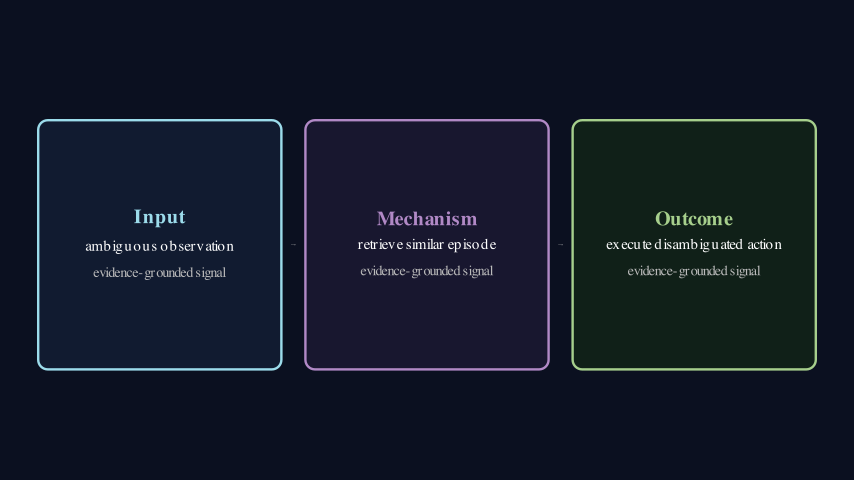
The main idea is that a robot cannot always act correctly from the current observation alone. If two scenes look the same but require different actions, the missing ingredient is history. Chameleon addresses this by storing structured memories that preserve both visual and geometric information, then retrieving the episode that best matches the current goal.
The differentiable memory stack is important because it lets the system use memory without turning recall into a brittle hard lookup. In effect, the robot can keep a compact history of useful episodes and revisit them when the scene becomes ambiguous.
Results
The paper evaluates the system on Camo-Dataset, a real UR5e dataset designed to stress episodic recall and spatial tracking. The results show that Chameleon improves reliability and control in settings where perception alone is insufficient.
The broader takeaway is that memory is not just for language agents. For manipulation, episodic memory can be the difference between a task that looks Markovian on paper and one that is actually solvable in the real world.
Takeaways
- Long-horizon manipulation often needs memory because observations alone can be ambiguous
- Geometry-aware episodic memory helps preserve the context needed for correct action selection
- Differentiable memory stacks make retrieval trainable rather than brittle
- Real robot datasets are essential for evaluating memory under perceptual confusion
- Episodic recall can materially improve long-horizon robotic control
论文: 2603.24576 作者: Xinying Guo, Chenxi Jiang, Hyun Bin Kim, Ying Sun, Yang Xiao, Yuhang Han, Jianfei Yang 分类: cs.RO, cs.AI, cs.CV
摘要
机器人操作往往需要记忆:遮挡和状态变化会让决策时的观测出现感知歧义,使得在观测层面上动作选择不再满足马尔可夫性,因为相同画面在不同历史下可能对应不同动作。本文提出Chameleon,一种存储几何感知多模态令牌并通过可微记忆栈检索与当前目标相关情景的记忆系统。论文还引入了Camo-Dataset,这是一个真实的UR5e机器人数据集,用于情景回忆、空间跟踪以及在感知歧义下的顺序操作。实验结果表明,该方法相比基线具有更好的可靠性和更强的长时程控制能力。
主要贡献
- 将长时程操作建模为感知歧义下的记忆检索问题
- 引入几何感知的多模态记忆令牌,用于保留消歧上下文
- 使用可微记忆栈进行目标驱动的情景回忆
- 发布Camo-Dataset,用于情景回忆和顺序操作评估
- 相比基线方法取得更好的长时程控制表现
方法论
核心思想是:机器人不能总是只依赖当前观测做出正确动作。如果两个场景看起来相同,但需要不同动作,那么缺失的关键就是历史。Chameleon通过存储结构化记忆来保留视觉和几何信息,然后检索与当前目标最匹配的那段情景。
可微记忆栈很重要,因为它让系统可以使用记忆而不必把回忆变成僵硬的硬查询。换句话说,机器人可以保留一组紧凑的、有用的情景历史,并在场景变得歧义时重新调用它们。
结果
论文在专门用于情景回忆和空间跟踪压力测试的Camo-Dataset上评估了该系统。结果显示,Chameleon在仅靠感知不足以完成任务的场景下提升了可靠性和控制能力。
更广泛的启示是:记忆不仅对语言智能体重要。对于操作任务而言,情景记忆可能是将“纸面上看起来是马尔可夫的任务”变成现实中可解决任务的关键。
要点总结
- 长时程操作通常需要记忆,因为观测本身可能是歧义的
- 几何感知的情景记忆有助于保留正确动作所需的上下文
- 可微记忆栈让检索变得可训练而不是僵硬
- 真实机器人数据集对于评估感知歧义下的记忆能力至关重要
- 情景回忆可以显著提升长时程机器人控制能力