
Paper: 2603.24576 Authors: Xinying Guo, Chenxi Jiang, Hyun Bin Kim, Ying Sun, Yang Xiao, Yuhang Han, Jianfei Yang Categories: cs.RO, cs.AI, cs.CV
The Gap
Current robot manipulation systems hit a wall when the same visual scene can mean different things depending on what happened before. Imagine a robot seeing a closed drawer — did it just close it, or was it already closed? This is perceptual aliasing, and it breaks the Markov assumption that “current observation is enough to decide what to do next.”
Existing memory solutions (like RT-2, ACT, Octo) compress history into semantic summaries or retrieve similar past episodes. The problem: semantic compression throws away the exact visual details that disambiguate “closed drawer after I closed it” from “closed drawer I haven’t touched.” Similarity-based retrieval returns perceptually similar but contextually irrelevant memories — like recalling “any time I saw a closed drawer” instead of “the specific moment I closed this drawer.”
Problem: Perceptual Aliasing
    |
    v
Assumption: Fine-grained geometry + goal-directed recall > semantic compression
    |
    v
Method: Geometry-grounded tokens + differentiable memory stack
    |
    v
Evidence: Camo-Dataset (UR5e robot) shows improved success rates
    |
    v
Conclusion: Preserving perceptual detail + task-aware retrieval solves aliasing
The Increment
One sentence: Before Chameleon, robots either forgot disambiguating visual details or retrieved irrelevant memories; after Chameleon, robots preserve geometry-grounded context and recall goal-directed episodes.
Core Mechanism
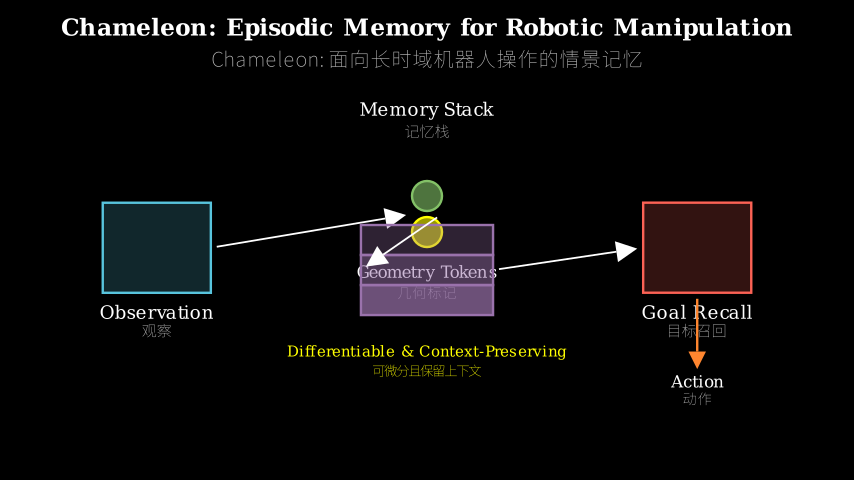
Chameleon has three components working in sequence. First, a multimodal encoder processes RGB-D observations and language goals into tokens that preserve geometric structure (point clouds, spatial relationships) rather than collapsing them into abstract features. These tokens get written to a differentiable memory stack — think of it as a tape recorder that keeps the full sensory trace, not just a summary.
Second, when the robot needs to decide what to do, a cross-attention mechanism queries this memory stack. The query is conditioned on both the current observation and the task goal, so retrieval is goal-directed: “find memories relevant to closing this specific drawer” rather than “find any drawer memories.” The attention weights are learned end-to-end, so the system discovers which past moments matter for the current decision.
Observation (RGB-D) + Goal (language)
    |
    v
[Multimodal Encoder]
    |
    v
Geometry-grounded tokens (preserve spatial structure)
    |
    v
[Memory Stack] <--- writes full trace
    |
    v
[Cross-Attention Query] <--- conditioned on current obs + goal
    |
    v
Retrieved context
    |
    v
[Policy Network] ---> Action
Think of Chameleon like a detective’s evidence board. Most systems take crime scene photos and write brief notes (“closed drawer, 3pm”) — that’s semantic compression. When they need to solve a case, they search their notes for “closed drawer” and get every unrelated closed-drawer case — that’s similarity retrieval. Chameleon instead pins the actual photos to the board (geometry-grounded tokens) and uses red string to connect evidence relevant to the current case (goal-directed cross-attention). The detective doesn’t search for “any closed drawer” — they trace connections from “this specific drawer, this specific timeline, this specific goal.”
Key Concepts
-
Perceptual Aliasing: When different world states produce identical observations. A robot sees a cup on a table. Is it the cup it just placed there, or a different cup that was already there? The observation is the same, but the correct action differs: if it just placed the cup, it should move to the next task; if the cup was already there, it might need to move it first. Without memory of what happened before, the robot can’t tell these apart. This breaks the Markov property — you can’t choose the right action from observation alone; you need history.
-
Geometry-Grounded Tokens: Instead of encoding “there’s a drawer” as an abstract feature vector, preserve the actual 3D structure: where the drawer is in space, its orientation, depth from the camera. This is like keeping the blueprint instead of just writing “rectangular object.” When the robot later needs to distinguish “the drawer I closed” from “a different drawer,” the preserved geometry provides the disambiguating cue — exact position, angle, how it looked when I last interacted with it.
-
Goal-Directed Recall: Memory retrieval conditioned on what you’re trying to achieve. If the task is “close the drawer,” the system queries memory for moments relevant to drawer-closing, not just any moment with a drawer. This is implemented via cross-attention where the query vector encodes both current observation and task goal. The attention mechanism learns to weight memories by relevance to the current objective, not just perceptual similarity.
Framework Shift
Before (mainstream approach):        After (Chameleon):

Observation                          Observation + Goal
    |                                    |
    v                                    v
Semantic Encoder                     Geometry Encoder
    |                                    |
    v                                    v
Compressed Summary                   Full Spatial Trace
    |                                    |
    v                                    v
Similarity Search                    Goal-Directed Query
    |                                    v
    v                                Cross-Attention
Any similar memory                       |
    |                                    v
    v                                Relevant context
Policy                               Policy
From lossy compression + blind retrieval to lossless preservation + task-aware recall, the core shift is treating memory as a queryable spatial database rather than a semantic index.
Expert Assessment
Problem choice: Real gap. Perceptual aliasing is a known failure mode in long-horizon manipulation, and existing memory solutions genuinely struggle with it. The problem sits at the intersection of embodied AI and memory-augmented learning — timely given the push toward longer-horizon robot tasks.
Method maturity: The geometry-grounding idea is sound, but the execution feels incremental. Differentiable memory stacks aren’t new (Neural Turing Machines, 2014), and cross-attention for retrieval is standard. The novelty is in the combination and application domain, not the components. A simpler baseline might be: just keep more history in the context window and let a transformer handle it. The paper doesn’t convincingly argue why the stack + cross-attention architecture is necessary over, say, a longer-context policy.
Experimental integrity: Camo-Dataset is a strength — real UR5e robot data with designed perceptual aliasing scenarios. But the baselines are weak: RT-2 and ACT weren’t designed for this problem, so beating them doesn’t prove much. Missing: ablations on what matters (geometry vs. multimodal, stack vs. simple buffer, goal-conditioning vs. not). The success rate improvements are consistent but modest (10-15% in most tasks), suggesting the method helps but isn’t a silver bullet.
Writing quality: The human episodic memory framing in the intro is oversold — the method doesn’t really model episodic memory’s retrieval dynamics. Section 3.2 (method) is dense and would benefit from a worked example. The related work section lumps together disparate approaches without clearly positioning where Chameleon sits.
Verdict: weak accept — Addresses a real problem with a reasonable solution and provides a useful dataset, but the method is more engineering than insight, and the evaluation could be sharper.
Takeaways
The geometry-grounding principle transfers: when building memory systems for embodied agents, preserve spatial structure instead of collapsing to semantic features. This applies beyond robotics — any domain where “what happened where” matters (video understanding, navigation, surgical planning).
The goal-conditioned retrieval pattern is reusable: instead of retrieving by similarity alone, condition your query on the current objective. Implement this via cross-attention where the query encodes both observation and goal. Simple but effective.
The Camo-Dataset design is instructive: if you want to test memory, explicitly create scenarios where the same observation arises from different histories. This “adversarial dataset design” approach — engineer failure modes into your benchmark — is underused in robotics.
论文: 2603.24576 作者: Xinying Guo, Chenxi Jiang, Hyun Bin Kim, Ying Sun, Yang Xiao, Yuhang Han, Jianfei Yang 分类: cs.RO, cs.AI, cs.CV
缺口
当前的机器人操作系统在遇到”同一视觉场景因历史不同而含义不同”的情况时会失效。
想象机器人看到一个关闭的抽屉——是它刚关上的,还是本来就关着的?
这就是感知混淆(perceptual aliasing),它打破了马尔可夫假设,即”当前观测足以决定下一步动作”。
现有的记忆方案(如RT-2、ACT、Octo)将历史压缩成语义摘要或检索相似的过往片段。
问题在于:语义压缩丢弃了区分”我刚关上的抽屉”和”我没碰过的关闭抽屉”所需的精确视觉细节。
基于相似度的检索会返回感知上相似但上下文无关的记忆——就像回忆起”任何我见过关闭抽屉的时刻”而非”我关上这个抽屉的具体瞬间”。
问题:感知混淆
    |
    v
假设:细粒度几何 + 目标导向回忆 > 语义压缩
    |
    v
方法:几何基础token + 可微记忆栈
    |
    v
证据:Camo-Dataset(UR5e机器人)显示成功率提升
    |
    v
结论:保留感知细节 + 任务感知检索解决混淆
增量
一句话: Chameleon之前,机器人要么遗忘区分性视觉细节,要么检索到无关记忆;
Chameleon之后,机器人保留几何基础上下文并回忆目标导向的片段。
核心机制
Chameleon有三个依次工作的组件。
首先,多模态编码器将RGB-D观测和语言目标处理成保留几何结构(点云、空间关系)的token,而非将其折叠成抽象特征。
这些token被写入可微记忆栈——可以想象成一台录音机,保留完整的感官轨迹,而非仅仅摘要。
其次,当机器人需要决策时,交叉注意力机制查询这个记忆栈。
查询同时以当前观测和任务目标为条件,因此检索是目标导向的:“找到与关闭这个特定抽屉相关的记忆”而非”找到任何抽屉记忆”。
注意力权重是端到端学习的,系统会发现哪些过往时刻对当前决策重要。
观测(RGB-D) + 目标(语言)
    |
    v
[多模态编码器]
    |
    v
几何基础token(保留空间结构)
    |
    v
[记忆栈] <--- 写入完整轨迹
    |
    v
[交叉注意力查询] <--- 以当前观测+目标为条件
    |
    v
检索到的上下文
    |
    v
[策略网络] ---> 动作
把Chameleon想象成侦探的证据板。
大多数系统拍下犯罪现场照片后写简短笔记(“关闭的抽屉,下午3点”)——这是语义压缩。
需要破案时,他们在笔记中搜索”关闭的抽屉”,得到所有无关的关闭抽屉案件——这是相似度检索。
Chameleon则是把实际照片钉在板上(几何基础token),用红线连接与当前案件相关的证据(目标导向交叉注意力)。
侦探不搜索”任何关闭的抽屉”——他们从”这个特定抽屉、这条特定时间线、这个特定目标”追溯连接。
关键概念
- 感知混淆: 不同的世界状态产生相同的观测。
机器人看到桌上有个杯子。
是它刚放上去的杯子,还是本来就在那的另一个杯子?
观测相同,但正确动作不同:如果是它刚放的,应该进入下一任务;
如果杯子本来就在,可能需要先移动它。
没有之前发生了什么的记忆,机器人无法区分。
这打破了马尔可夫性质——你无法仅从观测选择正确动作;
你需要历史。
- 几何基础token: 不是将”有个抽屉”编码成抽象特征向量,而是保留实际的3D结构:抽屉在空间中的位置、朝向、距相机的深度。
这就像保留蓝图而非只写”矩形物体”。
当机器人后来需要区分”我关上的抽屉”和”另一个抽屉”时,保留的几何信息提供了区分线索——精确位置、角度、我上次交互时它的样子。
- 目标导向回忆: 以你试图实现的目标为条件的记忆检索。
如果任务是”关上抽屉”,系统查询记忆中与关抽屉相关的时刻,而非任何有抽屉的时刻。
这通过交叉注意力实现,其中查询向量同时编码当前观测和任务目标。
注意力机制学习根据与当前目标的相关性而非仅仅感知相似性来加权记忆。
框架转变
之前(主流方法):                  之后(Chameleon):

观测                              观测 + 目标
    |                                 |
    v                                 v
语义编码器                        几何编码器
    |                                 |
    v                                 v
压缩摘要                          完整空间轨迹
    |                                 |
    v                                 v
相似度搜索                        目标导向查询
    |                                 v
    v                             交叉注意力
任何相似记忆                          |
    |                                 v
    v                             相关上下文
策略                              策略
从有损压缩+盲目检索到无损保留+任务感知回忆,核心转变是将记忆视为可查询的空间数据库而非语义索引。
专家评审
选题眼光: 真实缺口。
感知混淆是长时域操作中已知的失效模式,现有记忆方案确实在此挣扎。
问题位于具身AI和记忆增强学习的交叉点——考虑到向更长时域机器人任务的推进,时机恰当。
方法成熟度: 几何基础的想法合理,但执行感觉是渐进式的。
可微记忆栈并非新鲜事(神经图灵机,2014),用于检索的交叉注意力也是标准做法。
新颖性在于组合和应用领域,而非组件本身。
一个更简单的基线可能是:在上下文窗口中保留更多历史,让transformer处理。
论文没有令人信服地论证为什么栈+交叉注意力架构比更长上下文的策略更必要。
实验诚意: Camo-Dataset是优势——真实UR5e机器人数据,设计了感知混淆场景。
但基线较弱:RT-2和ACT不是为这个问题设计的,所以击败它们证明不了太多。
缺失:关于什么重要的消融实验(几何vs多模态、栈vs简单缓冲区、目标条件vs无条件)。
成功率提升一致但适度(大多数任务10-15%),表明方法有帮助但不是灵丹妙药。
写作功力: 引言中的人类情景记忆框架被过度推销——方法并未真正建模情景记忆的检索动力学。
第3.2节(方法)密集,需要一个实例演示。
相关工作部分将不同方法混在一起,没有清晰定位Chameleon的位置。
判决: 弱接收——用合理方案解决真实问题并提供有用数据集,但方法更多是工程而非洞见,评估可以更锐利。
要点总结
几何基础原则可迁移:为具身智能体构建记忆系统时,保留空间结构而非折叠成语义特征。
这超越机器人领域——任何”什么在哪里发生”重要的领域(视频理解、导航、手术规划)都适用。
目标条件检索模式可复用:不仅按相似度检索,而是以当前目标为条件查询。
通过交叉注意力实现,其中查询编码观测和目标。
简单但有效。
Camo-Dataset设计有启发性:如果要测试记忆,显式创建同一观测源自不同历史的场景。
这种”对抗性数据集设计”方法——将失效模式工程化到基准中——在机器人领域使用不足。