Paper: 2605.00803 Authors: Ziyang Huang, Yi Cao, Ali K. Shargh, Jing Luo, Ruidong Mei, Mohd Zaki, Zhan Liu, Wyatt Bunstine, William Jurayj, Somdatta Goswami Categories: cs.SE, cs.AI, cs.CL
The Gap
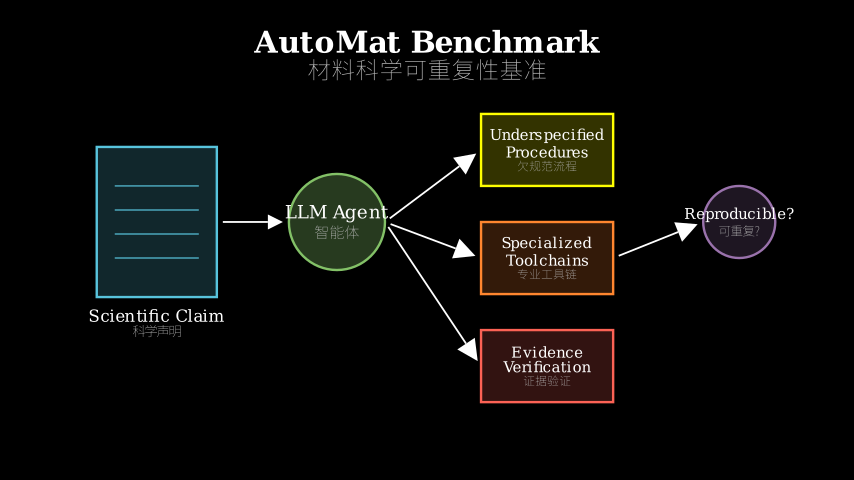
LLM-based coding agents crush software engineering benchmarks like HumanEval and SWE-bench. But those benchmarks test isolated coding tasks with clear specs and standard toolchains. Scientific computing is different: you’re reconstructing underspecified procedures from paper text, navigating domain-specific tools you’ve never seen, and judging whether your results actually support a scientific claim. No one has tested whether coding agents can handle this full pipeline.
The gap: we know agents can write code, but we don’t know if they can do computational science end-to-end. Prior benchmarks measure coding ability in isolation. This paper asks whether that ability transfers to reproducing scientific findings, where the real challenge is navigating ambiguity, specialized tools, and scientific reasoning.
Problem: Coding benchmarks != scientific workflows
   |
   v
Assumption: Scientific reproducibility requires
            procedure recovery + tool navigation + claim validation
   |
   v
Method: AutoMat benchmark with real materials science claims
        + multi-stage evaluation (procedure, execution, validation)
   |
   v
Evidence: Best agent achieves 54.1% success
          Failure modes: incomplete procedures (38%),
                        methodological deviations (22%),
                        execution fragility (18%)
   |
   v
Conclusion: Current agents struggle with scientific workflows
            Gap widens when procedures must be inferred from text
The Increment
One sentence: Before this paper, we knew LLMs could code; after it, we know they can’t reliably reproduce computational science findings, failing most when procedures are underspecified.
Core Mechanism
AutoMat is a three-stage gauntlet. First, the agent reads a materials science claim from a paper and must recover the computational procedure—often underspecified or scattered across methods sections. Second, it executes that procedure using specialized tools like VASP, Quantum ESPRESSO, or ASE, which have their own quirks and conventions. Third, it interprets the results and determines whether they support or contradict the original claim.
The benchmark curates claims from real papers, working with domain experts to establish ground truth. Each claim comes with varying levels of procedural detail: some include full code, others just describe the approach in prose. The evaluation tracks success at each stage—did the agent recover the right procedure? Did it execute without errors? Did it reach the correct scientific conclusion?
Paper claim --> [Agent] --> Procedure recovery
                              |
                              v
                         Tool execution
                         (VASP, QE, ASE...)
                              |
                              v
                         Result interpretation
                              |
                              v
                         Claim validation
                         (support/contradict)
Think of AutoMat as a cooking competition where the recipe is written in a foreign language with half the steps missing. The agent must figure out what ingredients to use (procedure recovery), operate unfamiliar kitchen equipment (tool navigation), taste the result, and decide if it matches the dish described in a food magazine (claim validation). A coding benchmark is like asking someone to chop an onion—useful, but it doesn’t tell you if they can cook a meal. AutoMat tests the full meal.
Key Concepts
-
Procedure recovery: Scientific papers rarely include executable code. Methods sections describe approaches in prose, often omitting parameters, convergence criteria, or preprocessing steps that experts consider “obvious.” Procedure recovery means reconstructing a runnable workflow from this incomplete description. It’s like being told “simmer until done” without a temperature or time—you need domain knowledge to fill the gaps.
-
Claim validation: Unlike software tests with binary pass/fail, scientific claims involve judgment. If a paper claims “material X is stable,” you must run simulations, extract energy values, compare to baselines, and decide if the evidence supports that conclusion. The agent needs to understand what “stable” means in context, what threshold matters, and whether small numerical differences are significant or noise.
-
Execution fragility: Scientific tools are brittle. VASP expects specific file formats. Quantum ESPRESSO has cryptic error messages. A missing pseudopotential or wrong unit cell parameter crashes the whole pipeline. Unlike web dev where you can Google the error, scientific computing errors require domain expertise to diagnose. Agents must handle this fragility without human intervention.
Framework Shift
Before (coding benchmarks):          After (AutoMat):

Spec --> Code --> Test               Paper text --> Procedure recovery
  |        |        |                     |              |
Clear   Standard  Binary            Ambiguous      Domain-specific
input   tools     output            description    tools (VASP, QE)
                                          |              |
                                          v              v
                                    Execution --> Interpretation
                                       |              |
                                    Fragile       Requires scientific
                                    toolchain     judgment
From isolated coding tasks to end-to-end scientific workflows, the core shift is from executing clear specs with standard tools to reconstructing ambiguous procedures with specialized tools and validating results against scientific claims.
Expert Assessment
Problem choice: This is a real gap. The field has been celebrating agent performance on SWE-bench without asking whether that success transfers to domains where specs are ambiguous and tools are specialized. Scientific reproducibility is a high-stakes application where we need to know the limits. The problem sits at the intersection of AI-for-science and agent evaluation—timely and important.
Method maturity: The benchmark design is solid. Working with domain experts to curate claims and establish ground truth is the right move. The three-stage evaluation cleanly separates failure modes. However, the paper doesn’t explore whether agents could improve with domain-specific prompting, retrieval-augmented generation over tool docs, or iterative refinement. It’s a diagnostic benchmark, not a methods paper, but some ablations on agent design would strengthen it.
Experimental integrity: Baselines are fair—they test multiple models (GPT-4, Claude, Gemini) and agent frameworks (ReAct, reflexion, multi-agent). The 54.1% success rate is sobering but believable given the task difficulty. Error analysis is thorough, breaking down failures by stage and root cause. One concern: the benchmark is small (exact size not specified in abstract), which limits statistical power. Also, no comparison to human performance—how often do grad students successfully reproduce these claims?
Writing quality: The abstract is clear and well-structured. The framing is strong—positioning this as both a benchmark and a diagnostic tool. If I were reviewing, I’d push the authors to expand the related work section to better situate this against other scientific benchmarks (e.g., ScienceQA, PubMedQA) and to include human baselines. The error analysis section is likely the paper’s strongest contribution and should be front-loaded.
Verdict: weak accept — Addresses a real gap with a well-designed benchmark, but limited scale and lack of human baselines weaken the empirical contribution. The error taxonomy is valuable for the community.
Takeaways
If you’re building agents for specialized domains, steal the three-stage evaluation framework: procedure recovery, execution, validation. It cleanly separates failure modes and tells you where your agent breaks. Also, the finding that agents perform worst when procedures must be inferred from text is a warning: if your domain has underspecified workflows, current agents will struggle. Consider building retrieval systems over domain-specific documentation or few-shot examples of complete procedures. Finally, the execution fragility issue suggests that agents need better error recovery—not just retry logic, but the ability to diagnose domain-specific errors and adjust parameters. That’s a concrete research direction.
论文: 2605.00803 作者: Ziyang Huang, Yi Cao, Ali K. Shargh, Jing Luo, Ruidong Mei, Mohd Zaki, Zhan Liu, Wyatt Bunstine, William Jurayj, Somdatta Goswami 分类: cs.SE, cs.AI, cs.CL
缺口
基于大语言模型的编码智能体在 HumanEval 和 SWE-bench 这类软件工程基准上表现出色。
但这些基准测试的是孤立的编码任务,有清晰的规格说明和标准工具链。
科学计算不同:你要从论文文本中重建规格不明的程序,操作从未见过的领域专用工具,还要判断结果是否真的支持科学声明。
没人测试过编码智能体能否处理这整条流水线。
缺口在于:我们知道智能体会写代码,但不知道它们能否端到端地做计算科学。
此前的基准只测孤立的编码能力。
本文问的是,这种能力能否迁移到重现科学发现上——那里的真正挑战是应对模糊性、专用工具和科学推理。
问题:编码基准 != 科学工作流
   |
   v
假设:科学可重复性需要
      程序恢复 + 工具导航 + 声明验证
   |
   v
方法:AutoMat 基准,使用真实材料科学声明
      + 多阶段评估(程序、执行、验证)
   |
   v
证据:最佳智能体成功率 54.1%
      失败模式:程序不完整(38%)、
               方法偏离(22%)、
               执行脆弱(18%)
   |
   v
结论:当前智能体在科学工作流上挣扎
      当程序必须从文本推断时差距扩大
增量
一句话:这篇论文之前,我们知道大语言模型会编码;之后,我们知道它们无法可靠地重现计算科学发现,在程序规格不明时失败最多。
核心机制
AutoMat 是一个三关卡挑战。
第一关,智能体读取论文中的材料科学声明,必须恢复计算程序——通常规格不明或散落在方法章节各处。
第二关,它用 VASP、Quantum ESPRESSO 或 ASE 这类专用工具执行程序,这些工具各有怪癖和惯例。
第三关,它解释结果,判断是否支持或反驳原始声明。
基准从真实论文中精选声明,与领域专家合作建立真值。
每个声明附带不同程度的程序细节:有些包含完整代码,有些只用散文描述方法。
评估追踪每个阶段的成功——智能体恢复了正确程序吗?
执行无误吗?
得出了正确的科学结论吗?
论文声明 --> [智能体] --> 程序恢复
                            |
                            v
                       工具执行
                       (VASP, QE, ASE...)
                            |
                            v
                       结果解释
                            |
                            v
                       声明验证
                       (支持/反驳)
把 AutoMat 想象成一场烹饪比赛,食谱用外语写的,还缺了一半步骤。
智能体必须搞清楚用什么食材(程序恢复),操作陌生的厨房设备(工具导航),品尝结果,判断是否符合美食杂志描述的菜品(声明验证)。
编码基准就像让人切洋葱——有用,但不能说明他们会不会做一顿饭。
AutoMat 测试的是做完整顿饭。
关键概念
- 程序恢复:科学论文很少包含可执行代码。
方法章节用散文描述方法,常常省略参数、收敛标准或专家认为”显而易见”的预处理步骤。
程序恢复意味着从这种不完整描述中重建可运行的工作流。
就像被告知”炖到熟”却没给温度和时间——你需要领域知识填补空白。
- 声明验证:不像软件测试有二元的通过/失败,科学声明涉及判断。
如果论文声称”材料 X 稳定”,你必须运行模拟,提取能量值,与基线比较,决定证据是否支持该结论。
智能体需要理解”稳定”在语境中的含义,什么阈值重要,以及小的数值差异是显著的还是噪声。
- 执行脆弱性:科学工具很脆弱。
VASP 期待特定文件格式。
Quantum ESPRESSO 有晦涩的错误信息。
缺少赝势或错误的晶胞参数会让整条流水线崩溃。
不像 Web 开发可以谷歌错误,科学计算错误需要领域专业知识诊断。
智能体必须在无人干预下处理这种脆弱性。
框架转变
之前(编码基准):                之后(AutoMat):

规格 --> 代码 --> 测试            论文文本 --> 程序恢复
  |        |        |                 |              |
清晰    标准     二元              模糊          领域专用
输入    工具     输出              描述          工具(VASP, QE)
                                      |              |
                                      v              v
                                 执行 --> 解释
                                   |              |
                                脆弱          需要科学
                                工具链        判断
从孤立编码任务到端到端科学工作流,核心转变是从用标准工具执行清晰规格,到用专用工具重建模糊程序并根据科学声明验证结果。
专家评审
选题眼光:这是真缺口。
该领域一直在庆祝智能体在 SWE-bench 上的表现,却没问这种成功能否迁移到规格模糊、工具专用的领域。
科学可重复性是高风险应用,我们需要知道极限在哪。
问题处于 AI-for-science 和智能体评估的交叉点——及时且重要。
方法成熟度:基准设计扎实。
与领域专家合作精选声明并建立真值是正确做法。
三阶段评估清晰分离失败模式。
但论文没探索智能体能否通过领域特定提示、工具文档的检索增强生成或迭代改进来提升。
这是诊断基准,不是方法论文,但一些智能体设计的消融实验会让它更强。
实验诚意:基线公平——测试了多个模型(GPT-4、Claude、Gemini)和智能体框架(ReAct、reflexion、多智能体)。
54.1% 的成功率令人清醒但可信,考虑到任务难度。
错误分析彻底,按阶段和根本原因分解失败。
一个担忧:基准规模小(摘要未说明确切大小),限制了统计效力。
另外,没有与人类表现比较——研究生成功重现这些声明的频率是多少?
写作功力:摘要清晰且结构良好。
框架强——将其定位为基准和诊断工具。
如果我审稿,我会推动作者扩展相关工作部分,更好地将其置于其他科学基准(如 ScienceQA、PubMedQA)之中,并包含人类基线。
错误分析部分可能是论文最强贡献,应该前置。
判决:弱接收 — 用精心设计的基准解决真实缺口,但规模有限且缺乏人类基线削弱了实证贡献。
错误分类法对社区有价值。
要点总结
如果你在为专业领域构建智能体,偷走这个三阶段评估框架:程序恢复、执行、验证。
它清晰分离失败模式,告诉你智能体在哪里崩溃。
另外,智能体在必须从文本推断程序时表现最差这一发现是个警告:如果你的领域有规格不明的工作流,当前智能体会挣扎。
考虑在领域特定文档或完整程序的少样本示例上构建检索系统。
最后,执行脆弱性问题表明智能体需要更好的错误恢复——不只是重试逻辑,而是诊断领域特定错误并调整参数的能力。
这是个具体的研究方向。