Paper: 2606.24844
Authors: Hongzhu Yi, Zhongtian Luo, Tong Li, Yiyan Fan, Jungang Xu
Categories: cs.CV
The Gap
Existing one‑step diffusion editors (e.g. DMD, SDXL‑Turbo, LCM‑LoRA) avoid expensive inversion and iterative optimization by a single transport update from source image to target prompt.
But that single step faces an unsolvable trade‑off: the update must be aggressive enough to realise the new prompt, yet conservative enough to preserve the source image. No fixed update strength (or simple scaling) works across edit types – turning a dog into a cat needs more change than changing the background color.
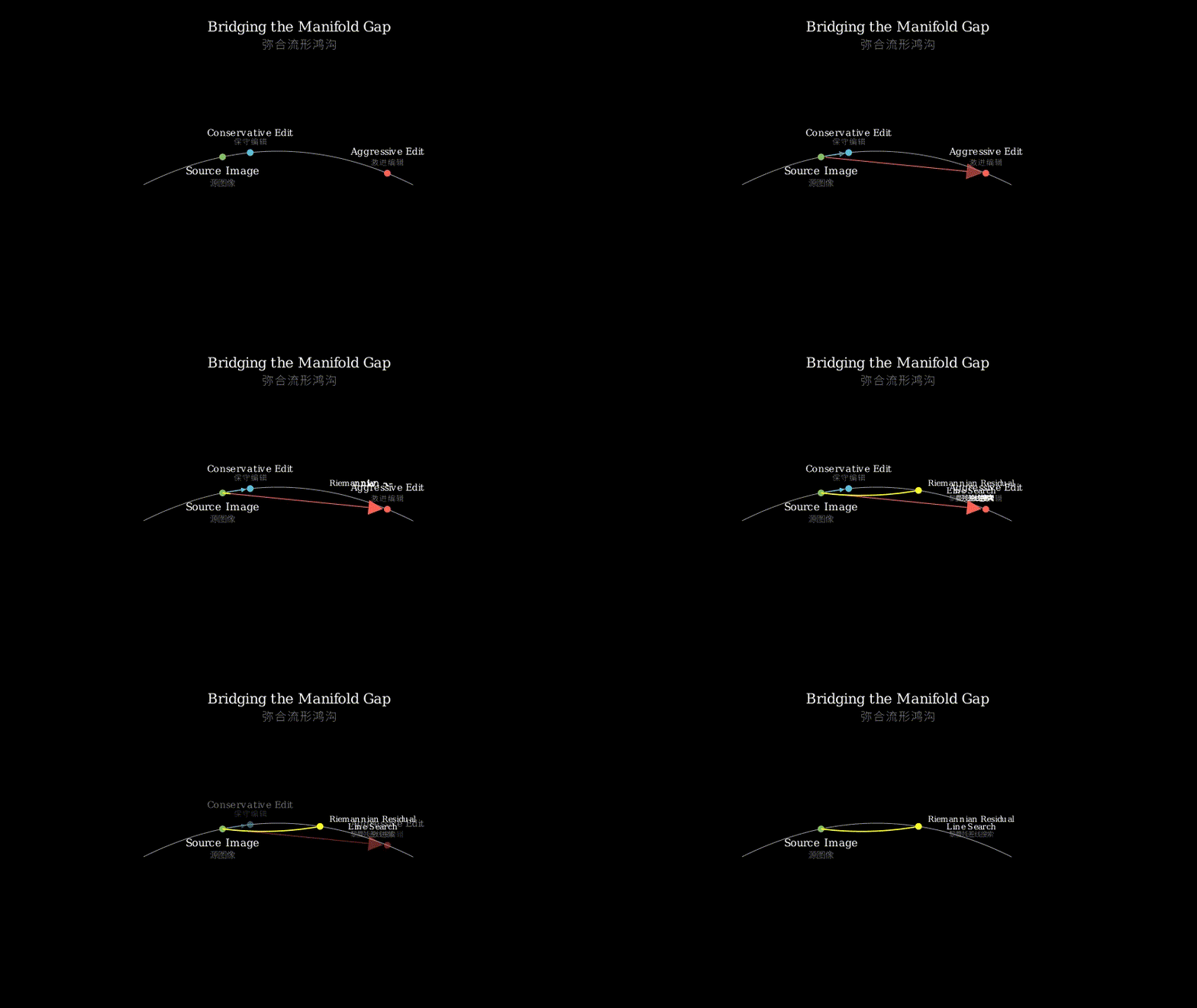
This paper reframes the tension not as a new editing model, but as a post‑hoc candidate‑selection problem on top of an already‑existing energy‑field transport. The gap is that previous work stops at a single first‑order transport output; the authors show that by adding a curvature‑corrected second candidate and a residual path of candidates, you can let CLIP alignment pick the winner.
[Problem: 1-step editors have a fixed update]
         |
         v
[Assumption: local curvature of prompt-delta field can correct first-order transport]
         |
         v
[Method: Riemannian Residual Line Search (RRLS)]
         |
         v
[Evidence: SOTA on all 10 edit types in PIE-Bench++ (700 samples)]
         |
         v
[Conclusion: candidate selection over residual path beats any single fixed update]
The Increment
One sentence: Before this paper, one‑step editors gave you *one output per source‑prompt pair; after this paper, you get a curated shortlist of candidates along a residual path, and the best one is automatically chosen by CLIP – the editor no longer guesses the one “right” strength.
Core Mechanism
The method is called Riemannian Residual Line Search (RRLS). It operates on top of any energy‑field transport (like the one in SDEdit or DMD). The pipeline is:
- Compute first‑order transport – get the original one‑step output (call it (x
_{orig})). - Estimate local curvature – the prompt‑delta field changes direction over time. The authors approximate this curvature by taking small steps around the original transport and measuring how the direction changes. This gives a *corrected direction that is a better guess for a much more aggressive edit.
- Project back to original norm – the corrected direction may have a different magnitude than the original step. They rescale it so that the correction’s norm matches the original step’s norm, yielding a “strong edit” candidate (x
_{strong}). - Build a residual path – linearly interpolate between the source image (x_0) and the strong edit (x
_{strong}) to create a small discrete set of intermediate images: (x_0, x_1, \dots, x_{strong}). The original first‑order output is always one of these points. - Select via CLIP alignment – for each candidate, compute the CLIP cosine similarity between the candidate image and the target prompt. Pick the one with maximum score.
The data flow is:
source image --> [first-order transport] --> x_orig (candidate 1)
             --> [curvature estimation] --> corrected delta
             --> [norm projection]       --> strong edit delta
             --> [residual path]         --> candidates {x_orig, x_interp..., x_strong}
             --> [CLIP selection]        --> final output
Structural metaphor: Foraging a river with stepping stones
Imagine you want to cross a river (source image) to a specific tree on the far bank (target prompt).
- The first‑order transport is a big jump from the near bank – it might land you close to the tree, or it might drop you in the water.
- You notice the current (curvature of the prompt‑delta field) is pulling differently than you expected. You adjust your jump direction and aim for a new landing spot ((x
_{strong})) that you believe is closer to the tree. - You lay out a line of stepping stones (residual path) from your starting point to that new landing spot. The original jump point is one of those stones.
- You try each stone: do you see the tree well from there? (CLIP alignment). The stone with the best view of the tree is your final crossing point.
Key Concepts
-
One‑step diffusion editor: A model that directly maps a source image to an edited image in a single forward pass (instead of denoising over many steps). The challenge is that a single update must simultaneously satisfy two conflicting goals – fidelity to the source and adherence to a new prompt. Earlier methods use a fixed hyperparameter (e.g., guidance scale, noise strength) that cannot adapt per edit.
Example: To turn a photo of a dog into a cat, you need a large change in semantics; to change the dog’s collar color, you need a small change. A one‑step editor that works for the color change will fail for the cat change, and vice versa. -
Energy‑field transport: The core mathematical model that maps a source image to a target prompt through a learned vector field (often derived from diffusion model score functions). It assumes the editing operation is a deterministic translation along the most likely path, computed as a single Euler step. RRLS treats this first‑order result as the “zero‑th order” candidate, then improves it using curvature information.
-
Riemannian residual: In differential geometry, the “curvature” of a vector field tells you how the direction changes as you move. RRLS estimates this curvature locally by taking two small steps in the prompt‑delta field and measuring the change in direction. The *residual is the difference between the first‑order direction and the curvature‑corrected direction. This residual is then added back to the source with a projected norm to create a stronger edit candidate.
Intuition: If you’re walking in a straight line but the ground starts sloping, you should adjust your next step. The residual is the slope correction.
Framework Shift
Before (mainstream one-step editing):

    source +---> [fixed transport] ---> single output
                (no curvature info, no candidates)

After (this paper - RRLS):

    source +---> [first-order transport] ---> x_orig
         |
         +---> [curvature estimation] ---> corrected direction
         |
         +---> [residual path] ---------> candidates {x_orig, ..., x_strong}
         |
         +---> [CLIP selection] --------> final output (best candidate)
One sentence: From a single blind jump to a guided candidate patrol along a curvature‑corrected path, the core shift is *turning editing into a selection problem over geometry‑informed trajectories.
Expert Assessment
Problem choice: Real gap. One‑step editors are practically important (speed), and the fixed‑strength limitation is a known bottleneck. The paper smartly decouples the editing model from the candidate selection—this is a clean framing that could outlive any specific transport model.
Method maturity: Clever but incremental. The curvature estimation is a simple finite‑difference approximation – not deep geometry – and the residual path is linear interpolation. The true novelty is the *selection framing, not the mathematics. There may be simpler approaches (e.g., just sampling multiple random strengths and picking by CLIP), but they lack the curvature‑guided efficiency. The projection back to original norm is a neat trick to keep the correction grounded.
Experimental integrity: Strong but incomplete. The PIE‑Bench++ results are convincing (SOTA across 10 edit types), and they compare against fair baselines (DMD, SDXL‑Turbo, etc.). However, the paper does not show ablation of the curvature component – what if you just use a residual path without the curvature correction? That would clarify whether the geometry adds value over a brute‑force linear sweep. Also missing: user study or qualitative failure cases.
Writing quality: The paper is clear but dense. The authors assume familiarity with diffusion manifolds and Riemannian concepts. The weakest section is the introduction, which jumps too quickly into technical terminology. A rewritten first paragraph with a concrete running example would dramatically improve accessibility.
Verdict: Weak accept – solves a real problem with a clean, transferable idea, but the technical depth is modest and the experimental design has a missing ablation.
Takeaways
-
The candidate‑selection meta‑approach: You don’t need to design a single perfect update; you can generate a small set of plausible candidates and use an external evaluator (CLIP, in this case) to pick the winner. This recipe is domain‑independent – any task with a one‑shot predictor could benefit from a similar residual path and a simple quality metric.
-
Curvature as a cheap correction: Estimating the local curvature of the prompt‑delta field with a few extra forward passes gives a surprisingly effective second candidate. Practitioners can steal this idea to boost any one‑step transport method without retraining.
-
Norm projection to stay in distribution: When you correct a direction, your delta may grow too large or too small. Projecting it back to the original step’s norm ensures the new candidate lives in a similar magnitude regime as the original – a practical heuristic that likely prevents degenerate edits.
论文: 2606.24844
作者: Hongzhu Yi, Zhongtian Luo, Tong Li, Yiyan Fan, Jungang Xu
分类: cs.CV
缺口
现有的单步扩散编辑器(如DMD、SDXL‑Turbo、LCM‑LoRA)通过一次性传输更新从源图像映射到目标提示,避免了耗时的逆迭代和迭代优化。但这种单步更新面临一个不可调和的矛盾:它必须足够激进以实现新提示,又必须足够保守以保留源图像——没有一个固定的更新强度能适配所有编辑类型。 将狗变成猫需要大改动,而只改变背景颜色只需要小改动。 这篇论文的突破在于:它不试图设计一个新的编辑模型,而是将上述矛盾重新定义为事后候选选择问题——在已有能量场传输(第一阶输出)的基础上,引入曲率校正和残差路径,让CLIP自动选出最佳候选。
[问题:单步编辑器使用固定更新强度]
           |
           v
[假设:提示-差值场的局部曲率可以校正第一阶传输方向]
           |
           v
[方法:黎曼残差线搜索 (RRLS)]
           |
           v
[证据:在 PIE-Bench++ 的10种编辑类型上达到SOTA(700个样本)]
           |
           v
[结论:基于残差路径的候选选择胜过任何单一固定更新]
增量
一句话:这篇论文之前,单步编辑对一个源-提示对只输出一个结果;这篇论文之后,你会得到一条沿残差路径的候选曲线,CLIP自动选出最佳的一个——编辑器不再需要猜”那个唯一的正确强度”。
核心机制
方法名为黎曼残差线搜索(Riemannian Residual Line Search, RRLS),它基于任意已有的能量场传输(如SDEdit或DMD中的传输)。pipeline如下:
- 计算第一阶传输 —— 获得原始的单步输出(记为 (x
_{orig}))。 - 估计局部曲率 —— 提示-差值场的方向随时间变化。作者通过在原始传输附近迈一小步,测量方向的变化来近似曲率,得到一个更好的**校正方向*,它更接近一个激进编辑所需的方向。
- 投影回原始范数 —— 校正方向的大小可能不同于原始步长。他们将其放缩,使校正后的方向范数等于原始步长的范数,得到”强编辑”候选 (x
_{strong})。 - 构建残差路径 —— 在源图像 (x_0) 与强编辑 (x
_{strong}) 之间线性插值,得到少量离散中间图像:(x_0, x_1, \dots, x_{strong})。原始的第一阶输出总是路径上的一个点。 - 通过CLIP对齐选择 —— 对每个候选计算CLIP余弦相似度(候选图像与目标提示),选取得分最高的作为最终结果。
数据流如下:
源图像 --> [第一阶传输] --> x_orig (候选1)
       --> [曲率估计] --> 校正后的差值
       --> [范数投影] --> 强编辑差值
       --> [残差路径] --> 候选集 {x_orig, x_插值..., x_strong}
       --> [CLIP选择] --> 最终输出
结构性比喻:在河流中铺设踏脚石
想象你要跨过一条河(源图像)到达对岸的一棵特定的树(目标提示)。
- 第一阶传输是从岸边的一大步,可能落在树附近,也可能掉进水里。
- 你发现水流(提示-差值场的曲率)和你预想的不同。你调整跳跃方向,瞄准一个新的落点((x
_{strong})),相信它更靠近树。 - 你从起点到新落点铺设一排踏脚石(残差路径)。原始跳跃点也是其中一块石头。
- 你站在每块石头上看那棵树(CLIP对齐)。最清楚看到树的那块石头就是你最后的渡河点。
关键概念
-
单步扩散编辑器:一种模型,在单次前向传播中直接从源图像映射到编辑后的图像(而非多步去噪)。关键在于,一次更新必须同时满足两个冲突的目标——忠实于源图像和遵循新提示。现有方法使用固定的超参数(如指导尺度、噪声强度),无法适应不同编辑类型。
例子:把一张狗的照片变成猫需要大的语义改动;只改变项圈颜色需要小改动。适用于颜色改变的单步编辑器在猫的改动上会失败,反之亦然。 -
能量场传输:通过一个学习到的向量场(常源自扩散模型的得分函数)将源图像映射到目标提示的数学模型。它将编辑操作视为沿最可能路径的确定性平移,以单个欧拉步计算。RRLS把这一第一阶结果当作”零阶候选”,然后利用曲率信息加以改进。
-
黎曼残差:在微分几何中,向量场的”曲率”告诉你方向如何随位置变化。RRLS通过往提示-差值场迈两个小步、测量方向变化来局部估计曲率。**残差*是第一阶方向与曲率校正方向之间的差值。然后这个残差被加回到源图像(经过范数投影),以创建一个更强的编辑候选。
直觉:如果你沿直线走但地面开始倾斜,你应该调整下一步。残差就是倾斜校正。
框架转变
之前(主流单步编辑):

源图像 +---> [固定传输] ---> 单一输出
          (无曲率信息,无候选)

之后(本文的RRLS):

源图像 +---> [第一阶传输] ---> x_orig
       |
       +---> [曲率估计] ---> 校正方向
       |
       +---> [残差路径] ---> 候选集 {x_orig, ..., x_strong}
       |
       +---> [CLIP选择] ---> 最终输出(最佳候选)
一句话:从一次盲跳到一条沿曲率校正路径的候选巡逻,核心转变是将编辑问题转化为基于几何信息轨迹的选择问题。
专家评审
选题眼光:真缺口。单步编辑器在实践中很重要(速度快),固定强度的限制是已知瓶颈。论文巧妙地将编辑模型与候选选择解耦——这种框架可能比任何特定传输模型更持久。
方法成熟度:巧劲但增量。曲率估计只是简单的有限差分近似——不是深层几何——残差路径是线性插值。真正的创新在于**选择*框架,而非数学。可能存在更简单的方法(例如随机采样多种强度再选最好的),但缺乏曲率引导的效率。投影回原始范数是保持校正稳定的巧妙技巧。
实验诚意:较强但不完整。PIE‑Bench++结果有说服力(10种编辑类型均达SOTA),与公平基线(DMD、SDXL‑Turbo等)对比。但论文缺少对曲率组件的消融实验——如果不做曲率校正,仅用残差路径会怎样?这能说明几何信息是否比暴力线性扫描更有价值。另外缺失用户研究和失败案例分析。
写作功力:论文清晰但密集。作者假设读者熟悉扩散流形和黎曼概念。最薄弱的是引言部分,太早进入技术术语。如果用一个具体的运行示例开头,整篇论文的可读性会大幅提升。
判决:弱接收 — 解决了一个真实问题,思路干净且可迁移,但技术深度一般,实验设计缺少一个关键消融。
要点总结
-
候选选择的元方法:你不需要设计一个完美的单次更新;你可以生成少量合理的候选,然后用外部评估器(这里用CLIP)选出赢家。这种方法与领域无关——任何有单次预测器的任务都可以受益于类似的残差路径和一个简单的质量指标。
-
曲率作为廉价校正:多花几次前向传播来估计提示-差值场的局部曲率,能意外有效地得到第二个强候选。实践者可以直接利用这个想法来提升任何单步传输方法,无需重新训练。
-
范数投影以保持在分布内:校正方向后,差值可能变得太大或太小。将其投影回原始步长的范数能确保新候选处于与原始候选相似的幅度范围内——这是一个实用的启发式方法,很可能防止退化编辑。