Paper: 2603.14948 Authors: Xingtai Gui, Meijie Zhang, Tianyi Yan, Wencheng Han, Jiahao Gong, Feiyang Tan, Cheng-zhong Xu, Jianbing Shen Categories: cs.CV
The Gap
Driving world models have gotten good at predicting what a scene will look like in the future—think video generation conditioned on sensor input. But here’s the problem: these models optimize for visual fidelity (making pretty, realistic videos), while planners need something different—representations that encode actionable motion information. The world model learns “this is what the scene looks like if I turn left,” but the planner has to learn motion planning from scratch using a completely different representation space. It’s like having a weather forecaster who can show you beautiful animations of tomorrow’s storm, but can’t tell you whether to bring an umbrella.
Prior work (GAIA-1, DriveDreamer, etc.) focuses on controllable scene generation—you can condition on high-level actions, but the motion representation isn’t explicitly designed to be inherited by the planner. The world model and planner live in separate worlds, connected only by a thin bridge of high-level action labels.
Problem: World models optimize for visual fidelity
         |
         v
Assumption: Motion representation should be planner-compatible
         |
         v
Method: Trajectory-aware world model + shared encoders
         |
         v
Evidence: NAVSIM/nuScenes benchmarks show planning improvement
         |
         v
Conclusion: Unifying representations bridges generation and planning
The Increment
One sentence: Before, world models generated scenes and planners learned separately; now, they share a unified representation space where visual dynamics and motion intentions are explicitly coupled.
Core Mechanism
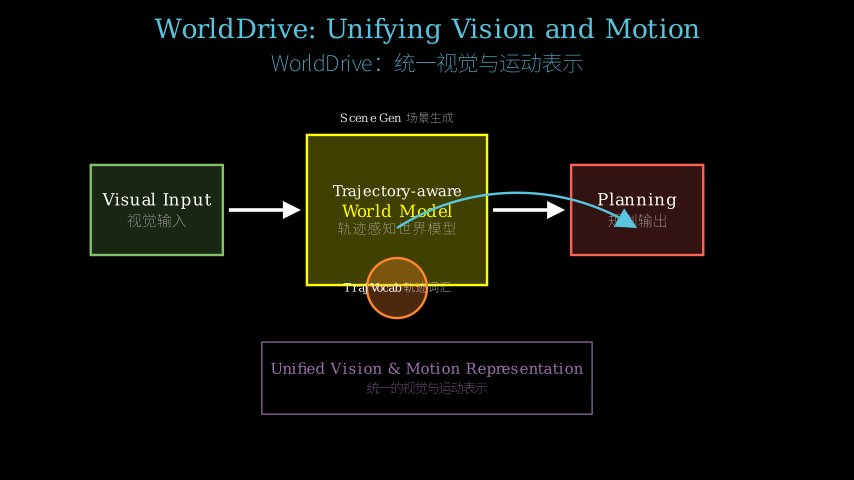
WorldDrive has three components working in concert. First, the Trajectory-aware Driving World Model takes sensor input and a trajectory from a learned vocabulary, then generates future scenes conditioned on that specific trajectory. The key is that trajectory tokens are embedded into the generation process, forcing the model to learn representations where visual dynamics (how the scene evolves) and motion intentions (where the car wants to go) are tightly coupled.
Second, the Multi-modal Planner doesn’t start from scratch. It inherits the vision and motion encoders from the world model—these are frozen, pre-trained representations that already understand the relationship between what you see and how you move. The planner adds a lightweight interaction module that combines motion representation, visual representation, and ego vehicle status to generate multiple trajectory candidates.
Third, the Future-aware Rewarder acts as a quality filter. It takes the frozen world model and uses it to evaluate trajectory candidates in real-time. For each candidate trajectory, it extracts future latent representations from the world model and scores them, selecting the trajectory that the world model thinks will lead to the most plausible future state.
Sensor Input ---> [Vision Encoder] ---> Visual Features
                         |                      |
Trajectory Vocab --------+                      |
                         |                      v
                         v              [World Model Decoder]
                  [Motion Encoder]              |
                         |                      v
                         |              Generated Future Scenes
                         |
                         +---> [Frozen for Planner]
                         |
                         v
              [Multi-modal Planner] ---> Trajectory Candidates
                         |
                         v
              [Future-aware Rewarder] ---> Selected Trajectory
                    (uses frozen world model)
Think of it like training a pilot. Traditional approaches are like teaching someone to fly using a flight simulator (world model) and then separately teaching them decision-making in a classroom (planner)—the simulator knowledge doesn’t transfer. WorldDrive is like a simulator that explicitly teaches both “what happens when I pull this stick” AND “how to decide which stick to pull,” using the same mental model. The instructor (world model) learns to explain maneuvers in terms the student (planner) will actually use. Then, when the student practices decision-making, they’re already fluent in the language the simulator taught them. Finally, before executing any maneuver, the student can mentally simulate it using their instructor’s frozen knowledge to check if it makes sense.
Key Concepts
-
Trajectory Vocabulary: Instead of conditioning the world model on raw trajectory coordinates or high-level action labels, WorldDrive learns a discrete vocabulary of trajectory tokens through VQ-VAE. Think of it like learning a language of motion primitives—“sharp left turn,” “gradual lane change,” “emergency brake”—rather than describing every motion as a sequence of steering angles. This discretization serves two purposes: it makes the generation problem more tractable (finite vocabulary vs infinite continuous space), and it creates a shared “language” that both the world model and planner can speak. When the world model generates a scene conditioned on token #47, and the planner outputs token #47, they’re talking about the same motion intention.
-
Representation Inheritance: Most end-to-end driving systems train the planner from scratch on raw sensor data. WorldDrive instead freezes the vision and motion encoders from the world model and transfers them to the planner. Why does this matter? The world model has already learned, through scene generation, which visual features matter for predicting motion and which motion patterns are physically plausible. The planner inherits this mature understanding rather than relearning it. It’s the difference between giving someone a pre-built vocabulary vs making them learn language from scratch—they can focus on composition (planning) rather than fundamentals (what features matter).
-
Future-aware Reward: Traditional planners evaluate trajectories using hand-crafted cost functions (distance to lane center, collision risk, etc.). WorldDrive’s rewarder instead asks the frozen world model: “If I execute this trajectory, what future state will I reach, and how plausible is that state?” It extracts latent representations from the world model for each candidate trajectory and scores them based on the model’s internal notion of plausibility. This is like having a chess engine that doesn’t just evaluate positions using material count, but uses a neural network trained on millions of games to recognize “this position feels wrong” even if it can’t articulate why.
Framework Shift
Before (mainstream approach):        After (this paper):

[World Model]                        [Trajectory-aware World Model]
     |                                    |         ^
     | (visual scenes)                   |         |
     v                                   | (shared | (trajectory
[Separate Training]                      |  repr.) |  condition)
     |                                   v         |
     | (raw sensors)                [Multi-modal Planner]
     v                                    |
[Planner]                                | (candidates)
     |                                   v
     v                            [Future-aware Rewarder]
[Trajectory]                          (uses frozen WM)
                                         |
                                         v
                                    [Trajectory]

Gap: Different representations      Bridge: Unified representation
From parallel pipelines to nested inheritance, the core shift is making the world model’s knowledge directly usable by the planner through shared representation space.
Expert Assessment
Problem choice: This is a real gap, not manufactured. The autonomous driving community has been excited about world models (see Tesla’s FSD, Wayve’s GAIA), but the connection to planning has been hand-wavy. Most papers show that world models can generate realistic videos, then separately show that planners can drive, but don’t rigorously connect the two. This paper tackles that schism head-on. It sits at a natural inflection point where world models are mature enough that we should be asking “how do we actually use them for decision-making?”
Method maturity: The approach is more clever than brute force. The trajectory vocabulary idea is elegant—it solves both the conditioning problem and the representation sharing problem with one mechanism. However, I’m skeptical about whether freezing the encoders is always optimal. The paper claims this ensures “mature representations,” but it also means the planner can’t adapt those representations to its specific needs. A more nuanced approach might allow fine-tuning with a small learning rate. The future-aware rewarder feels a bit bolted on—it’s not clear this is better than just training the planner end-to-end with the world model in the loop.
Experimental integrity: The benchmarks (NAVSIM, nuScenes) are standard and the baselines seem fair. The paper claims “leading performance among vision-only methods,” which is a careful hedge—they’re not claiming SOTA overall, just within the vision-only category. The ablations are reasonable, showing that each component contributes. One red flag: they don’t show failure cases or discuss when the approach breaks down. Also, the “high-fidelity action-controlled video generation” claim needs scrutiny—are they cherry-picking examples?
Writing quality: The abstract is dense and jargon-heavy (“planner-shared and inheritable” is awkward). The method section is clearer, but the paper would benefit from a more explicit discussion of design choices. Why VQ-VAE for trajectory vocabulary instead of alternatives? Why freeze encoders completely? The related work section does a decent job positioning the work, but could be more critical of prior approaches.
Verdict: Weak accept — solid contribution to a real problem, but the method feels like a first step rather than a definitive solution, and the experimental validation could be more thorough.
Takeaways
If you’re building any system where you have a generative model (world model, simulator, forecaster) and a decision-making component (planner, controller, agent), steal this idea: design your generative model’s conditioning mechanism to create representations that your decision-maker can inherit. Don’t just condition on high-level actions; condition on a structured representation (like the trajectory vocabulary here) that forces the generative model to learn decision-relevant features.
The trajectory vocabulary approach via VQ-VAE is directly transferable to other domains. If you’re doing robot manipulation, instead of conditioning your world model on raw joint angles, learn a vocabulary of motion primitives. If you’re doing dialogue systems, instead of conditioning on raw text, learn a vocabulary of conversational moves.
The “freeze and transfer” strategy is worth experimenting with, even if you ultimately fine-tune. Starting with frozen pre-trained representations from a related task often works better than random initialization, and it forces you to think about what knowledge should transfer vs what should be task-specific.
论文: 2603.14948 作者: Xingtai Gui, Meijie Zhang, Tianyi Yan, Wencheng Han, Jiahao Gong, Feiyang Tan, Cheng-zhong Xu, Jianbing Shen 分类: cs.CV
缺口
驾驶世界模型已经很擅长预测未来场景的样子——想象一下根据传感器输入生成的视频。
但问题来了:这些模型优化的是视觉保真度(生成逼真漂亮的视频),而规划器需要的是别的东西——能编码可执行运动信息的表征。
世界模型学会了”如果我左转,场景会是这样”,但规划器必须用完全不同的表征空间从头学习运动规划。
这就像有个气象预报员能给你展示明天暴风雨的精美动画,却不能告诉你该不该带伞。
先前的工作(GAIA-1、DriveDreamer 等)专注于可控场景生成——你可以基于高层动作进行条件控制,但运动表征并没有被明确设计成可被规划器继承的形式。
世界模型和规划器活在各自的世界里,只通过高层动作标签这座细桥连接。
问题:世界模型优化视觉保真度
         |
         v
假设:运动表征应该与规划器兼容
         |
         v
方法:轨迹感知世界模型 + 共享编码器
         |
         v
证据:NAVSIM/nuScenes 基准测试显示规划性能提升
         |
         v
结论:统一表征弥合了生成与规划的鸿沟
增量
一句话: 之前世界模型生成场景、规划器独立学习;现在它们共享统一的表征空间,视觉动态和运动意图被显式耦合。
核心机制
WorldDrive 有三个协同工作的组件。
首先,轨迹感知驾驶世界模型接收传感器输入和一个来自学习词汇表的轨迹,然后生成以该特定轨迹为条件的未来场景。
关键在于轨迹标记被嵌入到生成过程中,迫使模型学习这样的表征:视觉动态(场景如何演化)和运动意图(车想去哪里)紧密耦合。
其次,多模态规划器不从零开始。
它继承了世界模型的视觉和运动编码器——这些是冻结的、预训练的表征,已经理解了你看到的和你如何移动之间的关系。
规划器添加一个轻量级交互模块,结合运动表征、视觉表征和自车状态来生成多个轨迹候选。
第三,未来感知奖励器充当质量过滤器。
它使用冻结的世界模型实时评估轨迹候选。
对每个候选轨迹,它从世界模型中提取未来潜在表征并打分,选择世界模型认为会导致最合理未来状态的轨迹。
传感器输入 ---> [视觉编码器] ---> 视觉特征
                      |                  |
轨迹词汇表 -----------+                  |
                      |                  v
                      v          [世界模型解码器]
               [运动编码器]              |
                      |                  v
                      |          生成的未来场景
                      |
                      +---> [冻结用于规划器]
                      |
                      v
           [多模态规划器] ---> 轨迹候选
                      |
                      v
           [未来感知奖励器] ---> 选定轨迹
                 (使用冻结世界模型)
把它想象成训练飞行员。
传统方法就像用飞行模拟器(世界模型)教人飞行,然后在教室里单独教决策(规划器)——模拟器的知识无法迁移。
WorldDrive 就像一个模拟器,既明确教”拉这个操纵杆会发生什么”,又教”如何决定拉哪个操纵杆”,使用同一套心智模型。
教练(世界模型)学会用学生(规划器)实际会用的术语来解释机动动作。
然后,当学生练习决策时,他们已经流利掌握了模拟器教的语言。
最后,在执行任何机动之前,学生可以用教练的冻结知识进行心理模拟,检查是否合理。
关键概念
- 轨迹词汇表: WorldDrive 不是用原始轨迹坐标或高层动作标签来条件化世界模型,而是通过 VQ-VAE 学习一个离散的轨迹标记词汇表。
把它想象成学习一种运动原语的语言——“急转弯”、“渐进变道”、“紧急刹车”——而不是把每个动作描述成一串转向角。
这种离散化有两个目的:它让生成问题更易处理(有限词汇 vs 无限连续空间),并且创建了一种世界模型和规划器都能说的共享”语言”。
当世界模型生成以标记 #47 为条件的场景,规划器输出标记 #47 时,它们在谈论同一个运动意图。
- 表征继承: 大多数端到端驾驶系统从头在原始传感器数据上训练规划器。
WorldDrive 则冻结世界模型的视觉和运动编码器,并将它们迁移到规划器。
为什么这很重要?世界模型已经通过场景生成学会了哪些视觉特征对预测运动重要,哪些运动模式在物理上合理。
规划器继承了这种成熟的理解,而不是重新学习。
这就像给某人一个预建的词汇表 vs 让他们从零学习语言的区别——他们可以专注于组合(规划)而不是基础(哪些特征重要)。
- 未来感知奖励: 传统规划器用手工设计的代价函数(到车道中心的距离、碰撞风险等)评估轨迹。
WorldDrive 的奖励器则问冻结的世界模型:“如果我执行这条轨迹,我会到达什么未来状态,这个状态有多合理?“它为每个候选轨迹从世界模型中提取潜在表征,并根据模型内部的合理性概念打分。
这就像有个国际象棋引擎,不只是用子力数量评估局面,而是用在数百万局棋谱上训练的神经网络来识别”这个局面感觉不对”,即使它说不清为什么。
框架转变
之前(主流方法):                之后(本文方法):

[世界模型]                        [轨迹感知世界模型]
     |                                 |         ^
     | (视觉场景)                      |         |
     v                                | (共享  | (轨迹
[独立训练]                            |  表征) |  条件)
     |                                v         |
     | (原始传感器)              [多模态规划器]
     v                                 |
[规划器]                              | (候选)
     |                                v
     v                         [未来感知奖励器]
[轨迹]                            (使用冻结WM)
                                      |
                                      v
                                  [轨迹]

鸿沟:不同的表征                  桥梁:统一的表征
从并行管道到嵌套继承,核心转变是通过共享表征空间让世界模型的知识可被规划器直接使用。
专家评审
选题眼光: 这是真缺口,不是人造的。
自动驾驶社区对世界模型很兴奋(看看特斯拉的 FSD、Wayve 的 GAIA),但与规划的连接一直含糊不清。
大多数论文展示世界模型能生成逼真视频,然后单独展示规划器能驾驶,但没有严格连接两者。
这篇论文正面解决了这个分裂。
它处在一个自然的拐点:世界模型已经足够成熟,我们应该问”如何真正用它们做决策?”
方法成熟度: 这个方法更多是巧劲而非蛮力。
轨迹词汇表的想法很优雅——它用一个机制同时解决了条件化问题和表征共享问题。
但我对冻结编码器是否总是最优持怀疑态度。
论文声称这确保了”成熟表征”,但这也意味着规划器无法根据自己的特定需求调整这些表征。
更细致的方法可能允许用小学习率微调。
未来感知奖励器感觉有点拼凑——不清楚这是否比端到端训练规划器与世界模型在环更好。
实验诚意: 基准测试(NAVSIM、nuScenes)是标准的,基线看起来公平。
论文声称”纯视觉方法中的领先性能”,这是个谨慎的限定——他们没有声称整体 SOTA,只是在纯视觉类别内。
消融实验合理,显示每个组件都有贡献。
一个警示信号:他们没有展示失败案例或讨论方法何时失效。
另外,“高保真动作控制视频生成”的声称需要审视——他们是否在挑选例子?
写作功力: 摘要密集且术语繁重(“planner-shared and inheritable”很别扭)。
方法部分更清晰,但论文会受益于更明确地讨论设计选择。
为什么用 VQ-VAE 做轨迹词汇表而不是其他方法?为什么完全冻结编码器?相关工作部分在定位工作方面做得不错,但对先前方法可以更批判。
判决: 弱接收 — 对真实问题的扎实贡献,但方法感觉像第一步而非决定性解决方案,实验验证可以更彻底。
要点总结
如果你在构建任何系统,其中有生成模型(世界模型、模拟器、预测器)和决策组件(规划器、控制器、智能体),偷走这个想法:设计你的生成模型的条件化机制,创建决策者可以继承的表征。
不要只是基于高层动作进行条件化;基于结构化表征(像这里的轨迹词汇表)进行条件化,迫使生成模型学习与决策相关的特征。
通过 VQ-VAE 的轨迹词汇表方法可以直接迁移到其他领域。
如果你在做机器人操作,不要用原始关节角度条件化世界模型,而是学习运动原语词汇表。
如果你在做对话系统,不要用原始文本条件化,而是学习对话动作词汇表。
“冻结并迁移”策略值得实验,即使你最终会微调。
从相关任务的冻结预训练表征开始通常比随机初始化效果更好,它迫使你思考什么知识应该迁移 vs 什么应该是任务特定的。