
Paper: 2603.25732 Authors: Yan Li, Zezi Zeng, Ziwei Zhou, Xin Gao, Muzhao Tian, Yifan Yang, Mingxi Cheng, Qi Dai, Yuqing Yang, Lili Qiu Categories: cs.CV
The Gap
Image generation models like DALL-E and Midjourney have gotten scary good at making beautiful landscapes and portraits. But ask them to generate a slide deck with specific text in the right places, or a bar chart with accurate labels, and they fall apart. The problem: existing benchmarks (COCO, ImageNet) only test natural image synthesis—pretty pictures with loose constraints. They don’t measure what matters for real commercial work: precise text rendering, multi-element layout control, attribute binding (this label goes with that bar), and domain knowledge (scientific figures need specific conventions).
The gap is structural. Current evaluation assumes “good image = photorealistic + aesthetically pleasing.” Commercial design needs “correct image = all constraints satisfied + functionally usable.” No one has systematically tested whether models can handle the multi-constraint, structured nature of business documents.
Problem: Models trained on natural images
         fail at commercial design tasks
              |
              v
Assumption: Commercial design = natural image synthesis
            + structured constraints + domain knowledge
              |
              v
Method: Build benchmark with 5 document types,
        4 capability dimensions, 20 tasks,
        400 prompts, 8000 verification questions
              |
              v
Evidence: 26 models tested, all show substantial gaps
          (best model ~60% on complex tasks)
              |
              v
Conclusion: Current models not ready for
            professional visual content creation
The Increment
One sentence: Before this paper, we thought image generation was “solved” for practical use; after, we know models can’t handle the structured constraints of real commercial design.
Core Mechanism
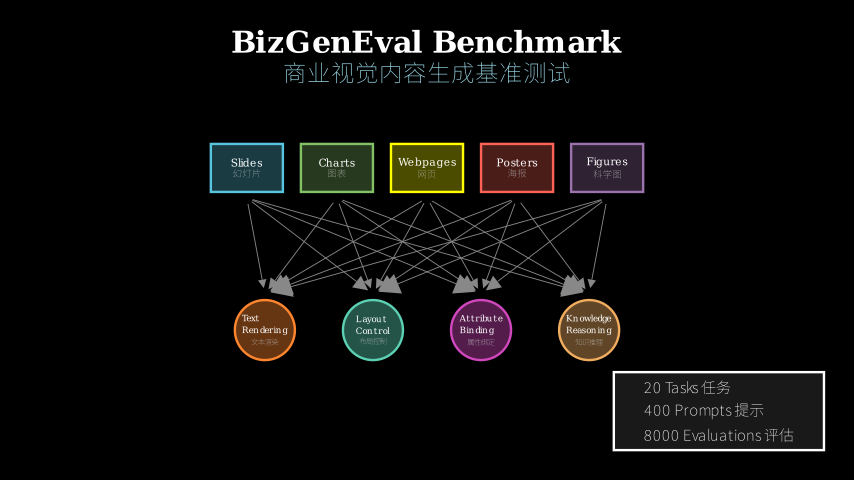
BizGenEval is a testing framework, not a model. It works like a standardized exam with multiple subjects. The benchmark covers five document types (slides, charts, webpages, posters, scientific figures) and tests four capabilities (text rendering, layout control, attribute binding, knowledge-based reasoning). Each combination creates a specific task—for example, “generate a bar chart with correct text labels” tests text rendering + charts.
For each task, human experts write prompts that specify multiple constraints: “Create a slide with title ‘Q4 Results’ in the top-left, a pie chart showing 40% blue and 60% red in the center, and footer text ‘Confidential’ in 8pt font.” Then they create checklist questions to verify each constraint: “Is the title ‘Q4 Results’?”, “Is it in the top-left?”, “Is the blue slice 40%?”, etc. Each image gets scored by how many checklist items it passes.
The data flow: prompt → model → generated image → human verification against checklist → pass/fail score for each constraint → aggregate metrics across tasks. The benchmark contains 400 carefully designed prompts and 8000 verification questions, all human-curated to ensure they test real commercial requirements.
Input Prompt                Generated Image           Verification
+-----------+              +-------------+           +------------+
| "Create   |              |             |           | Checklist: |
| slide:    |  ------>     |   [IMAGE]   |  ------>  | - Title?   |
| Title='X' |   Model      |             |   Human   | - Layout?  |
| Chart=... |              |             |           | - Colors?  |
+-----------+              +-------------+           +------------+
                                                            |
                                                            v
                                                     Score: 15/20
Think of BizGenEval as a driving test for image models. A regular benchmark is like testing if someone can steer a car on an empty road (natural image synthesis). BizGenEval is the full driving exam: parallel parking (layout control), reading street signs (text rendering), following GPS directions (attribute binding), and knowing traffic laws (domain knowledge). You need all four to drive safely, but most models only practiced steering. The test has five different courses (document types), each requiring all four skills in different combinations. The checklist questions are like the examiner’s clipboard—objective pass/fail criteria, not subjective judgment.
Key Concepts
-
Attribute Binding: In natural images, if you say “red car next to blue house,” the model might swap colors or positions—annoying but not critical. In commercial design, if a chart legend says “Revenue = Blue” but the blue bar shows costs, the document is wrong and unusable. Attribute binding means ensuring each visual element has the correct properties and relationships specified in the prompt. It’s the difference between “close enough” and “exactly right.” Example: A poster with three product photos must show Product A in the top slot, Product B middle, Product C bottom—not randomly arranged.
-
Multi-Constraint Satisfaction: Commercial documents have interdependent requirements. A slide needs the title in a specific font AND size AND position AND color, while also having a chart with correct data AND labels AND legend, plus footer text that doesn’t overlap anything. If any one constraint fails, the whole document fails. This is different from natural images where you can have a “mostly correct” sunset. The challenge: models trained with diffusion or autoregressive methods optimize for overall image quality, not constraint satisfaction. They’ll sacrifice text accuracy for better composition.
-
Checklist Verification: Instead of asking humans “rate this image 1-10,” BizGenEval asks binary questions: “Is the title text ‘Q4 Results’? Yes/No.” “Is the pie chart 40% blue? Yes/No.” This eliminates subjective bias and makes evaluation reproducible. Each prompt has 20 checklist questions covering all specified constraints. The score is simply: (passed questions) / (total questions). This approach reveals that models often get 80% of constraints right but fail on critical details—which means the output is unusable.
Framework Shift
Before (mainstream approach):        After (this paper):

Natural Image Synthesis:             Commercial Design Evaluation:

  Prompt                               Prompt + Constraints
    |                                    |
    v                                    v
  Model                                Model
    |                                    |
    v                                    v
  Image                                Image
    |                                    |
    v                                    v
  Human rates                          Checklist verification
  "quality" (1-10)                     (binary pass/fail)
    |                                    |
    v                                    v
  Single score                         Constraint-level scores
  (subjective)                         (objective, diagnostic)

Focus: Aesthetic quality               Focus: Functional correctness
Metric: FID, CLIP score                Metric: Constraint satisfaction rate
Goal: Pretty images                    Goal: Usable documents
From aesthetic evaluation to functional verification, the core shift is measuring whether outputs satisfy explicit requirements rather than implicit quality standards.
Expert Assessment
Problem choice: This is a real gap, not manufactured. The field has been celebrating FID improvements while ignoring that models can’t generate a usable PowerPoint slide. The timing is perfect—companies are trying to deploy these models for content creation and hitting walls. The problem sits at the intersection of vision and language, where most research focuses on understanding (VQA, captioning) rather than generation with constraints.
Method maturity: This is pure benchmark engineering, not algorithmic innovation. The insight is recognizing that commercial design is a different problem class than natural images. The execution is solid—five document types cover real use cases, four capability dimensions are well-chosen, and checklist verification is more rigorous than rating scales. However, the benchmark is static (400 prompts) and doesn’t test iterative refinement, which is how humans actually use these tools. Also, 8000 questions required massive human labor—not scalable for continuous evaluation.
Experimental integrity: Testing 26 models is thorough. The results are believable—best commercial APIs (GPT-4V, Gemini) score ~60% on complex tasks, open-source models ~40%. The paper shows per-task breakdowns, revealing that all models struggle with text rendering and attribute binding. One concern: the prompts are in English, but commercial design is global. Another: the checklist questions were written by the same people who wrote the prompts, which could introduce bias toward certain phrasings or constraint types.
Writing quality: The paper front-loads motivation well but buries the methodology. Section 3 (benchmark construction) should come before Section 2 (related work) so readers understand what they’re evaluating before comparing to other benchmarks. The results section is thorough but repetitive—showing per-task scores for 26 models creates a wall of numbers. A better approach: show aggregate scores in main text, per-task details in appendix. The discussion section is weak—it lists limitations but doesn’t propose solutions or research directions.
Verdict: weak accept — Addresses a real problem with solid execution, but the contribution is a benchmark (infrastructure) rather than a method (insight). Valuable for the community, but not groundbreaking.
Takeaways
If you’re building or evaluating generative models for practical applications, steal the checklist verification approach. Instead of asking “is this output good?”, decompose requirements into binary questions. This works beyond images—for code generation, ask “does it compile?”, “does it pass test X?”, “does it use library Y?”. For text generation, check factual claims individually rather than rating overall quality.
The four capability dimensions (text rendering, layout, attribute binding, knowledge reasoning) transfer to other structured generation tasks. If you’re generating UI mockups, CAD drawings, or data visualizations, test these separately. Models often excel at one (layout) while failing at another (text), and aggregate metrics hide this.
The broader lesson: “good at natural data” doesn’t mean “good at structured data.” If your application has explicit constraints, you need constraint-specific evaluation. Don’t assume a model that generates beautiful images can generate correct diagrams.
论文: 2603.25732 作者: Yan Li, Zezi Zeng, Ziwei Zhou, Xin Gao, Muzhao Tian, Yifan Yang, Mingxi Cheng, Qi Dai, Yuqing Yang, Lili Qiu 分类: cs.CV
缺口
DALL-E 和 Midjourney 这类图像生成模型在制作漂亮的风景照和肖像上已经强到可怕。
但让它们生成一份幻灯片,要求特定文字出现在正确位置,或者生成一个标签准确的柱状图,它们就崩了。
问题在于:现有基准测试(COCO、ImageNet)只测自然图像合成——约束宽松的漂亮图片。
它们不测量真实商业工作中重要的东西:精确的文字渲染、多元素布局控制、属性绑定(这个标签对应那根柱子)、领域知识(科学图表需要特定规范)。
这个缺口是结构性的。
当前评估假设”好图像 = 逼真 + 美观”。
商业设计需要”正确图像 = 所有约束满足 + 功能可用”。
没人系统地测试过模型能否处理商业文档的多约束、结构化特性。
问题:在自然图像上训练的模型
     在商业设计任务上失败
              |
              v
假设:商业设计 = 自然图像合成
            + 结构化约束 + 领域知识
              |
              v
方法:构建包含 5 种文档类型、
     4 个能力维度、20 个任务、
     400 个提示词、8000 个验证问题的基准
              |
              v
证据:测试 26 个模型,全都显示巨大差距
     (最好的模型在复杂任务上约 60%)
              |
              v
结论:当前模型还没准备好
     用于专业视觉内容创作
增量
一句话:这篇论文之前,我们以为图像生成在实用层面”解决了”;之后,我们知道模型处理不了真实商业设计的结构化约束。
核心机制
BizGenEval 是一个测试框架,不是模型。
它像一场有多个科目的标准化考试。
基准覆盖五种文档类型(幻灯片、图表、网页、海报、科学图表),测试四种能力(文字渲染、布局控制、属性绑定、基于知识的推理)。
每个组合创建一个具体任务——比如”生成带正确文字标签的柱状图”测试文字渲染 + 图表。
对每个任务,人类专家编写指定多个约束的提示词:“创建一张幻灯片,标题’Q4 Results’在左上角,中间是显示 40% 蓝色和 60% 红色的饼图,页脚文字’Confidential’用 8pt 字体。”
然后他们创建检查清单问题来验证每个约束:“标题是’Q4 Results’吗?”
“它在左上角吗?”
“蓝色切片是 40% 吗?”
等等。
每张图像根据通过多少检查项来打分。
数据流:提示词 → 模型 → 生成图像 → 人类对照检查清单验证 → 每个约束的通过/失败分数 → 跨任务的聚合指标。
基准包含 400 个精心设计的提示词和 8000 个验证问题,全部由人工策划以确保测试真实的商业需求。
输入提示词              生成图像              验证
+-----------+          +-------------+       +------------+
| "创建     |          |             |       | 检查清单: |
| 幻灯片:  |  ---->   |   [图像]    | ----> | - 标题?   |
| 标题='X' |   模型    |             |  人工  | - 布局?   |
| 图表=... |          |             |       | - 颜色?   |
+-----------+          +-------------+       +------------+
                                                   |
                                                   v
                                            得分:15/20
把 BizGenEval 想象成图像模型的驾照考试。
常规基准测试像测试某人能否在空旷道路上转方向盘(自然图像合成)。
BizGenEval 是完整的驾驶考试:侧方停车(布局控制)、识别路标(文字渲染)、跟随 GPS 指示(属性绑定)、了解交通法规(领域知识)。
你需要全部四项才能安全驾驶,但大多数模型只练习了转方向盘。
测试有五条不同路线(文档类型),每条都要求以不同组合运用全部四项技能。
检查清单问题就像考官的记录板——客观的通过/失败标准,不是主观判断。
关键概念
- 属性绑定:在自然图像中,如果你说”红车旁边有蓝房子”,模型可能交换颜色或位置——烦人但不致命。
在商业设计中,如果图表图例说”收入 = 蓝色”但蓝色柱子显示成本,文档就是错的,不能用。
属性绑定意味着确保每个视觉元素具有提示词中指定的正确属性和关系。
这是”差不多”和”完全正确”的区别。
例子:一张有三张产品照片的海报必须在顶部槽位显示产品 A,中间显示产品 B,底部显示产品 C——不能随机排列。
- 多约束满足:商业文档有相互依赖的要求。
一张幻灯片需要标题在特定字体、大小、位置、颜色,同时还要有带正确数据、标签、图例的图表,加上不与任何东西重叠的页脚文字。
如果任何一个约束失败,整个文档就失败。
这不同于自然图像,你可以有”基本正确”的日落。
挑战在于:用扩散或自回归方法训练的模型优化整体图像质量,不优化约束满足。
它们会为了更好的构图牺牲文字准确性。
- 检查清单验证:BizGenEval 不问人类”给这张图打 1-10 分”,而是问二元问题:“标题文字是’Q4 Results’吗?是/否。”
“饼图是 40% 蓝色吗?是/否。”
这消除了主观偏见,使评估可重现。
每个提示词有 20 个检查清单问题,覆盖所有指定约束。
分数就是:(通过的问题)/(总问题)。
这种方法揭示模型经常正确处理 80% 的约束但在关键细节上失败——这意味着输出不可用。
框架转变
之前(主流方法):              之后(本文方法):

自然图像合成:                  商业设计评估:

  提示词                          提示词 + 约束
    |                               |
    v                               v
  模型                            模型
    |                               |
    v                               v
  图像                            图像
    |                               |
    v                               v
  人类评"质量"                    检查清单验证
  (1-10 分)                     (二元通过/失败)
    |                               |
    v                               v
  单一分数                        约束级别分数
  (主观)                        (客观、诊断性)

焦点:美学质量                   焦点:功能正确性
指标:FID、CLIP 分数             指标:约束满足率
目标:漂亮图像                   目标:可用文档
从美学评估到功能验证,核心转变是测量输出是否满足明确要求,而非隐含的质量标准。
专家评审
选题眼光:这是真缺口,不是人造的。
该领域一直在庆祝 FID 改进,却忽略了模型生成不了可用的 PowerPoint 幻灯片。
时机完美——公司正试图部署这些模型用于内容创作,结果碰壁。
问题位于视觉和语言的交叉点,大多数研究关注理解(VQA、字幕生成)而非带约束的生成。
方法成熟度:这是纯粹的基准工程,不是算法创新。
洞见在于认识到商业设计是不同于自然图像的问题类别。
执行扎实——五种文档类型覆盖真实用例,四个能力维度选得好,检查清单验证比评分量表更严格。
但是,基准是静态的(400 个提示词),不测试迭代改进,而这才是人类实际使用这些工具的方式。
另外,8000 个问题需要大量人工劳动——不适合持续评估的规模化。
实验诚意:测试 26 个模型很彻底。
结果可信——最好的商业 API(GPT-4V、Gemini)在复杂任务上得分约 60%,开源模型约 40%。
论文展示了每个任务的细分,揭示所有模型都在文字渲染和属性绑定上挣扎。
一个担忧:提示词是英文的,但商业设计是全球性的。
另一个:检查清单问题由编写提示词的同一批人编写,这可能引入对某些措辞或约束类型的偏见。
写作功力:论文在动机部分开头做得好,但把方法论埋得太深。
第 3 节(基准构建)应该放在第 2 节(相关工作)之前,这样读者在比较其他基准之前先理解他们在评估什么。
结果部分彻底但重复——展示 26 个模型的每个任务分数造成一堵数字墙。
更好的方法:在正文中展示聚合分数,每个任务的细节放附录。
讨论部分薄弱——它列出局限性但不提出解决方案或研究方向。
判决:弱接收 — 用扎实的执行解决真实问题,但贡献是基准(基础设施)而非方法(洞见)。
对社区有价值,但不是突破性的。
要点总结
如果你在构建或评估用于实际应用的生成模型,偷走检查清单验证方法。
不要问”这个输出好吗?”
而是把需求分解成二元问题。
这超越图像——对于代码生成,问”它能编译吗?”
“它通过测试 X 吗?”
“它使用库 Y 吗?”
对于文本生成,单独检查事实声明而非评价整体质量。
四个能力维度(文字渲染、布局、属性绑定、知识推理)可迁移到其他结构化生成任务。
如果你在生成 UI 原型、CAD 图纸或数据可视化,分别测试这些。
模型经常在一项(布局)上表现出色,在另一项(文字)上失败,聚合指标掩盖了这一点。
更广泛的教训:“擅长自然数据”不意味着”擅长结构化数据”。
如果你的应用有明确约束,你需要针对约束的评估。
不要假设生成漂亮图像的模型能生成正确的图表。