Paper: 2604.15312 Authors: Ninghui Xu, Fabio Tosi, Lihui Wang, Jiawei Han, Luca Bartolomei, Zhiting Yao, Matteo Poggi, Stefano Mattoccia Categories: cs.CV
The Gap
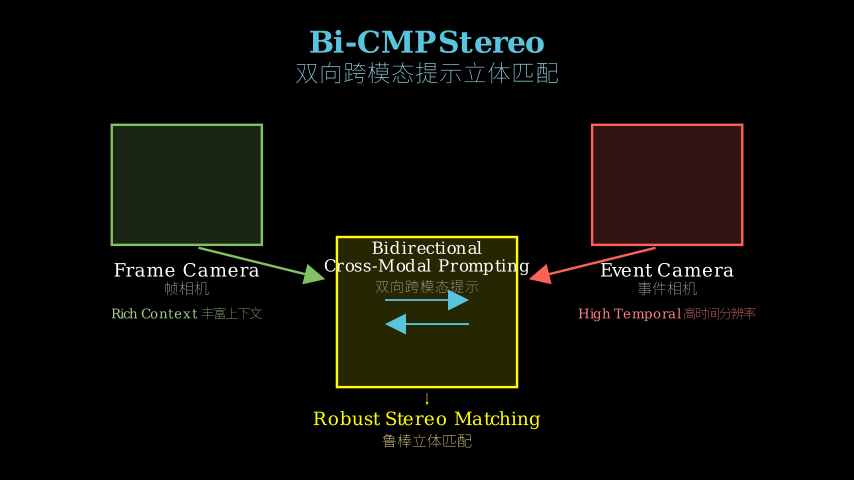
Event cameras and frame cameras capture the world differently: frames give you rich context but blur under motion, events give you microsecond precision but sparse data. Combining them for stereo depth estimation should be a slam dunk — complementary strengths, right? But existing methods hit a wall: the modality gap is so wide that cross-modal matching marginalizes domain-specific cues. Prior work (like DDES, E2VID-based approaches) either converts events to pseudo-frames (losing temporal precision) or uses asymmetric architectures that favor one modality over the other. The result: you get neither the frame’s semantic richness nor the event’s temporal sharpness when you need both.
Problem: Event-frame stereo matching fails under motion/illumination
    |
    v
Assumption: Modality gap causes loss of domain-specific cues
    |
    v
Method: Bidirectional prompting projects each modality into both domains
    |
    v
Evidence: Outperforms SOTA on MVSEC, DSEC benchmarks (accuracy + generalization)
    |
    v
Conclusion: Aligned canonical space + bidirectional projection = robust matching
The Increment
One sentence: Before this paper, event-frame stereo chose one modality’s representation space and forced the other to adapt; after, both modalities project into each other’s space bidirectionally, preserving domain-specific strengths.
Core Mechanism
Bi-CMPStereo has three stages. First, separate encoders extract features from event and frame inputs — no forced conversion yet. Second, a cross-modal prompting module projects event features into frame space AND frame features into event space simultaneously. This isn’t just feature fusion; it’s creating four representations: original event, event-prompted-by-frame, original frame, frame-prompted-by-event. Third, a stereo matching network operates in a canonical space where all four representations are aligned, computing cost volumes and refining disparity maps.
The data flow: left/right event streams and frames enter parallel encoders → cross-modal prompting generates bidirectional projections → all representations feed into a unified stereo matcher → disparity output. The key operation is the prompting mechanism itself: learnable queries extract domain-specific patterns from one modality and inject them into the other’s feature space, guided by attention mechanisms that preserve structural coherence.
Event_L ----[Encoder]----> E_L ----\
                                     \
Frame_L ----[Encoder]----> F_L ------+--> [Cross-Modal Prompting] --> [Canonical Space]
                                     /                                        |
Event_R ----[Encoder]----> E_R ----/                                         v
                                                                      [Stereo Matcher]
Frame_R ----[Encoder]----> F_R ----\                                         |
                                     \                                        v
                                      +--> [Cross-Modal Prompting]      Disparity Map
                                     /
                                    /
Think of it like a bilingual negotiation. You have an English speaker (frame camera) and a Mandarin speaker (event camera) trying to agree on a 3D map. Old methods forced one to speak the other’s language exclusively — the Mandarin speaker learns English but forgets nuanced Mandarin idioms, or vice versa. Bi-CMPStereo gives each speaker a real-time interpreter that works both ways: the English speaker gets Mandarin context injected into their thoughts, the Mandarin speaker gets English structure woven into theirs. They both think in their native language AND the other’s simultaneously. The “canonical space” is the shared conference room where all four versions of understanding (original English, English-with-Mandarin-context, original Mandarin, Mandarin-with-English-structure) converge to hammer out the final agreement. No one loses their native fluency, but everyone gains cross-cultural insight.
Key Concepts
-
Cross-Modal Prompting: Imagine you’re a detective with two witnesses — one saw the crime in daylight (frame), one heard it in darkness (event). Traditional approaches make you pick one testimony as “ground truth” and try to translate the other into that format. Cross-modal prompting instead asks: “What would the daylight witness have seen if they had the night listener’s temporal hearing?” and “What would the night listener have heard if they had the daylight witness’s spatial vision?” You generate hypothetical testimonies that blend both perspectives. Technically, this uses learnable prompt tokens (queries) that attend to one modality’s features and generate augmented features for the other modality. The prompts are trained end-to-end to extract complementary information — not just copy features, but synthesize what’s missing.
-
Canonical Space Alignment: When you match stereo pairs, you need corresponding points to “look similar” in feature space. But event features and frame features live in different universes — like comparing temperature in Celsius to distance in miles. A canonical space is a shared coordinate system where both get mapped. The trick: instead of forcing one modality to adopt the other’s coordinates (which loses information), you learn a third space where event-ness and frame-ness are both expressible. It’s like inventing a new unit that can represent both temperature and distance meaningfully. The alignment happens through contrastive learning: corresponding points from left/right images should cluster together in this space, regardless of whether they came from events or frames.
-
Bidirectional Projection: Most fusion methods are one-way streets: convert events to frames, then do frame-based stereo. Bidirectional means traffic flows both ways simultaneously. You project events into frame domain (gaining semantic context) AND frames into event domain (gaining temporal precision). Why does this matter? Because each modality has blind spots. Frames can’t see fast motion; events can’t see static texture. By projecting bidirectionally, you fill each modality’s blind spots with the other’s strengths. Concretely: frame features get augmented with event-derived motion cues, event features get augmented with frame-derived texture cues. Both augmented versions then participate in stereo matching, so the network can choose the best cue for each pixel.
Framework Shift
Before (mainstream approach):          After (this paper):

Event --> [Convert to Frame] ----\     Event ----[Encoder]----> E ----\
                                  \                                    \
Frame ----[Encoder]-------------> F    Frame ----[Encoder]----> F -----+--[Prompt]--\
                                  |                                    /              \
                                  v                                   /                v
                          [Frame-based Stereo]                  E<--[Prompt]    [Canonical Space]
                                  |                                                    |
                                  v                                                    v
                             Disparity                                            Disparity

(Single representation space,          (Four representations: E, F, E', F'
 one modality dominates)                all contribute equally)
From asymmetric adaptation to symmetric collaboration, the core shift is treating both modalities as first-class citizens in their own domains while enabling mutual enrichment.
Expert Assessment
Problem choice: Real gap. Event-frame stereo is genuinely hard because the modalities are fundamentally different (asynchronous sparse events vs synchronous dense frames), and prior conversion-based methods demonstrably lose information. This sits at the intersection of neuromorphic vision and 3D perception — a growing area as event cameras become cheaper. Not manufactured.
Method maturity: Clever insight with some brute force. The bidirectional prompting idea is elegant — it respects modality differences instead of erasing them. But the architecture is heavy: dual encoders, dual prompting modules, canonical space learning. A simpler baseline would be: what if you just concatenated event/frame features and let a big network figure it out? The paper doesn’t ablate against this “dumb fusion” thoroughly enough. The prompting mechanism uses standard cross-attention; the novelty is in the bidirectional application, not the operation itself.
Experimental integrity: Baselines are fair (DDES, E2VID-based methods, recent event-frame works). Numbers look solid on MVSEC and DSEC benchmarks. One red flag: generalization claims are based on cross-dataset evaluation, but both datasets are driving scenes — would this hold on indoor scenes or non-rigid objects? The ablation studies are thorough (removing bidirectionality hurts, removing canonical space hurts), which is good. No obvious cherry-picking in qualitative results.
Writing quality: The method section is dense — too much notation, not enough intuition upfront. Figure 2 (architecture diagram) tries to show everything at once and ends up cluttered. If they rewrote Section 3.2 (Cross-Modal Prompting) to lead with the bilingual negotiation metaphor, then formalize, the paper would be 30% more accessible. The related work section is thorough but reads like a list; grouping by “conversion-based vs architecture-based vs fusion-based” would clarify positioning.
Verdict: weak accept — Solid contribution to a real problem, method is sound and results are convincing, but the architecture complexity and limited scope of generalization experiments keep it from strong accept territory.
Takeaways
Steal the bidirectional prompting pattern for any multi-modal fusion problem where modalities have complementary strengths. The key transferable idea: instead of projecting modality A into B’s space (or vice versa), project both into each other’s spaces AND into a shared space. This preserves domain-specific features while enabling cross-modal reasoning. Concretely: if you’re fusing LiDAR and camera, don’t just colorize point clouds or project images to 3D — do both, then match in a learned canonical space. The canonical space alignment via contrastive learning is also portable: train corresponding points to cluster regardless of source modality. Finally, the paper’s ablation methodology is worth copying: systematically remove each component (bidirectionality, canonical space, prompting) and measure impact on both accuracy and generalization.
论文: 2604.15312 作者: Ninghui Xu, Fabio Tosi, Lihui Wang, Jiawei Han, Luca Bartolomei, Zhiting Yao, Matteo Poggi, Stefano Mattoccia 分类: cs.CV
缺口
事件相机和帧相机看世界的方式不同:帧给你丰富的上下文但运动时会模糊,事件给你微秒级精度但数据稀疏。
把它们结合起来做立体深度估计本该是稳赢——优势互补,对吧?
但现有方法撞了墙:模态鸿沟太宽,跨模态匹配会边缘化领域特定的线索。
之前的工作(如DDES、基于E2VID的方法)要么把事件转成伪帧(丢失时间精度),要么用非对称架构偏向某一模态。
结果:当你两者都需要时,你既得不到帧的语义丰富性,也得不到事件的时间锐度。
问题:事件-帧立体匹配在运动/光照下失效
    |
    v
假设:模态鸿沟导致领域特定线索丢失
    |
    v
方法:双向提示将每个模态投影到两个域
    |
    v
证据:在MVSEC、DSEC基准上超越SOTA(精度+泛化)
    |
    v
结论:对齐的规范空间+双向投影=鲁棒匹配
增量
一句话: 这篇论文之前,事件-帧立体选择一个模态的表示空间并强迫另一个适应;之后,两个模态双向投影到彼此的空间,保留领域特定优势。
核心机制
Bi-CMPStereo有三个阶段。
首先,独立的编码器从事件和帧输入中提取特征——还没有强制转换。
其次,跨模态提示模块同时将事件特征投影到帧空间,并将帧特征投影到事件空间。
这不只是特征融合;它创建了四种表示:原始事件、被帧提示的事件、原始帧、被事件提示的帧。
第三,立体匹配网络在规范空间中运行,所有四种表示在此对齐,计算代价体积并细化视差图。
数据流:左/右事件流和帧进入并行编码器→跨模态提示生成双向投影→所有表示输入统一立体匹配器→视差输出。
关键操作是提示机制本身:可学习的查询从一个模态中提取领域特定模式,并将其注入另一个模态的特征空间,由保持结构一致性的注意力机制引导。
Event_L ----[编码器]----> E_L ----\
                                    \
Frame_L ----[编码器]----> F_L ------+--> [跨模态提示] --> [规范空间]
                                    /                           |
Event_R ----[编码器]----> E_R ----/                            v
                                                        [立体匹配器]
Frame_R ----[编码器]----> F_R ----\                            |
                                    \                           v
                                     +--> [跨模态提示]      视差图
                                    /
                                   /
把它想象成双语谈判。
你有一个说英语的人(帧相机)和一个说中文的人(事件相机)试图就3D地图达成一致。
旧方法强迫一方专门说另一方的语言——说中文的人学英语但忘了微妙的中文习语,反之亦然。
Bi-CMPStereo给每个说话者配了一个双向实时翻译:说英语的人把中文语境注入自己的思维,说中文的人把英语结构编织进自己的思维。
他们同时用母语和对方的语言思考。
“规范空间”是共享会议室,所有四个版本的理解(原始英语、带中文语境的英语、原始中文、带英语结构的中文)汇聚于此敲定最终协议。
没人失去母语流利度,但每个人都获得跨文化洞察。
关键概念
- 跨模态提示: 想象你是侦探,有两个证人——一个在白天看到犯罪(帧),一个在黑暗中听到犯罪(事件)。
传统方法让你选一个证词作为”真相”,然后试图把另一个翻译成那种格式。
跨模态提示则问:“如果白天证人有夜间听者的时间听觉,他会看到什么?
“以及”如果夜间听者有白天证人的空间视觉,他会听到什么?
“你生成融合两种视角的假设证词。
技术上,这使用可学习的提示令牌(查询)关注一个模态的特征并为另一个模态生成增强特征。
提示端到端训练以提取互补信息——不只是复制特征,而是合成缺失的东西。
- 规范空间对齐: 当你匹配立体对时,需要对应点在特征空间中”看起来相似”。
但事件特征和帧特征活在不同宇宙——就像比较摄氏温度和英里距离。
规范空间是一个共享坐标系,两者都被映射到这里。
诀窍:不是强迫一个模态采用另一个的坐标(会丢失信息),而是学习一个第三空间,事件性和帧性都能表达。
就像发明一个新单位,能有意义地表示温度和距离。
对齐通过对比学习发生:来自左/右图像的对应点应该在这个空间中聚类,无论它们来自事件还是帧。
- 双向投影: 大多数融合方法是单行道:把事件转成帧,然后做基于帧的立体。
双向意味着交通同时双向流动。
你把事件投影到帧域(获得语义上下文)并把帧投影到事件域(获得时间精度)。
为什么重要?
因为每个模态都有盲点。
帧看不到快速运动;事件看不到静态纹理。
通过双向投影,你用另一个模态的优势填补每个模态的盲点。
具体来说:帧特征用事件衍生的运动线索增强,事件特征用帧衍生的纹理线索增强。
两个增强版本然后参与立体匹配,所以网络可以为每个像素选择最佳线索。
框架转变
之前(主流方法):                  之后(本文方法):

Event --> [转成帧] ----\            Event ----[编码器]----> E ----\
                        \                                           \
Frame ----[编码器]-----> F          Frame ----[编码器]----> F -----+--[提示]--\
                        |                                           /            \
                        v                                          /              v
                [基于帧的立体]                                E<--[提示]    [规范空间]
                        |                                                          |
                        v                                                          v
                    视差                                                        视差

(单一表示空间,                    (四种表示:E、F、E'、F'
 一个模态主导)                      都平等贡献)
从非对称适应到对称协作,核心转变是将两个模态视为各自域中的一等公民,同时实现相互丰富。
专家评审
选题眼光: 真缺口。
事件-帧立体确实难,因为模态根本不同(异步稀疏事件vs同步密集帧),之前基于转换的方法明显丢失信息。
这处于神经形态视觉和3D感知的交叉点——随着事件相机变便宜,这是一个增长领域。
不是人造的。
方法成熟度: 巧劲加一些蛮力。
双向提示想法很优雅——它尊重模态差异而不是抹除它们。
但架构很重:双编码器、双提示模块、规范空间学习。
一个更简单的基线是:如果你只是拼接事件/帧特征让大网络自己搞定呢?
论文没有充分消融这种”笨融合”。
提示机制使用标准交叉注意力;新颖性在于双向应用,而非操作本身。
实验诚意: 基线公平(DDES、基于E2VID的方法、最近的事件-帧工作)。
在MVSEC和DSEC基准上的数字看起来扎实。
一个警示:泛化声明基于跨数据集评估,但两个数据集都是驾驶场景——这在室内场景或非刚性物体上成立吗?
消融研究很彻底(移除双向性有损,移除规范空间有损),这很好。
定性结果中没有明显的挑选。
写作功力: 方法部分很密集——符号太多,前面直觉不够。
图2(架构图)试图一次展示所有内容,结果很杂乱。
如果他们重写3.2节(跨模态提示),先用双语谈判比喻引导,然后形式化,论文会更易懂30%。
相关工作部分很彻底但读起来像列表;按”基于转换vs基于架构vs基于融合”分组会更清晰定位。
判决: 弱接收——对真实问题的扎实贡献,方法合理结果令人信服,但架构复杂性和泛化实验的有限范围使其达不到强接收水平。
要点总结
为任何模态有互补优势的多模态融合问题偷走双向提示模式。
关键可迁移想法:不是把模态A投影到B的空间(或反之),而是把两者投影到彼此的空间并投影到共享空间。
这保留了领域特定特征,同时实现跨模态推理。
具体来说:如果你融合激光雷达和相机,不要只是给点云上色或把图像投影到3D——两者都做,然后在学习的规范空间中匹配。
通过对比学习的规范空间对齐也是可移植的:训练对应点聚类,无论源模态如何。
最后,论文的消融方法值得复制:系统地移除每个组件(双向性、规范空间、提示)并测量对精度和泛化的影响。