
Paper: 2603.11027 Authors: Mingyang Song, Mao Zheng, Chenning Xu Categories: cs.CL
The Gap
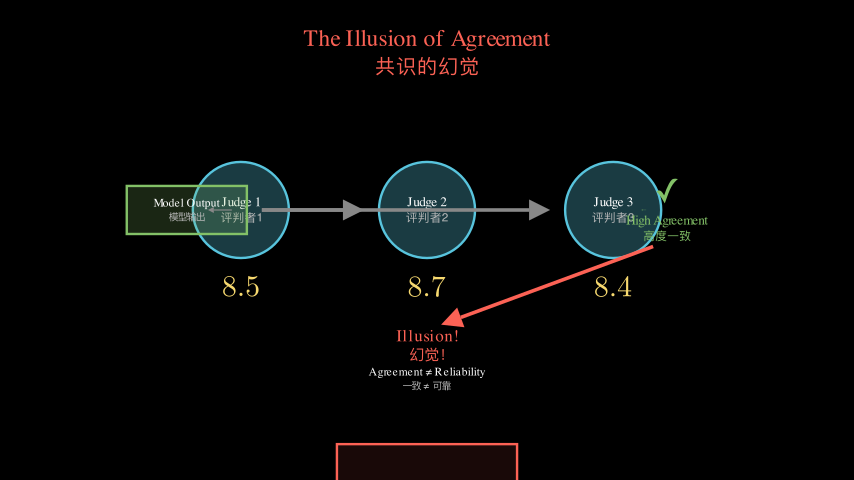
The LLM-as-a-judge paradigm has become the de facto standard for scalable evaluation — you ask GPT-4 or Claude to score model outputs, and if multiple judges agree, you trust the result. Prior work (PandaLM, MT-Bench, AlpacaEval) validated this by showing high inter-judge correlation at the model-ranking level. The implicit assumption: agreement = reliability.
The problem nobody had seriously stress-tested: what does “agreement” actually mean here? Model-level Spearman correlation tells you that Judge A and Judge B rank 32 models in roughly the same order. That’s a very coarse signal. It says nothing about whether they agree on why a specific output is good, or even whether they’d give the same score to the same output twice under slightly different conditions.
The authors also noticed something suspicious: judges produce elaborate, well-reasoned critiques, yet their scores seem to track simple surface features (length, formatting, keyword presence) rather than the substance of those critiques. The critique and the score are decoupled.
  Prior Assumption                  This Paper's Challenge
  +-----------------+               +----------------------+
  | High model-rank |               | Model-rank agreement |
  | correlation     |               | masks sample-level   |
  | among judges    |               | fragility            |
  +--------+--------+               +----------+-----------+
           |                                   |
           v                                   v
  +-----------------+               +----------------------+
  | Evaluation is   |               | Judges anchor on     |
  | reliable and    |               | surface heuristics   |
  | objective       |               | (Eval Illusion)      |
  +--------+--------+               +----------+-----------+
           |                                   |
           v                                   v
  +-----------------+               +----------------------+
  | Trust LLM judge |               | Rubric structure     |
  | scores for RLHF |               | alone restores 62%   |
  | / benchmarks    |               | of agreement         |
  +-----------------+               +----------+-----------+
                                               |
                                               v
                                    +----------------------+
                                    | MERG: inject domain  |
                                    | knowledge into rubric|
                                    | generation           |
                                    +----------+-----------+
                                               |
                                               v
                                    +----------------------+
                                    | Agreement rises in   |
                                    | codified domains,    |
                                    | falls in subjective  |
                                    | ones (as expected)   |
                                    +----------------------+
The Increment
One sentence: Before this paper, high inter-judge agreement was taken as evidence of reliable evaluation; after it, we know that agreement is largely a formatting artifact, and that injecting domain knowledge into rubrics is the lever that makes agreement actually informative.
Core Mechanism
The paper has two distinct contributions that work together. The first is diagnostic: they run a massive study — 105,600 evaluation instances across 32 LLMs, 3 frontier judges (GPT-4o, Claude, Gemini), 100 tasks, and 11 temperature settings — and decompose agreement into multiple layers. They compare model-level Spearman correlation (which looks great, ρ=0.99) against sample-level Pearson correlation (mediocre, r̄=0.72) and absolute agreement ICC (weak, 0.67). Then they run an ablation: strip the rubric content but keep its structural format, and 62% of the agreement comes back. That’s the smoking gun — judges are responding to rubric shape, not rubric substance.
The second contribution is prescriptive: MERG (Metacognitive Enhanced Rubric Generation). Instead of using a generic rubric template, MERG first classifies the task domain, then retrieves or generates domain-specific evaluation criteria grounded in expert knowledge for that domain. The rubric is dynamically constructed per task rather than reused from a fixed template. The “metacognitive” part means the system reasons about what kind of evaluative standards are appropriate before generating criteria — it’s a two-stage process: domain identification → knowledge-grounded criterion generation.
The validation is clever: they check whether MERG’s effect on agreement is domain-selective. In codified domains (Education, Academic writing) where there are established standards, agreement goes up (+22%, +27%). In subjective domains (creative writing, opinion), agreement goes down — which the authors interpret as a feature, not a bug. If judges genuinely disagree on subjective quality, forcing them to agree would be epistemically dishonest.
  Input: Task + Model Output
         |
         v
  +------+-------+
  | Domain       |
  | Classifier   |  <-- "What kind of task is this?"
  +------+-------+
         |
         v
  +------+-------+
  | Knowledge    |
  | Retrieval /  |  <-- Pull expert standards for this domain
  | Generation   |
  +------+-------+
         |
         v
  +------+-------+
  | Rubric       |
  | Constructor  |  <-- Build criteria grounded in domain knowledge
  +------+-------+
         |
         v
  +------+-------+
  | LLM Judge    |  <-- Now evaluates against meaningful criteria
  +------+-------+
         |
         v
  Score + Critique (anchored to domain standards, not surface features)
Think of MERG like a courtroom analogy. A generic rubric is like asking a jury to evaluate a medical malpractice case using only “common sense.” They’ll all agree the doctor seemed confident or the paperwork looked neat — surface signals. MERG is like bringing in an expert witness who establishes the standard of care for this specific procedure before the jury deliberates. Now the jury has a shared, substantive anchor. In a malpractice case (codified domain), this makes jurors converge on the right verdict. In an art criticism case (subjective domain), the expert witness might actually surface genuine disagreements that were previously papered over by everyone defaulting to “it looks professional.”
The rubric is the expert witness. Domain classification is deciding which expert to call. The two-stage generation is the expert’s testimony before deliberation begins.
Key Concepts
-
Evaluation Illusion: Judges write detailed, convincing critiques but their actual scores are driven by surface features — length, formatting, keyword density — not the content of those critiques. It’s like a wine critic who writes eloquent tasting notes but is actually just scoring based on bottle price. The critique sounds substantive but the score is a proxy for something shallow. The paper formalizes this by showing that rubric *structure (without content) recovers most of the agreement, meaning the judges are pattern-matching to format, not reasoning from criteria.
-
Model-level vs. Sample-level Agreement: Model-level agreement asks “do judges rank Model A above Model B?” Sample-level agreement asks “do judges give the same score to this specific output?” These can diverge dramatically. If Judge 1 gives output X a 7 and output Y a 5, and Judge 2 gives X a 9 and Y a 7, they agree on the ranking but disagree on the scores. When you aggregate over thousands of samples, the ranking correlation looks great even if individual scores are all over the place. This matters enormously for reward modeling in RLHF, where you’re training on individual scores, not rankings.
-
ICC (Intraclass Correlation Coefficient): A stricter agreement metric than Pearson correlation. Pearson tells you if scores move together; ICC tells you if they’re actually the same numbers. Two judges who always give scores 2 points apart have perfect Pearson correlation but terrible ICC. The paper uses ICC=0.67 as evidence that judges aren’t actually agreeing on absolute quality, just on relative ordering.
Framework Shift
Before (mainstream approach):        After (this paper):

  Task                                 Task
    |                                    |
    v                                    v
  Generic Rubric Template            Domain Classifier
  (reused across all tasks)              |
    |                                    v
    v                              Knowledge Retrieval
  Judge 1 --+                            |
  Judge 2 --+--> Aggregate Score         v
  Judge 3 --+                      Domain-Specific Rubric
    |                                    |
    v                              Judge 1 --+
  High model-rank correlation       Judge 2 --+--> Score
  = "evaluation is reliable"        Judge 3 --+
                                         |
                                         v
                                    Agreement is informative
                                    (rises in codified domains,
                                     reveals pluralism in subjective)
From treating agreement as a proxy for reliability to treating agreement as a signal that needs interpretation, the core shift is: consensus is only meaningful when judges share substantive standards, not just structural templates.
Expert Assessment
Problem choice: This is a real gap, not a manufactured one. The field has been using model-level Spearman correlation as a validity check for years without questioning what it actually measures. The Evaluation Illusion framing is sharp and the 62% rubric-structure ablation is a genuinely surprising result. The problem sits at a high-value intersection: it affects every benchmark that uses LLM judges, and it has direct implications for RLAIF reward modeling. Good problem selection.
Method maturity: MERG is a reasonable engineering solution but not a deep algorithmic contribution. Domain classification + knowledge retrieval + rubric generation is a sensible pipeline, and the domain-selective validation is the right way to test it. That said, the “metacognitive” framing feels like marketing — the actual mechanism is closer to retrieval-augmented prompt engineering than anything that deserves the word metacognition. A simpler baseline (just prepend Wikipedia domain summary to the rubric) would have been worth including to understand how much of the gain comes from the pipeline vs. just having any domain context at all.
Experimental integrity: The scale is impressive and the multi-level agreement decomposition is methodologically sound. The temperature sweep (11 settings) is a nice touch for robustness. The main concern: the +22%/+27% agreement gains in Education/Academic domains are reported without strong baselines for what MERG is actually being compared against. Is it beating a generic rubric? A human-written domain rubric? The paper needs to be clearer here. Also, “agreement increases” in codified domains is presented as validation, but it could also mean MERG is making judges more conformist rather than more accurate — you’d need ground-truth human expert scores to distinguish these.
Writing quality: The paper is well-structured but the “Metacognitive” branding in MERG is doing more work than the actual method justifies. The section explaining why decreased agreement in subjective domains is a *good thing is underdeveloped — this is actually the most interesting theoretical claim in the paper and it gets half a paragraph. If the authors rewrote that section with a proper treatment of evaluative pluralism and when disagreement is epistemically correct, the paper would be significantly stronger.
Verdict: weak accept — the diagnostic contribution (Evaluation Illusion + multi-level agreement decomposition) is solid and field-relevant; the prescriptive contribution (MERG) is useful but needs stronger baselines to be fully convincing.
Takeaways
The 62% rubric-structure ablation is directly stealable: if you’re building an evaluation pipeline, test whether your rubric’s format alone (stripped of content) produces similar scores. If it does, your rubric isn’t doing what you think it is.
The model-level vs. sample-level agreement distinction is a concrete diagnostic you can run on any existing evaluation setup in an afternoon. High Spearman at model level + low ICC at sample level = your evaluation is ranking models correctly but can’t be trusted for individual sample scoring (which matters for reward modeling).
The domain-selective validation design is a transferable methodology: if you’re proposing a method that should increase agreement in structured domains and reveal genuine disagreement in subjective ones, test both directions. Showing only the “agreement goes up” case is incomplete; showing the asymmetry is what makes the claim credible.
论文: 2603.11027 作者: Mingyang Song, Mao Zheng, Chenning Xu 分类: cs.CL
缺口
LLM-as-a-judge 已经成为可扩展评估的事实标准——让 GPT-4 或 Claude 给模型输出打分,如果多个评判者意见一致,就认为结果可信。 此前的工作(PandaLM、MT-Bench、AlpacaEval)通过展示评判者在模型排名层面的高相关性来验证这一范式。 隐含假设是:一致 = 可靠。
但没有人认真追问过:这里的”一致”究竟意味着什么? 模型级别的 Spearman 相关性只告诉你评判者 A 和评判者 B 对 32 个模型的排名大致相同。 这是一个非常粗糙的信号,完全无法说明他们是否对某个具体输出的好坏原因达成一致,甚至无法说明在略微不同的条件下他们是否会给出相同的分数。
作者还注意到一个可疑现象:评判者会生成详尽、有条理的批评,但分数似乎追踪的是表面特征(长度、格式、关键词密度),而非批评内容本身。 批评与分数是脱钩的。
  此前的假设                        本文的挑战
  +-----------------+               +----------------------+
  | 评判者之间模型  |               | 模型级一致性掩盖了   |
  | 排名相关性高    |               | 样本级的脆弱性       |
  +--------+--------+               +----------+-----------+
           |                                   |
           v                                   v
  +-----------------+               +----------------------+
  | 评估是可靠且    |               | 评判者锚定在表面启   |
  | 客观的          |               | 发式特征上(评估幻觉)|
  +--------+--------+               +----------+-----------+
           |                                   |
           v                                   v
  +-----------------+               +----------------------+
  | 信任 LLM 评判   |               | 仅凭评分标准结构就   |
  | 分数用于 RLHF   |               | 能恢复 62% 的一致性  |
  | 和基准测试      |               +----------+-----------+
  +-----------------+                          |
                                               v
                                    +----------------------+
                                    | MERG:将领域知识注   |
                                    | 入评分标准生成过程   |
                                    +----------+-----------+
                                               |
                                               v
                                    +----------------------+
                                    | 编码化领域一致性上升 |
                                    | 主观领域一致性下降   |
                                    | (符合预期)         |
                                    +----------------------+
增量
一句话:这篇论文之前,高评判者间一致性被视为评估可靠的证据;之后,我们知道这种一致性在很大程度上是格式伪像,而将领域知识注入评分标准才是让一致性真正有意义的关键杠杆。
核心机制
本文有两个相互配合的独立贡献。 第一个是诊断性的:他们进行了一项大规模研究——105,600 个评估实例,涵盖 32 个 LLM、3 个前沿评判者(GPT-4o、Claude、Gemini)、100 个任务和 11 个温度设置——并将一致性分解为多个层次。 他们将模型级 Spearman 相关性(看起来很好,ρ=0.99)与样本级 Pearson 相关性(一般,r̄=0.72)和绝对一致性 ICC(较弱,0.67)进行比较。 然后他们做了一个消融实验:去掉评分标准的内容但保留其结构格式,62% 的一致性就回来了。 这就是关键证据——评判者响应的是评分标准的形状,而不是内容。
第二个贡献是规范性的:MERG(元认知增强评分标准生成)。 MERG 不使用通用评分标准模板,而是先对任务领域进行分类,然后检索或生成基于该领域专家知识的评估标准。 评分标准针对每个任务动态构建,而不是从固定模板复用。 “元认知”部分意味着系统在生成标准之前先推理什么样的评估标准是合适的——这是一个两阶段过程:领域识别 → 知识驱动的标准生成。
验证方式很巧妙:他们检查 MERG 对一致性的影响是否具有领域选择性。 在有既定标准的编码化领域(教育、学术写作),一致性上升(+22%、+27%)。 在主观领域(创意写作、观点表达),一致性下降——作者将此解读为优点而非缺陷。 如果评判者对主观质量确