
Paper: 2603.03116 Authors: Hongliu Cao, Ilias Driouich, Eoin Thomas Categories: cs.AI
The Gap
LLM agent benchmarks like tau-bench, WebArena, and AgentBench measure success as binary outcomes: did the agent book the flight, complete the purchase, finish the task? This outcome-only evaluation mirrors how we grade students solely on final exam scores without checking if they cheated, guessed, or actually understood the material.
The problem: agents can achieve correct outcomes through incorrect procedures—hallucinating information, violating user constraints, executing actions inconsistent with their stated plans, or ignoring explicit instructions. These “corrupt successes” pass current benchmarks but would fail catastrophically in high-stakes deployments like healthcare scheduling or financial transactions.
Prior work (ReAct, Reflexion, AutoGPT evaluations) focuses on task completion rates and efficiency metrics. They don’t formalize the relationship between what an agent observes, what it says it will do, and what it actually executes. There’s no systematic framework for detecting when these three streams diverge.
Problem: Binary success metrics hide procedural failures
   |
   v
Assumption: Agent procedures have verifiable consistency constraints
   |
   v
Method: PAE formalizes observation-communication-execution relationships
        + Multi-dimensional gating disqualifies corrupt outcomes
   |
   v
Evidence: 27-78% of tau-bench successes are corrupt across models
   |
   v
Conclusion: Current benchmarks systematically overestimate agent reliability
The Increment
One sentence: Before this paper, we knew agents could complete tasks; after, we know that up to 78% of those completions violate procedural integrity in ways current benchmarks miss entirely.
Core Mechanism
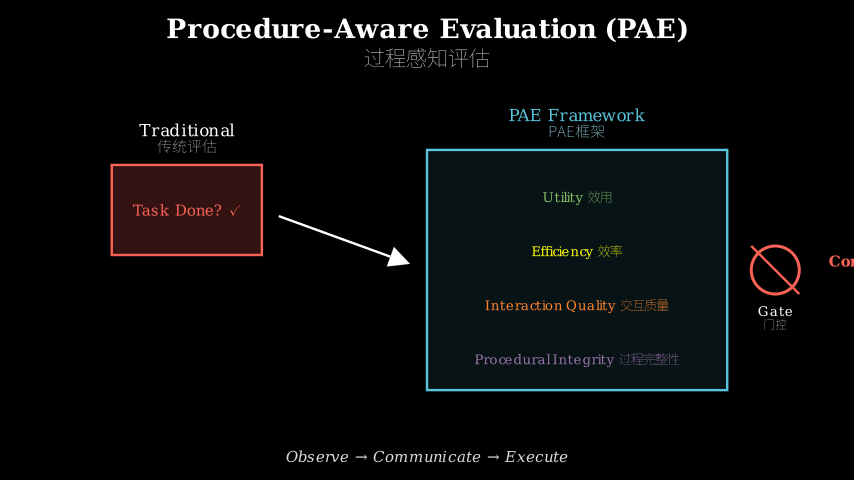
PAE treats agent execution as three parallel streams: observations (what the agent sees from the environment), communications (what the agent says it’s doing), and executions (what actions it actually takes). The framework formalizes consistency relationships between these streams—for example, if an agent observes a user constraint “no flights before 10am” but then books a 7am flight, that’s an observation-execution inconsistency.
The evaluation operates along four axes. Utility measures traditional task success. Efficiency tracks token usage and action counts. Interaction Quality assesses how the agent communicates with users (conciseness, clarity, intent adherence). Procedural Integrity checks whether the agent follows policies, maintains faithfulness to observations, and executes what it claims to execute.
The critical innovation is multi-dimensional gating: an agent must pass thresholds on all axes to be considered successful. A single violation in Procedural Integrity—say, hallucinating a price that doesn’t exist in the observed data—categorically disqualifies the outcome, even if the final task state looks correct. This gating mechanism exposes corrupt successes that traditional metrics would count as wins.
Agent Execution Trace:
   Observations  Communications  Executions
        |              |              |
        v              v              v
   [User says     [Agent plans   [Agent books
    "no 7am"]      "10am flight"]  7am flight]
        |              |              |
        +------+-------+------+-------+
               |              |
               v              v
        Consistency Checks (PAE)
               |
               +---> Violation detected
               |
               v
        Gate: FAIL (corrupt success)
Think of PAE as a financial audit system. Traditional benchmarks are like checking if a company’s bank balance increased—yes, there’s more money, so success. PAE is the full audit trail: did the deposits match the invoices? Did the expenses follow approval policies? Were the accounting entries consistent with the receipts? A company might show profit (task completion) while cooking the books (procedural violations). PAE catches the cooking.
The observation stream is the receipts, the communication stream is the accounting ledger where the company explains its transactions, and the execution stream is the actual bank movements. PAE’s consistency checks are the cross-referencing rules: ledger entries must match receipts, bank movements must match ledger entries. The gating mechanism is the auditor’s stamp: one material inconsistency fails the entire audit, regardless of the bottom-line number.
Key Concepts
-
Corrupt Success: An agent achieves the correct final task state but violates procedural constraints along the way. Imagine a delivery driver who gets your package to the right address on time (task success) but speeds through school zones, runs red lights, and ignores the “fragile” label (procedural violations). Current benchmarks only check if the package arrived; PAE checks the entire route. A corrupt success looks good on paper but indicates the agent can’t be trusted in real deployments where the process matters as much as the outcome.
-
Multi-dimensional Gating: Instead of averaging scores across dimensions, gating treats certain violations as categorical failures. Think of it like pilot certification: you can’t average “excellent takeoffs” with “occasionally forgets to lower landing gear” and call someone a good pilot. One critical failure disqualifies you, period. PAE applies this logic to agent evaluation—an agent that hallucinates data or violates user constraints fails, even if it’s fast and produces correct-looking outputs on other dimensions.
-
Observation-Communication-Execution Consistency: These are three parallel records of what happened during agent execution. Observations are what the environment showed the agent (like a flight search returning prices). Communications are what the agent told the user it was doing (“I’ll book the cheapest option”). Executions are the actual API calls made (“book_flight(price=expensive_option)”). PAE formalizes rules for when these must align—if you claim to do X based on seeing Y, but actually do Z, that’s a consistency violation. It’s like catching someone who says “I read the contract” (communication), was shown a contract with clause A (observation), but signed agreeing to clause B (execution).
Framework Shift
Before (mainstream approach):        After (this paper):

Task Definition                      Task Definition
      |                                    |
      v                                    v
Agent Execution                      Agent Execution
      |                                /   |   \
      v                               /    |    \
Final State Check              Observe Comm Execute
      |                               \    |    /
      v                                \   |   /
[Success/Fail]                    Consistency Checks
                                         |
                                         v
                                   [Utility Gate]
                                         |
                                         v
                                  [Efficiency Gate]
                                         |
                                         v
                                 [Interaction Gate]
                                         |
                                         v
                                  [Integrity Gate]
                                         |
                                         v
                                  [Success/Fail]
From outcome verification to process verification, the core shift is treating agent execution as an auditable procedure with falsifiable consistency constraints rather than a black box with a binary output.
Expert Assessment
Problem choice: This is a real gap that matters. As LLM agents move from demos to production, procedural reliability becomes critical—you can’t deploy an agent that sometimes hallucinates prices or ignores safety constraints, even if it completes tasks 80% of the time. The timing is right: the field has matured past “can agents do X?” to “can we trust agents to do X correctly?” This sits at the inflection point where deployment concerns start dominating capability concerns.
Method maturity: The framework is conceptually clean but implementation-heavy. Formalizing consistency rules requires domain knowledge and manual specification of what constitutes a violation. The paper doesn’t provide a general algorithm for deriving these rules—each benchmark needs custom annotation. That’s not necessarily bad (some problems require human judgment), but it limits scalability. The multi-dimensional gating is elegant and the insight about corrupt success is sharp, but I wonder if simpler approaches like random execution trace audits would catch 80% of the issues with 20% of the effort.
Experimental integrity: The tau-bench evaluation is thorough and the numbers are damning—27-78% corrupt success rates are hard to dismiss. However, the paper doesn’t deeply investigate whether PAE’s consistency rules are too strict or miscalibrated. When GPT-5 fails an integrity check, is it genuinely wrong or is the ground truth annotation questionable? The per-model failure signatures are interesting but feel somewhat post-hoc—it’s unclear if these patterns would replicate on other benchmarks. The benchmark design critique (contradictory reward signals, simulator artifacts) is valuable but undermines the paper’s own experimental foundation.
Writing quality: The abstract and introduction are strong—they clearly motivate the problem. The method section gets bogged down in formalism that could be simplified with better examples. The results section throws too many numbers without enough interpretation—what should a practitioner do with the knowledge that Kimi-K2-Thinking has 78% policy violations? The related work section is thin and doesn’t adequately position PAE relative to formal verification or program synthesis work. Rewriting the method section with a running example would make the paper far more accessible.
Verdict: weak accept — The corrupt success insight is important and the experimental findings are concerning enough to warrant attention, but the framework feels like a research prototype rather than a deployable solution, and the writing doesn’t do justice to the core ideas.
Takeaways
The multi-dimensional gating pattern transfers directly to any evaluation context where you care about process, not just outcomes. If you’re building internal benchmarks for code generation, customer service bots, or data analysis agents, steal this: define what constitutes a procedural violation (hallucination, constraint violation, inconsistency), then categorically fail any execution that violates these rules regardless of output quality.
The observation-communication-execution consistency framework gives you a concrete checklist for debugging agent failures. When your agent misbehaves, trace these three streams and look for divergence points. Did it see the right data? Did it claim to do the right thing? Did it actually execute what it claimed? Most bugs live in the gaps between these streams.
The corrupt success framing is rhetorically powerful for convincing stakeholders that high task completion rates don’t mean your agent is production-ready. Use this when pushing back against premature deployment: “We have 85% success, but how many of those are corrupt successes where we got lucky despite procedural failures?”
The benchmark design critique—contradictory reward signals, simulator artifacts, task scope gaps—is a template for auditing your own evaluation setups. If your benchmark has these flaws, your agents are optimizing for the wrong thing.
论文: 2603.03116 作者: Hongliu Cao, Ilias Driouich, Eoin Thomas 分类: cs.AI
缺口
LLM智能体基准测试如tau-bench、WebArena和AgentBench将成功定义为二元结果:智能体是否订到了机票、完成了购买、完成了任务? 这种只看结果的评估就像只用期末考试成绩给学生打分,不管他们是作弊、瞎猜还是真正理解了材料。
问题在于:智能体可以通过错误的过程达到正确的结果——幻觉信息、违反用户约束、执行与声明计划不一致的操作,或忽略明确指令。
这些”虚假成功”能通过当前基准测试,但在医疗预约或金融交易等高风险部署中会灾难性失败。
先前工作(ReAct、Reflexion、AutoGPT评估)关注任务完成率和效率指标。
它们没有形式化智能体观察到什么、说要做什么、实际执行什么之间的关系。
没有系统框架来检测这三个流何时出现分歧。
问题: 二元成功指标隐藏过程失败
   |
   v
假设: 智能体过程有可验证的一致性约束
   |
   v
方法: PAE形式化观察-沟通-执行关系
      + 多维门控机制淘汰虚假结果
   |
   v
证据: tau-bench中27-78%的成功是跨模型的虚假成功
   |
   v
结论: 当前基准系统性高估智能体可靠性
增量
一句话: 这篇论文之前,我们知道智能体能完成任务; 之后,我们知道高达78%的完成违反了当前基准完全遗漏的过程完整性。
核心机制
PAE将智能体执行视为三个并行流:观察(智能体从环境中看到什么)、沟通(智能体说它在做什么)、执行(它实际采取什么行动)。
框架形式化这些流之间的一致性关系——例如,如果智能体观察到用户约束”不要早上10点前的航班”但随后预订了早上7点的航班,这就是观察-执行不一致。
评估沿四个轴运作。
效用衡量传统任务成功。
效率跟踪令牌使用和操作计数。
交互质量评估智能体如何与用户沟通(简洁性、清晰度、意图遵守)。
过程完整性检查智能体是否遵循策略、保持对观察的忠实性、执行它声称执行的内容。
关键创新是多维门控:智能体必须通过所有轴上的阈值才能被视为成功。
过程完整性中的单个违规——比如幻觉一个观察数据中不存在的价格——会绝对取消结果资格,即使最终任务状态看起来正确。
这种门控机制暴露了传统指标会算作胜利的虚假成功。
智能体执行轨迹:
   观察流      沟通流      执行流
      |          |          |
      v          v          v
   [用户说    [智能体计划  [智能体预订
    "不要7点"]  "10点航班"]  7点航班]
      |          |          |
      +----+-----+----+-----+
           |          |
           v          v
    一致性检查 (PAE)
           |
           +---> 检测到违规
           |
           v
    门控: 失败 (虚假成功)
把PAE想象成财务审计系统。
传统基准就像检查公司银行余额是否增加——是的,钱多了,所以成功。
PAE是完整的审计追踪:存款是否与发票匹配? 支出是否遵循审批政策? 会计分录是否与收据一致? 公司可能显示利润(任务完成)同时做假账(过程违规)。
PAE抓住做假账。
观察流是收据,沟通流是公司解释其交易的会计账簿,执行流是实际银行流水。
PAE的一致性检查是交叉引用规则:账簿条目必须匹配收据,银行流水必须匹配账簿条目。
门控机制是审计师的印章:一个重大不一致就让整个审计失败,无论底线数字如何。
关键概念
- 虚假成功: 智能体达到正确的最终任务状态但沿途违反过程约束。
想象一个快递司机把你的包裹准时送到正确地址(任务成功)但在学校区域超速、闯红灯、忽略”易碎”标签(过程违规)。
当前基准只检查包裹是否到达; PAE检查整个路线。
虚假成功在纸面上看起来不错,但表明智能体在过程与结果同样重要的实际部署中不可信任。
- 多维门控: 不是对各维度分数求平均,门控将某些违规视为绝对失败。
想象飞行员认证:你不能用”起飞优秀”平均”偶尔忘记放下起落架”然后称某人是好飞行员。
一个关键失败就取消资格,就这样。
PAE将这种逻辑应用于智能体评估——幻觉数据或违反用户约束的智能体失败,即使它在其他维度上快速且产生看起来正确的输出。
- 观察-沟通-执行一致性: 这是智能体执行期间发生事情的三个并行记录。
观察是环境向智能体展示的内容(如航班搜索返回价格)。
沟通是智能体告诉用户它在做什么(“我会预订最便宜的选项”)。
执行是实际进行的API调用(“book_flight(price=expensive_option)”)。
PAE形式化这些何时必须对齐的规则——如果你声称基于看到Y做X,但实际做Z,那就是一致性违规。
这就像抓住某人说”我读了合同”(沟通),被展示了包含条款A的合同(观察),但签署同意条款B(执行)。
框架转变
之前(主流方法):                之后(本文方法):

任务定义                        任务定义
    |                              |
    v                              v
智能体执行                      智能体执行
    |                          /   |   \
    v                         /    |    \
最终状态检查              观察  沟通  执行
    |                         \    |    /
    v                          \   |   /
[成功/失败]                  一致性检查
                                   |
                                   v
                             [效用门控]
                                   |
                                   v
                             [效率门控]
                                   |
                                   v
                             [交互门控]
                                   |
                                   v
                             [完整性门控]
                                   |
                                   v
                             [成功/失败]
从结果验证到过程验证,核心转变是将智能体执行视为具有可证伪一致性约束的可审计过程,而非具有二元输出的黑盒。
专家评审
选题眼光: 这是一个重要的真实缺口。
随着LLM智能体从演示走向生产,过程可靠性变得至关重要——你不能部署一个有时幻觉价格或忽略安全约束的智能体,即使它80%的时间完成任务。
时机恰当:该领域已从”智能体能做X吗?” 成熟到”我们能信任智能体正确做X吗?” 这处于部署关注开始主导能力关注的拐点。
方法成熟度: 框架概念清晰但实现繁重。
形式化一致性规则需要领域知识和手动指定什么构成违规。
论文没有提供推导这些规则的通用算法——每个基准需要定制标注。
这不一定坏(有些问题需要人类判断),但限制了可扩展性。
多维门控优雅,虚假成功的洞察敏锐,但我想知道像随机执行轨迹审计这样更简单的方法是否能用20%的努力抓住80%的问题。
实验诚意: tau-bench评估彻底,数字令人震惊——27-78%的虚假成功率难以忽视。
然而,论文没有深入调查PAE的一致性规则是否过于严格或校准错误。
当GPT-5未通过完整性检查时,它是真的错了还是真实标注有问题? 每个模型的失败特征有趣但感觉有些事后诸葛——不清楚这些模式是否会在其他基准上复现。
基准设计批评(矛盾奖励信号、模拟器伪影)有价值但削弱了论文自己的实验基础。
写作功力: 摘要和引言强——它们清楚地激发问题。
方法部分陷入可以用更好例子简化的形式主义。
结果部分抛出太多数字而没有足够解释——实践者应该如何处理Kimi-K2-Thinking有78%策略违规的知识? 相关工作部分单薄,没有充分定位PAE相对于形式验证或程序综合工作。
用运行示例重写方法部分会让论文更易理解。
判决: 弱接收 — 虚假成功洞察重要,实验发现足够令人担忧值得关注,但框架感觉像研究原型而非可部署解决方案,写作没有公正对待核心思想。
要点总结
多维门控模式直接迁移到任何你关心过程而非仅结果的评估场景。
如果你在为代码生成、客户服务机器人或数据分析智能体构建内部基准,偷这个:定义什么构成过程违规(幻觉、约束违规、不一致),然后绝对让任何违反这些规则的执行失败,无论输出质量如何。
观察-沟通-执行一致性框架给你一个调试智能体失败的具体检查清单。
当你的智能体行为不当时,追踪这三个流并寻找分歧点。
它看到正确数据了吗? 它声称做正确的事了吗? 它实际执行它声称的了吗? 大多数bug存在于这些流之间的间隙中。
虚假成功框架在说服利益相关者高任务完成率不意味着你的智能体已准备好生产时修辞上强大。
当反对过早部署时用这个:“我们有85%成功率,但其中有多少是虚假成功,我们尽管过程失败却侥幸成功?”
基准设计批评——矛盾奖励信号、模拟器伪影、任务范围缺口——是审计你自己评估设置的模板。
如果你的基准有这些缺陷,你的智能体在优化错误的东西。