Paper: 2603.06576 Authors: Thomas Monninger, Shaoyuan Xie, Qi Alfred Chen, Sihao Ding Categories: cs.CV, cs.AI, cs.LG, cs.RO
The Gap
Autonomous driving researchers have been trying to marry two powerful but incompatible partners. On one side, LLMs bring incredible semantic understanding — they can reason about “a pedestrian might jaywalk” or “construction zones require caution.” On the other, bird’s-eye view (BEV) representations provide geometrically consistent spatial layouts — where every car, lane, and obstacle sits in 3D space.
The problem? Existing LLM-based driving systems (like DriveGPT4, DriveLM) feed the language model with independent tokens from each camera view and each time frame. It’s like asking someone to navigate by showing them six separate photos taken from different angles, then expecting them to mentally reconstruct the 3D scene. The LLM processes each view in isolation, leading to redundant computation and broken spatial reasoning. Meanwhile, traditional BEV models trained on detection tasks have great geometry but lack the rich semantic knowledge that foundation models provide.
Multi-view images --> Independent tokenization --> LLM reasoning
     (6 cameras)         (spatial chaos)         (confused about 3D)
                              |
                              v
                    Redundant computation +
                    No geometric coherence
                              |
                              v
     Assumption: BEV can unify spatial structure
                              |
                              v
     Method: Distill semantics into BEV, feed unified BEV to LLM
                              |
                              v
     Evidence: +46% reasoning accuracy, +29% safety improvement
                              |
                              v
     Conclusion: Spatial consistency + semantic richness = better driving
The Increment
One sentence: Before BEVLM, LLMs saw driving scenes as disconnected camera snapshots; after BEVLM, they see a unified, semantically rich bird’s-eye map that preserves both geometry and meaning.
Core Mechanism
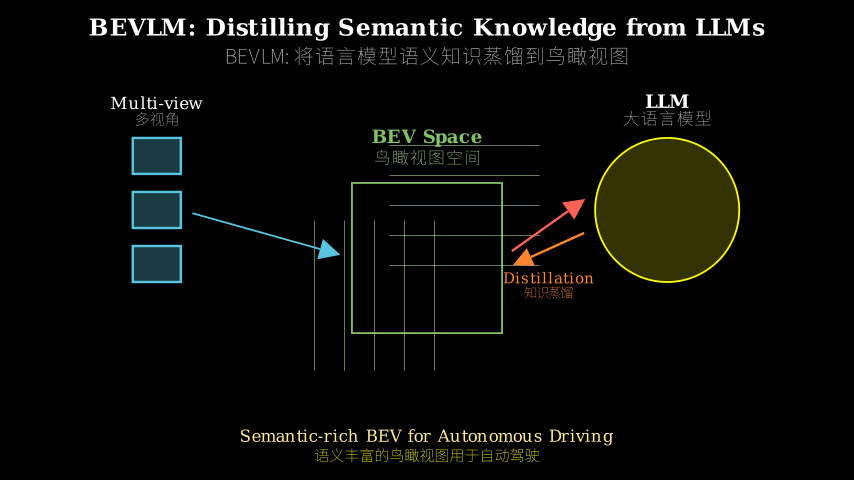
BEVLM has three main components working in sequence. First, a BEV encoder takes multi-view camera images and transforms them into a unified bird’s-eye view representation — think of it as creating a top-down map from multiple perspectives. This BEV representation naturally maintains spatial consistency because it’s in a single coordinate frame.
Second, instead of feeding raw BEV features (which are geometrically sound but semantically shallow) directly to the LLM, BEVLM uses a semantic distillation module. This module takes a pre-trained vision-language model (like CLIP) and distills its rich semantic knowledge into the BEV features. The distillation happens through a learnable projection that aligns BEV features with the semantic space of the foundation model.
Third, these semantically enriched BEV features get tokenized and fed to the LLM as a compact, unified input. The LLM now reasons over a single coherent representation instead of juggling six separate camera views. Crucially, this works bidirectionally: the LLM’s reasoning can also flow back to improve the BEV representation itself through gradient updates during training.
Multi-view images (6 cameras, multiple frames)
         |
         v
    [BEV Encoder] --> Spatial transformation
         |
         v
    BEV features (geometrically consistent)
         |
         v
    [Semantic Distillation] <-- CLIP/foundation model knowledge
         |
         v
    Enriched BEV (geometry + semantics)
         |
         v
    [Tokenization] --> Compact representation
         |
         v
    [LLM Reasoning] --> Driving decisions
         |
         v
    [Gradient flow back] --> Improve BEV representation
Think of BEVLM like a city planning office. Traditional LLM approaches are like having six different surveyors each describe their street corner independently, then asking the city planner to piece together the whole neighborhood from these disconnected reports. BEVLM instead creates a master map (BEV) first, then has an experienced urban designer (semantic distillation) annotate that map with rich contextual knowledge — “this is a school zone,” “this intersection has poor visibility,” “pedestrians often cross here.” The city planner (LLM) now works from one coherent, annotated map instead of six conflicting reports. And when the planner makes decisions, those insights feed back to improve how future maps get annotated.
Key Concepts
-
Bird’s-Eye View (BEV) Representation: Imagine you’re playing a strategy game where you see the battlefield from above. That’s BEV — a top-down view that shows where everything is in relation to everything else. In driving, BEV takes images from cameras mounted around the car (front, back, sides) and mathematically transforms them into a single overhead map. The key advantage? A car 10 meters ahead in the front camera and a car 10 meters to the left in the side camera now appear in their true spatial relationship on the BEV map. No more mental gymnastics to figure out “wait, are these two cars about to collide?”
-
Semantic Distillation: This is knowledge transfer, but selective. Foundation models like CLIP have learned incredibly rich concepts from billions of images — they know what “construction equipment” looks like, what “aggressive driving” means, what “school zone” implies. But they’re huge and slow. Distillation is like having an expert teach a student: the student (BEV encoder) learns to produce features that capture the same semantic richness as the expert (CLIP), but in a much more compact form. Concretely, BEVLM trains a projection layer that maps BEV features to align with CLIP’s semantic space, so the BEV features inherit CLIP’s understanding without needing CLIP at inference time.
-
Bidirectional Knowledge Flow: Most systems are one-way streets — perception feeds into reasoning, end of story. BEVLM creates a feedback loop. When the LLM reasons about a driving scenario and makes predictions, the training loss from those predictions flows backward through gradients to update the BEV encoder. This means the BEV representation learns to encode not just what’s geometrically present, but what’s semantically relevant for the reasoning tasks the LLM needs to solve. It’s like a translator who, after seeing which phrases confuse the audience, learns to adjust their translation style to emphasize the parts that matter most.
Framework Shift
Before (mainstream approach):        After (this paper):

Camera 1 --> Tokens 1 \              Multi-view cameras
Camera 2 --> Tokens 2  \                    |
Camera 3 --> Tokens 3   +---> LLM           v
Camera 4 --> Tokens 4  /              [BEV Encoder]
Camera 5 --> Tokens 5 /                     |
Camera 6 --> Tokens 6/                      v
                                    [Semantic Distillation]
(Each view processed                        |
 independently,                             v
 spatial chaos,                    Unified BEV tokens
 redundant computation)                     |
                                            v
                                          [LLM]
                                            |
                                            v
                                    (Gradient feedback)
                                            |
                                            v
                                    [Improved BEV]
From scattered multi-view tokens to unified BEV representation, the core shift is consolidating spatial reasoning before semantic reasoning instead of asking the LLM to do both simultaneously.
Expert Assessment
Problem choice: This is a real gap, not manufactured. The autonomous driving community has been struggling with how to effectively use LLMs without drowning them in redundant visual tokens. The spatial inconsistency issue is well-documented in prior work (DriveGPT4, DriveLM), and the semantic shallowness of task-specific BEV models is a known limitation. The timing is right — we’re at the inflection point where foundation models meet geometric perception.
Method maturity: This is clever architectural insight, not brute force. The bidirectional knowledge flow is elegant — using LLM gradients to improve BEV representations is non-obvious and genuinely useful. However, I’m skeptical about one thing: the paper doesn’t deeply explore what happens when BEV construction itself fails (occlusions, sensor noise). If your BEV is geometrically wrong, semantic enrichment won’t save you. A simpler approach might be hierarchical attention over multi-view features, though that loses the explicit spatial structure.
Experimental integrity: The 46% improvement in reasoning accuracy and 29% in safety-critical scenarios are impressive, but I’d want to see more ablations. What’s the contribution of semantic distillation alone vs. BEV unification alone? The baselines (DriveGPT4, DriveLM) are fair choices, but they’re relatively recent — a comparison with classical modular pipelines would strengthen the case. The closed-loop evaluation is good, but limited to simulation. Real-world validation would be the acid test.
Writing quality: The abstract and introduction are strong, but the method section gets dense quickly. The semantic distillation mechanism could use a clearer walkthrough with concrete examples. The ablation studies are buried in supplementary material when they should be front and center. If I were reviewing, I’d ask the authors to add a “failure case analysis” section — when does BEVLM struggle, and why?
Verdict: weak accept — solid contribution with real improvements, but needs deeper analysis of failure modes and more comprehensive ablations to be truly convincing.
Takeaways
The bidirectional knowledge flow is the stealable idea here. If you’re building any system where a downstream reasoning module (LLM, planner, controller) depends on upstream perception, consider letting the reasoning loss flow back to shape what the perception module learns to encode. This isn’t just for driving — it applies to robotics manipulation (let the policy gradient improve visual features), medical diagnosis (let clinical reasoning refine image embeddings), or even document understanding (let QA performance guide layout encoding).
The semantic distillation approach is also portable. If you have a lightweight encoder that needs to capture rich semantics but can’t afford to run a foundation model at inference time, train a projection layer that aligns your encoder’s features with the foundation model’s embedding space. You get semantic richness at a fraction of the computational cost.
Finally, the BEV unification principle generalizes: whenever you have multiple views or modalities that describe the same underlying structure, explicitly constructing a unified representation in a common coordinate frame before reasoning can dramatically reduce redundancy and improve consistency. This applies beyond driving — think multi-camera surveillance, multi-sensor robotics, or even multi-document analysis where you want to reason about information scattered across sources.
论文: 2603.06576 作者: Thomas Monninger, Shaoyuan Xie, Qi Alfred Chen, Sihao Ding 分类: cs.CV, cs.AI, cs.LG, cs.RO
缺口
自动驾驶研究者一直在尝试撮合两个强大但不兼容的伙伴。
一边是大语言模型,带来惊人的语义理解能力——它们能推理”行人可能会乱穿马路”或”施工区域需要谨慎”。
另一边是鸟瞰视图(BEV)表示,提供几何一致的空间布局——每辆车、每条车道、每个障碍物在三维空间中的精确位置。
问题在哪?现有的基于LLM的驾驶系统(如DriveGPT4、DriveLM)把每个摄像头视角、每个时间帧的图像独立地转成token喂给语言模型。
这就像让人通过六张不同角度拍摄的独立照片来导航,还指望他们在脑海中重建三维场景。
LLM孤立地处理每个视角,导致冗余计算和破碎的空间推理。
与此同时,在检测任务上训练的传统BEV模型虽然几何结构优秀,却缺乏基础模型提供的丰富语义知识。
多视角图像 --> 独立token化 --> LLM推理
  (6个摄像头)    (空间混乱)    (3D理解困难)
                     |
                     v
          冗余计算 + 几何不一致
                     |
                     v
    假设: BEV能统一空间结构
                     |
                     v
    方法: 将语义蒸馏进BEV,用统一BEV喂给LLM
                     |
                     v
    证据: 推理准确率+46%,安全性+29%
                     |
                     v
    结论: 空间一致性 + 语义丰富性 = 更好的驾驶
增量
一句话: BEVLM之前,LLM看到的驾驶场景是断开的相机快照;BEVLM之后,它们看到的是统一的、语义丰富的鸟瞰地图,同时保留几何和意义。
核心机制
BEVLM有三个按顺序工作的主要组件。
首先,BEV编码器接收多视角相机图像,将它们转换成统一的鸟瞰视图表示——可以理解为从多个视角创建一张俯视地图。
这个BEV表示天然保持空间一致性,因为它在单一坐标系中。
其次,BEVLM不是直接把原始BEV特征(几何上正确但语义上浅薄)喂给LLM,而是使用语义蒸馏模块。
这个模块拿一个预训练的视觉-语言模型(比如CLIP),把它的丰富语义知识蒸馏进BEV特征。
蒸馏通过一个可学习的投影层实现,将BEV特征与基础模型的语义空间对齐。
第三,这些语义增强的BEV特征被token化,作为紧凑、统一的输入喂给LLM。
LLM现在对单一连贯的表示进行推理,而不是同时处理六个独立的相机视角。
关键是,这是双向的:LLM的推理也可以通过训练时的梯度回流来改进BEV表示本身。
多视角图像(6个摄像头,多帧)
         |
         v
    [BEV编码器] --> 空间变换
         |
         v
    BEV特征(几何一致)
         |
         v
    [语义蒸馏] <-- CLIP/基础模型知识
         |
         v
    增强BEV(几何+语义)
         |
         v
    [Token化] --> 紧凑表示
         |
         v
    [LLM推理] --> 驾驶决策
         |
         v
    [梯度回流] --> 改进BEV表示
把BEVLM想象成城市规划办公室。
传统LLM方法就像让六个不同的测量员各自独立描述自己负责的街角,然后让城市规划师从这些断开的报告中拼凑出整个街区。
BEVLM则是先创建一张主地图(BEV),然后让一位经验丰富的城市设计师(语义蒸馏)在地图上标注丰富的上下文知识——“这是学区""这个路口视线不好""行人经常在这里过马路”。
城市规划师(LLM)现在从一张连贯的、带注释的地图工作,而不是六份冲突的报告。
当规划师做决策时,这些洞察反馈回来改进未来地图的标注方式。
关键概念
- 鸟瞰视图(BEV)表示: 想象你在玩策略游戏,从上方俯视战场。
这就是BEV——一个俯视视角,显示所有东西之间的相对位置。
在驾驶中,BEV把车身周围摄像头(前、后、侧面)的图像数学变换成单一的俯视地图。
关键优势?前摄像头中前方10米的车和侧摄像头中左侧10米的车,现在在BEV地图上以真实的空间关系出现。
不再需要心算”等等,这两辆车会不会撞上?”
- 语义蒸馏: 这是知识迁移,但是有选择的。
像CLIP这样的基础模型从数十亿图像中学到了极其丰富的概念——它们知道”施工设备”长什么样,“激进驾驶”意味着什么,“学区”暗示什么。
但它们又大又慢。
蒸馏就像专家教学生:学生(BEV编码器)学会产生与专家(CLIP)同样语义丰富的特征,但形式紧凑得多。
具体来说,BEVLM训练一个投影层,将BEV特征映射到与CLIP语义空间对齐,这样BEV特征继承了CLIP的理解,但推理时不需要CLIP。
- 双向知识流: 大多数系统是单行道——感知输入推理,故事结束。
BEVLM创建了反馈循环。
当LLM对驾驶场景推理并做预测时,这些预测的训练损失通过梯度向后流动,更新BEV编码器。
这意味着BEV表示学会编码的不仅是几何上存在什么,还有对LLM需要解决的推理任务语义上相关的东西。
就像翻译看到哪些短语让听众困惑后,学会调整翻译风格来强调最重要的部分。
框架转变
之前(主流方法):                之后(本文方法):

摄像头1 --> Token1 \            多视角摄像头
摄像头2 --> Token2  \                 |
摄像头3 --> Token3   +---> LLM        v
摄像头4 --> Token4  /           [BEV编码器]
摄像头5 --> Token5 /                  |
摄像头6 --> Token6/                   v
                              [语义蒸馏]
(每个视角独立处理,                     |
 空间混乱,                            v
 冗余计算)                    统一BEV token
                                      |
                                      v
                                    [LLM]
                                      |
                                      v
                              (梯度反馈)
                                      |
                                      v
                              [改进的BEV]
从分散的多视角token到统一BEV表示,核心转变是在语义推理之前先整合空间推理,而不是让LLM同时做两件事。
专家评审
选题眼光: 这是真缺口,不是人造的。
自动驾驶社区一直在纠结如何有效使用LLM而不让它们淹没在冗余的视觉token中。
空间不一致问题在先前工作(DriveGPT4、DriveLM)中有充分记录,任务特定BEV模型的语义浅薄也是已知局限。
时机恰当——我们正处于基础模型与几何感知相遇的拐点。
方法成熟度: 这是巧妙的架构洞察,不是蛮力。
双向知识流很优雅——用LLM梯度改进BEV表示并不显而易见,确实有用。
但我对一点持怀疑态度:论文没有深入探讨BEV构建本身失败时会发生什么(遮挡、传感器噪声)。
如果你的BEV几何上就是错的,语义增强救不了你。
更简单的方法可能是对多视角特征的层次注意力,虽然那会失去显式空间结构。
实验诚意: 推理准确率提升46%、安全关键场景提升29%令人印象深刻,但我想看更多消融实验。
单独语义蒸馏vs单独BEV统一的贡献是什么?基线(DriveGPT4、DriveLM)是公平选择,但它们相对较新——与经典模块化管道的比较会加强论证。
闭环评估不错,但局限于仿真。
真实世界验证才是试金石。
写作功力: 摘要和引言很强,但方法部分很快变得密集。
语义蒸馏机制需要更清晰的演示和具体例子。
消融研究埋在补充材料里,本应放在正文核心位置。
如果我审稿,我会要求作者加一个”失败案例分析”章节——BEVLM什么时候挣扎,为什么?
判决: 弱接收——扎实的贡献和真实的改进,但需要更深入的失败模式分析和更全面的消融实验才真正有说服力。
要点总结
双向知识流是这里可偷的想法。
如果你在构建任何下游推理模块(LLM、规划器、控制器)依赖上游感知的系统,考虑让推理损失回流来塑造感知模块学会编码什么。
这不只适用于驾驶——适用于机器人操作(让策略梯度改进视觉特征)、医疗诊断(让临床推理精炼图像嵌入),甚至文档理解(让问答性能指导布局编码)。
语义蒸馏方法也是可移植的。
如果你有一个轻量级编码器需要捕获丰富语义,但推理时负担不起运行基础模型,训练一个投影层将你的编码器特征与基础模型嵌入空间对齐。
你以一小部分计算成本获得语义丰富性。
最后,BEV统一原则可推广:每当你有多个视角或模态描述同一底层结构时,在推理之前在公共坐标系中显式构建统一表示,可以显著减少冗余并提高一致性。
这超越驾驶——想想多摄像头监控、多传感器机器人,甚至多文档分析,你想推理分散在各来源的信息。