Paper: 2605.30339 Authors: Tingle Li, Siddharth Gururani, Kevin J. Shih, Gantavya Bhatt, Sang-gil Lee, Zhifeng Kong, Arushi Goel, Gopala Anumanchipalli, Ming-Yu Liu Categories: cs.CV, cs.MM, cs.SD, eess.AS
The Gap
Video-to-audio (V2A) models have reached impressive perceptual quality—generated soundtracks sound plausible to human ears. But existing evaluations only measure whether the audio sounds good, not whether it reflects the actual physics in the video. Prior work uses metrics like Fréchet Audio Distance (FAD) and CLAP scores that reward perceptual realism but ignore physical correctness. No one has systematically tested: if you change one physical variable in a video (object size, drop height, material), does the generated audio change accordingly?
The gap: we can’t distinguish models that understand physics from models that memorize plausible audio patterns. This matters because physical reasoning is the foundation for controllable, interpretable generation—without it, V2A models are sophisticated pattern matchers, not physics simulators.
Problem: V2A models sound good but physical grounding unknown
    |
    v
Assumption: Physical correctness != perceptual realism
    |
    v
Method: Controlled counterfactual pairs + single-video pattern tests
    |
    v
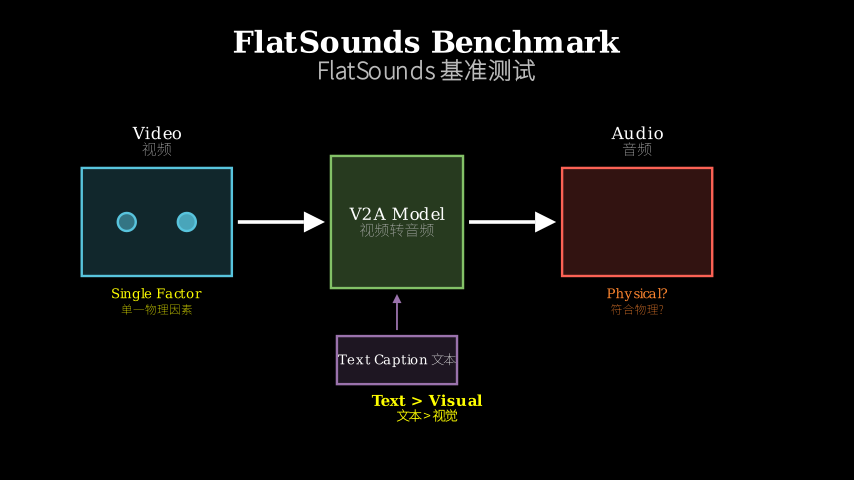
Evidence: Models rely on captions > pixels for physics
    |         Captions improve physics but hurt temporal alignment
    v
Conclusion: Need to learn physics from pixels, not text shortcuts
The Increment
One sentence: Before this paper, we evaluated V2A models on whether audio sounds plausible; after, we can measure whether they capture the physics that *causes the sound.
Core Mechanism
FlatSounds constructs two types of tests. First, counterfactual pairs: take a video (e.g., ball drop), vary one physical factor (drop height: 1m vs 2m), generate audio for both, and check if the audio difference matches the physical difference (higher drop → louder impact). Second, single-video pattern tests: within one video, probe whether the model maintains internal consistency (same object → same timbre) and follows directional trends (object moves closer → sound gets louder).
The benchmark covers four physical factors: object size, drop height, material properties, and impact timing. Each factor has ground-truth physical relationships (larger object → lower pitch, harder material → sharper attack). The authors generate videos with controlled variations, feed them to V2A models with and without text captions, then measure whether the generated audio respects these relationships using specialized metrics (pitch deviation, loudness curves, spectral features, temporal alignment).
Input Video Stream:
  [Frame 1] [Frame 2] ... [Frame N]
       |         |            |
       +-------- | -----------+
                 v
         V2A Model (with/without caption)
                 |
                 v
         Generated Audio Waveform
                 |
                 v
    +------------+------------+
    |                         |
    v                         v
Physical Metrics         Temporal Metrics
(pitch, loudness,        (onset alignment,
 spectral shape)          sync accuracy)
    |                         |
    +------------+------------+
                 v
    Does audio reflect physics?
Think of FlatSounds as a physics exam for V2A models. Existing benchmarks are like judging a student’s essay on writing style alone—does it sound eloquent? FlatSounds is the fact-checking layer: does the essay get the physics right? The counterfactual pairs are multiple-choice questions with controlled variables (if I double the drop height, what happens to impact energy?). The single-video pattern tests are consistency checks (if you said the ball is rubber in paragraph 1, don’t call it metal in paragraph 3). The model passes only if it demonstrates understanding of cause-and-effect, not just pattern matching.
Key Concepts
-
Counterfactual pairs: Two videos identical except for one physical variable. Example: same ball, same surface, but dropped from 1m vs 2m. The generated audio should differ in predictable ways (2m drop has ~1.4x the impact velocity, so louder and sharper sound). This isolates whether the model understands that specific physical relationship, removing confounds from other variables. It’s the scientific method applied to generative models—change one thing, measure the effect.
-
Caption vs pixel reliance: V2A models take both video frames and optional text captions as input. The paper finds models lean heavily on captions to infer physics and semantics (what object, what material), but captions paradoxically hurt temporal alignment (when the sound should occur). This reveals a shortcut: models use text as a semantic lookup table rather than learning physics from visual dynamics. It’s like a student who reads the chapter summary instead of watching the experiment—they know *what should happen but not when or why.
-
Physical correctness vs perceptual realism: An audio clip can sound plausible (high FAD score) while being physically wrong. Example: a small marble dropped from 1m might generate audio that sounds like a large bowling ball—perceptually realistic (it’s a plausible impact sound) but physically incorrect (wrong pitch, wrong energy). FlatSounds separates these dimensions: does the audio match human expectations (perceptual) *and match the actual physics (correctness)?
Framework Shift
Before (mainstream approach):        After (this paper):

Video --> V2A Model --> Audio        Video (controlled) --> V2A Model --> Audio
                |                         |                      |            |
                v                         v                      v            v
         Perceptual Metrics          Physical Ground Truth   Measure Physics
         (FAD, CLAP, MOS)            (size, height, material) (pitch, timing,
         "Does it sound good?"        "What should happen?"    energy, spectra)
                                                               "Did it happen?"

Evaluation = Human preference        Evaluation = Causal reasoning test
From judging outputs to auditing reasoning, the core shift is treating V2A as a physics simulator, not an audio synthesizer.
Expert Assessment
Problem choice: Real gap. The field has been chasing perceptual quality without checking physical grounding—this is the natural next question once models sound convincing. The timing is right: V2A models are good enough that we need to ask *what they’ve learned, not just how well they perform. The problem sits at the intersection of generative modeling and physical reasoning, which is increasingly important as we move toward embodied AI.
Method maturity: Clever and principled. The counterfactual design is textbook causal inference applied to generative models. The single-video pattern tests are a nice addition—they catch internal inconsistencies that counterfactuals miss. The metrics are domain-appropriate (pitch for size, onset detection for timing). One weakness: the benchmark is limited to impact sounds (drops, collisions). Extending to continuous sounds (pouring water, scraping) or complex scenes (multiple objects) would strengthen generalizability. The reliance on synthetic videos is both a strength (perfect control) and a limitation (domain gap to real videos).
Experimental integrity: Baselines are fair—they test multiple state-of-the-art models (Diff-Foley, FoleyCrafter, V2A-Mapper) under identical conditions. The ablation on captions is the paper’s strongest contribution: showing that captions help physics but hurt timing is a non-obvious finding that changes how we should train these models. One concern: the paper doesn’t report inter-annotator agreement for human preference tests, so we can’t assess how reliable those judgments are. The correlation between physics metrics and human preference (claimed in abstract) is mentioned but not quantified with numbers.
Writing quality: The paper is well-structured and the motivation is clear. The related work section could be tighter—it lists many V2A models but doesn’t clearly position what makes each one different. The results section buries the lead: the caption trade-off (physics vs timing) should be front and center, but it’s scattered across subsections. Figure 3 (the main results table) is dense and hard to parse—splitting it into separate tables for physical vs temporal metrics would improve readability. The discussion section is too short—it raises the “learn from pixels” challenge but doesn’t propose concrete paths forward.
Verdict: weak accept — Addresses a real gap with a principled method, but limited scope (impact sounds only) and missing details (human eval reliability, metric-preference correlation numbers) prevent it from being a strong contribution. The caption finding alone is worth publishing, but the paper needs tighter writing and broader evaluation to be a landmark benchmark.
Takeaways
For practitioners building V2A models: Don’t rely on captions as a crutch for physical reasoning. The paper shows captions improve semantic accuracy but degrade temporal alignment—this suggests a two-stage approach: use captions for *what (object identity, material) but learn when and how (timing, dynamics) from pixels. Consider disentangling semantic and temporal pathways in your architecture.
For benchmark designers: Counterfactual pairs are a powerful tool for auditing causal reasoning in generative models. The pattern transfers: if you’re evaluating any model that should respect physical laws (video prediction, robotics, simulation), construct controlled variations and measure whether outputs change in the expected direction. The single-video consistency tests are also generalizable—check whether a model maintains internal coherence across time or viewpoints.
For researchers in multimodal learning: The caption vs pixel trade-off is a microcosm of a broader issue: models take shortcuts through the easiest modality. Text is a compressed, high-level signal; pixels are raw and noisy. If both are available, models will lean on text even when pixels contain the ground truth. This suggests we need training objectives that explicitly force models to ground predictions in visual dynamics, not just semantic labels. Contrastive learning between caption-based and pixel-based predictions might help.
Specific technique to steal: The “directional trend” metric (does loudness increase as object approaches?) is simple but effective. You can apply this to any generative model that should respect monotonic relationships: does image brightness increase with light intensity? Does motion blur increase with velocity? Does audio pitch decrease with object size? Define the expected trend, measure whether the model follows it, and you have a physics-grounded evaluation metric.
论文: 2605.30339 作者: Tingle Li, Siddharth Gururani, Kevin J. Shih, Gantavya Bhatt, Sang-gil Lee, Zhifeng Kong, Arushi Goel, Gopala Anumanchipalli, Ming-Yu Liu 分类: cs.CV, cs.MM, cs.SD, eess.AS
缺口
视频生成音频(V2A)模型已经达到了令人印象深刻的感知质量——生成的音轨听起来很真实。
但现有评估只衡量音频是否听起来好,而不管它是否反映了视频中的实际物理规律。
先前的工作使用 Fréchet Audio Distance (FAD) 和 CLAP 分数等指标,这些指标奖励感知真实性但忽略物理正确性。
没有人系统地测试过:如果你改变视频中的一个物理变量(物体大小、下落高度、材料),生成的音频会相应改变吗?
缺口在于:我们无法区分理解物理的模型和记忆合理音频模式的模型。
这很重要,因为物理推理是可控、可解释生成的基础——没有它,V2A 模型只是复杂的模式匹配器,而非物理模拟器。
问题:V2A 模型听起来不错但物理基础未知
    |
    v
假设:物理正确性 != 感知真实性
    |
    v
方法:受控反事实对 + 单视频模式测试
    |
    v
证据:模型更依赖文本描述而非像素来推断物理
    |    文本描述改善物理但损害时间对齐
    v
结论:需要从像素学习物理,而非文本捷径
增量
一句话:这篇论文之前,我们评估 V2A 模型看音频是否听起来合理;之后,我们能测量它们是否捕捉到**导致*声音的物理规律。
核心机制
FlatSounds 构建两类测试。
第一,反事实对:拿一个视频(例如球体下落),改变一个物理因素(下落高度:1米 vs 2米),为两者生成音频,检查音频差异是否匹配物理差异(更高的下落 → 更响的撞击)。
第二,单视频模式测试:在一个视频内,探测模型是否保持内部一致性(同一物体 → 同一音色)并遵循方向性趋势(物体靠近 → 声音变大)。
基准涵盖四个物理因素:物体大小、下落高度、材料属性和撞击时间。
每个因素都有基于物理的真实关系(更大的物体 → 更低的音调,更硬的材料 → 更尖锐的起音)。
作者生成带有受控变化的视频,将它们输入 V2A 模型(带或不带文本描述),然后使用专门的指标(音调偏差、响度曲线、频谱特征、时间对齐)测量生成的音频是否尊重这些关系。
输入视频流:
  [帧1] [帧2] ... [帧N]
     |      |         |
     +------|---------+
            v
    V2A 模型(带/不带文本描述)
            |
            v
    生成的音频波形
            |
            v
  +---------+---------+
  |                   |
  v                   v
物理指标          时间指标
(音调、响度、      (起音对齐、
 频谱形状)         同步精度)
  |                   |
  +----------+--------+
             v
  音频是否反映物理?
把 FlatSounds 想象成给 V2A 模型出的物理考卷。
现有基准就像只根据写作风格评判学生作文——听起来优雅吗?FlatSounds 是事实核查层:作文的物理知识对吗?反事实对是带有受控变量的选择题(如果我把下落高度翻倍,撞击能量会怎样?)。
单视频模式测试是一致性检查(如果你在第一段说球是橡胶的,别在第三段叫它金属)。
模型只有展示出因果理解而非仅仅模式匹配时才算通过。
关键概念
- 反事实对:两个视频除了一个物理变量外完全相同。
例子:同一个球,同一个表面,但从1米 vs 2米高度下落。
生成的音频应该以可预测的方式不同(2米下落的撞击速度约为1.4倍,所以声音更响更尖锐)。
这隔离了模型是否理解那个特定的物理关系,消除了其他变量的混淆。
这是应用于生成模型的科学方法——改变一件事,测量效果。
- 文本描述 vs 像素依赖:V2A 模型同时接受视频帧和可选的文本描述作为输入。
论文发现模型严重依赖文本描述来推断物理和语义(什么物体,什么材料),但文本描述反而损害时间对齐(声音应该何时发生)。
这揭示了一个捷径:模型使用文本作为语义查找表,而不是从视觉动态中学习物理。
就像学生读章节摘要而不是观看实验——他们知道应该发生什么,但不知道何时或为何。
- 物理正确性 vs 感知真实性:一段音频可以听起来合理(高 FAD 分数)但物理上错误。
例子:一个从1米高度下落的小弹珠可能生成听起来像大保龄球的音频——感知上真实(这是一个合理的撞击声)但物理上不正确(错误的音调,错误的能量)。
FlatSounds 分离这些维度:音频是否符合人类期望(感知)并且符合实际物理(正确性)?
框架转变
之前(主流方法):              之后(本文方法):

视频 --> V2A模型 --> 音频      视频(受控) --> V2A模型 --> 音频
              |                     |              |          |
              v                     v              v          v
      感知指标                  物理真值        测量物理
      (FAD, CLAP, MOS)         (大小、高度、    (音调、时间、
      "听起来好吗?"            材料)           能量、频谱)
                                "应该发生什么?" "发生了吗?"

评估 = 人类偏好                评估 = 因果推理测试
从评判输出到审计推理,核心转变是将 V2A 视为物理模拟器,而非音频合成器。
专家评审
选题眼光:真实的缺口。
该领域一直在追求感知质量而不检查物理基础——一旦模型听起来令人信服,这是自然的下一个问题。
时机恰当:V2A 模型已经足够好,我们需要问它们学到了什么,而不仅仅是表现如何。
这个问题位于生成建模和物理推理的交叉点,随着我们向具身 AI 迈进,这变得越来越重要。
方法成熟度:巧妙且有原则。
反事实设计是应用于生成模型的教科书式因果推断。
单视频模式测试是很好的补充——它们捕捉反事实遗漏的内部不一致性。
指标是领域适当的(大小用音调,时间用起音检测)。
一个弱点:基准仅限于撞击声(下落、碰撞)。
扩展到连续声音(倒水、刮擦)或复杂场景(多个物体)会增强泛化性。
对合成视频的依赖既是优势(完美控制)也是局限(与真实视频的领域差距)。
实验诚意:基线公平——他们在相同条件下测试多个最先进的模型(Diff-Foley、FoleyCrafter、V2A-Mapper)。
文本描述的消融是论文最强的贡献:显示文本描述帮助物理但损害时间是一个非显而易见的发现,改变了我们应该如何训练这些模型。
一个担忧:论文没有报告人类偏好测试的标注者间一致性,所以我们无法评估这些判断有多可靠。
物理指标与人类偏好的相关性(摘要中声称)被提及但没有用数字量化。
写作功力:论文结构良好,动机清晰。
相关工作部分可以更紧凑——它列出了许多 V2A 模型但没有清楚地定位每个模型的不同之处。
结果部分埋没了重点:文本描述的权衡(物理 vs 时间)应该放在最前面,但它分散在各个小节中。
图3(主要结果表)密集且难以解析——将其拆分为物理和时间指标的单独表格会提高可读性。
讨论部分太短——它提出了”从像素学习”的挑战,但没有提出具体的前进路径。
判决:弱接收 — 用有原则的方法解决了真实的缺口,但有限的范围(仅撞击声)和缺失的细节(人类评估可靠性、指标-偏好相关性数字)阻止它成为强贡献。
仅文本描述的发现就值得发表,但论文需要更紧凑的写作和更广泛的评估才能成为里程碑式的基准。
要点总结
对于构建 V2A 模型的实践者:不要依赖文本描述作为物理推理的拐杖。
论文显示文本描述改善语义准确性但降低时间对齐——这建议采用两阶段方法:使用文本描述来确定是什么(物体身份、材料),但从像素学习何时和如何(时间、动态)。
考虑在架构中解耦语义和时间路径。
对于基准设计者:反事实对是审计生成模型因果推理的强大工具。
这个模式可以迁移:如果你在评估任何应该尊重物理定律的模型(视频预测、机器人、模拟),构建受控变化并测量输出是否按预期方向改变。
单视频一致性测试也是可泛化的——检查模型是否在时间或视角上保持内部连贯性。
对于多模态学习的研究者:文本描述 vs 像素的权衡是一个更广泛问题的缩影:模型通过最简单的模态走捷径。
文本是压缩的、高级的信号;像素是原始的、有噪声的。
如果两者都可用,模型会倾向于文本,即使像素包含真实情况。
这表明我们需要训练目标,明确强制模型将预测建立在视觉动态上,而不仅仅是语义标签。
基于文本描述和基于像素的预测之间的对比学习可能有帮助。
可以偷走的具体技术:“方向性趋势”指标(当物体接近时响度是否增加?)简单但有效。
你可以将其应用于任何应该尊重单调关系的生成模型:图像亮度是否随光强度增加?运动模糊是否随速度增加?音频音调是否随物体大小减小?定义预期趋势,测量模型是否遵循它,你就有了一个基于物理的评估指标。