
Paper: 2603.30038 Authors: Wenyi Li, Renkai Luo, Yue Yu, Huan-ang Gao, Mingju Gao, Li Yuan, Chaoyou Fu, Hao Zhao Categories: cs.CV
The Gap
AI coding assistants have conquered LeetCode and can scaffold web apps, but they crumble when asked to implement the geometric transformations and novel algorithms that drive 3D computer vision research. Existing benchmarks (HumanEval, MBPP) test generic programming; domain-specific ones (DS-1000) cover data science but skip the spatial reasoning and mathematical rigor of geometric vision. No one has systematically measured whether models can translate cutting-edge 3D vision papers into working code—the kind researchers write daily but can’t delegate to current AI.
Problem: AI codes well on generic tasks, fails on 3D geometric vision
   |
   v
Hypothesis: Lack of benchmarks for PhD-level 3D coding hides this gap
   |
   v
Method: Curate fill-in functions from recent papers + edge-case tests
   |
   v
Evidence: Best model (GPT-5) achieves only 36.6% pass rate
   |
   v
Conclusion: Current AI far from trustworthy scientific 3D coding
The Increment
One sentence: Before this paper, we assumed AI coding progress would naturally extend to scientific domains; after, we have quantitative proof that 3D geometric vision coding remains a frontier where even frontier models struggle.
Core Mechanism
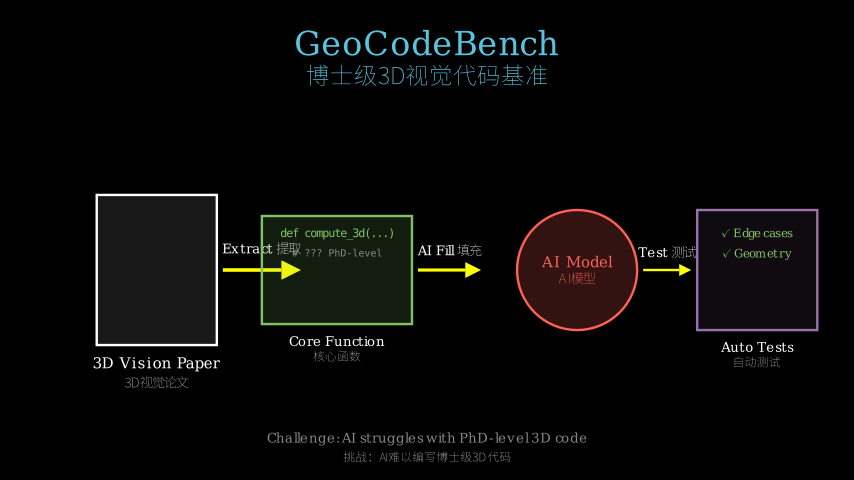
GeoCodeBench extracts 164 function-level implementation tasks from official repositories of papers published at top venues (CVPR, ICCV, NeurIPS, etc.). A tool first proposes candidate functions, then human experts screen for core 3D geometric components—things like rotation matrix composition, ray-surface intersection, or novel view synthesis logic. Each selected function becomes a fill-in-the-blank problem: the model receives the paper text (with controllable context length), function signature, and docstring, then must produce the implementation.
The benchmark auto-generates diverse unit tests for each target, including edge cases (zero vectors, degenerate triangles, boundary conditions). Scoring is fully automatic and reproducible: code either passes all tests or doesn’t. Tasks organize into a two-level hierarchy—General 3D (geometric transforms, physics/optics formulas) and Research (novel algorithms, complex geometric routing)—letting you diagnose where models fail.
Paper repo --> Tool proposes functions --> Human screens for 3D core
                                                    |
                                                    v
                                         Selected function becomes task
                                                    |
                    +-------------------------------+
                    |
                    v
    [Paper text] + [Function signature] --> Model --> [Implementation]
                                                              |
                                                              v
                                                    Auto-generated tests
                                                              |
                                                              v
                                                        Pass / Fail
Think of GeoCodeBench as a flight simulator for research coding. Generic coding benchmarks are like learning to drive in a parking lot—controlled, flat, forgiving. This benchmark is the mountain pass in a snowstorm: you need spatial reasoning (where am I in 3D?), mathematical precision (one sign error crashes everything), and algorithmic creativity (the paper’s pseudocode is a sketch, not a blueprint). The simulator doesn’t just check if your car moves; it throws edge cases at you—what if the road vanishes? What if gravity reverses? Only implementations that handle degenerate geometry, numerical instability, and algorithmic corner cases pass. The two-level hierarchy is your license classification: General 3D is the standard license (can you handle basic transforms?), Research is the commercial license (can you implement something no one’s coded before?).
Key Concepts
-
Fill-in-the-function task: Instead of “write a program from scratch,” you get a function signature, docstring, and surrounding context—your job is to complete the body. This mirrors real research workflows: you’re not building a codebase from zero, you’re implementing the one tricky geometric subroutine that makes or breaks the paper. It isolates coding ability from software engineering, focusing on algorithmic and mathematical correctness.
-
Edge-case unit tests: Standard tests check happy paths (does rotation work for 45°?). Edge-case tests probe boundaries: What if the rotation angle is zero? What if the input vector has length zero? What if two triangles are coplanar? In 3D geometry, edge cases aren’t rare—they’re where bugs hide. Auto-generating these tests ensures models can’t just memorize common patterns; they must handle the degenerate cases that break naive implementations.
-
Context ablation (Method-only vs Full-paper): The paper runs experiments feeding models different amounts of paper text—just the Method section vs the entire paper. Surprisingly, Method-only statistically outperforms full-paper inputs. Why? Long papers contain tangential discussions, related work, and experimental details that dilute the signal. Models struggle with long-context scientific comprehension: more text ≠ better understanding. This reveals a failure mode: current models can’t efficiently extract the algorithmic core from verbose academic writing.
Framework Shift
Before (generic coding benchmarks):     After (GeoCodeBench):

  Problem statement                       Research paper (10+ pages)
         |                                         |
         v                                         v
  Write full program                      Fill in core function
         |                                         |
         v                                         v
  Test on examples                        Test on edge cases
         |                                         |
         v                                         v
  Pass/Fail (syntax/logic)                Pass/Fail (geometric correctness)

  Focus: General programming              Focus: 3D spatial reasoning
         + algorithmic thinking                   + mathematical rigor
                                                  + novel algorithm impl.
From “can you code?” to “can you translate cutting-edge geometric vision research into correct, robust implementations?”—the core shift is from testing programming fluency to testing scientific coding under constraints of spatial reasoning and mathematical precision.
Expert Assessment
Problem choice: This is a real gap, not manufactured. The AI coding hype cycle has focused on productivity tools (autocomplete, bug fixes) and generic benchmarks. But researchers in 3D vision, robotics, and graphics can’t use these tools for their core work—implementing novel geometric algorithms. The paper sits at the intersection of two trends: AI-assisted coding reaching saturation on easy benchmarks, and scientific domains needing specialized evaluation. Timely and well-motivated.
Method maturity: The curation process (tool proposes, human screens) is pragmatic but introduces subjectivity—what counts as “core 3D geometric”? The paper doesn’t deeply justify selection criteria. However, the two-level hierarchy (General vs Research) is clever: it lets you diagnose whether failures stem from basic 3D incompetence or research-specific challenges. The context ablation (Method-only vs Full-paper) is the paper’s sharpest insight—it’s a simple experiment that reveals a fundamental limitation in long-context scientific reasoning.
Experimental integrity: Baselines are fair—eight models spanning open/closed, small/large. The 36.6% pass rate for GPT-5 is sobering and credible (not cherry-picked). One concern: the paper doesn’t report inter-annotator agreement for human screening, so we can’t assess curation reliability. Also, “PhD-level” is marketing—some tasks might be undergrad-level geometric transforms. But the core claim (models struggle on 3D coding) holds up.
Writing quality: The abstract oversells (“research of our community would change substantially”)—benchmarks don’t change research, better models do. The Method section is dense; a worked example of one task (paper excerpt → function signature → test cases) would clarify. The context ablation result is buried in experiments; it deserves prominence—it’s the paper’s most surprising finding.
Verdict: Weak accept—solid contribution with a sharp insight (context ablation), but curation subjectivity and overselling weaken it. The benchmark will be useful, but the paper’s lasting impact is showing that “more paper text” hurts performance, which challenges assumptions about long-context scientific AI.
Takeaways
For benchmark designers: Context ablation should be standard practice. Don’t assume more input helps—test it. GeoCodeBench’s Method-only result suggests that for scientific papers, extracting the algorithmic core (Method section) beats dumping the full paper into context.
For model developers: 3D geometric coding requires a different skill mix than web dev or data science. Spatial reasoning and mathematical precision don’t emerge from scaling alone. If you want models that help researchers, you need training data and evaluation that emphasize geometric edge cases, not just happy-path examples.
For researchers: Don’t expect current AI to implement your novel 3D algorithms reliably. Use it for boilerplate, but verify geometric correctness yourself. The 36.6% pass rate means you’ll spend more time debugging AI output than writing from scratch—for now.
Transferable technique: The “fill-in-the-function” format + auto-generated edge-case tests is a template for domain-specific coding benchmarks. If you work in computational physics, bioinformatics, or numerical optimization, you can adapt this approach: curate core functions from recent papers, generate tests that probe domain-specific failure modes, measure how models perform. The insight that Method-only context beats full-paper context likely transfers to other scientific domains where papers are verbose and models struggle with long-context reasoning.
论文: 2603.30038 作者: Wenyi Li, Renkai Luo, Yue Yu, Huan-ang Gao, Mingju Gao, Li Yuan, Chaoyou Fu, Hao Zhao 分类: cs.CV
缺口
AI编程助手已经攻克了LeetCode,能搭建Web应用,但当被要求实现驱动3D计算机视觉研究的几何变换和新颖算法时,它们就崩溃了。
现有基准(HumanEval、MBPP)测试通用编程;
领域特定的基准(DS-1000)覆盖数据科学,但跳过了几何视觉所需的空间推理和数学严谨性。
没有人系统地测量过模型能否将前沿3D视觉论文转化为可工作的代码——这是研究者每天都在写但无法委托给当前AI的那种代码。
问题:AI在通用任务上编码良好,在3D几何视觉上失败
   |
   v
假设:缺乏博士级3D编码基准掩盖了这个差距
   |
   v
方法:从近期论文中精选填空函数 + 边界测试
   |
   v
证据:最佳模型(GPT-5)仅达到36.6%通过率
   |
   v
结论:当前AI远未达到可信的科学3D编码水平
增量
一句话: 这篇论文之前,我们假设AI编码进展会自然延伸到科学领域;
之后,我们有了定量证据表明3D几何视觉编码仍是前沿模型也挣扎的前沿。
核心机制
GeoCodeBench从顶级会议(CVPR、ICCV、NeurIPS等)发表论文的官方代码库中提取164个函数级实现任务。
工具首先提议候选函数,然后人类专家筛选核心3D几何组件——比如旋转矩阵组合、光线-表面相交、新视角合成逻辑等。
每个选中的函数变成一个填空题:模型接收论文文本(可控的上下文长度)、函数签名和文档字符串,然后必须生成实现。
基准为每个目标自动生成多样化的单元测试,包括边界情况(零向量、退化三角形、边界条件)。
评分完全自动且可复现:代码要么通过所有测试,要么不通过。
任务组织成两级层次——通用3D(几何变换、物理/光学公式)和研究级(新颖算法、复杂几何路由)——让你能诊断模型在哪里失败。
论文仓库 --> 工具提议函数 --> 人类筛选3D核心
                                    |
                                    v
                          选中的函数变成任务
                                    |
            +------------------------+
            |
            v
[论文文本] + [函数签名] --> 模型 --> [实现]
                                        |
                                        v
                                  自动生成测试
                                        |
                                        v
                                    通过/失败
把GeoCodeBench想象成研究编码的飞行模拟器。
通用编码基准就像在停车场学开车——受控、平坦、宽容。
这个基准是暴风雪中的山路:你需要空间推理(我在3D空间的哪里?
)、数学精度(一个符号错误就全盘崩溃)、算法创造力(论文的伪代码是草图,不是蓝图)。
模拟器不只检查你的车能不能动;
它向你扔边界情况——如果路消失了怎么办?
如果重力反转了怎么办?
只有能处理退化几何、数值不稳定性和算法边界情况的实现才能通过。
两级层次是你的驾照分类:通用3D是标准驾照(你能处理基本变换吗?
),研究级是商业驾照(你能实现之前没人编码过的东西吗?
)。
关键概念
- 填空函数任务: 不是”从头写一个程序”,而是给你函数签名、文档字符串和周围上下文——你的工作是完成函数体。
这反映了真实的研究工作流:你不是从零构建代码库,而是实现那个让论文成败的棘手几何子程序。
它将编码能力与软件工程隔离开,专注于算法和数学正确性。
- 边界测试用例: 标准测试检查正常路径(45°旋转能工作吗?
)。
边界测试探测边界:如果旋转角度是零怎么办?
如果输入向量长度为零怎么办?
如果两个三角形共面怎么办?
在3D几何中,边界情况不罕见——它们是bug藏身之处。
自动生成这些测试确保模型不能只记住常见模式;
它们必须处理破坏朴素实现的退化情况。
- 上下文消融(仅方法 vs 全文): 论文运行实验,向模型提供不同数量的论文文本——仅方法部分 vs 整篇论文。
令人惊讶的是,仅方法在统计上优于全文输入。
为什么?
长论文包含无关讨论、相关工作和实验细节,稀释了信号。
模型在长上下文科学理解上挣扎:更多文本 ≠ 更好理解。
这揭示了一个失败模式:当前模型无法从冗长的学术写作中高效提取算法核心。
框架转变
之前(通用编码基准):              之后(GeoCodeBench):

  问题陈述                            研究论文(10+页)
      |                                      |
      v                                      v
  写完整程序                            填写核心函数
      |                                      |
      v                                      v
  在示例上测试                          在边界情况上测试
      |                                      |
      v                                      v
  通过/失败(语法/逻辑)                通过/失败(几何正确性)

  焦点:通用编程                        焦点:3D空间推理
       + 算法思维                              + 数学严谨性
                                              + 新颖算法实现
从”你会编码吗?
“到”你能将前沿几何视觉研究转化为正确、健壮的实现吗?
“——核心转变是从测试编程流畅度到测试空间推理和数学精度约束下的科学编码。
专家评审
选题眼光: 这是真实的缺口,不是人造的。
AI编码炒作周期聚焦于生产力工具(自动补全、bug修复)和通用基准。
但3D视觉、机器人和图形学的研究者无法将这些工具用于核心工作——实现新颖的几何算法。
论文处于两个趋势的交叉点:AI辅助编码在简单基准上达到饱和,科学领域需要专门评估。
及时且动机充分。
方法成熟度: 精选过程(工具提议,人类筛选)务实但引入主观性——什么算”核心3D几何”?
论文没有深入论证选择标准。
然而,两级层次(通用 vs 研究)很聪明:它让你能诊断失败是源于基本3D无能还是研究特定挑战。
上下文消融(仅方法 vs 全文)是论文最锐利的洞察——这是一个简单实验,揭示了长上下文科学推理的根本局限。
实验诚意: 基线公平——八个模型跨越开源/闭源、小/大。
GPT-5的36.6%通过率令人清醒且可信(不是精心挑选的)。
一个担忧:论文没有报告人类筛选的标注者间一致性,所以我们无法评估精选可靠性。
另外,“博士级”是营销——有些任务可能是本科级几何变换。
但核心主张(模型在3D编码上挣扎)站得住脚。
写作功力: 摘要过度推销(“我们社区的研究会实质性改变”)——基准不改变研究,更好的模型才改变。
方法部分密集;
一个任务的完整示例(论文摘录 → 函数签名 → 测试用例)会更清晰。
上下文消融结果埋在实验中;
它值得突出——这是论文最令人惊讶的发现。
判决: 弱接收——有锐利洞察(上下文消融)的扎实贡献,但精选主观性和过度推销削弱了它。
基准会有用,但论文的持久影响是展示”更多论文文本”损害性能,这挑战了关于长上下文科学AI的假设。
要点总结
对基准设计者: 上下文消融应该是标准实践。
不要假设更多输入有帮助——测试它。
GeoCodeBench的仅方法结果表明,对于科学论文,提取算法核心(方法部分)胜过将全文倾倒进上下文。
对模型开发者: 3D几何编码需要与Web开发或数据科学不同的技能组合。
空间推理和数学精度不会仅从扩展中涌现。
如果你想要帮助研究者的模型,你需要强调几何边界情况的训练数据和评估,而不仅仅是正常路径示例。
对研究者: 不要期望当前AI可靠地实现你的新颖3D算法。
用它处理样板代码,但自己验证几何正确性。
36.6%的通过率意味着你调试AI输出的时间会比从头写更多——目前如此。
可迁移技术: “填空函数”格式 + 自动生成边界测试是领域特定编码基准的模板。
如果你在计算物理、生物信息学或数值优化领域工作,你可以改编这种方法:从近期论文中精选核心函数,生成探测领域特定失败模式的测试,测量模型表现。
仅方法上下文胜过全文上下文的洞察可能迁移到其他科学领域,那里论文冗长且模型在长上下文推理上挣扎。