
Paper: 2604.15297 Authors: Yury Gorishniy, Ivan Rubachev, Dmitrii Feoktistov, Artem Babenko Categories: cs.LG
The Gap
Tabular deep learning has seen extensive architecture innovation—ResNet-like skip connections, attention mechanisms, specialized normalization layers. Yet everyone just uses AdamW to train these models. It’s the inherited default from computer vision and NLP, never questioned in the tabular context. Meanwhile, new optimizers like Muon, Shampoo, and others have shown promise in vision and language domains, but nobody’s checked if they help with tabular data. The field optimized the house but never tested different engines.
Problem: AdamW is default optimizer for tabular DL
   |
   v
Assumption: New optimizers (Muon, Shampoo, etc.) might work better
   |
   v
Method: Benchmark N optimizers on M tabular datasets with shared protocol
   |
   v
Evidence: Muon consistently outperforms AdamW across datasets
   |
   v
Conclusion: Practitioners should consider Muon as new default
The Increment
One sentence: Before this paper, tabular DL practitioners used AdamW by default without evidence; after, they have systematic benchmarks showing Muon as a stronger choice.
Core Mechanism
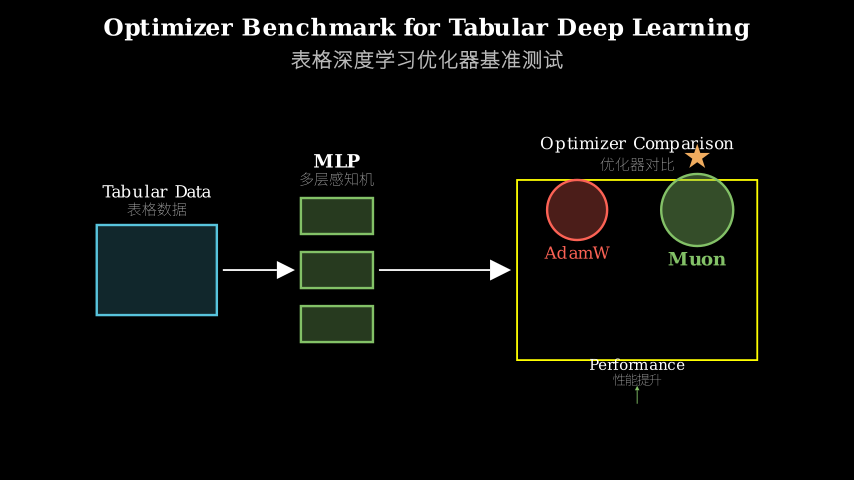
The paper doesn’t propose a new optimizer—it’s a benchmarking study. The mechanism is the experimental protocol itself. They take multiple optimizers (AdamW, Muon, Shampoo, Lion, AdamW with EMA, etc.) and run them through identical training pipelines on diverse tabular datasets. Each optimizer gets the same MLP architecture, same hyperparameter search budget, same evaluation metrics. The key is controlling everything except the optimizer, so differences in final performance isolate the optimizer’s contribution.
The protocol has three layers: dataset selection (regression and classification tasks across different domains), model architecture (vanilla MLPs plus variants with different normalization schemes), and hyperparameter tuning (systematic search over learning rates, weight decay, batch sizes). For each optimizer-dataset-architecture combination, they run multiple seeds and report aggregated metrics.
Input: Tabular dataset
   |
   v
[MLP Architecture] <--- Fixed across all experiments
   |
   v
[Optimizer X] <--- Variable being tested
   |    |
   |    +---> Learning rate search
   |    +---> Weight decay search
   |    +---> Batch size search
   |
   v
[Training Loop] ---> Loss curves, validation metrics
   |
   v
[Aggregation] ---> Mean rank across datasets
   |
   v
Output: Optimizer performance ranking
Think of this like a cooking competition where everyone gets identical ingredients and kitchen equipment, but each contestant uses a different technique to control the heat. You’re not inventing a new stove—you’re systematically testing whether gas, electric, or induction produces better results when everything else (recipe, cookware, timing) is held constant. The “heat control technique” is the optimizer, and the “quality of the dish” is model performance. By running the same recipe (MLP training) with different heat sources (optimizers) across multiple dishes (datasets), you can finally say which technique actually works best, rather than just using whatever your culinary school taught you.
Key Concepts
-
Optimizer in deep learning: At its core, an optimizer decides how to update model weights after seeing training data. Imagine you’re trying to find the lowest point in a foggy valley while blindfolded. Each step, you feel the ground’s slope (gradient) and decide which direction to move and how far. AdamW is like having a smart walking stick that remembers recent slopes and adjusts your step size accordingly—if you’ve been going downhill consistently, it takes bigger steps; if the terrain is rough, it takes smaller, cautious steps. Different optimizers are different walking strategies. Muon, for instance, uses momentum in a specific way that helps it navigate the “valleys” of tabular data more efficiently than AdamW’s strategy.
-
Exponential Moving Average (EMA) of weights: During training, your model weights jump around as they optimize. EMA is like taking a time-lapse photo with long exposure—instead of using the final frame’s exact position, you blend recent positions together, smoothing out the jitter. Concretely, if your model weight is 0.5 at step 100 and 0.6 at step 101, EMA might give you 0.52 (weighted average favoring recent values). This often produces a more stable, better-performing model than the raw final weights. The paper finds EMA helps AdamW on vanilla MLPs but not consistently across all architectures.
Framework Shift
Before (mainstream approach):        After (this paper):

[Tabular Data]                       [Tabular Data]
      |                                     |
      v                                     v
[MLP Architecture]                   [MLP Architecture]
      |                                     |
      v                                     v
[AdamW] <--- inherited default       [Optimizer Choice] <--- evidence-based
      |                                /    |    \
      v                              /      |      \
[Training]                      [AdamW] [Muon] [Shampoo]...
      |                                     |
      v                                     v
[Model]                              [Benchmark Results]
                                            |
                                            v
                                      [Informed Choice]
From blind inheritance to empirical selection, the core shift is treating optimizer choice as a first-class design decision backed by systematic evidence.
Expert Assessment
Problem choice: This is a real gap, not manufactured. Tabular DL has matured enough that optimizer choice matters, yet the community was running on autopilot. The timing is right—new optimizers exist, tabular benchmarks are standardized, and practitioners need guidance. It’s not glamorous research, but it’s the kind of service work that moves a field forward.
Method maturity: This is solid benchmarking craft. The shared protocol is well-designed: they control for hyperparameter search budget (crucial—some optimizers are just more sensitive to learning rate), use multiple seeds, and test across diverse datasets. The choice to include MLP variants (different normalizations) is smart—it checks whether findings generalize beyond vanilla architectures. No methodological red flags. The simplicity is a feature, not a bug.
Experimental integrity: Baselines are fair. They give each optimizer a proper hyperparameter search, not just default settings. The dataset selection spans regression and classification, different sizes, different domains—good coverage. One minor concern: they don’t deeply investigate *why Muon wins, just that it does. For a benchmarking paper, that’s acceptable, but it leaves mechanistic questions open. The numbers appear solid; they report aggregated ranks rather than cherry-picking individual wins.
Writing quality: The paper is clear and well-organized. The main weakness is in the discussion section—they could dig deeper into when Muon’s advantage is largest (dataset characteristics? architecture details?) and provide more actionable guidance. The EMA findings feel somewhat disconnected from the main Muon narrative; integrating these better would strengthen the story. The related work section is adequate but could better position this against prior optimizer comparisons in other domains.
Verdict: weak accept — Solid empirical work that provides actionable guidance to practitioners, though it doesn’t advance fundamental understanding of optimization.
Takeaways
If you’re training MLPs on tabular data and can afford slightly longer training times, switch from AdamW to Muon—the evidence is clear. More broadly, this paper demonstrates the value of systematic benchmarking in subdomains. The “inherited default” phenomenon happens everywhere: people use whatever worked in the last domain they came from. Before assuming your current optimizer is optimal, check if anyone’s actually tested alternatives in your specific setting. The EMA finding is also portable: if you’re using AdamW on any architecture, try maintaining an EMA of weights during training and using that for inference—it’s a nearly free performance boost on some architectures. Finally, the experimental protocol itself is reusable: if you’re comparing methods, control hyperparameter search budget explicitly, or you’re just measuring sensitivity to tuning rather than true performance.
论文: 2604.15297 作者: Yury Gorishniy, Ivan Rubachev, Dmitrii Feoktistov, Artem Babenko 分类: cs.LG
缺口
表格深度学习在架构上创新不断——类 ResNet 的跳跃连接、注意力机制、专用归一化层。
但所有人都用 AdamW 训练这些模型。
这是从计算机视觉和自然语言处理继承来的默认选择,从未在表格数据场景下被质疑过。
与此同时,Muon、Shampoo 等新优化器在视觉和语言领域表现出色,但没人检验过它们在表格数据上的效果。
这个领域优化了房子,却从未测试过不同的引擎。
问题:AdamW 是表格深度学习的默认优化器
   |
   v
假设:新优化器(Muon、Shampoo 等)可能表现更好
   |
   v
方法:在 M 个表格数据集上用统一协议基准测试 N 个优化器
   |
   v
证据:Muon 在各数据集上持续优于 AdamW
   |
   v
结论:实践者应考虑将 Muon 作为新默认选择
增量
一句话: 这篇论文之前,表格深度学习实践者无依据地默认使用 AdamW;
之后,他们有了系统性基准测试,显示 Muon 是更强的选择。
核心机制
这篇论文没有提出新优化器——它是一项基准测试研究。
机制就是实验协议本身。
他们拿多个优化器(AdamW、Muon、Shampoo、Lion、带 EMA 的 AdamW 等)在不同表格数据集上跑相同的训练流程。
每个优化器用相同的 MLP 架构、相同的超参数搜索预算、相同的评估指标。
关键是控制除优化器外的所有变量,这样最终性能的差异就能隔离出优化器的贡献。
协议有三层:数据集选择(跨不同领域的回归和分类任务)、模型架构(原版 MLP 加上不同归一化方案的变体)、超参数调优(系统性搜索学习率、权重衰减、批大小)。
对每个优化器-数据集-架构组合,他们运行多个随机种子并报告聚合指标。
输入:表格数据集
   |
   v
[MLP 架构] <--- 所有实验固定
   |
   v
[优化器 X] <--- 被测试的变量
   |    |
   |    +---> 学习率搜索
   |    +---> 权重衰减搜索
   |    +---> 批大小搜索
   |
   v
[训练循环] ---> 损失曲线、验证指标
   |
   v
[聚合] ---> 跨数据集的平均排名
   |
   v
输出:优化器性能排名
把这想象成一场烹饪比赛,每个人拿到相同的食材和厨具,但每位选手用不同的技巧控制火候。
你不是在发明新炉灶——你在系统性地测试当其他一切(配方、炊具、时间)都固定时,燃气、电磁炉还是电陶炉能产生更好的结果。
“火候控制技巧”是优化器,“菜品质量”是模型性能。
通过在多道菜(数据集)上用不同热源(优化器)跑相同配方(MLP 训练),你终于能说清哪种技巧真正最好,而不是只用烹饪学校教的那一套。
关键概念
- 深度学习中的优化器: 优化器的核心作用是决定看到训练数据后如何更新模型权重。
想象你在大雾弥漫的山谷里蒙眼寻找最低点。
每走一步,你摸摸地面的坡度(梯度),决定往哪个方向走、走多远。
AdamW 就像有根智能拐杖,它记得最近的坡度并相应调整步幅——如果你一直在下坡,它就迈大步;
如果地形崎岖,它就小心翼翼地挪小步。
不同优化器是不同的行走策略。
比如 Muon,它用动量的方式特别适合在表格数据的”山谷”里导航,比 AdamW 的策略更高效。
- 权重的指数移动平均(EMA): 训练时,模型权重会跳来跳去。
EMA 就像拍长曝光延时照片——不用最后一帧的精确位置,而是把最近的位置混合在一起,平滑掉抖动。
具体来说,如果你的模型权重在第 100 步是 0.5,第 101 步是 0.6,EMA 可能给你 0.52(偏向最近值的加权平均)。
这通常能产生比原始最终权重更稳定、表现更好的模型。
论文发现 EMA 在原版 MLP 上帮助 AdamW,但在所有架构上效果并不一致。
框架转变
之前(主流方法):                之后(本文方法):

[表格数据]                       [表格数据]
      |                                |
      v                                v
[MLP 架构]                       [MLP 架构]
      |                                |
      v                                v
[AdamW] <--- 继承的默认          [优化器选择] <--- 基于证据
      |                           /    |    \
      v                         /      |      \
[训练]                     [AdamW] [Muon] [Shampoo]...
      |                                |
      v                                v
[模型]                           [基准测试结果]
                                       |
                                       v
                                  [知情选择]
从盲目继承到实证选择,核心转变是把优化器选择当作有系统性证据支撑的一等设计决策。
专家评审
选题眼光: 这是真缺口,不是人造的。
表格深度学习已经成熟到优化器选择很重要的程度,但社区一直在自动驾驶模式。
时机恰当——新优化器存在,表格基准已标准化,实践者需要指导。
这不是光鲜的研究,但正是这种服务性工作推动领域前进。
方法成熟度: 这是扎实的基准测试手艺。
共享协议设计得好:他们控制超参数搜索预算(关键——有些优化器对学习率更敏感),用多个随机种子,在多样化数据集上测试。
选择包含 MLP 变体(不同归一化)很聪明——检验发现是否泛化到原版架构之外。
没有方法论上的危险信号。
简洁是特点,不是缺陷。
实验诚意: 基线公平。
他们给每个优化器做了适当的超参数搜索,不只是用默认设置。
数据集选择涵盖回归和分类、不同规模、不同领域——覆盖面好。
一个小顾虑:他们没深入研究 Muon 为什么赢,只是说它赢了。
对基准测试论文来说这可以接受,但留下了机制性问题。
数字看起来扎实;
他们报告聚合排名而非挑选个别胜利。
写作功力: 论文清晰、组织良好。
主要弱点在讨论部分——他们可以更深入挖掘 Muon 优势最大的情况(数据集特征?
架构细节?
)并提供更可操作的指导。
EMA 发现感觉与主要的 Muon 叙事有些脱节;
更好地整合这些会加强故事性。
相关工作部分足够,但可以更好地将此与其他领域的先前优化器比较定位。
判决: 弱接收 — 扎实的实证工作,为实践者提供可操作指导,但没有推进对优化的根本理解。
要点总结
如果你在表格数据上训练 MLP 且能承受稍长的训练时间,从 AdamW 切换到 Muon——证据很清楚。
更广泛地说,这篇论文展示了子领域系统性基准测试的价值。
“继承的默认”现象无处不在:人们用上个领域管用的东西。
在假设当前优化器最优之前,检查是否有人在你的具体设置下真正测试过替代方案。
EMA 发现也可迁移:如果你在任何架构上用 AdamW,试试训练时维护权重的 EMA 并用于推理——在某些架构上这几乎是免费的性能提升。
最后,实验协议本身可复用:如果你在比较方法,明确控制超参数搜索预算,否则你只是在测量调优敏感度而非真实性能。