
Paper: 2603.09961 Authors: Xinyu Gao, Gang Chen, Javier Alonso-Mora Categories: cs.RO, cs.AI, cs.CV
The Gap
Existing vision-language navigation methods (like VLN-CE, ZSON) ground language instructions to pixels in camera images. When you tell a robot “go to the chair near the window,” these methods look at what’s visible in the camera feed and pick a pixel. This works fine in open spaces, but fails catastrophically when furniture or people block the view. The target chair might be just around the corner, but if it’s not in the image, the model can’t point to it. The fundamental issue: image space is inherently limited to visible surfaces.
Problem: "Go near the couch"
   |
   v
Assumption: Target must be visible in camera
   |
   v
Method: VLM predicts pixel in image space
   |
   v
Evidence: 22.74% accuracy drop when target occluded
   |
   v
Conclusion: Need representation that includes occluded space
   |
   v
BEACON: Predict in BEV space (includes hidden areas)
The Increment
One sentence: Before, robots could only navigate to what they could see in their camera; now they can reason about where to go even when the target is hidden behind obstacles.
Core Mechanism
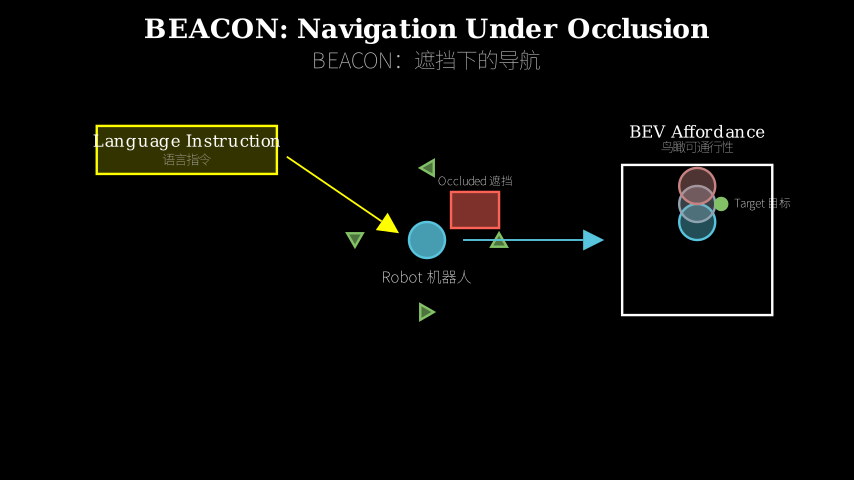
BEACON takes RGB-D images from four cameras around the robot (front, back, left, right) plus a language instruction. Instead of predicting a location in any single image, it outputs a bird’s-eye view heatmap showing where the robot should navigate within a local region (say, 5 meters around it). This BEV heatmap covers the entire floor area, including parts hidden behind furniture.
The architecture has three streams. First, the language instruction and four RGB images go into a vision-language model (BLIP-2) that produces image features enriched with spatial understanding. Second, the depth maps from all four cameras get projected into BEV space and fused into a geometric feature map. Third, these two streams merge: the VLM features are lifted into BEV using learned spatial embeddings, then combined with the depth-derived BEV features through cross-attention. The final output is a 2D heatmap in BEV coordinates.
Input:                    Processing:                Output:

RGB-D (4 views)          VLM Stream:                BEV Heatmap:
+ Instruction    --->    [BLIP-2]
                            |                       ###....###
  Front: [img]             v                        #.*......#
  Back:  [img]         Spatial Lift                 #........#
  Left:  [img]             |                        #...X....#
  Right: [img]             v                        #........#
                       [BEV Features]               ###....###
  "Go to couch"            |
                           v                        X = predicted
                       Cross-Attn  <--- Depth BEV   * = occluded
                           |                            but predicted
                           v
                      [Heatmap Head]
Think of it like a security guard monitoring a building. Image-space methods are like having cameras that only show what’s directly visible—if someone walks behind a pillar, they disappear from your awareness. BEACON is like having a mental map of the entire floor plan. The cameras (VLM) tell you what objects are where based on what’s visible, the depth sensors (geometric stream) tell you the layout of walls and obstacles, and your brain (cross-attention fusion) combines these to maintain awareness of the whole space, including areas currently blocked from view. When someone says “the person is near the water cooler,” you can point to that spot on your mental map even if a pillar currently blocks your camera’s view of it.
Key Concepts
-
Bird’s-Eye View (BEV) Representation: Imagine looking down at a room from the ceiling. Instead of seeing things from the robot’s eye-level perspective (where a table blocks everything behind it), you see the floor plan with all objects marked from above. In BEV, every location on the floor gets a coordinate, whether it’s visible from the cameras or not. A chair behind a couch still has a location in BEV space. This is crucial because language instructions often refer to spatial relationships (“near the window,” “behind the table”) that make sense in this overhead view, not in camera pixels where “behind” might mean “not visible at all.”
-
Spatial Lifting: The VLM processes images and understands “there’s a couch in the left image,” but that’s still image-space knowledge. Spatial lifting is the operation that takes these image features and projects them into the BEV grid. It’s like taking a photo of a room and figuring out where each object would appear on a floor plan. BEACON learns this mapping using positional embeddings that encode “this part of the left camera image corresponds to this region in BEV space.” The depth information helps constrain this projection—if something is 2 meters away in the left camera, it goes 2 meters to the left in BEV.
-
Occlusion-Aware Training: The dataset includes explicit labels for whether the target location is visible or occluded. During training, BEACON sees examples where “go to the chair” means pointing to a spot that’s currently hidden behind a table. This forces the model to learn spatial reasoning beyond direct visibility—it must infer that “if there’s a table here and the instruction mentions a chair near the window, the chair is probably in the occluded region behind the table near that window I can see.” Without this training signal, models default to only predicting visible locations.
Framework Shift
Before (Image-Space):              After (BEV-Space):

Camera View:                       Overhead View:

  [Robot Camera]                   +---+---+---+---+
  |             |                  | O | O |   |   |  O = obstacle
  |   [Table]   |                  +---+---+---+---+
  |      X      |                  |   | X |   | T |  X = robot
  |   (hidden)  |                  +---+---+---+---+  T = target
  |_____________|                  |   |   |   |   |
                                   +---+---+---+---+
  Can only predict                 Can predict in
  visible pixels                   occluded cells

  Prediction: ???                  Prediction: (3,1)
From pixel-grounding to spatial-grounding, the core shift is reasoning in a representation that includes unobservable space.
Expert Assessment
Problem choice: This is a real gap. Anyone who’s tried to deploy language-conditioned navigation in cluttered indoor environments hits this immediately. The problem isn’t manufactured—it’s a natural consequence of using image-space representations for spatial reasoning tasks. The timing is right too, as VLMs are mature enough to provide strong semantic understanding that can be lifted into geometric representations.
Method maturity: The approach is well-engineered rather than deeply novel. BEV representations are standard in autonomous driving, and lifting image features to BEV has been explored (BEVFormer, LSS). The contribution is adapting these ideas to language-conditioned navigation and showing they solve the occlusion problem. The cross-attention fusion between VLM and geometric features is sensible but not groundbreaking. A simpler approach might be to just use depth to mask out occluded regions in image space, but that wouldn’t let you reason about what’s behind obstacles.
Experimental integrity: The baselines are fair—they compare against ZSON, a strong recent method. The 22.74 percentage point improvement on occluded targets is substantial, but I’d want to see: (1) performance on non-occluded targets to ensure they didn’t sacrifice easy cases, (2) real robot experiments beyond simulation, (3) failure case analysis. The Habitat simulator is reasonable but doesn’t capture all real-world complexity. The ablations are thorough, systematically validating each design choice.
Writing quality: The paper is clear but could be tighter. The related work section lists many papers without clearly positioning the contribution. The method section would benefit from a single figure showing the full pipeline before diving into components. The experimental section is solid but buries the key result (Table 2, occluded subset) too deep—this should be front and center.
Verdict: weak accept — Solves a real problem with a well-executed adaptation of existing techniques, but the novelty is incremental and real-world validation is missing.
Takeaways
The key transferable idea: when your task involves reasoning about spatial relationships, don’t force your model to work in observation space if that space is fundamentally incomplete. Lift to a representation that includes the unobservable. This applies beyond robotics—in video understanding, you might want to reason about objects that leave the frame; in medical imaging, about anatomy behind bones; in satellite imagery, about what’s under cloud cover. The pattern is: observation space → geometric/spatial space → reasoning → back to actionable output.
Technically, the cross-attention fusion between semantic (VLM) and geometric (depth-derived) features is clean and reusable. Many robotics tasks need both “what is this?” (semantic) and “where is it?” (geometric) understanding. Keeping these in separate streams until late fusion preserves the strengths of each.
The occlusion-aware dataset construction is also worth stealing. If your task has a notion of “observable vs. unobservable,” explicitly label this in your data and stratify your evaluation. It forces honest assessment of whether your model truly reasons beyond direct observation or just memorizes visible patterns.
论文: 2603.09961 作者: Xinyu Gao, Gang Chen, Javier Alonso-Mora 分类: cs.RO, cs.AI, cs.CV
缺口
现有的视觉-语言导航方法(如VLN-CE、ZSON)把语言指令映射到相机图像中的像素。
当你告诉机器人”去窗边的椅子那里”,这些方法会看相机画面里可见的内容,然后选一个像素点。
在开阔空间这没问题,但当家具或人挡住视线时就彻底失效了。
目标椅子可能就在拐角处,但如果它不在图像里,模型就无法指向它。
根本问题:图像空间天然局限于可见表面。
问题:"去沙发附近"
   |
   v
假设:目标必须在相机中可见
   |
   v
方法:VLM 在图像空间预测像素
   |
   v
证据:目标被遮挡时准确率下降 22.74%
   |
   v
结论:需要包含遮挡区域的表示
   |
   v
BEACON:在 BEV 空间预测(包含隐藏区域)
增量
一句话:之前机器人只能导航到相机能看见的地方; 现在即使目标被障碍物遮挡,它们也能推理出该去哪里。
核心机制
BEACON 接收机器人周围四个相机(前后左右)的 RGB-D 图像,加上一条语言指令。
它不在任何单张图像中预测位置,而是输出一个鸟瞰视角的热力图,显示机器人应该在局部区域(比如周围5米)内导航到哪里。
这个 BEV 热力图覆盖整个地面区域,包括被家具遮挡的部分。
架构有三条流。
第一,语言指令和四张 RGB 图像进入视觉-语言模型(BLIP-2),产生富含空间理解的图像特征。
第二,四个相机的深度图被投影到 BEV 空间,融合成几何特征图。
第三,这两条流合并:VLM 特征通过学习到的空间嵌入被提升到 BEV,然后通过交叉注意力与深度衍生的 BEV 特征结合。
最终输出是 BEV 坐标系中的 2D 热力图。
输入:                    处理:                    输出:

RGB-D(4视角)           VLM 流:                   BEV 热力图:
+ 指令          --->     [BLIP-2]
                            |                       ###....###
  前:[图]                  v                        #.*......#
  后:[图]              空间提升                     #........#
  左:[图]                  |                        #...X....#
  右:[图]                  v                        #........#
                       [BEV 特征]                   ###....###
  "去沙发那"                |
                           v                        X = 预测位置
                       交叉注意  <--- 深度 BEV       * = 被遮挡
                           |                            但能预测
                           v
                      [热力图头]
把它想象成监控大楼的保安。
图像空间方法就像只有显示直接可见内容的摄像头——如果有人走到柱子后面,他们就从你的感知中消失了。
BEACON 就像在脑中有整个楼层的平面图。
摄像头(VLM)根据可见内容告诉你物体在哪里,深度传感器(几何流)告诉你墙壁和障碍物的布局,你的大脑(交叉注意力融合)结合这些信息来维持对整个空间的感知,包括当前被遮挡的区域。
当有人说”那个人在饮水机附近”,你可以在脑中的地图上指向那个位置,即使柱子当前挡住了摄像头的视线。
关键概念
- 鸟瞰视角(BEV)表示:想象从天花板往下看一个房间。
不是从机器人的视线高度看(桌子会挡住后面的所有东西),而是看到带有所有物体标记的平面图。
在 BEV 中,地面上的每个位置都有坐标,无论它是否在相机中可见。
沙发后面的椅子在 BEV 空间中仍然有位置。
这很关键,因为语言指令经常涉及空间关系(“窗边”、“桌子后面”),这些关系在俯视图中有意义,但在相机像素中”后面”可能意味着”完全不可见”。
- 空间提升:VLM 处理图像并理解”左边图像里有个沙发”,但这仍然是图像空间的知识。
空间提升是将这些图像特征投影到 BEV 网格中的操作。
就像拍一张房间的照片,然后弄清楚每个物体在平面图上会出现在哪里。
BEACON 使用位置嵌入来学习这个映射,这些嵌入编码了”左相机图像的这部分对应 BEV 空间中的这个区域”。
深度信息帮助约束这个投影——如果左相机中某物距离2米,它就在 BEV 中向左2米的位置。
- 遮挡感知训练:数据集包含目标位置是可见还是被遮挡的显式标签。
训练时,BEACON 看到”去椅子那里”意味着指向当前被桌子遮挡的位置的例子。
这迫使模型学习超越直接可见性的空间推理——它必须推断”如果这里有张桌子,指令提到窗边的椅子,椅子可能在我能看到的那扇窗附近、桌子后面的遮挡区域”。
没有这个训练信号,模型会默认只预测可见位置。
框架转变
之前(图像空间):                之后(BEV空间):

相机视角:                        俯视视角:

  [机器人相机]                     +---+---+---+---+
  |             |                  | O | O |   |   |  O = 障碍物
  |   [桌子]    |                  +---+---+---+---+
  |      X      |                  |   | X |   | T |  X = 机器人
  |   (隐藏)    |                  +---+---+---+---+  T = 目标
  |_____________|                  |   |   |   |   |
                                   +---+---+---+---+
  只能预测                         可以在遮挡
  可见像素                         单元格中预测

  预测:???                        预测:(3,1)
从像素定位到空间定位,核心转变是在包含不可观测空间的表示中推理。
专家评审
选题眼光:这是真实的缺口。
任何尝试在杂乱室内环境部署语言条件导航的人都会立即遇到这个问题。
问题不是人造的——它是使用图像空间表示进行空间推理任务的自然后果。
时机也合适,因为 VLM 已经足够成熟,可以提供强大的语义理解,能被提升到几何表示中。
方法成熟度:这个方法工程化得很好,但不算深度创新。
BEV 表示在自动驾驶中是标准做法,将图像特征提升到 BEV 也已被探索过(BEVFormer、LSS)。
贡献在于将这些想法适配到语言条件导航,并展示它们解决了遮挡问题。
VLM 和几何特征之间的交叉注意力融合是合理的,但不算突破性的。
更简单的方法可能是用深度来遮蔽图像空间中的遮挡区域,但那样无法推理障碍物后面有什么。
实验诚意:基线是公平的——他们与 ZSON(一个强大的近期方法)比较。
在遮挡目标上 22.74 个百分点的提升是可观的,但我想看:(1)非遮挡目标上的性能,确保他们没有牺牲简单情况; (2)超越仿真的真实机器人实验; (3)失败案例分析。
Habitat 仿真器是合理的,但没有捕捉所有真实世界的复杂性。
消融实验很彻底,系统地验证了每个设计选择。
写作功力:论文清晰但可以更紧凑。
相关工作部分列举了很多论文,但没有清晰地定位贡献。
方法部分在深入组件之前,应该有一张展示完整流程的图。
实验部分扎实,但把关键结果(表2,遮挡子集)埋得太深——这应该放在最前面和中心位置。
判决:弱接收 — 用执行良好的现有技术适配解决了真实问题,但新颖性是增量式的,缺少真实世界验证。
要点总结
关键的可迁移想法:当你的任务涉及空间关系推理时,如果观测空间根本上是不完整的,不要强迫模型在观测空间中工作。
提升到包含不可观测部分的表示。
这超越了机器人学——在视频理解中,你可能想推理离开画面的物体; 在医学成像中,推理骨骼后面的解剖结构; 在卫星图像中,推理云层下的内容。
模式是:观测空间 → 几何/空间空间 → 推理 → 回到可执行输出。
技术上,语义(VLM)和几何(深度衍生)特征之间的交叉注意力融合很干净且可复用。
许多机器人任务需要”这是什么?“(语义)和”它在哪里?“(几何)的理解。
将这些保持在独立流中直到后期融合,保留了各自的优势。
遮挡感知数据集构建也值得借鉴。
如果你的任务有”可观测 vs 不可观测”的概念,在数据中显式标注这一点并分层评估。
它迫使诚实评估你的模型是否真正推理超越直接观测,还是只是记忆可见模式。