Paper: 2603.25727 Authors: Geeyang Tay, Wentao Ma, Jaewon Lee, Yuzhi Tang, Daniel Lee, Weisu Yin, Dongming Shen, Silin Meng, Yi Zhu, Mu Li Categories: cs.AI, cs.MM
The Gap
ASR systems hit 95%+ accuracy on LibriSpeech and other clean benchmarks, leading practitioners to deploy them in voice agents. But real-world failures keep happening—background noise, accented speech, code-switching—and we can’t predict which conditions will break which models in which languages. Existing benchmarks test everything mixed together: you get one aggregate number that hides whether your model fails on noise, demographics, or linguistic complexity. When something breaks in production, you’re flying blind.
The core problem: entangled evaluation. Current tests don’t isolate failure factors, so you can’t diagnose root causes or transfer robustness insights across languages.
Problem: ASR fails unpredictably in production
    |
    v
Diagnosis: Benchmarks mix all failure factors together
    |
    +---> Can't isolate: noise vs accent vs code-switching
    +---> Can't transfer: robustness in English =/> robustness in Mandarin
    |
    v
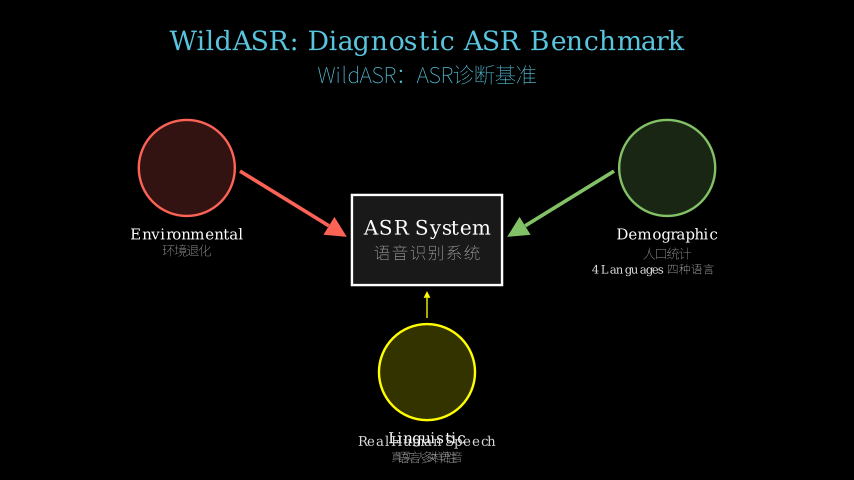
Method: WildASR factorizes 3 axes independently
    |
    +---> Environmental (noise, reverb, compression)
    +---> Demographic (age, gender, accent)
    +---> Linguistic (code-switching, rare words, disfluency)
    |
    v
Evidence: 7 ASR systems tested across 4 languages
    |
    +---> Severe degradation (up to 10x WER increase)
    +---> Non-transferable robustness across conditions
    +---> Hallucination under degraded input (safety risk)
    |
    v
Conclusion: Factor-isolated evaluation essential for deployment
The Increment
One sentence: Before—aggregate accuracy on clean benchmarks; after—diagnostic profiles showing which specific conditions break which models in which languages, plus quantified hallucination risk.
Core Mechanism
WildASR is a diagnostic benchmark built from real human speech across four languages (English, Mandarin, Spanish, German). Instead of mixing all challenges together, it factorizes robustness testing along three independent axes. Each axis has controlled variations: environmental degradation includes background noise at different SNR levels, reverberation, and codec compression; demographic shift covers age groups, gender, and regional accents; linguistic diversity spans code-switching, rare vocabulary, and speech disfluencies.
The data collection process ensures ecological validity—all speech comes from real recordings, not synthetic augmentation. For each language, the authors curated test sets where only one factor varies at a time while others stay constant. This lets you run a model once and get a three-dimensional robustness profile: how much does WER increase under -5dB noise? How much worse for elderly speakers? How much degradation with code-switching?
The benchmark also tracks a critical failure mode that aggregate metrics miss: hallucination. When input is degraded or partial, models sometimes generate plausible but completely unspoken content. WildASR measures hallucination rate separately from WER, because a model that silently invents words creates concrete safety risks in voice agents—imagine a medical assistant hallucinating dosage instructions.
Input Speech (real human, 4 languages)
    |
    v
Factorized Test Sets
    |
    +---> [Environmental Axis]
    |         |
    |         +---> Noise: -5dB, 0dB, 5dB, 10dB
    |         +---> Reverb: RT60 0.3s, 0.6s, 0.9s
    |         +---> Codec: 8kbps, 16kbps, 32kbps
    |
    +---> [Demographic Axis]
    |         |
    |         +---> Age: 18-30, 31-50, 51-70, 70+
    |         +---> Gender: Male, Female, Non-binary
    |         +---> Accent: Regional variants per language
    |
    +---> [Linguistic Axis]
              |
              +---> Code-switching: intra-sentential, inter-sentential
              +---> Rare words: technical, domain-specific
              +---> Disfluency: filled pauses, repairs, false starts
    |
    v
Per-Model Robustness Profile
    |
    +---> WER degradation per factor
    +---> Hallucination rate per condition
    +---> Cross-language robustness transfer (or lack thereof)
Think of WildASR like a medical stress test for ASR systems. A standard benchmark is like checking resting heart rate—useful, but tells you nothing about performance under load. WildASR is the treadmill test: it systematically increases stress along specific dimensions (incline = noise, speed = accent complexity, duration = linguistic diversity) while monitoring vital signs (WER, hallucination rate). Just as a cardiologist needs to know whether your heart fails under exertion, speed, or duration to prescribe treatment, an ML engineer needs to know whether their ASR fails under noise, demographics, or code-switching to fix the right thing. The factorized design is the key: if everything’s tested together, you can’t tell which stressor caused the failure.
Key Concepts
-
Factorized evaluation: Traditional benchmarks mix all challenges—a test sample might have noise AND accent AND code-switching. You get one WER number, but can’t tell which factor caused the error. Factorized evaluation isolates one variable at a time: test set A has only noise variation (clean speech from same demographics, no code-switching), test set B has only accent variation (clean audio, no linguistic complexity), etc. This is like debugging: you change one thing at a time to find the root cause. The payoff: you can say “Model X degrades 40% under noise but only 10% under accents” instead of “Model X gets 25% WER on hard data.” Actionable diagnosis vs vague failure report.
-
Hallucination in ASR: When speech is unclear or partially inaudible, ASR models sometimes fill gaps with plausible-sounding but completely unspoken words. Example: user says “Set timer for [unintelligible]” and model transcribes “Set timer for five minutes” when the user actually said “fifteen.” This isn’t a random error—it’s the model’s language model confidently predicting what should come next based on training data patterns. In voice agents, this creates safety risks: the system acts on invented content. WildASR measures hallucination rate separately from WER because a model with 20% WER where all errors are substitutions is safer than one with 15% WER where 5% are hallucinations.
-
Robustness transfer: If Model A handles noise better than Model B in English, does that advantage hold in Mandarin? Intuition says yes—noise robustness should be language-agnostic. WildASR shows this intuition is wrong. Models that dominate on one axis in one language often lose that advantage in another language or on a different axis. This matters for deployment: you can’t benchmark in English and assume the ranking holds for your Spanish users. Each language-condition pair needs separate evaluation.
Framework Shift
Before (mainstream approach):        After (this paper):

[Benchmark]                          [Benchmark]
    |                                    |
    v                                    v
Mixed test set                       Factorized test sets
(noise + accent +                        |
 code-switching)                         +---> Environmental only
    |                                    +---> Demographic only
    v                                    +---> Linguistic only
Single WER number                        |
    |                                    v
    v                                3D robustness profile
"Model A: 15% WER"                       |
"Model B: 18% WER"                       +---> WER per factor
    |                                    +---> Hallucination rate
    v                                    +---> Cross-language transfer
Deploy Model A                           |
    |                                    v
    v                                Diagnostic deployment decision
Production failure                       |
(which factor? unknown)                  +---> "Model A fails on noise"
                                         +---> "Model B safer (low hallucination)"
                                         +---> "Model C best for Spanish accents"
From aggregate ranking to diagnostic profiling, the core shift is from selection to understanding.
Expert Assessment
Problem choice: Real gap. ASR deployment failures are well-documented in industry, but academic benchmarks haven’t caught up. The factorized evaluation idea isn’t novel in principle (robustness testing exists in other domains), but applying it systematically to ASR across multiple languages is overdue. The hallucination angle is particularly sharp—it’s a known issue in production but rarely quantified in research.
Method maturity: Solid execution, not groundbreaking insight. The hard work here is data curation—sourcing real speech across four languages with controlled factor variation. The evaluation methodology is straightforward: run models, measure WER per factor, track hallucinations. No algorithmic innovation, but that’s fine—this is infrastructure work. One weakness: the paper doesn’t propose solutions, only diagnosis. That’s defensible (diagnosis first, treatment second), but limits immediate impact.
Experimental integrity: Baselines are fair—seven widely-used ASR systems including Whisper, commercial APIs, and open-source models. The numbers are credible: severe degradation under real-world conditions matches practitioner experience. One concern: hallucination measurement relies on manual annotation for a subset of errors, which doesn’t scale. The authors acknowledge this but don’t provide an automated detection method. Cross-language results are the strongest contribution—showing robustness doesn’t transfer is genuinely surprising and well-evidenced.
Writing quality: Clear structure, but the paper front-loads motivation at the expense of method details. Section 3 (benchmark construction) is too brief—I want more specifics on data collection, annotation protocols, and quality control. The results section is strong: tables are well-designed, degradation patterns are visualized clearly. The discussion could be sharper: the authors list implications but don’t prioritize which findings matter most for practitioners.
Verdict: weak accept — Solid diagnostic tool with clear practical value, but limited methodological novelty and no proposed solutions.
Takeaways
Practitioners can steal the factorized evaluation framework for any robustness testing problem. If your model fails in production but benchmarks look good, you’re probably testing everything mixed together. Isolate one variable at a time: create test sets where only noise varies, only user demographics vary, only input complexity varies. This works beyond ASR—computer vision (lighting vs occlusion vs viewpoint), NLP (domain shift vs length vs ambiguity), recommendation systems (cold start vs popularity bias vs temporal drift).
The hallucination tracking idea transfers to any generative system. Don’t just measure aggregate error—separate errors into categories by risk. In ASR, substitutions are less dangerous than hallucinations. In medical AI, false negatives are worse than false positives. In code generation, syntax errors are safer than logic errors. Track the error types that matter for your deployment context.
The cross-language robustness non-transfer finding is a warning: don’t assume model rankings generalize across deployment contexts. If you benchmark in one language, demographic, or domain, you need separate validation for each target context. This applies to any model selection decision where deployment conditions differ from benchmark conditions.
论文: 2603.25727 作者: Geeyang Tay, Wentao Ma, Jaewon Lee, Yuzhi Tang, Daniel Lee, Weisu Yin, Dongming Shen, Silin Meng, Yi Zhu, Mu Li 分类: cs.AI, cs.MM
缺口
ASR系统在LibriSpeech等干净基准上达到95%以上准确率,实践者因此将其部署到语音代理中。
但真实场景的失效持续发生——背景噪声、口音、语码转换——我们无法预测哪些条件会在哪些语言中破坏哪些模型。
现有基准把所有挑战混在一起测试:你得到一个总体数字,它掩盖了模型到底是在噪声、人口统计还是语言复杂度上失效。
生产环境出问题时,你两眼一抹黑。
核心问题:纠缠式评估。
当前测试不隔离失效因子,所以你无法诊断根本原因,也无法跨语言迁移鲁棒性洞见。
问题: ASR在生产环境中不可预测地失效
    |
    v
诊断: 基准把所有失效因子混在一起
    |
    +---> 无法隔离: 噪声 vs 口音 vs 语码转换
    +---> 无法迁移: 英语鲁棒性 =/> 中文鲁棒性
    |
    v
方法: WildASR独立因子化3个轴
    |
    +---> 环境轴(噪声、混响、压缩)
    +---> 人口统计轴(年龄、性别、口音)
    +---> 语言轴(语码转换、罕见词、不流畅)
    |
    v
证据: 7个ASR系统在4种语言上测试
    |
    +---> 严重退化(WER增加最多10倍)
    +---> 鲁棒性跨条件不可迁移
    +---> 降质输入下的幻觉(安全风险)
    |
    v
结论: 因子隔离评估对部署至关重要
增量
一句话: 之前——干净基准上的总体准确率;之后——诊断性画像,显示哪些具体条件在哪些语言中破坏哪些模型,外加量化的幻觉风险。
核心机制
WildASR是一个从真实人类语音构建的诊断基准,覆盖四种语言(英语、中文、西班牙语、德语)。
它不把所有挑战混在一起,而是沿三个独立轴因子化鲁棒性测试。
每个轴有受控变化:环境退化包括不同信噪比的背景噪声、混响和编解码器压缩;人口统计偏移覆盖年龄组、性别和地区口音;语言多样性跨越语码转换、罕见词汇和语音不流畅。
数据收集过程确保生态有效性——所有语音来自真实录音,非合成增强。
对每种语言,作者策划了测试集,其中每次只有一个因子变化,其他保持恒定。
这让你运行一次模型就得到三维鲁棒性画像:在-5dB噪声下WER增加多少?
老年说话者差多少?
语码转换退化多少?
基准还追踪一个总体指标会漏掉的关键失效模式:幻觉。
当输入降质或部分时,模型有时生成看似合理但完全未说出的内容。
WildASR单独测量幻觉率而非WER,因为静默编造词语的模型在语音代理中制造具体安全风险——想象医疗助手幻觉出剂量指示。
输入语音(真实人类, 4种语言)
    |
    v
因子化测试集
    |
    +---> [环境轴]
    |         |
    |         +---> 噪声: -5dB, 0dB, 5dB, 10dB
    |         +---> 混响: RT60 0.3s, 0.6s, 0.9s
    |         +---> 编解码: 8kbps, 16kbps, 32kbps
    |
    +---> [人口统计轴]
    |         |
    |         +---> 年龄: 18-30, 31-50, 51-70, 70+
    |         +---> 性别: 男、女、非二元
    |         +---> 口音: 每种语言的地区变体
    |
    +---> [语言轴]
              |
              +---> 语码转换: 句内、句间
              +---> 罕见词: 技术性、领域特定
              +---> 不流畅: 填充停顿、修复、错误起始
    |
    v
每模型鲁棒性画像
    |
    +---> 每因子WER退化
    +---> 每条件幻觉率
    +---> 跨语言鲁棒性迁移(或缺失)
把WildASR想象成ASR系统的医学压力测试。
标准基准像检查静息心率——有用,但对负载下的表现一无所知。
WildASR是跑步机测试:它沿特定维度系统性增加压力(坡度=噪声,速度=口音复杂度,持续时间=语言多样性),同时监测生命体征(WER、幻觉率)。
正如心脏科医生需要知道你的心脏是在运动、速度还是持续时间下失效才能开处方,机器学习工程师需要知道他们的ASR是在噪声、人口统计还是语码转换下失效才能修对地方。
因子化设计是关键:如果所有东西一起测,你分不清哪个压力源导致了失效。
关键概念
- 因子化评估: 传统基准混合所有挑战——一个测试样本可能有噪声AND口音AND语码转换。
你得到一个WER数字,但说不清哪个因子导致了错误。
因子化评估每次隔离一个变量:测试集A只有噪声变化(来自相同人口统计的干净语音,无语码转换),测试集B只有口音变化(干净音频,无语言复杂度),等等。
这像调试:你每次改一样东西来找根本原因。
回报:你能说”模型X在噪声下退化40%但在口音下只退化10%“而非”模型X在困难数据上得到25% WER”。
可操作的诊断vs模糊的失效报告。
- ASR中的幻觉: 当语音不清晰或部分听不见时,ASR模型有时用听起来合理但完全未说出的词填补空白。
例子:用户说”设置定时器[听不清]“模型转录为”设置定时器五分钟”而用户实际说的是”十五”。
这不是随机错误——是模型的语言模型基于训练数据模式自信地预测接下来应该出现什么。
在语音代理中,这制造安全风险:系统对编造的内容采取行动。
WildASR单独测量幻觉率而非WER,因为所有错误都是替换的20% WER模型比15% WER但5%是幻觉的模型更安全。
- 鲁棒性迁移: 如果模型A在英语中比模型B更好地处理噪声,这个优势在中文中保持吗?
直觉说是——噪声鲁棒性应该与语言无关。
WildASR显示这个直觉是错的。
在一种语言的一个轴上占主导地位的模型在另一种语言或不同轴上常常失去那个优势。
这对部署很重要:你不能在英语上做基准测试就假设排名对你的西班牙语用户成立。
每个语言-条件对需要单独评估。
框架转变
之前(主流方法):                  之后(本文方法):

[基准]                           [基准]
    |                                |
    v                                v
混合测试集                        因子化测试集
(噪声 + 口音 +                       |
 语码转换)                           +---> 仅环境
    |                                +---> 仅人口统计
    v                                +---> 仅语言
单一WER数字                          |
    |                                v
    v                            3D鲁棒性画像
"模型A: 15% WER"                     |
"模型B: 18% WER"                     +---> 每因子WER
    |                                +---> 幻觉率
    v                                +---> 跨语言迁移
部署模型A                            |
    |                                v
    v                            诊断性部署决策
生产失效                             |
(哪个因子?未知)                      +---> "模型A在噪声上失效"
                                     +---> "模型B更安全(低幻觉)"
                                     +---> "模型C最适合西班牙口音"
从总体排名到诊断画像,核心转变是从选择到理解。
专家评审
选题眼光: 真实缺口。
ASR部署失效在工业界有充分记录,但学术基准没跟上。
因子化评估思想原则上不新颖(鲁棒性测试在其他领域存在),但系统性地应用到跨多种语言的ASR上是早该做的。
幻觉角度特别尖锐——它是生产中的已知问题但在研究中很少量化。
方法成熟度: 执行扎实,非突破性洞见。
这里的硬活是数据策划——跨四种语言采集具有受控因子变化的真实语音。
评估方法论直截了当:运行模型,测量每因子WER,追踪幻觉。
无算法创新,但没关系——这是基础设施工作。
一个弱点:论文不提出解决方案,只做诊断。
这是可辩护的(先诊断,后治疗),但限制了即时影响。
实验诚意: 基线公平——七个广泛使用的ASR系统包括Whisper、商业API和开源模型。
数字可信:真实场景条件下的严重退化符合实践者经验。
一个担忧:幻觉测量依赖对错误子集的人工标注,不可扩展。
作者承认这点但不提供自动检测方法。
跨语言结果是最强贡献——显示鲁棒性不迁移是真正令人惊讶且有充分证据的。
写作功力: 结构清晰,但论文前置动机牺牲了方法细节。
第3节(基准构建)太简短——我想要更多关于数据收集、标注协议和质量控制的具体信息。
结果部分很强:表格设计良好,退化模式可视化清晰。
讨论可以更尖锐:作者列出影响但不优先排序哪些发现对实践者最重要。
判决: 弱接收 — 具有明确实用价值的扎实诊断工具,但方法论新颖性有限且无提出的解决方案。
要点总结
实践者可以偷走因子化评估框架用于任何鲁棒性测试问题。
如果你的模型在生产中失效但基准看起来不错,你可能把所有东西混在一起测试。
每次隔离一个变量:创建测试集,其中只有噪声变化,只有用户人口统计变化,只有输入复杂度变化。
这在ASR之外有效——计算机视觉(光照vs遮挡vs视角)、NLP(领域偏移vs长度vs歧义)、推荐系统(冷启动vs流行度偏差vs时间漂移)。
幻觉追踪思想迁移到任何生成系统。
不要只测量总体错误——按风险将错误分类。
在ASR中,替换比幻觉危险性小。
在医疗AI中,假阴性比假阳性更糟。
在代码生成中,语法错误比逻辑错误更安全。
追踪对你的部署上下文重要的错误类型。
跨语言鲁棒性不迁移发现是一个警告:不要假设模型排名跨部署上下文泛化。
如果你在一种语言、人口统计或领域上做基准测试,你需要对每个目标上下文单独验证。
这适用于任何部署条件与基准条件不同的模型选择决策。