Paper: 2603.06530 Authors: Guangyao Li, Xin Wang, Wenwu Zhu Categories: cs.CV
The Gap
Audio-visual research has fragmented into specialized silos. You’ve got one model for event localization (finding when a dog barks), another for segmentation (outlining which pixels belong to the barking dog), and yet another for question answering (what color is the dog?). Each task has its own architecture, training pipeline, and dataset format. This isn’t just inconvenient—it’s fundamentally at odds with how humans perceive scenes, where we seamlessly integrate temporal, spatial, and semantic understanding.
The prior approaches—task-specific models like CMBS for segmentation, MUSIC-AVQA for QA, and LLP for parsing—achieve decent performance within their narrow domains. But they can’t share knowledge across tasks. A model that learns to localize dog barks can’t leverage that knowledge to answer “where is the dog?” And critically, they can’t exploit inter-task relationships: knowing when an event happens should inform where it appears spatially.
Problem: Fragmented task-specific models
   |
   v
Assumption: Shared representation can bridge tasks
   |
   v
Method: Token-based unification + multi-scale perception
   |
   v
Evidence: Competitive/superior on 5 benchmarks
   |
   v
Conclusion: Joint learning improves all tasks
The Increment
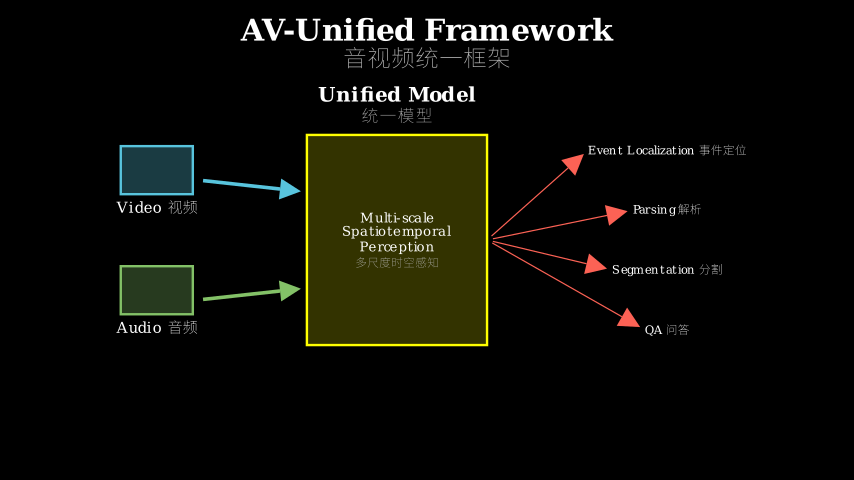
One sentence: Before, you needed five different models for five audio-visual tasks; now, one model handles them all through a shared token vocabulary.
Core Mechanism
AV-Unified has three main components working in sequence. First, a tokenization layer converts all inputs and outputs—whether they’re temporal boundaries, spatial masks, or text answers—into discrete tokens from a shared vocabulary. This is the key trick: a bounding box becomes a sequence like [x1][y1][x2][y2], a time segment becomes [start][end], and an answer becomes word tokens.
Second, a multi-scale temporal perception module processes the audio-visual input at different time resolutions. Think of it as having multiple clocks running simultaneously—one ticking every second, another every 0.5 seconds, another every 2 seconds. This captures both quick events (a door slam) and slow ones (a conversation). The module uses cross-attention between audio and visual features at each scale, then aggregates them.
Third, a cross-modal spatial perception module handles the spatial dimension. Here’s where it gets clever: visual features guide audio features to learn spatial structure, even though audio doesn’t inherently have pixel-level information. It’s like teaching someone blind to navigate by describing the room layout—the visual modality acts as a teacher for the audio modality through cross-attention and contrastive learning.
Input (video + audio)
   |
   v
+---------------------------+
| Tokenization Layer        |
| (converts to tokens)      |
+---------------------------+
   |
   +---> [Task Prompt] ---+
   |                      |
   v                      v
+---------------------------+
| Multi-scale Temporal      |
| [0.5s] [1s] [2s] clocks  |
| Audio <--> Visual         |
+---------------------------+
   |
   v
+---------------------------+
| Spatial Perception        |
| Visual guides Audio       |
| Cross-attention           |
+---------------------------+
   |
   v
Output tokens --> Decode to task format
Think of AV-Unified as a universal translator at a UN meeting. Different countries (tasks) speak different languages (output formats): one speaks in timestamps, another in pixel coordinates, another in natural language. The translator doesn’t learn each language pair separately. Instead, it converts everything into a common intermediate language (tokens) that captures the essential meaning. The multi-scale temporal module is like having interpreters who specialize in different speaking speeds—some handle rapid-fire debates, others handle slow ceremonial speeches. The spatial perception module is like a visual aide who helps the audio-focused interpreter understand spatial references by pointing at a map. The task prompt is like announcing which country is speaking next, so the translator knows what context to expect.
Key Concepts
-
Token Unification: Imagine you’re organizing a messy desk with papers, photos, and sticky notes. Instead of having separate filing systems for each type, you photograph everything and store the photos in one album with labels. That’s what token unification does—it takes diverse data types (bounding boxes, time intervals, text) and converts them into a single format: sequences of discrete symbols. A bounding box
(10, 20, 50, 60)becomes tokens[10][20][50][60]. A time segment2.5s-4.3sbecomes[2.5][4.3]. An answer “dog” becomes[dog]. Now your model only needs to learn one language: predicting the next token in a sequence. This isn’t just convenient—it enables weight sharing and transfer learning across tasks. -
Multi-scale Temporal Perception: Audio-visual events happen at wildly different speeds. A gunshot lasts 0.1 seconds. A phone conversation lasts minutes. If you only look at one time resolution, you’ll miss events. It’s like trying to read both a speedometer and an odometer with the same glance—you need different scales. This module runs parallel processing streams at different temporal granularities (say, 0.5s, 1s, 2s windows), then fuses them. Each scale captures different event types: fine-grained for transient sounds, coarse-grained for sustained activities. The fusion happens through learned attention weights that decide which scale matters most for the current input.
-
Cross-modal Spatial Guidance: Audio doesn’t come with pixel coordinates, but visual data does. The problem: how do you train a model to localize sound sources spatially when your audio features have no inherent spatial structure? The solution: use visual features as a teacher. During training, the model learns to align audio features with visual features that *do have spatial information. It’s like learning to navigate by sound after someone first shows you a map. The visual modality provides supervision through contrastive learning—audio features corresponding to the same spatial region should be similar, different regions should be dissimilar. This cross-modal guidance lets the audio branch learn spatial awareness indirectly.
Framework Shift
Before (mainstream approach):        After (this paper):

Task 1: Event Localization          +----------------------+
  [Model A] --> timestamps          |   AV-Unified Model   |
                                    |                      |
Task 2: Segmentation                |  [Token Vocab]       |
  [Model B] --> pixel masks         |  [Multi-scale Time]  |
                                    |  [Spatial Guidance]  |
Task 3: Question Answering          |  [Task Prompts]      |
  [Model C] --> text answers        +----------------------+
                                              |
Task 4: Parsing                               v
  [Model D] --> event labels         All outputs as tokens
                                     (timestamps, masks, text)
Task 5: Segmentation                          |
  [Model E] --> audio masks                   v
                                    Decode to task format
No shared knowledge
From isolated specialists to a single polyglot, the core shift is representation unification enabling knowledge transfer.
Expert Assessment
Problem choice: This is a real gap, not manufactured. The field has genuinely fragmented into task-specific solutions, and there’s clear value in unification—both for practical deployment (one model vs. five) and scientific understanding (what’s shared across tasks?). It sits at a natural inflection point where enough individual tasks have matured that unification becomes feasible and valuable.
Method maturity: The token unification idea is borrowed from NLP (think T5, GPT), which is smart but not novel. The multi-scale temporal module is standard practice in video understanding. The genuinely clever bit is the cross-modal spatial guidance—using visual features to teach audio features about spatial structure is an elegant solution to a real problem. However, I’m skeptical about whether this is simpler than just having task-specific heads on a shared backbone. The tokenization adds complexity (quantization, vocabulary design) that might not be necessary.
Experimental integrity: The baselines are fair—they compare against published task-specific models on standard benchmarks. The numbers look solid across five datasets (AVE, LLP, MUSIC-AVQA, VGG-SS, AVS). But there’s a red flag: no ablation showing whether joint training actually helps each individual task, or if it’s just competitive with training separately. The paper claims “joint learning improves all tasks” but doesn’t show single-task baselines trained with the same architecture. Also, the computational cost comparison is missing—does unification save FLOPs or just consolidate models?
Writing quality: The abstract oversells (“naturally integrate multiple audio-visual tasks”) without acknowledging that humans don’t actually tokenize the world. The method section is dense and would benefit from a clearer separation of “what” (architecture) vs. “why” (design choices). The related work section is thorough but reads like a literature dump rather than a narrative. If I could rewrite one section, it’d be the introduction—frame the problem as “knowledge transfer across tasks” rather than “humans integrate tasks,” which is a weak motivation.
Verdict: weak accept — Solid engineering that advances the field incrementally, but the core ideas aren’t novel enough for a strong accept, and the experimental story has gaps.
Takeaways
The big steal here is token-based task unification as a design pattern. If you’re working on any multi-task problem where outputs have different formats (detection boxes, segmentation masks, classifications, text), consider converting everything to tokens. This isn’t just about convenience—it forces you to think about what’s shared across tasks at the representation level.
The cross-modal guidance technique is worth lifting: if you have two modalities where one has richer supervision (e.g., visual has spatial labels, audio doesn’t), use contrastive learning to let the rich modality teach the poor one. This transfers beyond audio-visual to any asymmetric multi-modal setup.
Finally, the multi-scale temporal processing is a reminder that temporal granularity matters. Don’t assume one time resolution fits all events. Run parallel streams at different scales and fuse them. This applies to any temporal modeling problem, not just audio-visual.
What you can’t steal: the specific architecture details are too tied to this problem. The task prompts are a nice touch but not groundbreaking. And the paper doesn’t provide enough insight into when unification helps vs. hurts to guide your own design choices.
论文: 2603.06530 作者: Guangyao Li, Xin Wang, Wenwu Zhu 分类: cs.CV
缺口
视听研究已经碎片化成专业孤岛。
你需要一个模型做事件定位(找到狗叫的时间点),另一个做分割(勾画出叫的狗的像素轮廓),还有一个做问答(狗是什么颜色)。
每个任务都有自己的架构、训练流程和数据集格式。
这不只是不方便的问题——它从根本上违背了人类感知场景的方式,我们会无缝整合时间、空间和语义理解。
此前的方法——像CMBS做分割、MUSIC-AVQA做问答、LLP做解析这些任务专用模型——在各自狭窄领域表现尚可。
但它们无法跨任务共享知识。
一个学会定位狗叫的模型,无法利用这个知识来回答”狗在哪里?”。
更关键的是,它们无法利用任务间关系:知道事件何时发生应该能告知它在空间何处出现。
问题: 碎片化的任务专用模型
   |
   v
假设: 共享表示可以连接任务
   |
   v
方法: 基于token的统一 + 多尺度感知
   |
   v
证据: 在5个基准上有竞争力/更优
   |
   v
结论: 联合学习改进所有任务
增量
一句话: 以前你需要五个不同模型处理五个视听任务; 现在一个模型通过共享token词汇表搞定全部。
核心机制
AV-Unified有三个主要组件按顺序工作。
首先,token化层将所有输入输出——无论是时间边界、空间掩码还是文本答案——转换成共享词汇表中的离散token。
这是关键技巧:边界框变成序列如[x1][y1][x2][y2],时间段变成[start][end],答案变成词token。
其次,多尺度时间感知模块在不同时间分辨率处理视听输入。
把它想象成同时运行多个时钟——一个每秒滴答,另一个每0.5秒,还有一个每2秒。
这能捕捉快速事件(关门声)和慢速事件(对话)。
模块在每个尺度使用音频和视觉特征间的交叉注意力,然后聚合它们。
第三,跨模态空间感知模块处理空间维度。
这里变得巧妙:视觉特征引导音频特征学习空间结构,尽管音频本身没有像素级信息。
就像通过描述房间布局教盲人导航——视觉模态通过交叉注意力和对比学习充当音频模态的教师。
输入 (视频 + 音频)
   |
   v
+---------------------------+
| Token化层                 |
| (转换为token)             |
+---------------------------+
   |
   +---> [任务提示] -------+
   |                      |
   v                      v
+---------------------------+
| 多尺度时间感知            |
| [0.5秒] [1秒] [2秒] 时钟 |
| 音频 <--> 视觉           |
+---------------------------+
   |
   v
+---------------------------+
| 空间感知                  |
| 视觉引导音频              |
| 交叉注意力                |
+---------------------------+
   |
   v
输出token --> 解码为任务格式
把AV-Unified想象成联合国会议上的通用翻译。
不同国家(任务)说不同语言(输出格式):一个说时间戳,另一个说像素坐标,还有一个说自然语言。
翻译不会分别学习每对语言。
相反,它把一切转换成捕捉本质含义的通用中间语言(token)。
多尺度时间模块像是专攻不同语速的口译员——有些处理快速辩论,有些处理缓慢仪式演讲。
空间感知模块像是帮助专注音频的口译员理解空间指代的视觉助手,通过指着地图。
任务提示像是宣布下一个发言国家,让翻译知道该期待什么语境。
关键概念
- Token统一: 想象你在整理乱糟糟的桌子,上面有文件、照片和便签。
与其为每种类型建立单独归档系统,你给所有东西拍照,把照片存在一个带标签的相册里。
这就是token统一做的事——它把不同数据类型(边界框、时间区间、文本)转换成单一格式:离散符号序列。
边界框(10, 20, 50, 60)变成token [10][20][50][60]。
时间段2.5秒-4.3秒变成[2.5][4.3]。
答案”狗”变成[狗]。
现在你的模型只需学一种语言:预测序列中的下一个token。
这不只是方便——它实现了跨任务的权重共享和迁移学习。
- 多尺度时间感知: 视听事件发生速度差异极大。
枪声持续0.1秒。
电话交谈持续几分钟。
如果你只看一个时间分辨率,会错过事件。
就像试图用同一瞥同时读速度表和里程表——你需要不同尺度。
这个模块在不同时间粒度(比如0.5秒、1秒、2秒窗口)运行并行处理流,然后融合它们。
每个尺度捕捉不同事件类型:细粒度捕捉瞬态声音,粗粒度捕捉持续活动。
融合通过学习的注意力权重发生,决定哪个尺度对当前输入最重要。
- 跨模态空间引导: 音频不带像素坐标,但视觉数据有。
问题:当你的音频特征没有固有空间结构时,如何训练模型在空间上定位声源? 解决方案:用视觉特征当教师。
训练时,模型学习将音频特征与确实有空间信息的视觉特征对齐。
就像有人先给你看地图后学习通过声音导航。
视觉模态通过对比学习提供监督——对应同一空间区域的音频特征应该相似,不同区域应该不相似。
这种跨模态引导让音频分支间接学习空间意识。
框架转变
之前(主流方法):                  之后(本文方法):

任务1: 事件定位                  +----------------------+
  [模型A] --> 时间戳              |   AV-Unified模型     |
                                 |                      |
任务2: 分割                       |  [Token词汇表]       |
  [模型B] --> 像素掩码            |  [多尺度时间]        |
                                 |  [空间引导]          |
任务3: 问答                       |  [任务提示]          |
  [模型C] --> 文本答案            +----------------------+
                                           |
任务4: 解析                                v
  [模型D] --> 事件标签            所有输出作为token
                                 (时间戳、掩码、文本)
任务5: 分割                                |
  [模型E] --> 音频掩码                     v
                                 解码为任务格式
无共享知识
从孤立专家到单一通才,核心转变是表示统一实现知识迁移。
专家评审
选题眼光: 这是真缺口,不是人造的。
该领域确实碎片化成任务专用解决方案,统一有明确价值——无论是实际部署(一个模型vs五个)还是科学理解(任务间共享什么?)。
它处在自然拐点,足够多的单独任务已经成熟,统一变得可行且有价值。
方法成熟度: token统一想法借鉴自NLP(想想T5、GPT),聪明但不新颖。
多尺度时间模块是视频理解的标准做法。
真正巧妙的是跨模态空间引导——用视觉特征教音频特征空间结构是对真实问题的优雅解决方案。
但我怀疑这是否比在共享主干上加任务专用头更简单。
token化增加了复杂性(量化、词汇表设计),可能没必要。
实验诚意: 基线公平——他们在标准基准上与已发表的任务专用模型比较。
数字在五个数据集(AVE、LLP、MUSIC-AVQA、VGG-SS、AVS)上看起来扎实。
但有个危险信号:没有消融实验显示联合训练是否真的帮助每个单独任务,还是只是与单独训练有竞争力。
论文声称”联合学习改进所有任务”但没展示用相同架构训练的单任务基线。
另外,缺少计算成本比较——统一节省FLOPs还是只是整合模型?
写作功力: 摘要过度推销(“自然整合多个视听任务”),没承认人类实际上不会token化世界。
方法部分密集,如果能更清晰地分离”是什么”(架构)vs”为什么”(设计选择)会更好。
相关工作部分详尽但读起来像文献堆砌而非叙事。
如果我能重写一节,会是引言——把问题框定为”跨任务知识迁移”而非”人类整合任务”,后者是弱动机。
判决: 弱接收 — 扎实的工程增量推进领域,但核心想法不够新颖达不到强接收,实验故事有缺口。
要点总结
这里的大收获是基于token的任务统一作为设计模式。
如果你在做任何输出格式不同(检测框、分割掩码、分类、文本)的多任务问题,考虑把一切转换成token。
这不只是方便——它迫使你在表示层面思考任务间共享什么。
跨模态引导技术值得借鉴:如果你有两个模态,其中一个有更丰富监督(比如视觉有空间标签,音频没有),用对比学习让富模态教穷模态。
这迁移到视听之外的任何非对称多模态设置。
最后,多尺度时间处理提醒时间粒度很重要。
不要假设一个时间分辨率适合所有事件。
在不同尺度运行并行流并融合它们。
这适用于任何时间建模问题,不只是视听。
你偷不走的:具体架构细节太绑定这个问题。
任务提示是个好点子但不突破性。
论文没提供足够洞见说明何时统一有帮助vs有害,无法指导你自己的设计选择。