
Paper: 2603.30040 Authors: Izavan dos S. Correia, Henrique C. T. Santos, Tiago A. E. Ferreira Categories: cs.SE, cs.AI
The Gap
Compiler researchers have spent decades building static analysis tools to detect parallelizable loops. Dependence analysis checks if loop iterations can run independently. Polyhedral models mathematically model iteration spaces. These work beautifully on regular, array-based scientific code. But they hit a wall with irregular patterns: pointer chasing, dynamic data structures, indirect array indexing, function calls with unknown side effects.
Prior ML attempts (token-based classifiers, RNNs) required heavy feature engineering—extracting control flow graphs, data dependence chains, memory access patterns. Each new code pattern meant new features. The preprocessing pipeline became the bottleneck.
This paper asks: can a pre-trained language model, treating code as text, learn to recognize parallelization opportunities without explicit feature extraction?
Problem: Static analysis fails on irregular code
         ML approaches need handcrafted features
            |
            v
Assumption: Code patterns for parallelizability
            are learnable from context
            |
            v
Method: DistilBERT + subword tokenization
        on raw source code
            |
            v
Evidence: 99%+ accuracy, 10-fold CV
          Low false positives
            |
            v
Conclusion: Lightweight transformers can replace
            feature engineering pipeline
The Increment
One sentence: Before this paper, identifying parallelizable loops required either brittle static analysis or heavy feature engineering; after, a 66M-parameter model reads raw code and classifies loops with compiler-grade accuracy.
Core Mechanism
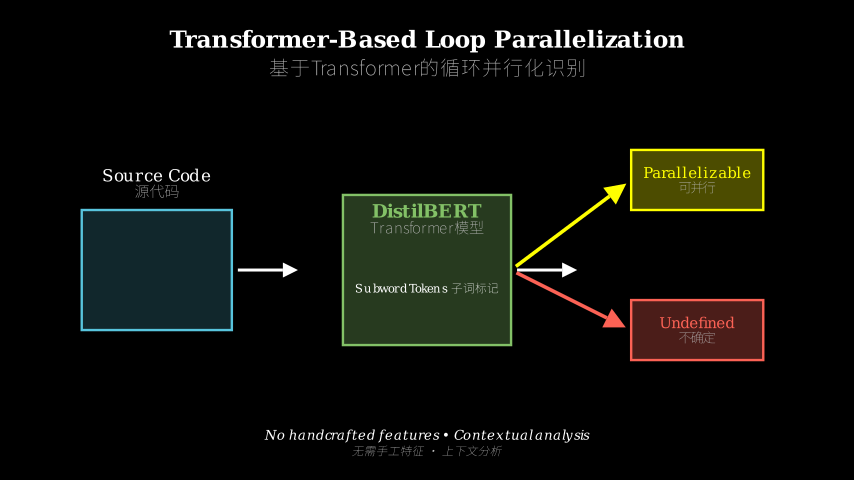
The method takes a loop’s source code as plain text. DistilBERT’s WordPiece tokenizer breaks it into subwords (handling variable names, operators, keywords uniformly). The tokenized sequence feeds into 6 transformer layers. Each layer runs self-attention across all tokens, building representations that capture both local syntax (bracket matching, variable scoping) and global semantics (data flow patterns, iteration independence).
The final layer’s [CLS] token embedding—a 768-dimensional vector summarizing the entire loop—passes through a classification head (two dense layers with dropout). Output: probability distribution over “parallelizable” vs “not parallelizable.”
Source Code Text
      |
      v
[WordPiece Tokenizer]
      |
      v
Token Embeddings (subwords)
      |
      v
[6 Transformer Layers]
  (self-attention + FFN)
      |
      v
[CLS] Token Vector (768-dim)
      |
      v
[Classification Head]
  (Dense -> Dropout -> Dense)
      |
      v
P(parallelizable | code)
Think of this as a code reading comprehension test. The tokenizer is like a careful reader who breaks unfamiliar words into recognizable parts (sub-words). The transformer layers are like multiple passes through the text—first pass catches syntax, second pass tracks variable lifetimes, third pass infers data dependencies. The [CLS] token is your mental summary after reading: “This loop is safe to parallelize because…” The classification head is the final yes/no decision based on that summary.
The key insight: you don’t need to explicitly extract “loop-carried dependencies” or “memory access patterns” as features. The transformer learns to attend to the code tokens that matter for parallelization (array indices, loop bounds, variable updates) through training on labeled examples.
Key Concepts
-
Subword Tokenization (WordPiece): Instead of treating each word as atomic, split rare words into common pieces. For code, this means
parallelForbecomesparallel+##For, and unknown variable names likemyCustomVarbecomemy+##Custom+##Var. Why this matters: the model never sees “unknown token” for new variable names—it composes understanding from familiar subwords. It’s like reading a foreign language where you recognize roots and suffixes even if you don’t know the full word. -
Self-Attention for Code: Traditional compilers analyze code sequentially or with fixed dependency graphs. Self-attention lets every token “look at” every other token simultaneously, weighted by relevance. When processing
for (i=0; i<n; i++) { a[i] = b[i] + c[i]; }, the attention mechanism learns to connecta[i]with the loop variablei, recognize thatb[i]andc[i]are reads (not writes), and infer no loop-carried dependency exists. It’s pattern matching across the entire code snippet in parallel, not step-by-step analysis. -
[CLS] Token as Loop Summary: BERT-style models prepend a special [CLS] token to input. Through training, this token’s embedding learns to aggregate information from all other tokens. For loop classification, [CLS] becomes a compressed representation of “everything relevant about this loop’s parallelizability.” It’s like a lawyer’s case summary—distills pages of evidence into a single verdict-ready brief.
Framework Shift
Before (static analysis):        After (this paper):

Source Code                      Source Code (raw text)
    |                                |
    v                                v
[Parse to AST]                   [Subword Tokenize]
    |                                |
    v                                v
[Extract CFG/DFG]                [Transformer Layers]
    |                             (learn patterns)
    v                                |
[Dependence Analysis]                v
 (polyhedral model)              [CLS] Embedding
    |                                |
    v                                v
[Heuristic Rules]                [Classify]
    |                                |
    v                                v
Parallelizable?                  Parallelizable?

Explicit feature pipeline        End-to-end learned
Fixed analysis rules             Adaptive pattern recognition
From rule-based symbolic reasoning to learned pattern matching, the core shift is replacing explicit dependency tracking with implicit contextual understanding.
Expert Assessment
Problem choice: Real gap. Automatic parallelization has been a compiler holy grail for 40 years. The irregular code problem is genuine—polyhedral models dominate HPC but fail on everyday software. However, the paper doesn’t engage with why this matters economically. Multi-core CPUs are ubiquitous, but most developers don’t manually parallelize loops anyway (they use higher-level frameworks). The motivation feels academic rather than urgent.
Method maturity: Clever application of existing tools, not a novel architecture. DistilBERT is off-the-shelf. The insight is that pre-trained language models transfer to code without modification. But there’s a simpler baseline missing: what about a CNN over token sequences? Or even logistic regression on TF-IDF features? The paper compares to prior token-based methods but doesn’t ablate against trivial baselines to prove transformers are necessary.
Experimental integrity: The 99% accuracy is suspicious. The dataset mixes synthetic loops (likely very regular patterns) with “manually annotated real-world code” (no details on source, size, or annotation process). 10-fold CV on a small dataset risks overfitting to dataset quirks. No out-of-distribution testing—what happens on code from different domains, languages, or coding styles? The low false positive rate is good, but false negatives matter too (missed parallelization opportunities). Only accuracy/precision/recall reported, no analysis of failure modes.
Writing quality: The related work section is thin—doesn’t position this against recent neural program analysis work (graph neural networks on ASTs, code transformers like CodeBERT/GraphCodeBERT). The “results” section is just tables; no error analysis, no visualization of what the model learned (attention maps would be illuminating). The discussion hand-waves about “computational efficiency” without runtime comparisons. Rewriting Section 4 with failure case studies and attention visualizations would make this compelling.
Verdict: Weak accept — Solid execution of a straightforward idea, but lacks depth in evaluation and doesn’t prove the approach generalizes beyond the specific dataset.
Takeaways
Steal the tokenization strategy: Subword tokenization (WordPiece/BPE) is underused in code analysis tools. It elegantly handles the open vocabulary problem (new variable names, library functions) without custom preprocessing. If you’re building any ML system over code, start here instead of word-level or character-level tokenization.
Question the feature engineering reflex: Before building a complex feature extraction pipeline (AST traversal, graph construction, symbolic analysis), try throwing raw text at a pre-trained transformer. The gap between “proper” program analysis and “just use BERT” is narrowing. This paper is evidence that for classification tasks, the latter often suffices.
The dataset is the real contribution: A balanced, labeled dataset of parallelizable vs non-parallelizable loops is valuable. The paper doesn’t release it (or I missed that detail), which is a missed opportunity. If you’re working on program synthesis or optimization, creating high-quality labeled datasets is higher leverage than tweaking model architectures.
Don’t trust 99% accuracy without OOD testing: When a paper reports near-perfect results, the first question is: how diverse is the test set? This paper’s results likely reflect dataset homogeneity, not true generalization. For your own work, always include out-of-distribution evaluation—different codebases, languages, or adversarial examples.
论文: 2603.30040 作者: Izavan dos S. Correia, Henrique C. T. Santos, Tiago A. E. Ferreira 分类: cs.SE, cs.AI
缺口
编译器研究者花了几十年构建静态分析工具来检测可并行循环。
依赖分析检查循环迭代能否独立运行。
多面体模型用数学建模迭代空间。
这些方法在规则的、基于数组的科学计算代码上表现完美。
但遇到不规则模式就撞墙了:指针追踪、动态数据结构、间接数组索引、副作用未知的函数调用。
之前的机器学习尝试(基于 token 的分类器、RNN)需要大量特征工程——提取控制流图、数据依赖链、内存访问模式。
每种新代码模式都意味着新特征。
预处理流水线成了瓶颈。
本文问:预训练语言模型能否把代码当文本处理,无需显式特征提取就学会识别并行化机会?
问题:静态分析在不规则代码上失效
     机器学习方法需要手工特征
            |
            v
假设:并行化的代码模式
     可以从上下文中学习
            |
            v
方法:DistilBERT + 子词分词
     处理原始源代码
            |
            v
证据:99%+ 准确率,10折交叉验证
     低假阳性率
            |
            v
结论:轻量级 transformer 可替代
     特征工程流水线
增量
一句话: 这篇论文之前,识别可并行循环要么依赖脆弱的静态分析,要么需要繁重的特征工程;之后,一个 6600 万参数的模型读原始代码就能以编译器级准确率分类循环。
核心机制
方法把循环源代码当纯文本输入。
DistilBERT 的 WordPiece 分词器把它切成子词(统一处理变量名、运算符、关键字)。
分词后的序列送入 6 层 transformer。
每层对所有 token 做自注意力,构建既捕获局部语法(括号匹配、变量作用域)又捕获全局语义(数据流模式、迭代独立性)的表示。
最后一层的 [CLS] token 嵌入——一个总结整个循环的 768 维向量——通过分类头(两个带 dropout 的全连接层)。
输出:“可并行”vs”不可并行”的概率分布。
源代码文本
      |
      v
[WordPiece 分词器]
      |
      v
Token 嵌入(子词)
      |
      v
[6 层 Transformer]
  (自注意力 + FFN)
      |
      v
[CLS] Token 向量(768维)
      |
      v
[分类头]
  (全连接 -> Dropout -> 全连接)
      |
      v
P(可并行 | 代码)
把这想象成代码阅读理解测试。
分词器像个细心的读者,把陌生词拆成可识别的部分(子词)。
Transformer 层像多遍阅读文本——第一遍抓语法,第二遍追踪变量生命周期,第三遍推断数据依赖。
[CLS] token 是你读完后的心理总结:“这个循环可以安全并行因为…”。
分类头是基于那个总结做的最终是/否决定。
关键洞察:你不需要显式提取”循环携带依赖”或”内存访问模式”作为特征。
Transformer 通过在标注样本上训练,学会关注对并行化重要的代码 token(数组索引、循环边界、变量更新)。
关键概念
- 子词分词(WordPiece): 不把每个词当原子,而是把罕见词切成常见片段。
对代码来说,这意味着 parallelFor 变成 parallel + ##For,未知变量名如 myCustomVar 变成 my + ##Custom + ##Var。
为什么重要:模型永远不会遇到新变量名的”未知 token”——它从熟悉的子词组合理解。
就像读外语时你能认出词根和后缀,即使不认识完整的词。
- 代码的自注意力: 传统编译器顺序分析代码或用固定依赖图。
自注意力让每个 token 同时”看”所有其他 token,按相关性加权。
处理 for (i=0; i<n; i++) { a[i] = b[i] + c[i]; } 时,注意力机制学会连接 a[i] 和循环变量 i,识别 b[i] 和 c[i] 是读(不是写),推断不存在循环携带依赖。
这是在整个代码片段上并行做模式匹配,不是逐步分析。
- [CLS] Token 作为循环摘要: BERT 风格模型在输入前加特殊 [CLS] token。
通过训练,这个 token 的嵌入学会聚合所有其他 token 的信息。
对循环分类,[CLS] 成为”关于这个循环可并行性的一切相关信息”的压缩表示。
就像律师的案情摘要——把几页证据浓缩成一份可直接判决的简报。
框架转变
之前(静态分析):              之后(本文方法):

源代码                        源代码(原始文本)
    |                                |
    v                                v
[解析成 AST]                   [子词分词]
    |                                |
    v                                v
[提取 CFG/DFG]                 [Transformer 层]
    |                             (学习模式)
    v                                |
[依赖分析]                           v
 (多面体模型)                    [CLS] 嵌入
    |                                |
    v                                v
[启发式规则]                       [分类]
    |                                |
    v                                v
可并行?                          可并行?

显式特征流水线                  端到端学习
固定分析规则                    自适应模式识别
从基于规则的符号推理到学习模式匹配,核心转变是用隐式上下文理解替代显式依赖追踪。
专家评审
选题眼光: 真实缺口。
自动并行化是编译器领域 40 年的圣杯。
不规则代码问题是真的——多面体模型在高性能计算领域占主导但在日常软件上失效。
但论文没讨论这为什么在经济上重要。
多核 CPU 无处不在,但大多数开发者反正不手动并行化循环(他们用更高层框架)。
动机感觉偏学术而非紧迫。
方法成熟度: 巧妙应用现有工具,不是新架构。
DistilBERT 是现成的。
洞察是预训练语言模型无需修改就能迁移到代码。
但缺少更简单的基线:在 token 序列上用 CNN 怎么样?或者甚至 TF-IDF 特征上的逻辑回归?论文对比了之前基于 token 的方法,但没有消融实验证明 transformer 是必需的。
实验诚意: 99% 准确率可疑。
数据集混合了合成循环(可能是非常规则的模式)和”手动标注的真实代码”(没有来源、规模或标注过程的细节)。
小数据集上的 10 折交叉验证有过拟合到数据集特性的风险。
没有分布外测试——在不同领域、语言或编码风格的代码上会怎样?低假阳性率不错,但假阴性也重要(错过的并行化机会)。
只报告了准确率/精确率/召回率,没有失败模式分析。
写作功力: 相关工作部分单薄——没有把这项工作放在最近神经程序分析工作(AST 上的图神经网络、CodeBERT/GraphCodeBERT 等代码 transformer)的背景下。
“结果”部分只有表格;没有错误分析,没有模型学到什么的可视化(注意力图会很有启发性)。
讨论部分对”计算效率”一笔带过,没有运行时对比。
用失败案例研究和注意力可视化重写第 4 节会让这篇论文更有说服力。
判决: 弱接收 — 直接想法的扎实执行,但评估缺乏深度,没有证明方法在特定数据集之外能泛化。
要点总结
偷走分词策略: 子词分词(WordPiece/BPE)在代码分析工具中使用不足。
它优雅地处理开放词汇问题(新变量名、库函数),无需自定义预处理。
如果你在构建任何代码上的机器学习系统,从这里开始,而不是词级或字符级分词。
质疑特征工程反射: 在构建复杂特征提取流水线(AST 遍历、图构建、符号分析)之前,试试把原始文本扔给预训练 transformer。
“正统”程序分析和”直接用 BERT”之间的差距在缩小。
本文是证据:对分类任务,后者通常就够了。
数据集才是真正贡献: 可并行 vs 不可并行循环的平衡标注数据集很有价值。
论文没有发布它(或者我漏看了),这是错失的机会。
如果你在做程序合成或优化,创建高质量标注数据集比调模型架构杠杆更高。
别在没有分布外测试时相信 99% 准确率: 当论文报告近乎完美的结果,第一个问题是:测试集有多多样?本文结果可能反映数据集同质性,不是真正泛化。
对你自己的工作,总是包含分布外评估——不同代码库、语言或对抗样例。