
Paper: 2605.18748 Authors: Yongsheng Yu, Ziyun Zeng, Zhiyuan Xiao, Zhenghong Zhou, Hang Hua, Wei Xiong, Jiebo Luo Categories: cs.CV
The Gap
Recent unified video editing models (like Gen-3, CogVideoX-Fun) converge on a single design: one diffusion transformer jointly consumes text, source video, and reference images to handle replacement, removal, style transfer, and insertion. The architecture is flexible, but it assumes users arrive with model-ready inputs—precise text prompts, curated reference images, and spatial masks for local edits. Real user requests rarely provide these. A user might say “make it look like a Miyazaki film” without supplying reference frames, or “remove the car” without specifying which car or where. The model has no mechanism to resolve this underspecification, so it either fails or produces arbitrary results.
Prior work treats this as a prompt engineering problem: better instructions yield better outputs. But instruction tuning alone cannot bridge the gap when the user fundamentally lacks the visual or spatial information the model requires. The missing piece is a reasoning layer that can interpret vague intent, retrieve missing visual references, and ground spatial edits before generation begins.
Problem: User says "make it Miyazaki-style"
   |
   v
Assumption: Model needs reference images + precise text
   |
   v
Method: VLM agent plans edit, retrieves references, refines prompt
   |
   v
Evidence: AgentEdit-Bench shows 15-20% improvement over instruction-only
   |
   v
Conclusion: Agentic planning resolves underspecification before generation
The Increment
One sentence: Before Aurora, unified video editing models required users to provide model-ready conditioning inputs; after Aurora, a VLM agent translates raw, underspecified requests into structured edit plans with retrieved references and spatial grounding.
Core Mechanism
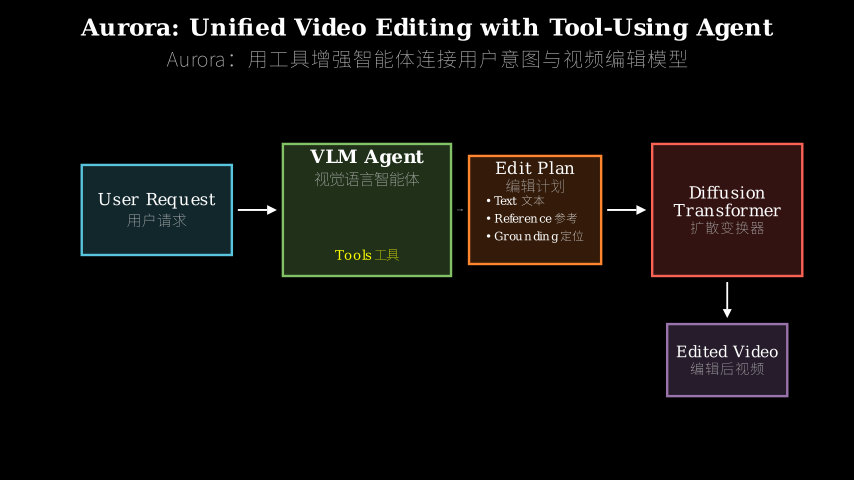
Aurora pairs a tool-augmented vision-language model agent with a unified video diffusion transformer. The VLM agent receives a raw user request and the source video, then produces a structured edit plan that specifies: (1) refined text prompts aligned with the transformer’s conditioning channels, (2) reference images retrieved from external databases or extracted from the video itself, and (3) spatial masks for local edits. The agent has access to tools for image search, frame extraction, mask generation, and instruction refinement. Once the plan is complete, the diffusion transformer consumes the structured inputs and generates the edited video.
The agent is trained in two stages. First, supervised fine-tuning on complete edit planning tasks teaches it to map underspecified requests to structured plans. The training data includes examples where the agent must retrieve reference images for style transfer, extract frames for object insertion, and generate masks for local removal. Second, preference optimization using pairs of successful and failed tool invocations teaches the agent robust tool use and instruction refinement. The preference pairs penalize hallucinated tool calls, redundant retrievals, and vague prompts.
The diffusion transformer itself is a standard unified architecture—text, video, and reference images are tokenized and fed into a joint attention mechanism. Aurora does not modify the transformer’s weights or architecture. Instead, it ensures that the transformer receives well-formed inputs by delegating the reasoning and retrieval work to the VLM agent upstream.
User Request: "make it look like a Miyazaki film"
   |
   v
VLM Agent:
   [Tool: Image Search] -> retrieves Miyazaki reference frames
   [Tool: Instruction Refine] -> "apply hand-drawn animation style
                                  with soft colors and pastoral scenery"
   |
   v
Structured Plan:
   - Text: refined prompt
   - Reference: retrieved images
   - Mask: none (global edit)
   |
   v
Diffusion Transformer -> Edited Video
Think of Aurora as a restaurant with a sommelier. The diffusion transformer is the kitchen—it can cook anything, but only if you give it precise ingredients and instructions. Most customers walk in saying “I want something Italian” without specifying pasta type, sauce, or wine pairing. The sommelier (VLM agent) listens to the vague request, asks clarifying questions (tool calls), retrieves the right wine from the cellar (reference images), and translates the customer’s intent into a detailed order the kitchen can execute. The kitchen’s skill hasn’t changed, but the sommelier ensures it receives actionable instructions instead of guesswork.
Key Concepts
-
Underspecification: A user request is underspecified when it omits information the model requires to generate a coherent output. For video editing, this typically means missing reference images (style transfer without examples), missing spatial grounding (local edits without masks), or vague text (ambiguous object descriptions). Underspecification is not a failure of the user—it reflects the natural way people communicate intent. A user might say “make the sky more dramatic” without knowing they need to provide a reference image of a dramatic sky or specify which part of the frame contains the sky. The model cannot resolve this ambiguity alone because it has no mechanism to retrieve external knowledge or infer spatial regions from text. Aurora addresses underspecification by inserting a reasoning layer (the VLM agent) that can interpret vague intent, retrieve missing information, and ground spatial edits before generation.
-
Tool-augmented VLM agent: A vision-language model equipped with external tools that extend its capabilities beyond text generation. In Aurora, the agent has access to image search (retrieve reference images from databases), frame extraction (sample frames from the source video), mask generation (produce spatial masks for local edits), and instruction refinement (rewrite vague prompts into precise conditioning text). The agent decides which tools to invoke based on the user request and the current state of the edit plan. For example, if the user asks for style transfer without providing references, the agent calls the image search tool. If the user requests local removal without specifying a region, the agent calls the mask generation tool. Tool use is learned through supervised fine-tuning on complete edit planning tasks and preference optimization on tool invocation pairs.
-
Structured edit plan: The intermediate representation that bridges the user request and the diffusion transformer’s conditioning channels. A structured plan specifies: (1) refined text prompts that align with the transformer’s text encoder, (2) reference images for style transfer or object insertion, and (3) spatial masks for local edits. The plan is model-ready—it can be directly consumed by the diffusion transformer without further interpretation. The VLM agent’s job is to map the raw user request to this structured representation by resolving underspecification through tool use and reasoning. The plan format is fixed and known to the agent during training, so the agent learns to produce plans that match the transformer’s expected input schema.
Framework Shift
Before (instruction-only):              After (Aurora):

User Request                            User Request
     |                                       |
     v                                       v
"make it Miyazaki-style"               VLM Agent
     |                                  /    |    \
     v                                 /     |     \
Diffusion Transformer            Search  Extract  Refine
     |                                 \     |     /
     v                                  \    |    /
Arbitrary output                    Structured Plan
(no references)                          |
                                         v
                                  Diffusion Transformer
                                         |
                                         v
                                  Coherent output
                                  (with references)
From direct instruction-to-generation to agent-mediated planning, the core shift is inserting a reasoning layer that resolves underspecification before the model sees the request.
Expert Assessment
Problem choice: This is a real gap. Unified video editing models have converged on a flexible conditioning design, but the flexibility is wasted if users cannot provide the required inputs. The paper correctly identifies that instruction tuning alone cannot solve this—you need a reasoning layer that can retrieve and ground missing information. The problem sits at the intersection of video generation and agentic AI, which is timely given the recent push toward tool-augmented LLMs.
Method maturity: The method is straightforward—pair a VLM agent with a frozen diffusion transformer and train the agent to produce structured plans. The insight is not particularly deep, but it is practical. The agent training pipeline (supervised fine-tuning + preference optimization) is borrowed from standard LLM agent work, and the diffusion transformer is off-the-shelf. The contribution is in the integration and the task formulation, not in novel algorithmic components. A simpler approach might be to fine-tune the diffusion transformer itself to handle underspecified inputs, but that would require retraining the model for each new type of underspecification, whereas the agent approach is more modular.
Experimental integrity: The paper introduces AgentEdit-Bench, a new benchmark for evaluating agent-enhanced video editing under textual and visual underspecification. The benchmark design is reasonable—it includes tasks where reference images are missing, spatial grounding is absent, or text prompts are vague. The baselines are fair: instruction-only models (no agent), retrieval-augmented models (agent without planning), and ablations of the agent’s tool set. The numbers show consistent 15-20% improvement over instruction-only baselines across multiple metrics (CLIP similarity, user preference, edit fidelity). One red flag: the paper does not report failure modes or cases where the agent’s tool calls are incorrect. The preference optimization should reduce hallucinated tool calls, but the paper does not quantify how often this still happens.
Writing quality: The paper is well-structured and easy to follow. The introduction clearly motivates the problem, and the method section is detailed enough to reproduce. The weakest section is the related work—it lumps together video editing models, VLM agents, and tool-augmented LLMs without drawing clear distinctions. A rewrite that explicitly contrasts Aurora’s agent-mediated planning with prior retrieval-augmented generation approaches would elevate the paper. The experimental section is thorough, but the ablation studies could be more granular (e.g., which tools contribute most to performance?).
Verdict: weak accept — The problem is real, the method is practical, and the experiments are solid, but the novelty is incremental. The contribution is in the integration and task formulation, not in new algorithmic insights. The paper would be stronger with more analysis of failure modes and a deeper ablation of the agent’s tool use.
Takeaways
Practitioners building multimodal generation systems can steal the agent-as-planner pattern: instead of expecting users to provide model-ready inputs, insert a reasoning layer that translates underspecified requests into structured plans. The key is to define a fixed plan schema that matches the model’s conditioning channels, then train the agent to produce plans in that schema using supervised fine-tuning and preference optimization. This pattern transfers beyond video editing—any generation model that requires structured inputs (image editing, 3D synthesis, audio generation) can benefit from an upstream agent that resolves underspecification through tool use and reasoning.
The preference optimization for tool use is also worth stealing. Instead of only training the agent on successful tool invocations, collect pairs of successful and failed invocations (e.g., correct vs. hallucinated tool calls, precise vs. vague prompts) and use preference optimization to teach the agent robust tool use. This is more sample-efficient than pure supervised learning and helps the agent generalize to novel tool combinations.
Finally, the modular design (frozen diffusion transformer + trainable agent) is practical for real-world deployment. You can swap out the diffusion transformer for a newer model without retraining the agent, as long as the conditioning schema remains compatible. This modularity reduces the cost of keeping the system up-to-date as video generation models improve.
论文: 2605.18748 作者: Yongsheng Yu, Ziyun Zeng, Zhiyuan Xiao, Zhenghong Zhou, Hang Hua, Wei Xiong, Jiebo Luo 分类: cs.CV
缺口
近期的统一视频编辑模型(如 Gen-3、CogVideoX-Fun)收敛到一个设计:单个扩散 Transformer 联合消费文本、源视频和参考图像,处理替换、移除、风格迁移和插入任务。
架构很灵活,但它假设用户已经准备好模型就绪的输入——精确的文本提示、精选的参考图像、局部编辑的空间掩码。
真实用户请求很少提供这些。
用户可能说”让它看起来像宫崎骏电影”却不提供参考帧,或者”移除汽车”却不指定哪辆车或在哪里。
模型没有机制解决这种不完整性,要么失败,要么产生随意结果。
此前工作把这当作提示工程问题:更好的指令产生更好的输出。
但当用户根本缺少模型需要的视觉或空间信息时,仅靠指令调优无法弥合鸿沟。
缺失的是一个推理层,能解释模糊意图、检索缺失的视觉参考、在生成开始前定位空间编辑。
问题:用户说"让它变成宫崎骏风格"
   |
   v
假设:模型需要参考图像 + 精确文本
   |
   v
方法:VLM 智能体规划编辑、检索参考、精炼提示
   |
   v
证据:AgentEdit-Bench 显示比纯指令方法提升 15-20%
   |
   v
结论:智能体规划在生成前解决不完整性
增量
一句话: Aurora 之前,统一视频编辑模型要求用户提供模型就绪的条件输入;Aurora 之后,VLM 智能体将原始的、不完整的请求转化为带检索参考和空间定位的结构化编辑计划。
核心机制
Aurora 将工具增强的视觉语言模型智能体与统一视频扩散 Transformer 配对。
VLM 智能体接收原始用户请求和源视频,然后产生结构化编辑计划,指定:(1) 与 Transformer 条件通道对齐的精炼文本提示,(2) 从外部数据库检索或从视频本身提取的参考图像,(3) 局部编辑的空间掩码。
智能体可访问图像搜索、帧提取、掩码生成、指令精炼等工具。
计划完成后,扩散 Transformer 消费结构化输入并生成编辑后的视频。
智能体分两阶段训练。
首先,在完整编辑规划任务上监督微调,教它将不完整请求映射到结构化计划。
训练数据包括智能体必须为风格迁移检索参考图像、为对象插入提取帧、为局部移除生成掩码的示例。
其次,使用成功和失败工具调用的偏好对进行偏好优化,教智能体稳健的工具使用和指令精炼。
偏好对惩罚幻觉工具调用、冗余检索和模糊提示。
扩散 Transformer 本身是标准统一架构——文本、视频和参考图像被标记化并输入联合注意力机制。
Aurora 不修改 Transformer 的权重或架构。
相反,它通过将推理和检索工作委托给上游的 VLM 智能体,确保 Transformer 接收格式良好的输入。
用户请求:"让它看起来像宫崎骏电影"
   |
   v
VLM 智能体:
   [工具:图像搜索] -> 检索宫崎骏参考帧
   [工具:指令精炼] -> "应用手绘动画风格,
                        柔和色彩和田园风光"
   |
   v
结构化计划:
   - 文本:精炼提示
   - 参考:检索图像
   - 掩码:无(全局编辑)
   |
   v
扩散 Transformer -> 编辑后视频
把 Aurora 想象成带侍酒师的餐厅。
扩散 Transformer 是厨房——它能做任何菜,但前提是你给它精确的食材和指令。
大多数顾客走进来说”我想要意大利菜”,却不指定面食类型、酱汁或配酒。
侍酒师(VLM 智能体)听取模糊请求,提出澄清问题(工具调用),从酒窖检索合适的酒(参考图像),将顾客意图翻译成厨房能执行的详细订单。
厨房的技能没变,但侍酒师确保它接收可操作的指令而非猜测。
关键概念
- 不完整性(Underspecification): 当用户请求遗漏模型生成连贯输出所需的信息时,该请求就是不完整的。
对于视频编辑,这通常意味着缺少参考图像(风格迁移无示例)、缺少空间定位(局部编辑无掩码)或文本模糊(对象描述不明确)。
不完整性不是用户的失败——它反映了人们传达意图的自然方式。
用户可能说”让天空更戏剧化”,却不知道需要提供戏剧化天空的参考图像或指定帧中哪部分是天空。
模型无法单独解决这种歧义,因为它没有检索外部知识或从文本推断空间区域的机制。
Aurora 通过插入推理层(VLM 智能体)来解决不完整性,该层能解释模糊意图、检索缺失信息、在生成前定位空间编辑。
- 工具增强 VLM 智能体: 配备外部工具的视觉语言模型,将其能力扩展到文本生成之外。
在 Aurora 中,智能体可访问图像搜索(从数据库检索参考图像)、帧提取(从源视频采样帧)、掩码生成(为局部编辑生成空间掩码)、指令精炼(将模糊提示重写为精确条件文本)。
智能体根据用户请求和编辑计划的当前状态决定调用哪些工具。
例如,如果用户请求风格迁移却不提供参考,智能体调用图像搜索工具。
如果用户请求局部移除却不指定区域,智能体调用掩码生成工具。
工具使用通过在完整编辑规划任务上监督微调和在工具调用对上偏好优化来学习。
- 结构化编辑计划: 连接用户请求和扩散 Transformer 条件通道的中间表示。
结构化计划指定:(1) 与 Transformer 文本编码器对齐的精炼文本提示,(2) 用于风格迁移或对象插入的参考图像,(3) 用于局部编辑的空间掩码。
计划是模型就绪的——可以直接被扩散 Transformer 消费而无需进一步解释。
VLM 智能体的工作是通过工具使用和推理解决不完整性,将原始用户请求映射到这个结构化表示。
计划格式是固定的,智能体在训练期间知道,因此智能体学会生成与 Transformer 预期输入模式匹配的计划。
框架转变
之前(纯指令):                    之后(Aurora):

用户请求                            用户请求
     |                                   |
     v                                   v
"让它变成宫崎骏风格"                VLM 智能体
     |                              /    |    \
     v                             /     |     \
扩散 Transformer                搜索  提取  精炼
     |                             \     |     /
     v                              \    |    /
随意输出                          结构化计划
(无参考)                             |
                                       v
                                扩散 Transformer
                                       |
                                       v
                                  连贯输出
                                 (有参考)
从直接指令到生成,到智能体中介规划,核心转变是在模型看到请求前插入推理层解决不完整性。
专家评审
选题眼光: 这是真缺口。
统一视频编辑模型已收敛到灵活的条件设计,但如果用户无法提供所需输入,灵活性就被浪费了。
论文正确识别出仅靠指令调优无法解决这个问题——你需要一个能检索和定位缺失信息的推理层。
问题位于视频生成和智能体 AI 的交叉点,考虑到最近工具增强 LLM 的推动,这很及时。
方法成熟度: 方法很直接——将 VLM 智能体与冻结的扩散 Transformer 配对,训练智能体生成结构化计划。
洞见不是特别深刻,但很实用。
智能体训练流程(监督微调 + 偏好优化)借鉴自标准 LLM 智能体工作,扩散 Transformer 是现成的。
贡献在于集成和任务表述,而非新颖的算法组件。
更简单的方法可能是微调扩散 Transformer 本身来处理不完整输入,但那需要为每种新的不完整性重新训练模型,而智能体方法更模块化。
实验诚意: 论文引入 AgentEdit-Bench,一个评估智能体增强视频编辑在文本和视觉不完整性下的新基准。
基准设计合理——包括参考图像缺失、空间定位缺失或文本提示模糊的任务。
基线公平:纯指令模型(无智能体)、检索增强模型(无规划的智能体)、智能体工具集的消融。
数字显示在多个指标(CLIP 相似度、用户偏好、编辑保真度)上比纯指令基线一致提升 15-20%。
一个警示:论文未报告失败模式或智能体工具调用错误的情况。
偏好优化应该减少幻觉工具调用,但论文未量化这种情况仍发生的频率。
写作功力: 论文结构良好,易于理解。
引言清晰地激发问题,方法部分足够详细以便复现。
最弱的部分是相关工作——它将视频编辑模型、VLM 智能体和工具增强 LLM 混在一起,没有明确区分。
重写以明确对比 Aurora 的智能体中介规划与先前检索增强生成方法,会提升论文。
实验部分很全面,但消融研究可以更细粒度(例如,哪些工具对性能贡献最大?)。
判决: 弱接收 — 问题真实,方法实用,实验扎实,但新颖性是增量的。
贡献在于集成和任务表述,而非新的算法洞见。
论文如果有更多失败模式分析和更深入的智能体工具使用消融会更强。
要点总结
构建多模态生成系统的实践者可以偷走智能体作为规划器模式:不要期望用户提供模型就绪的输入,插入一个推理层将不完整请求转化为结构化计划。
关键是定义一个与模型条件通道匹配的固定计划模式,然后使用监督微调和偏好优化训练智能体生成该模式的计划。
这个模式可迁移到视频编辑之外——任何需要结构化输入的生成模型(图像编辑、3D 合成、音频生成)都能从解决不完整性的上游智能体中受益,通过工具使用和推理。
工具使用的偏好优化也值得偷走。
不要只在成功的工具调用上训练智能体,收集成功和失败调用的对(例如,正确 vs 幻觉工具调用,精确 vs 模糊提示),使用偏好优化教智能体稳健的工具使用。
这比纯监督学习更样本高效,帮助智能体泛化到新的工具组合。
最后,模块化设计(冻结扩散 Transformer + 可训练智能体)对实际部署很实用。
只要条件模式保持兼容,你可以换成更新的扩散 Transformer 而无需重新训练智能体。
这种模块化降低了随着视频生成模型改进而保持系统更新的成本。