Paper: 2606.05121 Authors: Zhifei Xie, Zihang Liu, Ze An, Xiaobin Hu, Yue Liao, Ziyang Ma, Dongchao Yang, Mingbao Lin, Deheng Ye, Shuicheng Yan Categories: cs.SD, cs.AI, cs.CL, cs.MM, eess.AS
The Gap
Today’s Large Audio Language Models (LALMs) work offline: you feed them a complete audio file, they process it, they respond. Streaming audio models exist but are task-specific—one for real-time ASR, another for voice chat, none with general audio understanding. The gap: no unified model that stays always-on, continuously listens to mixed audio streams (speech, environment sounds, music), understands context from the semantic content of what it hears, and decides when to interrupt or respond—all in real time.
Prior approaches treat streaming as an engineering problem (chunking offline models) or build specialized streaming architectures for single tasks. Neither path leads to a model that can, for example, listen to a conversation, hear a smoke alarm in the background, and proactively say “I hear a fire alarm, are you safe?” while maintaining dialogue context.
Problem: Offline LALMs can't interact in real time
   |
   v
Assumption: Audio interaction needs unified perceive-decide-respond loop
   |
   v
Method: SoundFlow framework + streaming-native training data
   |
   v
Evidence: StreamAudio-2M corpus, 8 benchmarks, proactive intervention tests
   |
   v
Conclusion: Audio-Interaction retains offline performance, gains online abilities
The Increment
One sentence: Before this paper, audio models were either offline-capable or streaming-specialized; after it, one model can do both—processing complete files for complex tasks while simultaneously running an always-on loop that listens, understands context, and decides when to speak.
Core Mechanism
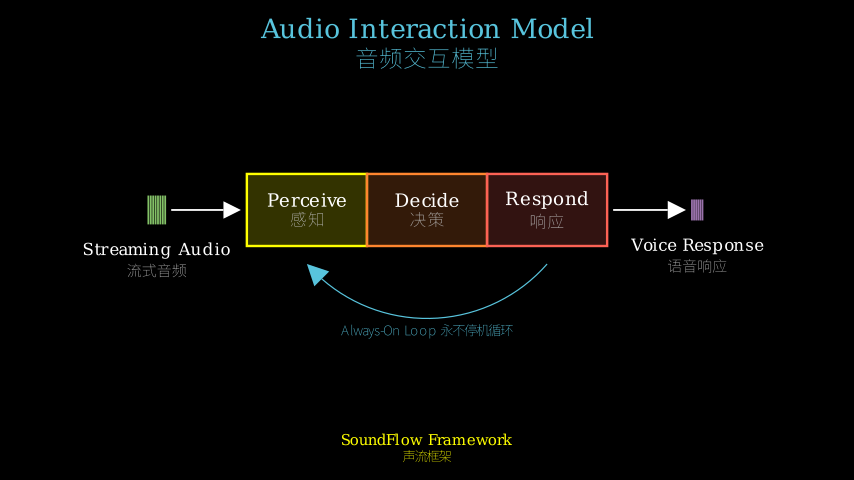
Audio-Interaction operates through a three-phase loop. Perceive: streaming audio encoder processes incoming chunks (512ms windows, 256ms stride) and maintains a sliding context buffer. Decide: a comprehension-aware decision module evaluates whether the accumulated context contains a complete semantic unit worth responding to—not just voice activity detection, but semantic completeness (did the user finish their thought? is there an urgent sound?). Respond: if the decision is “yes,” the model generates output; if “no,” it continues accumulating context.
The architecture fuses a streaming audio encoder (continuous input processing) with an autoregressive language model backbone. Audio chunks flow through the encoder, producing frame-level embeddings that accumulate in a context buffer. At each decision point, the model queries: “Is this a natural breakpoint?” using learned semantic boundaries rather than fixed silence thresholds. When triggered, the language model generates a response while the encoder continues listening—asynchronous operation prevents response generation from blocking perception.
Audio Stream -----> [Encoder] -----> [Context Buffer]
                        |                    |
                        |                    v
                        |            [Decision Module]
                        |              /           \
                        |         Continue      Respond
                        |              |            |
                        v              v            v
                    Keep Listening  Accumulate  [LM Generate]
                                                    |
                                                    v
                                                 Output
Think of it like a simultaneous interpreter at a conference. Most interpreters wait for the speaker to finish a sentence (offline model). Audio-Interaction is the interpreter who listens continuously, builds understanding as words arrive, recognizes when a complete thought has formed even mid-sentence, and starts translating before the speaker pauses—all while still listening for the next phrase. The “decide” phase is the interpreter’s judgment of “this chunk is translatable now” versus “I need more context.” The asynchronous design means the interpreter can speak their translation while already processing the speaker’s next words.
Key Concepts
-
Streaming-native data construction: Traditional audio datasets pair complete recordings with labels. For streaming models, you need training data that mirrors real-time scenarios—partial inputs, interruption points, context accumulated over time. SoundFlow synthesizes this by chunking existing data with semantic-aware boundaries (not arbitrary splits), marking decision points where a response makes sense, and creating negative examples where the model should wait. It’s like turning a complete movie script into a dataset of “what would you know at minute 5? at minute 10?” rather than just “what happens in the whole movie?”
-
Comprehension-aware training: Most streaming ASR models learn to emit words as fast as possible. Audio-Interaction learns a second objective: predict whether the current audio chunk contains enough information to act on. During training, positive examples (respond now) come from natural turn boundaries in conversations, completed audio events, or urgent sounds. Negative examples (keep listening) come from mid-sentence fragments, incomplete thoughts, or ambiguous environmental audio. The model learns both “what does this audio mean?” and “do I know enough yet?”
-
Asynchronous low-latency inference: Generating audio responses takes time (100-500ms for text-to-speech). In synchronous systems, the model stops listening while responding—it misses whatever happens during generation. Audio-Interaction decouples perception from generation: one thread continuously processes incoming audio, another generates responses when triggered. The perception thread maintains state across response generation, so when the response finishes, the model already understands what happened during that time. It’s the difference between closing your eyes while you talk versus keeping them open.
Framework Shift
Before (offline LALMs):                After (Audio-Interaction):

[Complete Audio] --> [Model] --> [Response]    [Audio Stream...]
                                                      |
     Single-shot                                     v
     processing                               [Perceive Loop]
                                                /    |     \
                                           Buffer  Decide  Continue
                                                    |
                                                    v
                                              [Respond Module]
                                                    |
                                              [Keep Listening]
From batch processing to continuous flow, the core shift is treating audio as an open-ended stream where understanding and response emerge from accumulated context, not from complete pre-segmented inputs.
Expert Assessment
Problem choice: Real gap. Current LALMs (GPT-4o, Gemini) do handle audio but still require complete inputs or operate in turn-based modes. The “always-on listener” regime—where a model stays active in an environment, hears everything, and decides when to engage—is genuinely unexplored territory. This matters for ambient assistants, accessibility tools, and human-AI collaboration where rigid turn-taking breaks down.
Method maturity: SoundFlow is engineering-heavy but conceptually straightforward—it’s mostly about data construction and training setup rather than algorithmic novelty. The decision module uses standard attention mechanisms; the innovation is in framing the problem (semantic decision boundaries) rather than the mechanism. The asynchronous inference architecture is practical but not groundbreaking. However, for a unification paper, this is appropriate—the value is in the integration, not individual components.
Experimental integrity: 8 benchmarks is thorough. Proactive-Sound-Bench (their custom eval for intervention abilities) is necessary since no prior benchmark exists, but limited to 500 samples—needs expansion. The offline task results show competitive performance (within 2-3% of task-specific models), which validates that streaming doesn’t cripple offline abilities. Missing: stress tests under noisy conditions, overlapping speech, or adversarial audio designed to trigger false interventions. Latency numbers (256ms stride implies ~500ms response delay minimum) are reported but not deeply analyzed—what’s the breakdown between decision time and generation time?
Writing quality: Abstract oversells (“it is time to unify them”) when the paper is a solid first attempt, not a definitive solution. The SoundFlow framework description (Section 3) frontloads implementation details before explaining why those choices matter—reverse the order. The StreamAudio-2M corpus construction is the paper’s most reusable contribution but buried in Section 4.2—should be elevated. Proactive intervention examples (Section 5.3) are compelling and should appear earlier to motivate the problem.
Verdict: weak accept — Solid engineering contribution that opens a useful research direction, but lacks the conceptual depth or experimental rigor for strong accept. The unification of offline and streaming audio understanding is valuable, the data construction methodology is reusable, and the problem framing (perceive-decide-respond loop) will influence follow-up work. However, the method is compositional rather than novel, and key questions (how to balance proactivity vs. over-interruption, latency-quality tradeoffs, robustness to acoustic variability) remain underexplored.
Takeaways
For practitioners building audio systems: The streaming-native data construction approach is immediately useful—don’t just chunk your offline datasets randomly. Insert semantic decision points where a response would naturally occur, create negative examples where partial context is misleading, and train a secondary objective for “should I respond now?” alongside the primary task. This applies beyond audio: any streaming modality (video, sensor data, live logs) benefits from comprehension-aware boundaries rather than fixed windows.
For researchers: The perceive-decide-respond loop as a unifying abstraction is worth stealing. Many modalities (vision, robotics, multimodal agents) struggle with the same tension: process everything offline for maximum quality, or commit to incremental decisions for real-time interaction. Framing the “decide” step as a learned semantic boundary detector—not just silence/activity detection—transfers directly.
Architectural lesson: Asynchronous perception and generation is table stakes for interactive systems. If your model stops listening while it talks, you’ve built a walkie-talkie, not a conversation partner. The specific implementation here (separate threads, persistent state buffers) is standard concurrent programming, but the paper’s value is demonstrating it’s feasible at LALM scale without sacrificing offline task performance.
论文: 2606.05121
作者: Zhifei Xie, Zihang Liu, Ze An, Xiaobin Hu, Yue Liao, Ziyang Ma, Dongchao Yang, Mingbao Lin, Deheng Ye, Shuicheng Yan
分类: cs.SD, cs.AI, cs.CL, cs.MM, eess.AS
缺口
现在的大型音频语言模型(LALMs)都是离线工作的:你给它一个完整音频文件,它处理,它回应。
流式音频模型存在但都是任务专用的——一个做实时语音识别,另一个做语音对话,没有一个具备通用音频理解能力。
缺口在于:没有统一模型能做到永不停机,持续倾听混合音频流(语音、环境声、音乐),从听到内容的语义中理解上下文,并决定何时打断或回应——全程实时。
此前的方法要么把流式当工程问题(把离线模型切块),要么为单一任务构建专门的流式架构。
两条路都通不向这样的模型:比如边听对话,边听到背景里的烟雾报警器,主动说”我听到火警,你安全吗?“同时保持对话上下文。
问题:离线 LALMs 无法实时交互
   |
   v
假设:音频交互需要统一的感知-决策-响应循环
   |
   v
方法:SoundFlow 框架 + 流式原生训练数据
   |
   v
证据:StreamAudio-2M 语料,8个基准,主动干预测试
   |
   v
结论:Audio-Interaction 保留离线性能,获得在线能力
增量
一句话:这篇论文之前,音频模型要么能离线处理要么做流式专用;之后,一个模型两者兼得——既能处理完整文件做复杂任务,又能同时运行永不停机的循环,倾听、理解上下文、决定何时开口。
核心机制
Audio-Interaction 通过三阶段循环运转。
感知:流式音频编码器处理输入块(512ms 窗口,256ms 步长),维护滑动上下文缓冲区。
决策:理解感知决策模块评估累积的上下文是否包含值得回应的完整语义单元——不只是语音活动检测,而是语义完整性(用户说完了吗?有紧急声音吗?)。
响应:如果决策是”是”,模型生成输出;如果”否”,继续累积上下文。
架构融合了流式音频编码器(连续输入处理)和自回归语言模型主干。
音频块流经编码器,产生帧级嵌入,累积到上下文缓冲区。
每个决策点,模型询问:“这是个自然断点吗?“使用学到的语义边界而非固定静音阈值。
触发时,语言模型生成响应,编码器继续倾听——异步操作防止响应生成阻塞感知。
音频流 -----> [编码器] -----> [上下文缓冲]
                  |                  |
                  |                  v
                  |          [决策模块]
                  |            /         \
                  |        继续         响应
                  |          |            |
                  v          v            v
              保持倾听    累积      [语言模型生成]
                                        |
                                        v
                                      输出
想象同声传译员在会议上。
大多数译员等发言人说完一句话(离线模型)。
Audio-Interaction 是这样的译员:持续倾听,在词语到达时构建理解,识别何时一个完整思想已经成形(即使在句子中间),在发言人暂停前就开始翻译——同时还在听下一个短语。
“决策”阶段是译员判断”这块现在可译”还是”我需要更多上下文”。
异步设计意味着译员能边说翻译边处理发言人的下一句话。
关键概念
- 流式原生数据构建:传统音频数据集配对完整录音和标签。
对流式模型,你需要镜像实时场景的训练数据——部分输入、中断点、随时间累积的上下文。
SoundFlow 通过用语义感知边界(非任意切分)分块现有数据来合成这些,标记有意义响应的决策点,创建模型应该等待的负样本。
就像把完整电影剧本变成”第5分钟你会知道什么?第10分钟呢?“的数据集,而不只是”整部电影发生了什么?”
- 理解感知训练:大多数流式 ASR 模型学习尽快输出词语。
Audio-Interaction 学习第二个目标:预测当前音频块是否包含足够信息来采取行动。
训练期间,正样本(现在响应)来自对话中的自然转折边界、完成的音频事件或紧急声音。
负样本(继续倾听)来自句子中间片段、不完整思想或模糊环境音频。
模型既学”这音频什么意思?“也学”我知道的够了吗?”
- 异步低延迟推理:生成音频响应需要时间(文本转语音100-500ms)。
在同步系统中,模型响应时停止倾听——错过生成期间发生的一切。
Audio-Interaction 解耦感知和生成:一个线程持续处理输入音频,另一个在触发时生成响应。
感知线程在响应生成期间维护状态,所以响应结束时,模型已经理解那段时间发生了什么。
就像你说话时闭眼还是睁眼的区别。
框架转变
之前(离线 LALMs):                 之后(Audio-Interaction):

[完整音频] --> [模型] --> [响应]     [音频流...]
                                           |
    单次处理                               v
                                    [感知循环]
                                     /   |    \
                                缓冲  决策  继续
                                         |
                                         v
                                   [响应模块]
                                         |
                                   [保持倾听]
从批处理到连续流,核心转变是把音频当作开放式流,理解和响应从累积上下文中涌现,而非从完整预分段输入。
专家评审
选题眼光:真缺口。
当前 LALMs(GPT-4o、Gemini)确实处理音频,但仍需完整输入或在轮流模式下运作。
“永不停机倾听者”机制——模型在环境中保持活跃,听到一切,决定何时介入——是真正未探索的领域。
这对环境助手、无障碍工具、人机协作(刚性轮流会崩溃的场景)很重要。
方法成熟度:SoundFlow 工程繁重但概念直白——主要关于数据构建和训练设置而非算法新颖性。
决策模块使用标准注意力机制;创新在问题框架(语义决策边界)而非机制。
异步推理架构实用但非突破性。
不过对于统一性论文,这很合适——价值在整合,非单个组件。
实验诚意:8个基准很全面。
Proactive-Sound-Bench(他们针对干预能力的自定义评估)是必要的,因为没有先前基准存在,但仅限500样本——需要扩展。
离线任务结果显示竞争力(在任务专用模型2-3%范围内),验证了流式不会削弱离线能力。
缺失:噪声条件、重叠语音或旨在触发错误干预的对抗音频下的压力测试。
延迟数字(256ms 步长意味着最少约500ms响应延迟)已报告但未深入分析——决策时间和生成时间的分解是什么?
写作功力:摘要夸大(“是时候统一它们了”),而论文是扎实的首次尝试,非最终解决方案。
SoundFlow 框架描述(第3节)在解释为什么这些选择重要之前就堆实现细节——应该倒过来。
StreamAudio-2M 语料构建是论文最可复用的贡献,却埋在第4.2节——应该提升。
主动干预例子(第5.3节)很有说服力,应该更早出现以激发问题动机。
判决:弱接收 — 扎实的工程贡献,开启了有用的研究方向,但缺乏强接收所需的概念深度或实验严谨性。
离线和流式音频理解的统一有价值,数据构建方法可复用,问题框架(感知-决策-响应循环)会影响后续工作。
但方法是组合性而非新颖性,关键问题(如何平衡主动性与过度打断、延迟-质量权衡、对声学变异性的鲁棒性)仍未充分探索。
要点总结
对构建音频系统的实践者:流式原生数据构建方法可立即使用——别只是随机分块离线数据集。
在自然响应会发生的地方插入语义决策点,创建部分上下文有误导性的负样本,在主要任务之外训练”我现在应该响应吗?“的次要目标。
这超越音频适用:任何流式模态(视频、传感器数据、实时日志)都受益于理解感知边界而非固定窗口。
对研究者:感知-决策-响应循环作为统一抽象值得借鉴。
许多模态(视觉、机器人、多模态智能体)纠结于同一张力:离线处理所有东西以获得最高质量,还是承诺增量决策以实现实时交互。
将”决策”步骤框架为学习的语义边界检测器——而非仅仅静音/活动检测——可直接迁移。
架构教训:异步感知和生成是交互系统的基本要求。
如果你的模型说话时停止倾听,你构建的是对讲机,不是对话伙伴。
这里的具体实现(独立线程、持久状态缓冲)是标准并发编程,但论文的价值在于证明它在 LALM 规模下可行,且不牺牲离线任务性能。