
Paper: 2604.04902 Authors: Connor Dilgren, Sarah Wiegreffe Categories: cs.LG
The Gap
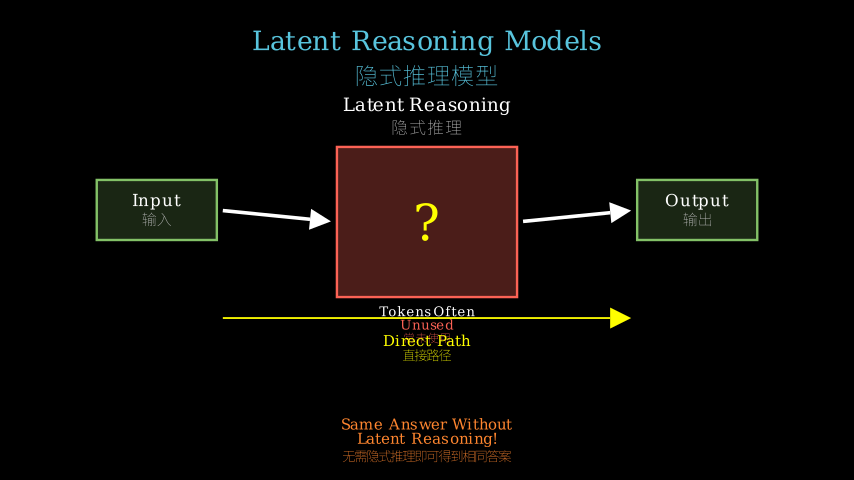
Latent reasoning models (LRMs) promise a sweet deal: explore multiple reasoning paths in parallel without the inference cost of generating explicit chain-of-thought text. Models like Coconut and Quiet-STaR insert special “thinking” tokens between input and output, claiming these tokens encode internal reasoning. The field has accepted this at face value—low cost, high parallelism, problem solved.
But there’s a catch nobody checked: we don’t actually know what these latent tokens are doing. Are they reasoning? Are they necessary? Can we trust them? Prior work measured task performance but never opened the hood. The gap is methodological: LRMs are black boxes by design, yet we’ve been deploying them without verification tools.
Problem: LRMs claim to reason in latent space
   |
   v
Assumption: Latent tokens = reasoning happens
   |
   v
Gap: No method to verify what latent tokens actually encode
   |
   v
This paper: Probe LRMs with ablation + decoding experiments
   |
   +---> Evidence 1: Latent tokens often unnecessary (same answer without them)
   |
   +---> Evidence 2: When necessary, tokens decode to gold reasoning (65-93%)
   |
   +---> Evidence 3: Can extract verified traces without gold reference
   |
   v
Conclusion: LRMs are more interpretable than claimed, but underutilized
The Increment
One sentence: Before this paper, latent reasoning was an unverified black box; after, we know these models often don’t use their reasoning capacity and when they do, it’s surprisingly readable.
Core Mechanism
The method has three prongs. First, ablation testing: remove latent reasoning tokens entirely and check if the model still produces correct answers. If yes, the tokens were decorative. Second, decoding with gold traces: given a correct prediction and the gold reasoning steps, try to decode those exact steps from the latent token activations using the model’s own vocabulary head. Success rate tells you how often the model implements the expected solution. Third, verified decoding without gold: generate candidate reasoning traces from latent tokens, then verify each candidate by checking if it leads to the correct answer when fed back through the model.
Input --> [Latent Tokens] --> Output
            ^     |
            |     v
       Ablation  Decode
       Test      Attempt
            |
            v
    Three Questions:
    1. Remove tokens --> same answer? (necessity)
    2. Decode --> matches gold? (interpretability)
    3. Generate + verify --> valid trace? (extractability)
Think of latent reasoning tokens like a student’s scratch paper during an exam. The first experiment asks: “What if we take away the scratch paper—can they still get the right answer?” Often, yes. The second experiment: “When they do use scratch paper, can we read their handwriting and see if they followed the textbook method?” Surprisingly readable. The third experiment: “Without knowing the textbook answer, can we reconstruct their work and check if it’s valid?” Yes, for most correct answers but not for wrong ones—which means the scratch paper quality correlates with answer correctness.
The metaphor is load-bearing: latent tokens are scratch paper, ablation is confiscation, decoding is reading handwriting, verification is checking the work. Each component maps directly.
Key Concepts
-
Latent reasoning tokens: Special tokens inserted between input and output where the model supposedly “thinks” without generating human-readable text. Unlike chain-of-thought which produces “Let’s think step by step…” in natural language, latent tokens are just vector representations. The promise: same reasoning benefit, lower cost. The reality this paper exposes: often unused or, when used, not as opaque as advertised. Imagine a calculator with a “show work” button that’s usually off—latent tokens are the hidden work, and this paper is pressing the button to see what’s there.
-
Verified decoding: A two-step process to extract reasoning from latent tokens. Step one: decode token activations into natural language using the model’s vocabulary (like reverse-engineering compressed data). Step two: feed that decoded reasoning back into the model and check if it produces the same correct answer (verification). If both steps succeed, you’ve found an interpretable reasoning trace. The verification step is crucial—it prevents you from hallucinating patterns that aren’t really there. It’s like finding a recipe in a chef’s notes and then cooking it to confirm it actually makes the dish.
Framework Shift
Before (mainstream approach):        After (this paper):

Input                                Input
  |                                    |
  v                                    v
[Latent Tokens]                      [Latent Tokens]
  (black box)                          |
  |                                    +---> Ablate: needed?
  v                                    |
Output                                 +---> Decode: readable?
  ^                                    |
  |                                    +---> Verify: valid?
Trust on faith                         |
                                       v
                                     Output
                                       ^
                                       |
                                  Evidence-based trust
From “latent tokens are opaque reasoning” to “latent tokens are often unused or surprisingly transparent,” the core shift is from assumption to verification.
Expert Assessment
Problem choice: Real gap. The field rushed to adopt LRMs for efficiency without building interpretability tools. This is forensic work that should have happened before deployment. It sits at the intersection of mechanistic interpretability and reasoning research—both hot areas, so timing is good.
Method maturity: Clever and simple. Ablation is Occam’s razor applied to model components. The verified decoding trick (generate trace, check if it reproduces the answer) is elegant—it sidesteps the need for human annotation. No obvious simpler approach was overlooked. The weakness: only tested on two LRMs (Coconut, Quiet-STaR) and logical reasoning tasks. Generalization is an open question.
Experimental integrity: Baselines are fair—they compare to the models’ own performance with and without latent tokens. The 65-93% decoding success rate is striking, but I’d want to see the failure modes analyzed more. One red flag: the paper doesn’t deeply explore *why latent tokens are often unnecessary. Is it dataset leakage? Model capacity? Task simplicity? The numbers hold up, but the causal story is incomplete.
Writing quality: Section 3 (methods) is dense—too many experimental details crammed together. Splitting it into “Necessity Experiments” and “Interpretability Experiments” would help. The related work section undersells how radical these findings are. If I were rewriting, I’d lead with the punchline: “We found latent reasoning tokens are mostly unused” and build from there.
Verdict: weak accept — Solid empirical work exposing an important oversight in LRM research, but limited scope and incomplete causal analysis prevent it from being a strong accept.
Takeaways
For practitioners: Before deploying an LRM, run the ablation test. If your model performs the same without latent tokens, you’re paying inference cost for nothing—switch to a standard model. If latent tokens matter, use verified decoding as a confidence signal: predictions with extractable reasoning traces are more trustworthy.
For researchers: The verified decoding method is generalizable. You can apply it to any model with intermediate representations—probe vision transformers’ attention maps, decode LSTM hidden states, etc. The pattern: generate interpretation, verify it reproduces behavior, measure success rate.
Specific technique to steal: The “generate and verify” loop for interpretability. Don’t just decode representations—check if your interpretation is faithful by feeding it back through the system. This prevents interpretability theater where you see patterns that aren’t functionally relevant.
论文: 2604.04902 作者: Connor Dilgren, Sarah Wiegreffe 分类: cs.LG
缺口
隐式推理模型(LRM)承诺了一笔划算的买卖:并行探索多条推理路径,却不用付出生成显式思维链文本的推理成本。
像Coconut和Quiet-STaR这样的模型在输入和输出之间插入特殊的”思考”token,声称这些token编码了内部推理。
学界照单全收——低成本、高并行,问题解决。
但有个没人检查的陷阱:我们其实不知道这些隐式token在干什么。
它们在推理吗?
它们必要吗?
能信吗?
先前工作测量了任务性能,但从未打开引擎盖。
缺口是方法论上的:LRM设计上就是黑盒,但我们一直在没有验证工具的情况下部署它们。
问题:LRM声称在隐空间推理
   |
   v
假设:隐式token = 推理正在发生
   |
   v
缺口:没有方法验证隐式token实际编码了什么
   |
   v
本文:用消融+解码实验探测LRM
   |
   +---> 证据1:隐式token常常不必要(没有它们也能得到相同答案)
   |
   +---> 证据2:必要时,token能解码为金标准推理(65-93%)
   |
   +---> 证据3:无需金标准参考也能提取可验证的轨迹
   |
   v
结论:LRM比声称的更可解释,但利用不足
增量
一句话:这篇论文之前,隐式推理是未经验证的黑盒;之后,我们知道这些模型常常不使用它们的推理能力,而当使用时,出乎意料地可读。
核心机制
方法有三个分支。
第一,消融测试:完全移除隐式推理token,检查模型是否仍能产生正确答案。
如果是,token就是装饰性的。
第二,用金标准轨迹解码:给定一个正确预测和金标准推理步骤,尝试用模型自己的词表头从隐式token激活中解码出那些确切步骤。
成功率告诉你模型多频繁地实现了预期解法。
第三,无金标准的验证解码:从隐式token生成候选推理轨迹,然后通过检查每个候选在反馈给模型时是否导向正确答案来验证它。
输入 --> [隐式Token] --> 输出
            ^     |
            |     v
       消融    解码
       测试    尝试
            |
            v
    三个问题:
    1. 移除token --> 相同答案?(必要性)
    2. 解码 --> 匹配金标准?(可解释性)
    3. 生成+验证 --> 有效轨迹?(可提取性)
把隐式推理token想象成学生考试时的草稿纸。
第一个实验问:“如果我们拿走草稿纸——他们还能得到正确答案吗?“通常能。
第二个实验:“当他们确实用草稿纸时,我们能读懂他们的字迹,看看他们是否遵循了教科书方法吗?“出乎意料地可读。
第三个实验:“在不知道教科书答案的情况下,我们能重建他们的工作并检查它是否有效吗?“对大多数正确答案可以,但对错误答案不行——这意味着草稿纸质量与答案正确性相关。
这个比喻是承重的:隐式token是草稿纸,消融是没收,解码是读字迹,验证是检查工作。
每个组件都直接映射。
关键概念
- 隐式推理token:在输入和输出之间插入的特殊token,模型据称在此”思考”而不生成人类可读文本。
与生成”让我们一步步思考…”自然语言的思维链不同,隐式token只是向量表示。
承诺:相同的推理收益,更低的成本。
本文揭露的现实:常常未使用,或使用时不像宣传的那样不透明。
想象一个有”显示过程”按钮的计算器,通常是关闭的——隐式token就是隐藏的工作,而本文是按下按钮看看里面有什么。
- 验证解码:从隐式token提取推理的两步过程。
第一步:用模型的词表将token激活解码为自然语言(像逆向工程压缩数据)。
第二步:将解码的推理反馈给模型,检查它是否产生相同的正确答案(验证)。
如果两步都成功,你就找到了一条可解释的推理轨迹。
验证步骤至关重要——它防止你幻想出实际不存在的模式。
就像在厨师笔记中找到食谱,然后烹饪它以确认它确实能做出那道菜。
框架转变
之前(主流方法):                之后(本文方法):

输入                              输入
  |                                 |
  v                                 v
[隐式Token]                       [隐式Token]
  (黑盒)                            |
  |                                 +---> 消融:需要吗?
  v                                 |
输出                                +---> 解码:可读吗?
  ^                                 |
  |                                 +---> 验证:有效吗?
凭信念信任                          |
                                    v
                                  输出
                                    ^
                                    |
                               基于证据的信任
从”隐式token是不透明推理”到”隐式token常常未使用或出乎意料地透明”,核心转变是从假设到验证。
专家评审
选题眼光:真实缺口。
学界为了效率匆忙采用LRM,却没有构建可解释性工具。
这是部署前就该做的取证工作。
它位于机制可解释性和推理研究的交叉点——两个都是热门领域,所以时机不错。
方法成熟度:巧妙且简单。
消融是奥卡姆剃刀应用于模型组件。
验证解码技巧(生成轨迹,检查它是否重现答案)很优雅——它绕过了人工标注的需求。
没有明显被忽略的更简单方法。
弱点:只在两个LRM(Coconut、Quiet-STaR)和逻辑推理任务上测试。
泛化是个开放问题。
实验诚意:基线公平——它们与模型自身有无隐式token的性能比较。
65-93%的解码成功率很惊人,但我想看到对失败模式的更多分析。
一个警示:论文没有深入探索为什么隐式token常常不必要。
是数据集泄漏?
模型容量?
任务简单?
数字站得住,但因果故事不完整。
写作功力:第3节(方法)太密集——太多实验细节挤在一起。
拆分成”必要性实验”和”可解释性实验”会有帮助。
相关工作部分低估了这些发现的激进程度。
如果我重写,我会以结论开头:“我们发现隐式推理token大多未使用”,然后从那里展开。
判决:弱接收 — 扎实的实证工作,揭露了LRM研究中的重要疏忽,但有限的范围和不完整的因果分析使它无法成为强接收。
要点总结
对实践者:部署LRM之前,运行消融测试。
如果你的模型没有隐式token表现相同,你就是在为无用功付推理成本——切换到标准模型。
如果隐式token重要,用验证解码作为置信信号:有可提取推理轨迹的预测更值得信赖。
对研究者:验证解码方法是可泛化的。
你可以将它应用于任何有中间表示的模型——探测视觉transformer的注意力图,解码LSTM隐藏状态等。
模式是:生成解释,验证它重现行为,测量成功率。
可偷的具体技术:“生成并验证”循环用于可解释性。
不要只解码表示——通过将你的解释反馈给系统来检查它是否忠实。
这防止了可解释性作秀,即你看到的模式在功能上并不相关。