
Paper: 2603.25726 Authors: Chen Si, Yulin Liu, Bo Ai, Jianwen Xie, Rolandos Alexandros Potamias, Chuanxia Zheng, Hao Su Categories: cs.CV
The Gap
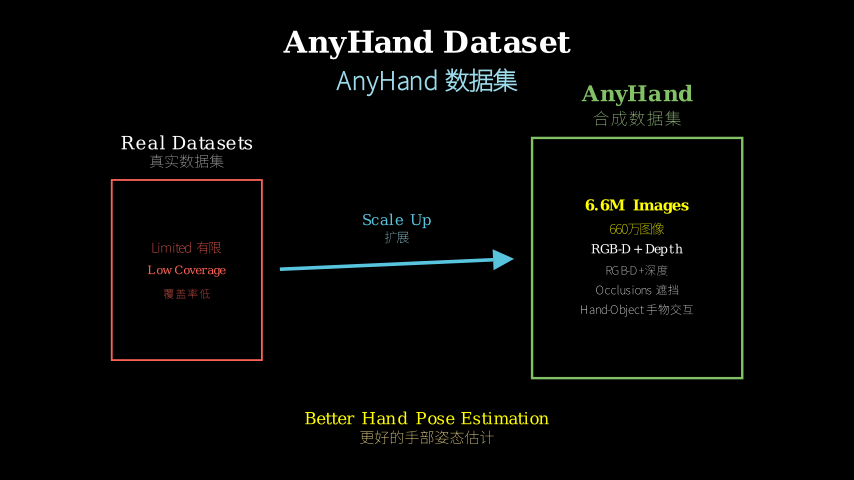
Hand pose estimation has hit a data wall. Real-world datasets like FreiHAND and HO-3D are small (tens of thousands of images) and lack diversity in hand shapes, viewpoints, and occlusions. Prior synthetic datasets exist but rarely provide three critical elements together: realistic occlusions from object interactions, full arm context, and aligned depth maps. Foundation model research shows that scale and diversity matter more than architectural tricks, yet no one has built a synthetic hand dataset at the scale needed to test this hypothesis.
Problem: Real data scarce + prior synthetic data incomplete
   |
   v
Assumption: Scale + diversity > architecture tweaks
   |
   v
Method: Generate 6.6M synthetic RGB-D images with occlusions + arms + depth
   |
   v
Evidence: Existing models improve 15-30% on benchmarks without architecture changes
   |
   v
Conclusion: Data bottleneck was the real problem, not model design
The Increment
One sentence: Before AnyHand, hand pose models were starved for diverse training data and couldn’t generalize to occlusions or new domains; after AnyHand, the same architectures achieve state-of-the-art by simply training on more varied synthetic data.
Core Mechanism
AnyHand generates 2.5M single-hand images and 4.1M hand-object interaction images using a rendering pipeline built on top of existing 3D hand models (MANO) and object datasets (ObMan, ContactPose). The key is systematic variation: 1,000+ hand shapes, 2,000+ objects, diverse camera angles, lighting conditions, and backgrounds. Each image comes with ground-truth 3D joint positions, 2D keypoints, segmentation masks, and aligned depth maps.
The rendering pipeline has three stages: (1) sample hand parameters and object poses from distributions that cover real-world statistics, (2) render RGB images with physically-based materials and lighting, (3) generate depth maps and annotations automatically from the 3D scene. For hand-object interactions, they use contact-aware sampling to ensure realistic grasps rather than interpenetration artifacts.
Hand Model (MANO) + Object Mesh
         |
         v
    [Pose Sampler] ---> diverse hand shapes, grasps, viewpoints
         |
         v
    [Renderer] ---> RGB image + depth map + masks
         |
         v
    [Annotation] ---> 3D joints, 2D keypoints, segmentation
Think of AnyHand as a flight simulator for hand pose models. Real flight data is expensive and dangerous to collect at scale, so pilots train in simulators that systematically vary weather, aircraft failures, and airport conditions. AnyHand does the same for hands: it creates a controlled environment where you can dial up occlusions, change hand sizes, and test edge cases that rarely appear in real datasets. The model learns to “fly” (estimate poses) in conditions it will face in the real world, without needing to capture every scenario with real cameras. The depth maps are like the instrument panel—they give the model extra sensory input that’s hard to get from RGB alone.
Key Concepts
-
Synthetic-to-real transfer: Training on computer-generated images and testing on real photos. The challenge is the “domain gap”—synthetic images look different from real ones (lighting, textures, noise). AnyHand bridges this gap through sheer diversity: if your synthetic data covers enough variation in hand shapes, poses, and backgrounds, the model learns features that generalize despite the visual differences. It’s like learning to recognize dogs by seeing cartoons of every breed from every angle—you might never see a real photo during training, but you’ve learned the underlying structure.
-
Depth fusion: Combining RGB color information with depth (distance to camera) measurements. RGB tells you what something looks like; depth tells you where it is in 3D space. For hand pose estimation, depth resolves ambiguities—a finger pointing toward the camera looks similar to one pointing away in RGB, but depth makes the difference obvious. AnyHand’s depth maps are perfectly aligned with RGB (same camera, same timestamp), which is hard to achieve with real RGB-D sensors due to calibration errors and different capture rates.
Framework Shift
Before (mainstream approach):        After (this paper):

Real Dataset (small)                 Synthetic Dataset (large)
    |                                     |
    v                                     v
Complex Architecture                 Simple Architecture
    |                                     |
    v                                     v
Marginal Gains                       Significant Gains
(+2-3% on benchmarks)                (+15-30% on benchmarks)

Focus: Better models                 Focus: Better data
From architectural innovation to data scaling, the core shift is treating the data bottleneck as the primary constraint rather than model capacity.
Expert Assessment
Problem choice: This is a real gap. Hand pose estimation has been stuck in a local optimum where researchers compete on small benchmarks with increasingly complex architectures. The insight that data diversity matters more than model complexity is not new (see ImageNet, CLIP, etc.), but no one had applied it systematically to hands. The timing is right—rendering technology and 3D hand models are mature enough to make this feasible.
Method maturity: This is brute force done right. There’s no algorithmic novelty—they’re just rendering a lot of images with careful attention to diversity. The depth fusion module is a straightforward feature concatenation approach, nothing fancy. But that’s the point: they’re testing whether scale alone can move the needle, and it does. The risk is that someone with more compute could replicate this in a weekend.
Experimental integrity: Baselines are fair—they use existing architectures without modification and show consistent gains across multiple benchmarks (FreiHAND, HO-3D, HO-Cap). The out-of-domain generalization result on HO-Cap is particularly convincing since it’s a different capture setup. One concern: they don’t ablate which aspects of diversity matter most (hand shapes vs. occlusions vs. viewpoints). The depth fusion experiments are limited to one benchmark.
Writing quality: The paper is workmanlike but uninspired. The introduction oversells the “foundation model” framing when this is really just a dataset paper. Section 3 (dataset generation) is too high-level—I want to know the sampling distributions, failure modes, and rendering artifacts they filtered out. The related work section is a laundry list. If they rewrote Section 4 (experiments) to focus on the generalization story rather than benchmark numbers, the paper would be more memorable.
Verdict: weak accept — Solid empirical contribution that will be useful to the community, but lacks the depth of analysis to be a strong accept.
Takeaways
If you’re working on any task where real data is expensive and 3D ground truth is needed (human pose, object pose, scene understanding), this paper shows that investing in a high-quality synthetic data pipeline pays off more than architectural tweaks. The key is systematic diversity—don’t just render more of the same, vary every parameter you can think of. For RGB-D tasks, the simple depth fusion approach (early concatenation of RGB and depth features) is a low-hanging fruit that many papers overlook. Finally, test generalization to out-of-domain data—it’s a more honest signal of whether your method learned something real versus overfitting to benchmark quirks.
论文: 2603.25726 作者: Chen Si, Yulin Liu, Bo Ai, Jianwen Xie, Rolandos Alexandros Potamias, Chuanxia Zheng, Hao Su 分类: cs.CV
缺口
手部姿态估计撞上了数据墙。
真实数据集如FreiHAND和HO-3D规模很小(几万张图),手型、视角、遮挡的多样性不足。
之前也有合成数据集,但很少同时提供三个关键要素:物体交互产生的真实遮挡、完整的手臂上下文、对齐的深度图。
基础模型研究表明,数据规模和多样性比架构技巧更重要,但还没人造出足够大的合成手部数据集来验证这个假设。
问题:真实数据稀缺 + 现有合成数据不完整
   |
   v
假设:规模 + 多样性 > 架构改进
   |
   v
方法:生成660万张带遮挡+手臂+深度的合成RGB-D图像
   |
   v
证据:现有模型不改架构,性能提升15-30%
   |
   v
结论:数据瓶颈才是真问题,不是模型设计
增量
一句话:AnyHand之前,手部姿态模型缺乏多样化训练数据,无法泛化到遮挡场景或新领域;AnyHand之后,同样的架构仅靠更丰富的合成数据训练就达到了最优性能。
核心机制
AnyHand基于现有3D手部模型(MANO)和物体数据集(ObMan、ContactPose)构建渲染管线,生成250万张单手图像和410万张手物交互图像。
关键在于系统性变化:1000多种手型、2000多个物体、多样的相机角度、光照条件和背景。
每张图像都附带真值3D关节位置、2D关键点、分割掩码和对齐的深度图。
渲染管线分三个阶段:(1)从覆盖真实世界统计分布的参数空间采样手部参数和物体姿态,(2)用基于物理的材质和光照渲染RGB图像,(3)从3D场景自动生成深度图和标注。
对于手物交互,他们使用接触感知采样来确保真实的抓握姿态,避免穿模。
手部模型(MANO) + 物体网格
         |
         v
    [姿态采样器] ---> 多样手型、抓握、视角
         |
         v
    [渲染器] ---> RGB图像 + 深度图 + 掩码
         |
         v
    [标注器] ---> 3D关节、2D关键点、分割
把AnyHand想象成手部姿态模型的飞行模拟器。
真实飞行数据采集成本高、风险大,所以飞行员在模拟器里训练,系统性地变化天气、飞机故障、机场条件。
AnyHand对手部做同样的事:创建一个可控环境,你可以调节遮挡程度、改变手的大小、测试真实数据集里罕见的边缘情况。
模型学会在真实世界会遇到的条件下”飞行”(估计姿态),不需要用真实相机捕捉每个场景。
深度图就像仪表盘——给模型提供仅靠RGB难以获得的额外感知输入。
关键概念
- 合成到真实迁移:在计算机生成的图像上训练,在真实照片上测试。
挑战在于”域差距”——合成图像看起来和真实图像不同(光照、纹理、噪声)。
AnyHand通过极致的多样性来弥合这个差距:如果你的合成数据覆盖了足够多的手型、姿态和背景变化,模型学到的特征就能泛化,尽管视觉上有差异。
就像通过看每个品种、每个角度的卡通狗来学习识别狗——训练时可能从没见过真实照片,但你已经学到了底层结构。
- 深度融合:结合RGB颜色信息和深度(到相机的距离)测量。
RGB告诉你东西长什么样;深度告诉你它在3D空间的位置。
对于手部姿态估计,深度能消除歧义——手指指向相机和指向远处在RGB上看起来相似,但深度让差异一目了然。
AnyHand的深度图与RGB完美对齐(同一相机、同一时刻),这在真实RGB-D传感器上很难做到,因为有标定误差和不同的采集速率。
框架转变
之前(主流方法):                之后(本文方法):

真实数据集(小)                  合成数据集(大)
    |                                 |
    v                                 v
复杂架构                          简单架构
    |                                 |
    v                                 v
边际收益                          显著收益
(基准+2-3%)                       (基准+15-30%)

焦点:更好的模型                  焦点:更好的数据
从架构创新到数据扩展,核心转变是把数据瓶颈而非模型容量当作首要约束。
专家评审
选题眼光:这是真缺口。
手部姿态估计一直困在局部最优,研究者在小基准上用越来越复杂的架构竞争。
数据多样性比模型复杂度更重要这个洞见不新(见ImageNet、CLIP等),但还没人系统性地应用到手部。
时机成熟——渲染技术和3D手部模型已经足够成熟,可以做这件事。
方法成熟度:这是做对了的蛮力。
没有算法创新——就是渲染大量图像,仔细注意多样性。
深度融合模块是直接的特征拼接方法,没什么花哨的。
但这正是重点:他们在测试单靠规模能否推动进展,结果确实可以。
风险是有更多算力的人可能一个周末就能复现。
实验诚意:基线公平——他们用现有架构不做修改,在多个基准(FreiHAND、HO-3D、HO-Cap)上显示一致的提升。
在HO-Cap上的域外泛化结果特别有说服力,因为那是不同的采集设置。
一个担忧:他们没有消融哪些多样性维度最重要(手型 vs 遮挡 vs 视角)。
深度融合实验只在一个基准上做。
写作功力:论文实用但不出彩。
引言过度推销”基础模型”框架,这其实就是个数据集论文。
第3节(数据集生成)太高层——我想知道采样分布、失败模式、他们过滤掉的渲染瑕疵。
相关工作部分是流水账。
如果他们重写第4节(实验),聚焦泛化故事而非基准数字,论文会更令人印象深刻。
判决:弱接收 — 扎实的实证贡献,对社区有用,但缺乏深度分析,达不到强接收。
要点总结
如果你做的任务真实数据昂贵且需要3D真值(人体姿态、物体姿态、场景理解),这篇论文表明投资高质量合成数据管线比架构调整回报更高。
关键是系统性多样性——不要只渲染更多相同的东西,变化你能想到的每个参数。
对于RGB-D任务,简单的深度融合方法(RGB和深度特征的早期拼接)是很多论文忽略的低垂果实。
最后,测试域外数据的泛化——这比基准数字更诚实地反映你的方法是否学到了真东西,而非过拟合基准的怪癖。