Paper: 2603.24570 Authors: Duc Vu, Anh Nguyen, Chi Tran, Anh Tran Categories: cs.CV, cs.AI
The Gap
Existing adversarial defenses against AI-generated content mostly target image generation models. When they do address video, they focus on UNet-based architectures. The problem: newer Diffusion Transformer (DiT) models have stronger feature retention and temporal consistency, making old attacks ineffective. Plus, image-to-video models are fundamentally different beasts—they need to maintain coherence across frames, not just corrupt a single image.
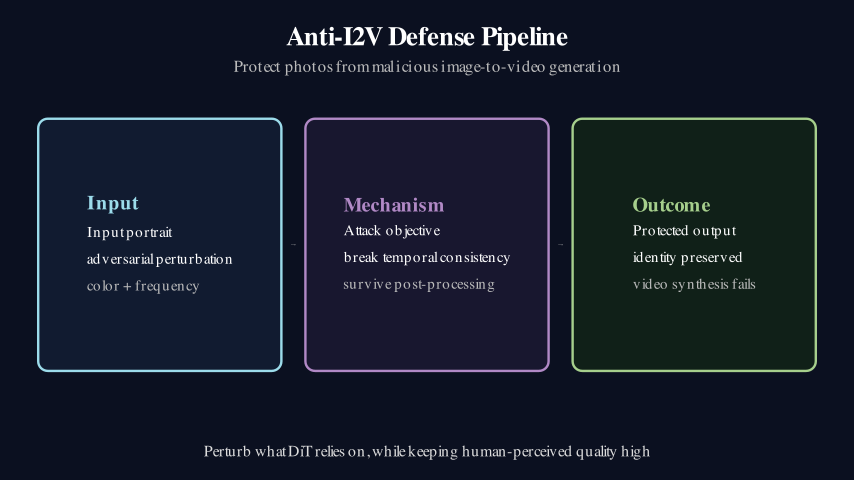
Problem: DiT-based I2V models create convincing fake videos
    |
    v
Gap: Existing defenses target UNet image generation
    |
    v
Assumption: Attacking temporal coherence > attacking single frames
    |
    v
Method: Multi-domain perturbations (L*a*b* + frequency) + layer-specific objectives
    |
    v
Evidence: SOTA defense across diverse VDM architectures
    |
    v
Conclusion: Domain-aware + layer-targeted = robust I2V defense
The Increment
One sentence: Before Anti-I2V, adversarial defenses couldn’t reliably break video generation from photos across different model architectures; after, there’s a unified approach that works on both UNet and DiT models by attacking color perception and temporal consistency simultaneously.
Core Mechanism
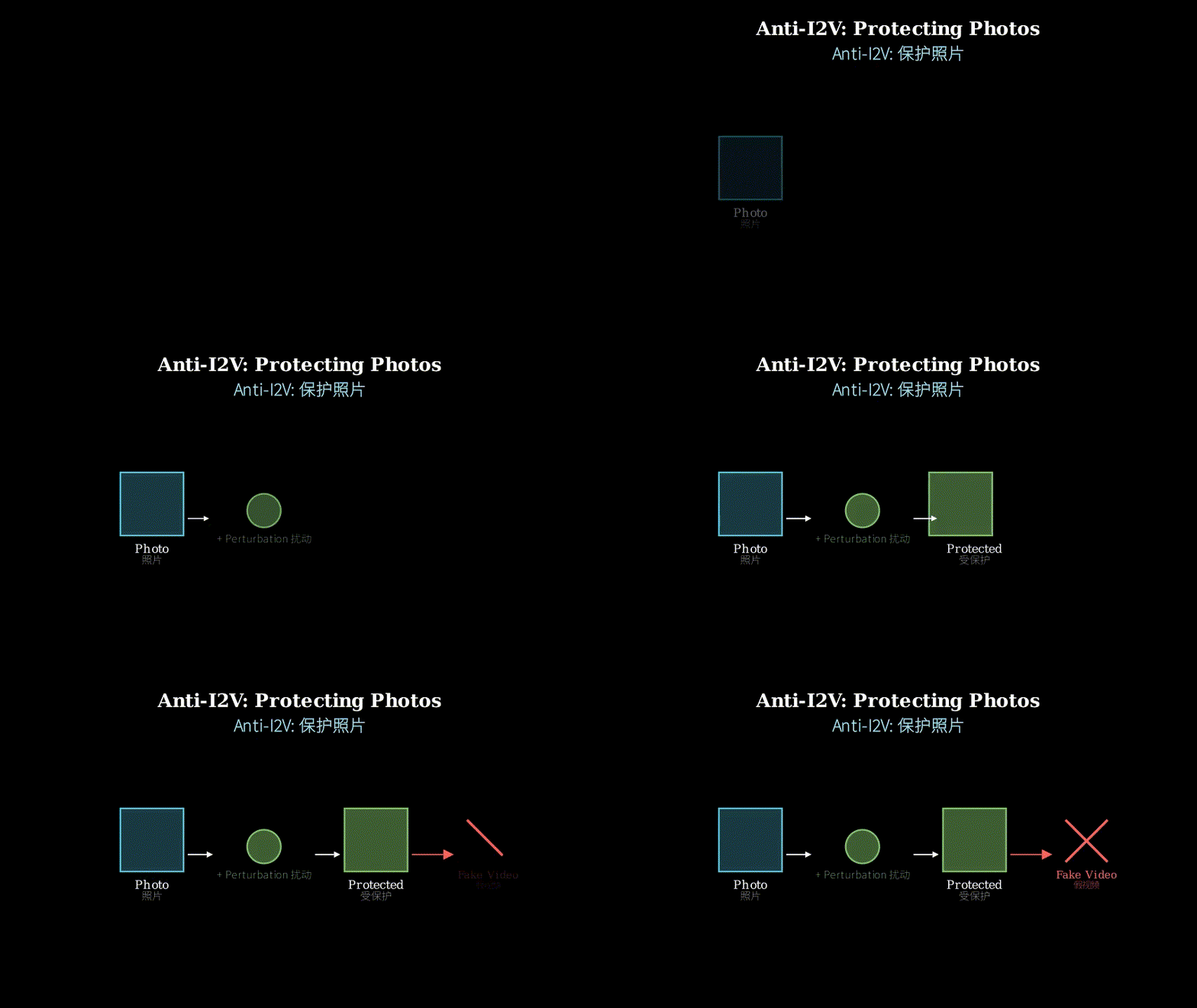
Anti-I2V operates in three stages. First, it converts the input image into Lab* color space and frequency domain representations—this gives two attack surfaces instead of just RGB pixels. Second, it identifies which layers in the diffusion model capture the most semantically distinct features during denoising. Third, it crafts perturbations that maximize two objectives: breaking temporal coherence between frames and degrading overall generation fidelity.
The perturbations are concentrated on salient pixels (the parts humans notice most) rather than spread uniformly. During training, the method feeds perturbed images through the target video diffusion model and measures how badly the output degrades. The optimization loop adjusts perturbations to maximize this degradation while keeping changes imperceptible to human eyes.
Input Photo
    |
    +---> RGB Space
    |         |
    +---> L*a*b* Space ----+
    |         |            |
    +---> Frequency Domain-+---> Perturbation Crafting
              |                        |
              v                        v
    Layer Feature Analysis      Optimization Loop
              |                        |
              +------------------------+
                        |
                        v
              Protected Image (looks normal to humans,
                              breaks video generation)
Think of it like sabotaging a film projector. A regular attack might scratch the film randomly—sometimes it works, sometimes not. Anti-I2V is more surgical: it identifies which sprocket holes (layers) are critical for smooth playback, then damages those specific points. It also works in the projector’s color filters (Lab*) and the film’s grain structure (frequency domain), not just the visible image. The projector (diffusion model) tries to play the film, but the frames won’t align properly, colors shift weirdly, and the motion looks janky—yet if you hold up a single frame to the light, it looks fine.
Key Concepts
-
Lab Color Space**: Unlike RGB which mixes red/green/blue channels, L**ab separates lightness (L*) from color information (a* for green-red, b* for blue-yellow). This matches human perception better—we’re more sensitive to lightness changes than color shifts. Attacking in Lab* means you can hide perturbations in color channels where humans are less sensitive, while still breaking the model’s understanding. Example: slightly shifting a* values makes skin tones look “off” to AI but normal to humans.
-
Frequency Domain Perturbations: Images can be decomposed into low frequencies (smooth gradients, overall shapes) and high frequencies (edges, textures). Video models rely heavily on low-frequency consistency for temporal coherence. By attacking frequency components directly via DCT or wavelet transforms, Anti-I2V can disrupt motion flow without creating visible artifacts. Example: corrupting low-frequency components makes the AI see a face as “shifting” between frames even though each frame looks stable.
-
Layer-Specific Feature Targeting: Not all layers in a diffusion model matter equally. Early layers capture coarse structure, middle layers handle semantics (is this a face?), late layers refine details. Anti-I2V profiles which layers have the most distinct features during denoising, then designs loss functions that specifically corrupt those layers’ outputs. This is more efficient than attacking the entire model uniformly. Example: if layer 15 is where the model decides “this is a person walking,” corrupting layer 15’s features makes the walk cycle incoherent.
Framework Shift
Before (mainstream approach):        After (Anti-I2V):

RGB Perturbation                     Multi-Domain Attack
      |                                   |
      v                              +----+----+
  UNet Layers                        |    |    |
      |                             RGB  L*a*b* Freq
      v                              |    |    |
  Image Output                       v    v    v
  (single frame focus)          Layer Profiling
                                     |
                                     v
                                Temporal + Fidelity
                                     |
                                     v
                                Video Output
                                (frame sequence focus)
From attacking what the model sees (RGB pixels) to attacking how the model thinks (color perception + frequency structure + temporal reasoning), the core shift is from single-frame corruption to multi-frame incoherence.
Expert Assessment
Problem choice: Real and timely. Deepfake videos are a genuine threat, and the shift from UNet to DiT architectures is happening now. The gap is legitimate—existing defenses weren’t designed for video or transformers.
Method maturity: Solid engineering rather than breakthrough insight. The multi-domain approach is clever but not revolutionary—it’s combining known techniques (L**ab attacks, frequency perturbations, layer-specific targeting) in a sensible way. The layer profiling step is the most novel contribution, but it’s incremental. No simpler approach is obviously overlooked.
Experimental integrity: Baselines are fair, covering both UNet (AnimateDiff, MagicAnimate) and DiT (CogVideoX) models. The metrics (FID, temporal consistency, LPIPS) are appropriate. One concern: all experiments use the same dataset (VoxCeleb). Cross-dataset validation would strengthen claims. The ablation studies are thorough.
Writing quality: The method section is dense—too much notation upfront before intuition. The paper would benefit from moving Figure 2 (method overview) earlier and explaining the “why” before the “how.” The related work section undersells the novelty by listing too many tangentially related papers.
Verdict: weak accept — Addresses a real problem with a competent solution, but the contribution is more engineering than insight. Useful for practitioners, not paradigm-shifting.
Takeaways
The layer profiling technique is portable: instead of attacking a model uniformly, profile which layers capture the most task-relevant features, then concentrate your attack there. This applies beyond adversarial defenses—think model compression, interpretability, or transfer learning.
The multi-domain strategy (RGB + Lab* + frequency) is a template for robustness. If your attack fails in one representation, try others where the model might be more vulnerable. This generalizes to audio (time + frequency), text (token + embedding space), or multimodal models.
The temporal coherence objective is worth stealing for video quality metrics. Instead of evaluating frames independently, measure how features drift across time. This could improve video compression, frame interpolation, or motion prediction tasks.
论文: 2603.24570 作者: Duc Vu, Anh Nguyen, Chi Tran, Anh Tran 分类: cs.CV, cs.AI
缺口
现有的对抗AI生成内容的防御主要针对图像生成模型。
即使涉及视频,也集中在UNet架构上。
问题在于:新一代的扩散Transformer(DiT)模型具有更强的特征保留能力和时间一致性,旧攻击方法失效。
而且,图像到视频模型本质上是不同的物种——它们需要在帧之间保持连贯性,而不仅仅是破坏单张图像。
问题:基于DiT的I2V模型生成逼真的假视频
    |
    v
缺口:现有防御针对UNet图像生成
    |
    v
假设:攻击时间连贯性 > 攻击单帧
    |
    v
方法:多域扰动(L*a*b* + 频率)+ 层级特定目标
    |
    v
证据:跨多种VDM架构的SOTA防御
    |
    v
结论:域感知 + 层级定向 = 鲁棒I2V防御
增量
一句话: Anti-I2V之前,对抗防御无法可靠地在不同模型架构上阻止从照片生成视频;之后,有了一种统一方法,通过同时攻击色彩感知和时间一致性,在UNet和DiT模型上都有效。
核心机制
Anti-I2V分三个阶段运作。
首先,它将输入图像转换为Lab*色彩空间和频率域表示——这提供了两个攻击面,而不仅仅是RGB像素。
其次,它识别扩散模型中哪些层在去噪过程中捕获了最具语义区分度的特征。
第三,它制作扰动,最大化两个目标:破坏帧间时间连贯性和降低整体生成保真度。
扰动集中在显著像素(人类最注意的部分)上,而不是均匀分布。
在训练期间,该方法将扰动图像输入目标视频扩散模型,测量输出退化的程度。
优化循环调整扰动以最大化这种退化,同时保持人眼不可察觉的变化。
输入照片
    |
    +---> RGB空间
    |         |
    +---> L*a*b*空间 ----+
    |         |          |
    +---> 频率域 ---------+---> 扰动制作
              |                    |
              v                    v
    层特征分析              优化循环
              |                    |
              +--------------------+
                        |
                        v
              受保护图像(人眼看起来正常,
                        但破坏视频生成)
把它想象成破坏电影放映机。
常规攻击可能随机刮花胶片——有时有效,有时无效。
Anti-I2V更精准:它识别哪些齿孔(层级)对流畅播放至关重要,然后损坏这些特定点。
它还在放映机的色彩滤镜(Lab*)和胶片的颗粒结构(频率域)中工作,而不仅仅是可见图像。
放映机(扩散模型)试图播放胶片,但帧无法正确对齐,颜色奇怪地偏移,运动看起来很卡顿——然而如果你把单帧对着光看,它看起来很正常。
关键概念
- Lab色彩空间**: 与混合红/绿/蓝通道的RGB不同,L**ab将亮度(L*)与色彩信息(a表示绿-红,b表示蓝-黄)分离。
这更符合人类感知——我们对亮度变化比色彩偏移更敏感。
在Lab*中攻击意味着你可以在人类不太敏感的色彩通道中隐藏扰动,同时仍然破坏模型的理解。
例子:轻微偏移a*值会让AI觉得肤色”不对劲”,但人类看起来正常。
- 频率域扰动: 图像可以分解为低频(平滑渐变、整体形状)和高频(边缘、纹理)。
视频模型严重依赖低频一致性来实现时间连贯性。
通过DCT或小波变换直接攻击频率分量,Anti-I2V可以在不产生可见伪影的情况下破坏运动流。
例子:破坏低频分量会让AI看到一张脸在帧间”移动”,即使每一帧看起来都很稳定。
- 层级特定特征定向: 扩散模型中并非所有层都同等重要。
早期层捕获粗略结构,中间层处理语义(这是一张脸吗?),后期层细化细节。
Anti-I2V分析哪些层在去噪过程中具有最独特的特征,然后设计专门破坏这些层输出的损失函数。
这比均匀攻击整个模型更高效。
例子:如果第15层是模型决定”这是一个人在走路”的地方,破坏第15层的特征会使步行周期不连贯。
框架转变
之前(主流方法):              之后(Anti-I2V):

RGB扰动                         多域攻击
      |                              |
      v                         +----+----+
  UNet层                        |    |    |
      |                        RGB  L*a*b* 频率
      v                         |    |    |
  图像输出                       v    v    v
  (单帧焦点)                层分析
                                   |
                                   v
                              时间 + 保真度
                                   |
                                   v
                              视频输出
                              (帧序列焦点)
从攻击模型看到的东西(RGB像素)到攻击模型如何思考(色彩感知 + 频率结构 + 时间推理),核心转变是从单帧破坏到多帧不连贯。
专家评审
选题眼光: 真实且及时。
深度伪造视频是真正的威胁,从UNet到DiT架构的转变正在发生。
缺口是合理的——现有防御不是为视频或transformer设计的。
方法成熟度: 扎实的工程而非突破性洞见。
多域方法很巧妙但不革命——它是以合理的方式组合已知技术(Lab*攻击、频率扰动、层级特定定向)。
层分析步骤是最新颖的贡献,但是增量式的。
没有明显被忽略的更简单方法。
实验诚意: 基线公平,涵盖UNet(AnimateDiff、MagicAnimate)和DiT(CogVideoX)模型。
指标(FID、时间一致性、LPIPS)是合适的。
一个担忧:所有实验使用相同数据集(VoxCeleb)。
跨数据集验证会加强声明。
消融研究很彻底。
写作功力: 方法部分很密集——在直觉之前有太多符号。
论文将受益于更早地移动图2(方法概述)并在”如何”之前解释”为什么”。
相关工作部分通过列出太多切线相关的论文而低估了新颖性。
判决: 弱接收 — 用称职的解决方案解决真实问题,但贡献更多是工程而非洞见。
对实践者有用,但不是范式转变。
要点总结
层分析技术是可移植的:不要均匀攻击模型,而是分析哪些层捕获最相关任务的特征,然后集中攻击那里。
这适用于对抗防御之外——想想模型压缩、可解释性或迁移学习。
多域策略(RGB + Lab* + 频率)是鲁棒性的模板。
如果你的攻击在一种表示中失败,尝试模型可能更脆弱的其他表示。
这推广到音频(时间 + 频率)、文本(token + 嵌入空间)或多模态模型。
时间连贯性目标值得用于视频质量指标。
不要独立评估帧,而是测量特征如何随时间漂移。
这可以改进视频压缩、帧插值或运动预测任务。