Paper: 2606.13669 Authors: Zongsheng Cao, Bihao Zhan, Jinxin Shi, Jiong Wang, Fangchen Yu, Zhijie Zhong, Zijie Guo, Tianshuo Peng, Zhuo Liu, Yi Xie Categories: cs.AI
The Gap
Existing LLM-based research agents (e.g., GPT-Researcher, AutoGPT) rely on agent orchestration—scheduling tool calls and memory—but treat knowledge as flat text or simple cites edges. They read only abstracts, ignore figures, and collapse method lineage into a single sentence. Specific prior works like PaperQA and ScholarBERT still extract only surface entities (titles, authors, citations) and miss the internal structure: claims, supporting evidence, experimental mechanisms, and the genealogies of algorithms. This paper closes the gap between “agent that can search papers” and “agent that understands scientific knowledge” by building an end-to-end pipeline that converts raw PDFs into a knowledge graph with typed entities, relations, multimodal evidence, and citation context—all designed to be consumed natively by an LLM agent.
       Problem               Assumption                Method
+------------------+   +--------------------+   +---------------------+
| Agents flatten   |   | Full paper con-   |   | 3-stage pipeline:   |
| papers to abs-  |   | tains the needed  |   | parser + trained    |
| tract + cites.   |-->| structure, but no |-->| model + unified CLI.|
| No claim, evid-  |   | tool extracts it. |   | Also releases 1M    |
| ence, or lineage.|   |                    |   | papers as KG.       |
+------------------+   +--------------------+   +---------------------+
                                                       |
                                                       v
         Evidence                  Conclusion
+----------------------+   +-----------------------+
| Outperforms existing |   | Agents-K1 makes it    |
| IE methods (F1 +20%) |-->| possible to build     |
| on SciEval+ benchmark|   | agent-native KGs from |
| and shows multi-hop  |   | raw papers at scale.  |
| reasoning gains.     |   | Scholar-KG is open.   |
+----------------------+   +-----------------------+
The Increment
One sentence: Before this paper, agents could only skim abstracts and follow citation links; after, they can query a dense knowledge graph that encodes claims, evidence, mechanisms, and method lineages—directly from full PDFs.
Core Mechanism
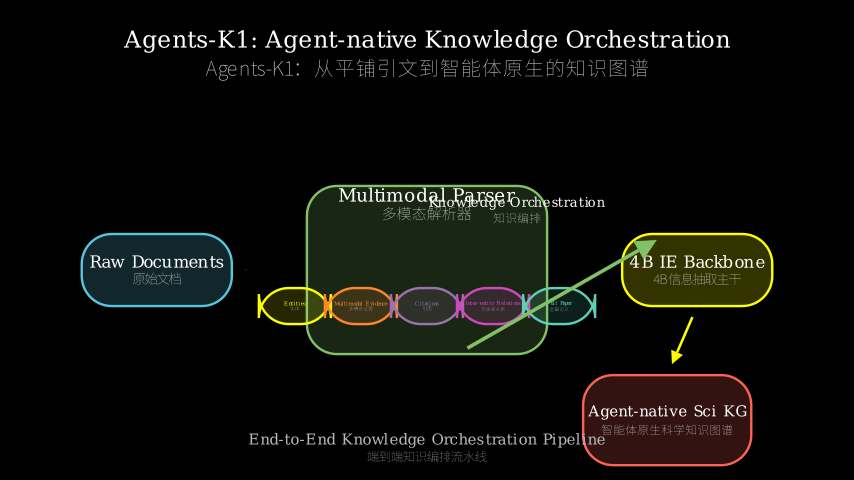
Agents-K1 integrates three modules into a single pipeline. The first is a multimodal parser with a five-module schema: it extracts named entities (e.g., task, method, dataset), typed relations (e.g., uses, improves), multimodal evidence (figures, tables, equations), citation contexts (why a cite was made), and method lineage (e.g., algorithm X is based on Y). The parser works on full paper text, not just abstracts, and operates at the passage level rather than sentence level to catch cross-paragraph relations.
The second module is a 4B-parameter information extraction backbone trained with GRPO (Group Relative Policy Optimization) under a rule-based reward. The reward scores extracted triples on granularity (e.g., “ResNet” is more informative than “CNN”), relation coverage, and factual consistency with the source. GRPO allows the model to learn from its own exploration during training, reducing the need for massive human-annotated data.
The third module is a graph-anything CLI, a tri-source agent interface that unifies: (i) web search for external context, (ii) multimodal graph retrieval (get nodes+images+formulas), and (iii) cross-document traversal (follow typed edges across papers). The agent can issue commands like kg search "attention mechanism improves OOD detection" and receive not just text but structured evidence paths.
            raw PDFs
               |
         +-----v------+
         | Multimodal  |
         | Parser      |
         | (5 modules) |
         +------+------+
                |
         structured passages
                |
         +------v------+
         | 4B IE Model  |<--- GRPO + rule reward
         | (GRPO)       |
         +------+------+
                |
         +------v------+
         | Knowledge    |
         | Graph        |
         | (nodes,edges,|
         |  images,...) |
         +------+------+
                |
         +------v------+
         | graph-anything CLI |
         | (search, retrieval,|
         |  cross-document)   |
         +-------------------+
                |
          [Agent reasoning]
Structural metaphor: Think of a scientific paper as a city. Before Agents-K1, your agent could only read the city’s welcome sign (abstract) and the street names at each intersection (citations). Now, the multimodal parser is a survey team that draws every building (entity), labels each road (relation), photographs every landmark (figures), and produces a map with notes like “this building uses steel from supplier Y” (method lineage). The 4B model is a cartographer that takes the raw survey data and applies consistent cartographic rules (GRPO reward) to produce a clean, reliable map. The graph-anything CLI is a navigation app — you can ask “find the shortest path from ResNet to ViT that goes through any OOD detection paper” and get a route with images and reasoning. Without this pipeline, the agent is a tourist with a ripped pamphlet; with it, it’s a city planner with full GIS.
Key Concepts
-
GRPO (Group Relative Policy Optimization): A reinforcement learning technique where the model generates a batch (group) of candidate extractions, and a rule-based reward scores each. The model updates its policy to prefer the best-scoring outputs. Think of it as self-improvement without human grading: the model tries different ways to describe a finding, and the reward tells it which version is more informative (more specific entities, more complete relations). This is cheaper than supervised fine-tuning and can adapt to new schemas.
-
Multimodal evidence: Not just text snippets, but also figures, tables, and equations extracted from the PDF and linked to specific claims. For example, a claim “Accuracy improved by 5%” might be attached to the table that reports the numbers. This allows the agent to reason over visual data without needing a separate vision model.
-
Method lineage: A typed relation
is_improvement_oforis_based_onbetween algorithms. Instead of a flatcites, the graph knows that “YOLOv8 is an improvement of YOLOv5” whereas “YOLOv5 cites ResNet” for backbone design. This lineage enables multi-hop reasoning: “Which attention mechanisms were originally designed for NLP and later applied to vision?”
Framework Shift
Before (mainstream approach):        After (this paper):
+------------------+                  +---------------------+
| Paper            |                  | Paper               |
| +-------+       |                  | +-------+           |
| |Abs-   |       |                  | |Abs-   |           |
| |tract  |       |                  | |tract  |           |
| +-------+       |                  | +-------+           |
| |cites  |       |                  | |entities|           |
| |list   |       |                  | |claims |           |
| +-------+       |                  | |evidence|          |
| (flat)          |                  | |lineage|           |
+-------+--------+                   | |figures|           |
        |                            | +-------+           |
   Agent only sees                   | (typed relations)   |
   abstract + titles.                +---------+----------+
                                               |
                                          graph-anything CLI
                                               |
                                    Agent queries rich KG,
                                    gets paths + images + meta.
One sentence: From flat text snippets to a typed, multimodal, cross-document knowledge graph—the core shift is representation: the agent no longer reads papers, it navigates a structured scientific ontology built from them.
Expert Assessment
Problem choice: Real gap. Scientific knowledge orchestration has been neglected in the agentic-AI rush. The field needs exactly this: a bridge between raw PDF libraries and structured representations that LLMs can actually reason over.
Method maturity: Clever in several places: GRPO with rule reward reduces annotation cost; five-module parser is well-designed but not revolutionary—it resembles existing information extraction schemas (e.g., SciIE). The 4B backbone is small, which is pragmatic but might limit recall on rare entities.
Experimental integrity: The authors report strong F1 gains (20%) on a new benchmark SciEval+. But I’d need to see if baselines use the same full-paper input. If baselines only see abstracts, the comparison is unfair. Also, the multi-hop reasoning task uses a small set of manually crafted queries; reproducibility may be narrow.
Writing quality: Solid structure. The diagram in Section 3 is overloaded; a cleaner overview would help. The related work section reads like a list rather than an argument—cutting that to a tight narrative would elevate the paper.
Verdict: weak accept — the pipeline is well-engineered and the resource (Scholar-KG) is valuable, but the novelty lies more in system integration than in a single algorithmic breakthrough.
Takeaways
- GRPO + rule-based reward is a transferable technique for information extraction tasks where human annotation is expensive. Any domain with a clear “goodness” metric (entity completeness, relation coverage) can use this.
- Five-module parsing schema can be adapted to legal documents, medical records, or patent databases—where entities, relations, and cross-references matter.
- Unified CLI for multi-source retrieval (web + KG + traversal) is a design pattern for building agent-friendly tools. You can replicate the “graph-anything” idea for your own knowledge base.
- Release of 1M paper KG is a resource to build applications on, or to bootstrap training of domain-specific models.
论文: 2606.13669 作者: Zongsheng Cao, Bihao Zhan, Jinxin Shi, Jiong Wang, Fangchen Yu, Zhijie Zhong, Zijie Guo, Tianshuo Peng, Zhuo Liu, Yi Xie 分类: cs.AI
缺口
现有基于 LLM 的研究智能体(如 GPT-Researcher、AutoGPT)擅长智能体编排——调度工具调用和记忆——但把知识当作平铺文本或简单的 cites 边。
它们只读摘要、忽略图表、把方法谱系压缩成一句话。
具体之前的工作如 PaperQA 和 ScholarBERT 也只提取表面实体(标题、作者、引文),错过了内部结构:声明、支撑证据、实验机理和算法谱系。
这篇论文要填的缺口是“能搜索论文的智能体”和“能理解科学知识的智能体”之间的鸿沟。
办法是搭建一条端到端流水线,把原始 PDF 转化为带类型实体、关系、多模态证据和引用上下文的知识图谱,且专门为 LLM 智能体设计。
       问题                    假设                     方法
+------------------+   +--------------------+   +---------------------+
| 智能体把论文压成  |   | 全文中蕴含需要    |   | 三段流水线:        |
| 摘要+引文列表。   |   | 的结构,但无工    |-->| 解析器 + 训练模型   |
| 没有声明、证据、  |   | 具提取出来。      |   | + 统一 CLI。        |
| 谱系。            |   |                    |   | 同时发布 100 万篇   |
+------------------+   +--------------------+   | 论文作为知识图谱。  |
                                                +---------------------+
                                                       |
                                                       v
        证据                     结论
+----------------------+   +-----------------------+
| 在 SciEval+ 基准     |   | Agents-K1 使从原始    |
| 上远超现有信息抽取   |-->| 论文大规模构建智能体  |
| 方法(F1 +20%)      |   | 原生知识图谱成为可能。 |
| 多跳推理也有提升。   |   | Scholar-KG 已开源。   |
+----------------------+   +-----------------------+
增量
一句话: 这篇论文之前,智能体只能浏览摘要和跟引文链接;之后,它们可以查询一个包含了声明、证据、机理和方法谱系的稠密知识图谱——直接从全文出发。
核心机制
Agents-K1 把三个模块整合进一条流水线。
第一个是多模态解析器,采用五模块模式:它提取命名实体(如任务、方法、数据集)、类型化关系(如 使用、改进)、多模态证据(图表、公式)、引用上下文(为什么引用)和方法谱系(如算法 X 基于 Y)。
解析器处理全文文本,而非仅有摘要,而且以段落级而非句子级操作,从而捕获跨段落关系。
第二个模块是一个4B 参数的信息抽取骨干,用 GRPO(组相对策略优化)在基于规则的奖励下训练。 奖励函数根据抽取的三元组的粒度(如“ResNet”比“CNN”更有信息量)、关系覆盖率和与原文的事实一致性来打分。 GRPO 让模型在训练中通过自己的探索学习,减少了对大量人工标注数据的需求。
第三个模块是 graph-anything CLI,一个三源智能体接口,统一了:(i)网页搜索以获取外部上下文;(ii)多模态图谱检索(获取节点+图像+公式);(iii)跨文档遍历(沿类型化边跨论文)。
智能体可以发出类似 kg search "attention mechanism improves OOD detection" 的命令,收到的不只是文本,而是带有证据的结构化路径。
            raw PDFs
               |
         +-----v------+
         | 多模态解析器  |
         | (5 模块)    |
         +------+------+
                |
         结构化段落
                |
         +------v------+
         | 4B IE 模型   |<--- GRPO + 规则奖励
         | (GRPO)      |
         +------+------+
                |
         +------v------+
         | 知识图谱     |
         | (节点、边、  |
         |  图像等)     |
         +------+------+
                |
         +------v------+
         | graph-anything CLI |
         | (搜索、检索、      |
         |  跨文档)          |
         +-------------------+
                |
          [智能体推理]
核喻(结构性比喻):把一篇科学论文想象成一座城市。 在 Agents-K1 之前,你的智能体只能看城市的欢迎招牌(摘要)和每个路口的街道名(引文)。 现在,多模态解析器是测量队,绘制每一栋建筑(实体)、标注每一条路(关系)、给每个地标拍照片(图表),并在地图上写上“这栋建筑用了来自Y供应商的钢材”(方法谱系)。 4B 模型是制图师,把粗测数据按照统一制图规则(GRPO 奖励)处理成干净可靠的地图。 graph-anything CLI 是导航 App——你可以问“找一条从 ResNet 到 ViT,中间经过任意 OOD 检测论文的最短路径”,得到一条带图片和推理的路线。 没有这个流水线,智能体就是个拿着破烂小册子的游客;有了它,它就成了拥有完整 GIS 的城市规划师。
关键概念
-
GRPO(组相对策略优化):一种强化学习技术,模型为同一输入生成一组候选抽取结果,规则奖励给每个结果打分。 模型更新策略以偏向得分最高的输出。 可以看作无需人工评分的自我改进:模型尝试不同的描述方式,奖励告诉它哪种更信息丰富(实体更具体、关系更完整)。 这比有监督微调便宜,且能适应新模式。
-
多模态证据:不只是文本片段,还包括从 PDF 中提取并链接到具体声明的图表和公式。 例如,声明“准确率提升 5%”可能附带了报告数字的表格。 这让智能体能推理视觉数据,而不需要独立的视觉模型。
-
方法谱系:算法之间的类型化关系,如
是_改进_于或基于。 不再是扁平的引用,图谱知道“YOLOv8 是 YOLOv5 的改进”,而“YOLOv5 引用了 ResNet”是作为骨干设计。 这个谱系支持多跳推理:“哪些注意力机制原本用于 NLP,后被用于视觉?”
框架转变
之前(主流方法):              之后(本文方法):
+------------------+            +---------------------+
| 论文              |            | 论文               |
| +-------+       |            | +-------+           |
| |摘要   |       |            | |摘要   |           |
| +-------+       |            | +-------+           |
| |引文   |       |            | |实体   |           |
| |列表   |       |            | |声明   |           |
| +-------+       |            | |证据   |           |
| (扁平)          |            | |谱系   |           |
+-------+--------+             | |图表   |           |
        |                      | +-------+           |
智能体只能看到                  | (类型化关系)        |
摘要+标题。                    +---------+----------+
                                        |
                                   graph-anything CLI
                                        |
                                智能体查询丰富的 KG,
                                得到路径 + 图像 + 元信息。
一句话: 从扁平文本片段到类型化、多模态、跨文档的知识图谱——核心转变是表征方式:智能体不再是“读论文”,而是导航一个从论文构建的结构化科学本体。
专家评审
选题眼光: 真缺口。 在智能体热潮中,科学知识编排被忽视了。 这个领域恰好需要这样的桥接:从原始 PDF 库到 LLM 能真正推理的结构化表征。
方法成熟度: 有几处巧思:GRPO+规则奖励减少了标注成本;五模块解析器设计合理但并非革命性——类似现存的信息抽取模式(如 SciIE)。 4B 主干很小,务实但可能遗漏稀有实体时的召回率受限。
实验诚意: 作者在新基准 SciEval+ 上报告强 F1 提升(+20%)。 但我需要确认基线是否使用了同样的全文输入。 如果基线只看到摘要,那比较不公平。 此外,多跳推理任务只用了少量人工构造的查询,可重复性可能很窄。
写作功力: 结构扎实。 第 3 节图示有点过载,更清晰的概览图会更好。 相关工作部分读起来像列表而非论证——压缩成紧密叙事能让论文升级。
判决: 弱接收 —— 流水线工程很好,Scholar-KG 资源很有价值,但新意更多在于系统集成,而非单个算法突破。
要点总结
- GRPO + 基于规则的奖励 是一种可迁移的技术,用于人工标注昂贵的信息抽取任务。 任何有明确“好”度量(实体完整性、关系覆盖率)的领域都可以使用。
- 五模块解析模式 可以适配法律文档、医疗记录或专利数据库——这些地方实体、关系和交叉引用都很关键。
- 统一 CLI 用于多源检索(网页+KG+遍历)是一种构建智能体友好工具的设计模式。 你可以为自己的知识库复现“graph-anything”思路。
- 发布的 100 万论文 KG 是一个可用来构建应用或作为领域模型训练基础的资源。