
Paper: 2603.08706 Authors: Weize Liu, Minghui Liu, Sy-Tuyen Ho, Souradip Chakraborty, Xiyao Wang, Furong Huang Categories: cs.AI, cs.CL, cs.LG
The Gap
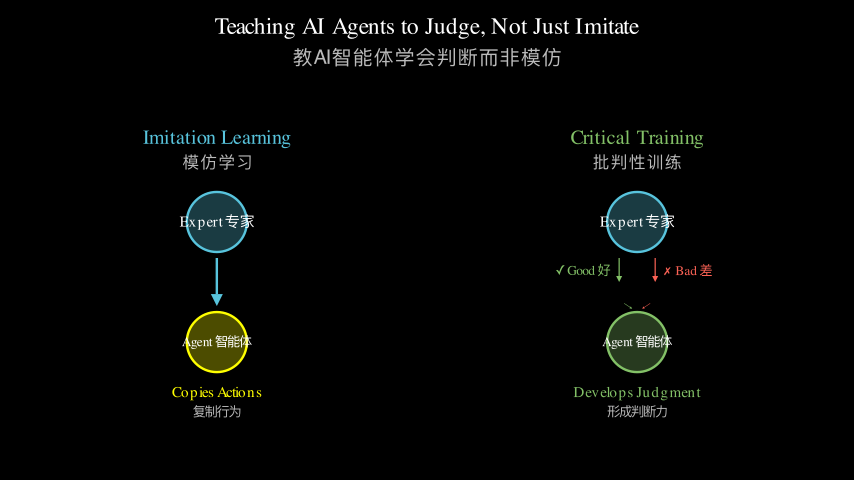
Current LLM agent training relies on imitation learning - watch an expert, copy their actions. This teaches agents what to do but not why. They never see the contrast between good and bad choices, so they can’t develop judgment about action quality.
Recent work tried to fix this by adding “reflection” - showing agents text that explains why expert actions are better than alternatives. But here’s the problem: the model is still just imitating. It’s copying pre-written reflection text, not learning to reason about quality on its own. It’s like the difference between memorizing someone else’s food reviews versus developing your own palate.
Problem: Imitation learning lacks "why"
    |
    v
Prior fix: Add reflection text to imitate
    |
    v
Limitation: Still imitation, not autonomous reasoning
    |
    v
ACT: Train judgment via RL rewards
    |
    v
Evidence: +5.07 over imitation, +4.62 over RL
    |
    v
Conclusion: Judgment training > reflection imitation
The Increment
One sentence: Before ACT, agents learned by copying actions and reflections; after ACT, agents learn by developing their own judgment through comparing alternatives.
Core Mechanism
ACT presents the model with pairs of actions - one better, one worse - and asks it to judge which is superior. The model outputs its reasoning and choice. If the judgment is correct, it gets rewarded. If wrong, it doesn’t. This is pure reinforcement learning on the judgment task itself.
The training data comes from existing agent trajectories. For each decision point, ACT creates pairs: the expert action versus alternatives (either from other trajectories or generated by the model itself). The model learns to identify quality differences by being rewarded for correct judgments, not by imitating explanation text.
The key insight: by training the model to judge rather than imitate, you force it to develop internal reasoning about what makes actions good or bad. This reasoning capability then transfers to actual agent execution - the model can evaluate its own action candidates and pick better ones.
Training Loop:

    [Expert Action] + [Alternative Action]
            |
            v
    Model judges: "Which is better?"
            |
            v
    Model outputs: reasoning + choice
            |
            v
    Reward if correct, no reward if wrong
            |
            v
    Model updates to improve judgment
            |
            v
    Judgment skill transfers to agent execution
Think of it like developing a wine palate. The old way (imitation learning) is reading wine descriptions and memorizing them - “this Bordeaux has notes of blackcurrant and oak.” The reflection approach is reading a sommelier’s comparison notes - “this wine is better because…” But you’re still just memorizing text.
ACT is different: you taste two wines side by side, decide which is better, and get feedback on whether you’re right. Do this enough times, and you develop your own palate - an internal model of what makes wine good. Now when you encounter a new wine, you can evaluate it yourself without needing someone else’s tasting notes. The judgment skill you built transfers to new situations.
In ACT, each component maps directly: the two wines are the action alternatives, your judgment is the model’s reasoning process, the feedback is the RL reward, and your developed palate is the model’s learned reasoning capability. The model isn’t memorizing quality assessments - it’s building the ability to make them.
Key Concepts
-
Judgment Training vs Reflection Imitation: Traditional reflection-based methods give the model text like “Action A is better than Action B because X, Y, Z” and train it to generate similar text. This is still supervised learning - the model learns to produce reflection-shaped outputs. Judgment training instead asks “Which is better, A or B?” and rewards correct answers. The model must develop its own reasoning to succeed. It’s the difference between copying someone’s math homework (you learn the answer format) versus solving problems and checking if you got them right (you learn the reasoning process).
-
Autonomous Reasoning Development: The paper emphasizes “autonomous” because the model isn’t being told what reasoning to use - it discovers effective reasoning patterns through trial and error. When rewarded for correct judgments, the model experiments with different ways of analyzing actions until it finds approaches that work. This is fundamentally different from distilling reasoning from a teacher model, where the reasoning patterns are predetermined. Autonomous development means the model might discover reasoning strategies the designers didn’t anticipate.
-
Judgment Transfer: The surprising part is that training on judgment (comparing actions) improves execution (choosing actions). Why does this work? Because good judgment requires understanding what makes actions effective. When the model learns to identify better actions in comparisons, it builds internal representations of action quality. During execution, these same representations help evaluate candidate actions. It’s like how learning to critique essays makes you a better writer - the analytical skill transfers to production.
Framework Shift
Before (imitation + reflection):        After (ACT):

Expert trajectory                       Expert + alternatives
       |                                       |
       v                                       v
Extract actions + reflection text       Create judgment pairs
       |                                       |
       v                                       v
Model imitates both                     Model judges quality
       |                                       |
       v                                       v
Learns: "copy this pattern"             Learns: "develop reasoning"
       |                                       |
       v                                       v
Execution: recall patterns              Execution: evaluate options
From copying expert behavior and explanations to developing autonomous judgment capability, the core shift is from pattern matching to reasoning development.
Expert Assessment
Problem choice: This is a real gap. The limitation of imitation learning in agent training is well-documented, and the reflection-based fixes do feel like band-aids - you’re still in the supervised learning paradigm. The problem sits at a natural inflection point where the field is moving from “make agents that can follow instructions” to “make agents that can reason about their choices.”
Method maturity: The core idea is elegant - use RL to train judgment rather than imitation to copy reflection. It’s not revolutionary (preference learning and comparison-based training exist), but the application to agent training is clever. I don’t see simpler approaches being overlooked. The method is straightforward enough that it should be reproducible.
Experimental integrity: The baselines look fair - they compare against imitation learning, standard RL, and knowledge distillation approaches. The improvements are consistent across three benchmarks (not cherry-picked). The OOD generalization results are particularly convincing - if it only worked on training distributions, I’d be skeptical. One minor concern: the paper doesn’t deeply analyze failure cases or discuss when ACT doesn’t help.
Writing quality: The abstract and introduction are clear. The method section could use more detail on how they construct the alternative actions and handle the reward signal. The results section is solid but could benefit from more error analysis. If I were revising, I’d expand the “why does judgment transfer to execution” discussion - that’s the key insight and it deserves more theoretical grounding.
Verdict: weak accept to strong accept - This is solid work with a clear contribution, good experimental validation, and practical value. The core insight (judgment training > reflection imitation) is well-executed. Not groundbreaking, but a meaningful step forward in agent training methodology.
Takeaways
For practitioners building LLM agents: Don’t just train on expert demonstrations. Create comparison datasets where your model judges between good and bad actions. This is relatively easy to implement - take your existing trajectory data, pair successful actions with alternatives, and train with preference learning or RL on judgment accuracy.
For researchers in RL/LLM intersection: The judgment-to-execution transfer is worth exploring more deeply. What other capabilities can you develop through comparison training that transfer to generation? Could you train better code generation by training judgment on code quality comparisons?
For anyone doing imitation learning: When you add “reflection” or “reasoning” to your training data, ask: is the model learning to reason or learning to imitate reasoning-shaped text? If it’s the latter, consider whether judgment training could develop more genuine capability.
Specific technique to steal: The alternative action construction method. They use both (1) actions from other trajectories at similar states and (2) model-generated alternatives. This creates a rich comparison dataset without needing human annotation of “why” each action is better.
论文: 2603.08706 作者: Weize Liu, Minghui Liu, Sy-Tuyen Ho, Souradip Chakraborty, Xiyao Wang, Furong Huang 分类: cs.AI, cs.CL, cs.LG
缺口
当前的大语言模型智能体训练依赖模仿学习——观察专家,复制其动作。
这教会智能体做什么,但不教为什么。
它们从未看到好坏选择之间的对比,因此无法形成对动作质量的判断力。
近期工作试图通过添加”反思”来修复这个问题——向智能体展示解释为何专家动作优于替代方案的文本。
但问题在于:模型仍然只是在模仿。
它在复制预先写好的反思文本,而非学习自主推理质量。
这就像背诵别人的美食评论与培养自己的味觉之间的区别。
问题:模仿学习缺乏"为什么"
    |
    v
先前修复:添加反思文本供模仿
    |
    v
局限:仍是模仿,非自主推理
    |
    v
ACT:通过强化学习奖励训练判断
    |
    v
证据:比模仿学习高5.07分,比强化学习高4.62分
    |
    v
结论:判断训练 > 反思模仿
增量
一句话: ACT之前,智能体通过复制动作和反思来学习;ACT之后,智能体通过比较替代方案来发展自己的判断力。
核心机制
ACT向模型呈现成对的动作——一个更好,一个更差——并要求它判断哪个更优。
模型输出其推理和选择。
如果判断正确,就获得奖励。
如果错误,则没有奖励。
这是对判断任务本身的纯强化学习。
训练数据来自现有的智能体轨迹。
对于每个决策点,ACT创建配对:专家动作与替代方案(来自其他轨迹或由模型自身生成)。
模型通过因正确判断而获得奖励来学习识别质量差异,而非通过模仿解释文本。
关键洞察:通过训练模型判断而非模仿,你迫使它发展关于什么使动作好或坏的内部推理。
这种推理能力随后迁移到实际的智能体执行——模型可以评估自己的候选动作并选择更好的。
训练循环:

    [专家动作] + [替代动作]
            |
            v
    模型判断:"哪个更好?"
            |
            v
    模型输出:推理 + 选择
            |
            v
    正确则奖励,错误则无奖励
            |
            v
    模型更新以改进判断
            |
            v
    判断技能迁移到智能体执行
把它想象成培养品酒味觉。
旧方法(模仿学习)是阅读葡萄酒描述并记住它们——“这款波尔多有黑醋栗和橡木的味道”。
反思方法是阅读侍酒师的对比笔记——“这款酒更好因为…”。
但你仍然只是在记忆文本。
ACT不同:你并排品尝两款酒,决定哪个更好,并获得关于你是否正确的反馈。
做足够多次,你就培养出自己的味觉——一个关于什么使葡萄酒好的内部模型。
现在当你遇到新酒时,你可以自己评估它,而不需要别人的品酒笔记。
你建立的判断技能迁移到新情况。
在ACT中,每个组件直接映射:两款酒是动作替代方案,你的判断是模型的推理过程,反馈是强化学习奖励,你培养的味觉是模型学到的推理能力。
模型不是在记忆质量评估——它在建立做出评估的能力。
关键概念
- 判断训练 vs 反思模仿: 传统的基于反思的方法给模型提供文本,如”动作A比动作B更好,因为X、Y、Z”,并训练它生成类似文本。
这仍然是监督学习——模型学习产生反思形状的输出。
判断训练则问”A和B哪个更好?“并奖励正确答案。
模型必须发展自己的推理才能成功。
这就像抄袭别人的数学作业(你学到答案格式)与解决问题并检查是否正确(你学到推理过程)之间的区别。
- 自主推理发展: 论文强调”自主”,因为模型没有被告知使用什么推理——它通过试错发现有效的推理模式。
当因正确判断而获得奖励时,模型尝试不同的分析动作方式,直到找到有效的方法。
这与从教师模型蒸馏推理根本不同,后者的推理模式是预先确定的。
自主发展意味着模型可能发现设计者未预料到的推理策略。
- 判断迁移: 令人惊讶的部分是,判断训练(比较动作)改进了执行(选择动作)。
为什么有效?因为良好的判断需要理解什么使动作有效。
当模型学会在比较中识别更好的动作时,它建立了动作质量的内部表示。
在执行期间,这些相同的表示帮助评估候选动作。
这就像学习批评文章如何使你成为更好的作家——分析技能迁移到创作。
框架转变
之前(模仿 + 反思):              之后(ACT):

专家轨迹                           专家 + 替代方案
       |                                  |
       v                                  v
提取动作 + 反思文本                 创建判断配对
       |                                  |
       v                                  v
模型模仿两者                        模型判断质量
       |                                  |
       v                                  v
学到:"复制这个模式"                学到:"发展推理"
       |                                  |
       v                                  v
执行:回忆模式                      执行:评估选项
从复制专家行为和解释到发展自主判断能力,核心转变是从模式匹配到推理发展。
专家评审
选题眼光: 这是真实的缺口。
智能体训练中模仿学习的局限性有充分记录,基于反思的修复确实感觉像创可贴——你仍然在监督学习范式中。
这个问题处于一个自然的拐点,该领域正从”制造能遵循指令的智能体”转向”制造能推理其选择的智能体”。
方法成熟度: 核心思想优雅——使用强化学习训练判断而非模仿来复制反思。
这不是革命性的(偏好学习和基于比较的训练已存在),但应用于智能体训练很巧妙。
我没看到更简单的方法被忽略。
方法足够直接,应该可以复现。
实验诚意: 基线看起来公平——他们与模仿学习、标准强化学习和知识蒸馏方法进行比较。
改进在三个基准上一致(非挑选)。
分布外泛化结果特别有说服力——如果只在训练分布上有效,我会持怀疑态度。
一个小担忧:论文没有深入分析失败案例或讨论ACT何时无效。
写作功力: 摘要和引言清晰。
方法部分可以更详细地说明如何构建替代动作和处理奖励信号。
结果部分扎实,但可以从更多错误分析中受益。
如果我修订,我会扩展”为什么判断迁移到执行”的讨论——这是关键洞察,值得更多理论基础。
判决: 弱接收到强接收——这是扎实的工作,有清晰的贡献、良好的实验验证和实用价值。
核心洞察(判断训练 > 反思模仿)执行良好。
不是开创性的,但在智能体训练方法论上是有意义的进步。
要点总结
对于构建大语言模型智能体的实践者: 不要只在专家演示上训练。
创建比较数据集,让你的模型在好坏动作之间判断。
这相对容易实现——取你现有的轨迹数据,将成功动作与替代方案配对,并在判断准确性上用偏好学习或强化学习训练。
对于强化学习/大语言模型交叉领域的研究者: 判断到执行的迁移值得更深入探索。
你还能通过比较训练发展哪些能力并迁移到生成?你能通过在代码质量比较上训练判断来训练更好的代码生成吗?
对于做模仿学习的任何人: 当你向训练数据添加”反思”或”推理”时,问:模型是在学习推理还是学习模仿推理形状的文本?如果是后者,考虑判断训练是否能发展更真实的能力。
可偷的具体技术: 替代动作构建方法。
他们使用(1)来自类似状态的其他轨迹的动作和(2)模型生成的替代方案。
这创建了丰富的比较数据集,无需人工标注每个动作”为什么”更好。