
Paper: 2602.23258 Authors: Yutong Wang, Siyuan Xiong, Xuebo Liu, Wenkang Zhou, Liang Ding, Miao Zhang, Min Zhang Categories: cs.AI, cs.CL
Abstract
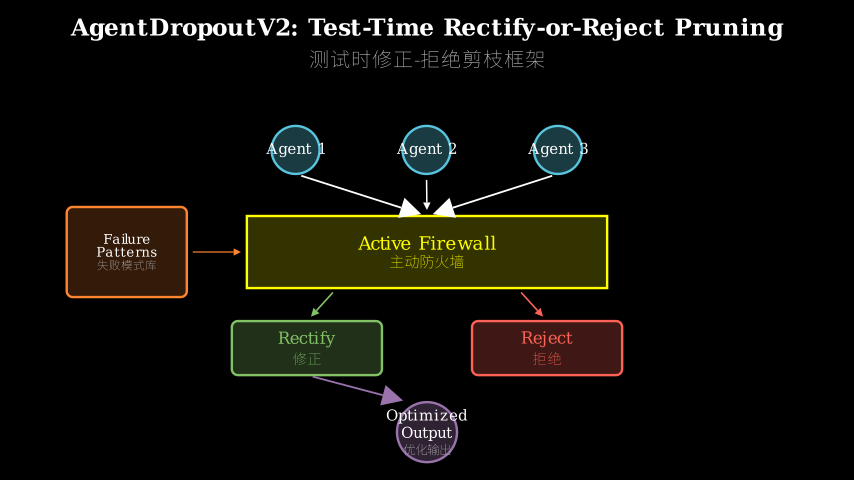
Multi-Agent Systems (MAS) have demonstrated remarkable capabilities in complex reasoning tasks, but they face a critical vulnerability: the cascading propagation of errors generated by individual agents. AgentDropoutV2 addresses this challenge through a novel test-time rectify-or-reject pruning framework that dynamically optimizes information flow without requiring model retraining. The system functions as an active firewall, intercepting agent outputs and employing a retrieval-augmented rectifier that iteratively corrects errors using a failure-driven indicator pool. By leveraging distilled failure patterns as prior knowledge, the framework precisely identifies potential errors and prunes irreparable outputs to prevent downstream contamination. Empirical evaluation on extensive math benchmarks demonstrates an average accuracy improvement of 6.3 percentage points, with the system exhibiting robust generalization across varying task difficulties.
Key Contributions
- Test-time optimization framework: Introduces a training-free approach to enhance MAS reliability through dynamic output intervention and correction
- Retrieval-augmented rectification: Employs a failure-driven indicator pool that captures distilled error patterns to guide iterative error correction
- Adaptive pruning mechanism: Implements a rectify-or-reject strategy that surgically removes irreparable outputs while preserving system integrity through fallback mechanisms
- Empirical validation: Demonstrates consistent performance gains across multiple math benchmarks with an average 6.3 percentage point accuracy improvement
Methodology: Active Firewall Architecture
AgentDropoutV2 operates as an intermediary layer between agent outputs and downstream consumers, implementing a three-stage pipeline:
Stage 1: Error Detection - The system employs a failure-driven indicator pool containing distilled patterns of common error types. These indicators serve as prior knowledge, enabling the framework to flag potentially erroneous outputs before they propagate through the system.
Stage 2: Retrieval-Augmented Rectification - For flagged outputs, the framework invokes a retrieval-augmented rectifier that iteratively attempts to correct errors. This component leverages context-aware indicators to understand the specific failure mode and applies targeted corrections. The iterative nature allows for multiple correction attempts, with each iteration informed by the previous attempt’s outcome.
Stage 3: Pruning Decision - Outputs that resist rectification after multiple iterations are classified as irreparable and pruned from the information flow. A fallback strategy ensures system continuity by substituting pruned outputs with safe alternatives or triggering alternative reasoning paths.
The framework’s key innovation lies in its dynamic adaptivity: rectification effort scales with task difficulty, allocating more computational resources to complex problems while efficiently processing simpler cases.
Experimental Results and Analysis
The evaluation on math benchmarks reveals several important findings:
Performance Gains: AgentDropoutV2 achieves an average accuracy improvement of 6.3 percentage points across tested benchmarks. This gain is particularly pronounced in scenarios where error propagation would otherwise compound, demonstrating the framework’s effectiveness at breaking error cascades.
Generalization Capability: The system exhibits robust performance across diverse problem types and difficulty levels. The failure-driven indicator pool, despite being constructed from a finite set of error patterns, generalizes effectively to novel error manifestations.
Adaptive Resource Allocation: Analysis of rectification attempts shows that the system dynamically modulates its intervention intensity. Simple problems receive minimal intervention, while complex problems trigger more extensive rectification efforts, optimizing the trade-off between accuracy and computational cost.
Error Pattern Coverage: The context-aware indicators successfully resolve a wide spectrum of error types, from simple computational mistakes to more subtle logical inconsistencies. This breadth of coverage suggests that the distilled failure patterns capture fundamental error modes rather than surface-level symptoms.
Implications for Multi-Agent System Design
AgentDropoutV2 represents a paradigm shift in how we approach reliability in multi-agent systems. Traditional approaches rely on either rigid structural constraints that limit flexibility or expensive fine-tuning that reduces deployability. This framework demonstrates that test-time intervention can achieve comparable or superior results while maintaining system adaptability.
The active firewall metaphor is particularly apt: just as network firewalls inspect and filter traffic without modifying the underlying network infrastructure, AgentDropoutV2 monitors and corrects information flow without altering agent architectures. This separation of concerns enables the framework to be deployed across diverse MAS implementations.
The failure-driven indicator pool introduces an interesting form of meta-learning: rather than learning task-specific patterns, the system learns failure patterns that transcend individual tasks. This abstraction enables generalization and suggests potential applications beyond mathematical reasoning to other domains where error propagation poses challenges.
Takeaways
- Test-time intervention can effectively mitigate error propagation in multi-agent systems without requiring model retraining or architectural modifications
- Retrieval-augmented rectification guided by distilled failure patterns enables precise error identification and correction across diverse error types
- Adaptive pruning with fallback strategies balances error prevention with system integrity, preventing both error propagation and system failure
- The framework achieves 6.3 percentage point average accuracy gains on math benchmarks while exhibiting robust generalization across task difficulties
- Separating reliability mechanisms from agent architecture enables flexible deployment and maintains system adaptability
论文: 2602.23258 作者: Yutong Wang, Siyuan Xiong, Xuebo Liu, Wenkang Zhou, Liang Ding, Miao Zhang, Min Zhang 分类: cs.AI, cs.CL
摘要
多智能体系统(MAS)在复杂推理任务中展现出卓越能力,但面临一个关键弱点:单个智能体产生的错误信息会级联传播。AgentDropoutV2通过一个新颖的测试时修正-拒绝剪枝框架解决这一挑战,该框架能够动态优化信息流而无需模型重训练。系统充当主动防火墙,拦截智能体输出并采用检索增强修正器,基于失败驱动的指标池迭代纠正错误。通过利用提炼的失败模式作为先验知识,框架精确识别潜在错误并剪枝无法修复的输出以防止下游污染。在大规模数学基准测试上的实证评估显示平均准确率提升6.3个百分点,系统在不同任务难度下表现出稳健的泛化能力。
主要贡献
- 测试时优化框架: 引入无需训练的方法,通过动态输出干预和修正增强多智能体系统可靠性
- 检索增强修正: 采用失败驱动的指标池捕获提炼的错误模式,指导迭代错误修正
- 自适应剪枝机制: 实现修正-拒绝策略,精准移除无法修复的输出,同时通过回退机制保持系统完整性
- 实证验证: 在多个数学基准测试中展示一致的性能提升,平均准确率提高6.3个百分点
方法论: 主动防火墙架构
AgentDropoutV2作为智能体输出与下游消费者之间的中间层运行,实现三阶段流水线:
阶段1: 错误检测 - 系统采用失败驱动的指标池,包含常见错误类型的提炼模式。这些指标作为先验知识,使框架能够在潜在错误输出传播前进行标记。
阶段2: 检索增强修正 - 对于被标记的输出,框架调用检索增强修正器迭代尝试纠正错误。该组件利用上下文感知指标理解特定失败模式并应用针对性修正。迭代特性允许多次修正尝试,每次迭代都基于前一次尝试的结果。
阶段3: 剪枝决策 - 经过多次迭代仍无法修正的输出被归类为无法修复并从信息流中剪枝。回退策略通过用安全替代方案替换被剪枝的输出或触发替代推理路径来确保系统连续性。
框架的关键创新在于其动态自适应性:修正努力随任务难度扩展,为复杂问题分配更多计算资源,同时高效处理简单案例。
实验结果与分析
在数学基准测试上的评估揭示了几个重要发现:
性能提升: AgentDropoutV2在测试基准上实现平均6.3个百分点的准确率提升。这一提升在错误传播会复合的场景中尤为显著,证明了框架在打破错误级联方面的有效性。
泛化能力: 系统在不同问题类型和难度级别上表现出稳健性能。失败驱动的指标池尽管由有限的错误模式集构建,但能有效泛化到新颖的错误表现形式。
自适应资源分配: 对修正尝试的分析显示系统动态调节其干预强度。简单问题接受最小干预,而复杂问题触发更广泛的修正努力,优化准确性与计算成本之间的权衡。
错误模式覆盖: 上下文感知指标成功解决广泛的错误类型,从简单的计算错误到更微妙的逻辑不一致。这种覆盖广度表明提炼的失败模式捕获了基本错误模式而非表面症状。
对多智能体系统设计的启示
AgentDropoutV2代表了我们处理多智能体系统可靠性方法的范式转变。传统方法依赖于限制灵活性的刚性结构约束或降低可部署性的昂贵微调。该框架证明测试时干预可以实现相当或更优的结果,同时保持系统适应性。
主动防火墙隐喻特别贴切:正如网络防火墙在不修改底层网络基础设施的情况下检查和过滤流量,AgentDropoutV2在不改变智能体架构的情况下监控和修正信息流。这种关注点分离使框架能够部署在不同的多智能体系统实现中。
失败驱动的指标池引入了一种有趣的元学习形式:系统不是学习任务特定模式,而是学习超越单个任务的失败模式。这种抽象实现了泛化,并暗示了在数学推理之外其他错误传播构成挑战的领域的潜在应用。
要点总结
- 测试时干预可以有效缓解多智能体系统中的错误传播,无需模型重训练或架构修改
- 由提炼失败模式指导的检索增强修正能够在不同错误类型中实现精确的错误识别和修正
- 带回退策略的自适应剪枝平衡了错误预防与系统完整性,既防止错误传播又避免系统故障
- 框架在数学基准测试上实现平均6.3个百分点的准确率提升,同时在不同任务难度下表现出稳健泛化能力
- 将可靠性机制与智能体架构分离实现了灵活部署并保持系统适应性