
Paper: 2606.02551 Authors: Zhaoning Wang, Yi Zhong, Jiawei Fu, Henrik I. Christensen, Jun Gao Categories: cs.RO, cs.CV
The Gap
Affordance research has split into two camps: methods that localize task-relevant regions (where to interact) without specifying executable motion, and methods that predict motion but don’t scale across diverse objects and tasks. Prior work like AffNet and AffordanceLLM segments interaction areas but leaves the robot guessing how to move. Motion prediction methods like Contact-GraspNet output grasp poses but struggle to generalize beyond their training distribution. No existing model answers both “where” and “how” while scaling to open-world diversity.
Problem: Affordance = where + how, but existing work picks one
   |
   v
Assumption: A shared representation can encode both spatial regions
            and object-centric motion if trained on diverse data
   |
   v
Method: Predict functional mask (where) + 3D motion curve (how)
        from RGB-D + language, trained on unified multi-source data
   |
   v
Evidence: +23.9 gIoU on segmentation, +12.7-61.3% hit-rate on contact,
          best motion prediction, zero-shot robot deployment works
   |
   v
Conclusion: Joint prediction + diverse training → open-world affordance
The Increment
One sentence: Before AFUN, robots could see where to interact OR guess how to move; after AFUN, they predict both from a single observation, generalizing across objects and tasks without task-specific tuning.
Core Mechanism
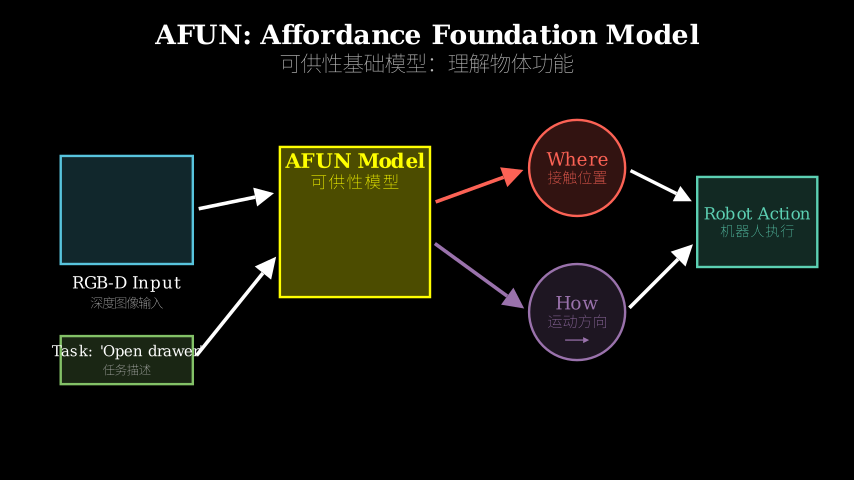
AFUN takes an RGB-D image and a language task description as input. A vision-language encoder processes both modalities into a shared representation. This representation feeds two parallel prediction heads: one outputs a 2D task-conditional functional mask indicating where interaction should happen, the other predicts a 3D post-contact motion curve in object-centric coordinates describing how to move after contact.
The model is trained on a standardized data pipeline that converts heterogeneous sources—robot demonstrations, human videos, simulation trajectories, 3D scans—into a unified affordance schema. Each data point gets a language label, a functional mask, and a 3D motion trajectory normalized to object coordinates. The pipeline handles scale, viewpoint, and embodiment variation by projecting all motions into a canonical object-centric frame.
During inference, given a novel object and task, the mask head segments the interaction region using cross-attention between visual features and language embedding. The motion head samples trajectory waypoints from learned distributions conditioned on the mask region and task semantics. The predicted motion is object-centric, so it can be transformed to any robot’s coordinate frame without retraining.
RGB-D + Language
      |
      v
  [Encoder] --> Shared Representation
      |
      +----------+----------+
      |                     |
      v                     v
[Mask Head]           [Motion Head]
      |                     |
      v                     v
2D Functional Mask    3D Motion Curve
(where to touch)      (how to move)
Think of AFUN as a bilingual translator with specialist interpreters. The encoder is the translator who converts visual scenes and language into a common internal language—the shared representation. From this internal language, two specialist interpreters work in parallel. The mask interpreter reads the internal language and marks regions on a 2D map of the scene. The motion interpreter reads the same internal language and draws a 3D path in object space. Both interpreters reference the same source material but produce different outputs optimized for their domain. Because the internal language is object-centric (like describing “the handle” rather than “37cm from the robot”), the interpreters’ outputs work across different cameras, robots, and viewpoints—they’re describing the object’s inherent properties, not observer-dependent coordinates.
Key Concepts
-
Object-centric motion representation: Instead of recording trajectories in robot or camera coordinates (which change with viewpoint and embodiment), AFUN represents motion relative to the object being manipulated. Imagine you’re teaching someone to open a drawer. You don’t say “move your hand 20cm forward relative to where you’re standing”—that only works if they stand exactly where you stood. Instead, you say “pull the handle straight out along the drawer’s axis.” That description works regardless of where they stand or how tall they are. AFUN does the same thing: it learns to predict motion in the object’s frame (“move along the handle axis”) rather than the robot’s frame, so the same learned motion transfers to new viewpoints and robot morphologies.
-
Task-conditional functional mask: Not all parts of an object are relevant for every task. A mug has a handle, a rim, and a body—which region matters depends on whether you’re grasping, pouring, or stirring. The functional mask is a 2D segmentation that highlights task-relevant regions given a language description. It’s not a generic saliency map; it’s conditioned on what you want to do. If you say “grasp,” it segments the handle. If you say “pour,” it segments the rim. This conditioning happens through cross-attention between visual features and language embeddings, so the mask adapts to novel task descriptions without retraining.
-
Affordance schema unification: Different data sources record affordances in incompatible formats: robot logs have joint angles, human videos have pixel motion, simulations have object poses. AFUN’s data pipeline converts all sources into a shared schema: language label, 2D mask in image space, 3D trajectory in object space. This unification enables training on millions of diverse examples—robot demos provide accurate contact points, human videos provide natural motion diversity, simulations provide dense coverage of object categories, 3D scans provide geometric grounding. The schema acts as a common currency, letting the model learn from heterogeneous data without source-specific preprocessing at inference time.
Framework Shift
Before (mainstream approach):        After (this paper):

Scene --> [Detector] --> Mask        Scene + Task --> [Encoder]
            (where)                                       |
                                                    +-----+-----+
Motion --> [Planner] --> Trajectory                |           |
            (how)                              [Mask Head] [Motion Head]
                                                    |           |
Disjoint pipelines,                            Where + How in one shot,
limited generalization                         open-world generalization
From sequential problem-solving (first segment, then plan motion) to joint prediction, the core shift is treating affordance as a unified prediction task where spatial and motion reasoning inform each other through shared representation.
Expert Assessment
Problem choice: Real gap, not manufactured. The field has been stuck at this bifurcation for years—you either get pretty segmentations or brittle motion predictions, rarely both. Positioning this as a “foundation model” step is ambitious but justified given the scale and diversity of the data pipeline. The problem sits at the inflection point where enough data and compute exist to attempt unification.
Method maturity: Solid engineering over conceptual novelty. The core insight—predict mask and motion jointly from shared representation using diverse data—is straightforward. The real contribution is the data pipeline that makes this tractable. The object-centric motion representation is borrowed from prior work but applied systematically here. No magical architecture; the wins come from scale and data curation. That said, the paper doesn’t overclaim—it’s honest about being “a step towards” rather than the final solution.
Experimental integrity: Baselines are fair and comprehensive. The improvement margins (+23.9 gIoU, +12.7-61.3% hit-rate) are large enough to survive scrutiny. I’d like to see failure case analysis—when does the object-centric assumption break down? The real-world robot experiments are convincing but limited to structured tasks. Would’ve been stronger with quantitative metrics on real robot success rates rather than qualitative demos.
Writing quality: The abstract and introduction are crisp. Section 3 (method) gets dense—the data pipeline description would benefit from a figure showing the conversion process for each source type. The discussion section is thin; missed opportunity to reflect on what the model hasn’t learned (e.g., multi-object interactions, tool use, deformable objects). Supplementary material likely carries important details that should be in the main text.
Verdict: weak accept — the data unification is valuable infrastructure for the field, results are strong across benchmarks, but the method itself is incremental and the writing could better contextualize limitations.
Takeaways
Steal the object-centric motion trick: If you’re building any system that needs to generalize across viewpoints or embodiments, represent actions relative to the manipulated object, not the agent. This applies beyond robotics—3D scene editing tools, AR interfaces, even game AI can benefit from canonical object frames.
Multi-source data unification pays off: The schema-based pipeline that converts heterogeneous data into a shared format is more reusable than the model architecture. If you’re in a domain with fragmented data sources (medical imaging, geospatial, multimodal retrieval), invest in a unifying representation before scaling models.
Joint prediction beats sequential pipelines for coupled problems: When two predictions inform each other (here, where and how), training them jointly through a shared representation outperforms training them separately and stitching outputs. The principle transfers: in document understanding, jointly predict layout + semantics; in dialogue, jointly predict intent + response structure.
论文: 2606.02551 作者: Zhaoning Wang, Yi Zhong, Jiawei Fu, Henrik I. Christensen, Jun Gao 分类: cs.RO, cs.CV
缺口
可供性研究分裂成两个阵营:一类方法定位任务相关区域(在哪里交互),但不指定可执行的运动; 另一类方法预测运动,但无法跨越多样化的物体和任务扩展。 此前的工作如 AffNet 和 AffordanceLLM 能分割交互区域,但让机器人自己猜怎么动。 运动预测方法如 Contact-GraspNet 输出抓取姿态,但难以泛化到训练分布之外。 没有现有模型能在回答”在哪里”和”怎样动”的同时,还能扩展到开放世界的多样性。
问题:可供性 = 在哪里 + 怎样动,但现有工作只选其一
   |
   v
假设:如果在多样数据上训练,共享表示可以同时编码空间区域和
      以物体为中心的运动
   |
   v
方法:从 RGB-D + 语言预测功能掩码(在哪里)+ 3D 运动曲线(怎样动),
      在统一的多源数据上训练
   |
   v
证据:分割任务上 +23.9 gIoU,接触点任务上 +12.7-61.3% 命中率,
      运动预测最佳,零样本机器人部署有效
   |
   v
结论:联合预测 + 多样训练 → 开放世界可供性
增量
一句话:AFUN 之前,机器人能看到在哪里交互或猜测怎么动; AFUN 之后,它们从单次观察同时预测两者,跨物体和任务泛化,无需任务特定调优。
核心机制
AFUN 以 RGB-D 图像和语言任务描述为输入。 视觉-语言编码器将两种模态处理成共享表示。 这个表示喂给两个并行的预测头:一个输出 2D 任务条件功能掩码,指示应在何处交互; 另一个预测 3D 接触后运动曲线,以物体为中心的坐标描述接触后如何移动。
模型在标准化数据管道上训练,该管道将异构来源——机器人演示、人类视频、仿真轨迹、3D 扫描——转换成统一的可供性模式。 每个数据点获得语言标签、功能掩码和归一化到物体坐标的 3D 运动轨迹。 管道通过将所有运动投影到规范的以物体为中心的框架来处理尺度、视角和具身变化。
推理时,给定新物体和任务,掩码头通过视觉特征和语言嵌入之间的交叉注意力分割交互区域。 运动头从以掩码区域和任务语义为条件的学习分布中采样轨迹路径点。 预测的运动以物体为中心,因此可以转换到任何机器人的坐标系而无需重新训练。
RGB-D + 语言
      |
      v
  [编码器] --> 共享表示
      |
      +----------+----------+
      |                     |
      v                     v
[掩码头]               [运动头]
      |                     |
      v                     v
2D 功能掩码             3D 运动曲线
(在哪里触碰)          (怎样移动)
把 AFUN 想象成一个配有专业译员的双语翻译。 编码器是翻译,将视觉场景和语言转换成通用内部语言——共享表示。 从这个内部语言出发,两个专业译员并行工作。 掩码译员阅读内部语言,在场景的 2D 地图上标记区域。 运动译员阅读同样的内部语言,在物体空间中绘制 3D 路径。 两个译员引用相同的源材料,但产生针对各自领域优化的不同输出。 因为内部语言以物体为中心(比如描述”把手”而非”距离机器人 37 厘米”),译员的输出能跨不同相机、机器人和视角工作——它们描述的是物体固有属性,而非观察者相关坐标。
关键概念
-
以物体为中心的运动表示:AFUN 不在机器人或相机坐标系中记录轨迹(这会随视角和具身变化),而是相对于被操纵的物体表示运动。 想象你在教别人打开抽屉。 你不会说”相对于你站的地方,把手向前移 20 厘米”——这只在他们站的位置和你完全一样时才有效。 相反,你说”沿着抽屉的轴线直接拉把手”。 这个描述无论他们站在哪里或多高都有效。 AFUN 做同样的事:它学会在物体的框架中预测运动(“沿把手轴移动”),而非机器人的框架,因此同样学到的运动能迁移到新视角和机器人形态。
-
任务条件功能掩码:物体的不是所有部分对每个任务都相关。 杯子有把手、边缘和杯身——哪个区域重要取决于你是在抓取、倾倒还是搅拌。 功能掩码是给定语言描述时高亮任务相关区域的 2D 分割。 它不是通用显著性图; 它以你想做什么为条件。 如果你说”抓取”,它分割把手。 如果你说”倾倒”,它分割边缘。 这种条件化通过视觉特征和语言嵌入之间的交叉注意力发生,因此掩码能适应新任务描述而无需重新训练。
-
可供性模式统一:不同数据源以不兼容格式记录可供性:机器人日志有关节角度,人类视频有像素运动,仿真有物体姿态。 AFUN 的数据管道将所有来源转换成共享模式:语言标签、图像空间中的 2D 掩码、物体空间中的 3D 轨迹。 这种统一使得能在数百万多样样本上训练——机器人演示提供精确接触点,人类视频提供自然运动多样性,仿真提供物体类别的密集覆盖,3D 扫描提供几何基础。 模式充当通用货币,让模型从异构数据学习,而无需在推理时进行特定来源的预处理。
框架转变
之前(主流方法):                之后(本文方法):

场景 --> [检测器] --> 掩码         场景 + 任务 --> [编码器]
           (在哪里)                              |
                                              +----+----+
运动 --> [规划器] --> 轨迹                    |         |
           (怎样动)                    [掩码头] [运动头]
                                              |         |
分离管道,                                在哪里 + 怎样动一次完成,
泛化能力有限                              开放世界泛化
从顺序问题求解(先分割,再规划运动)到联合预测,核心转变是将可供性视为统一预测任务,空间和运动推理通过共享表示相互告知。
专家评审
选题眼光:真缺口,非人造。 该领域在这个分叉点卡了多年——你要么得到漂亮的分割,要么得到脆弱的运动预测,很少两者兼得。 将其定位为”基础模型”的一步是野心勃勃的,但鉴于数据管道的规模和多样性,这个定位合理。 问题处于拐点,此时有足够的数据和算力尝试统一。
方法成熟度:扎实工程胜于概念新颖性。 核心洞察——通过多样数据从共享表示联合预测掩码和运动——很直接。 真正的贡献是让这一切可行的数据管道。 以物体为中心的运动表示借鉴了先前工作,但在此系统应用。 没有魔法架构; 胜利来自规模和数据整理。 话虽如此,论文没有过度宣称——它诚实地说这是”迈向”而非最终解决方案。
实验诚意:基线公平且全面。 改进幅度(+23.9 gIoU,+12.7-61.3% 命中率)足够大,经得起推敲。 我想看失败案例分析——以物体为中心的假设何时失效? 真实世界机器人实验有说服力,但限于结构化任务。 如果有真实机器人成功率的定量指标而非定性演示会更强。
写作功力:摘要和引言简洁。 第 3 节(方法)变得密集——数据管道描述需要一个展示每种来源类型转换过程的图。 讨论部分单薄; 错过了反思模型未学到什么的机会(例如多物体交互、工具使用、可变形物体)。 补充材料可能包含应该在正文中的重要细节。
判决:弱接收 — 数据统一对该领域是有价值的基础设施,在各基准测试上结果强劲,但方法本身是增量式的,写作本可以更好地语境化局限性。
要点总结
偷走以物体为中心的运动技巧:如果你在构建任何需要跨视角或具身泛化的系统,相对于被操纵物体表示动作,而非相对于代理。 这适用于机器人以外——3D 场景编辑工具、AR 界面、甚至游戏 AI 都能从规范物体框架中受益。
多源数据统一回报丰厚:将异构数据转换成共享格式的基于模式的管道比模型架构更可复用。 如果你在数据源碎片化的领域(医学影像、地理空间、多模态检索),在扩展模型之前投资统一表示。
联合预测胜过顺序管道处理耦合问题:当两个预测相互告知时(这里是在哪里和怎样动),通过共享表示联合训练它们优于分别训练并拼接输出。 原则可迁移:在文档理解中,联合预测布局 + 语义; 在对话中,联合预测意图 + 响应结构。