
Paper: 2604.15291 Authors: Fabrizio Genilotti, Arianna Stropeni, Gionata Grotto, Francesco Borsatti, Manuel Barusco, Davide Dalle Pezze, Gian Antonio Susto Categories: cs.CV, cs.AI
The Gap
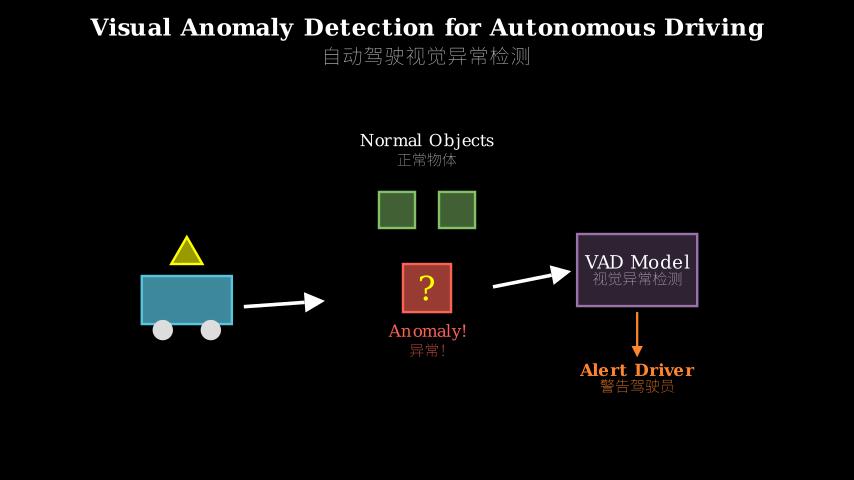
Autonomous driving systems are trained on finite datasets. When they encounter something outside that distribution—a fallen tree, construction debris, an overturned vehicle—they don’t know they don’t know. Standard object detectors confidently misclassify or ignore these anomalies because they’re optimized for closed-world recognition. Prior work in Visual Anomaly Detection (VAD) focused on industrial inspection (scratches on metal, fabric defects) or medical imaging, not the chaotic, high-stakes environment of road scenes. Existing benchmarks are small, synthetic datasets lack realism, and no one had systematically tested whether VAD methods scale to autonomous driving’s computational constraints.
Problem: Closed-world detectors fail silently on out-of-distribution road hazards
    |
    v
Assumption: VAD methods (trained on normality) can flag anomalies without prior knowledge
    |
    v
Method: Benchmark 8 VAD approaches on AnoVox (largest synthetic AD anomaly dataset)
    |
    v
Evidence: Tiny-Dinomaly matches full-scale accuracy at 10x lower memory cost
    |
    v
Conclusion: VAD transfers to road scenes; edge deployment is feasible
The Increment
One sentence: Before this paper, VAD was a lab curiosity for industrial defects; after, it’s a benchmarked, edge-deployable safety layer for autonomous vehicles.
Core Mechanism
The paper doesn’t propose a new method—it’s a systematic evaluation. They take eight existing VAD approaches (PatchCore, DRAEM, SimpleNet, EfficientAD, PaDiM, FastFlow, RD++, Dinomaly) and test them on AnoVox, a synthetic dataset with 20,000+ images containing 12 anomaly types (animals, debris, construction objects). Each method learns what “normal” road scenes look like during training, then at test time produces a pixel-level anomaly map highlighting regions that deviate from normality. The key twist: they test four backbone architectures (ResNet, WideResNet, MobileNet, DeiT-Tiny) to measure the accuracy-efficiency tradeoff for edge devices.
Training Phase:
  Normal road images --> VAD model --> Learn "normality" distribution
                            |
                            v
                    [Feature extractor backbone]
                            |
                            v
                    [Method-specific head]
                    (memory bank / decoder / flow model)

Test Phase:
  New image --> Backbone --> Features --> Compare to normality
                                              |
                                              v
                                    Anomaly score per pixel
                                              |
                                              v
                                    Heatmap (red = anomalous)
Think of VAD like a museum security guard who’s memorized every painting in the gallery. They don’t need a catalog of what thieves look like—they just know when something’s wrong because a frame is crooked, a painting is missing, or there’s a new object that wasn’t there yesterday. The backbone (ResNet, MobileNet, etc.) is their visual system—how detailed their perception is. The method-specific head (memory bank in PatchCore, normalizing flow in FastFlow) is their mental model of “how things should be.” When a new scene arrives, they compare it to their internalized normal and flag deviations. Tiny-Dinomaly is the guard with photographic memory but low energy consumption—they remember just as much detail but don’t need to constantly reference a heavy filing cabinet.
Key Concepts
-
Visual Anomaly Detection (VAD): Instead of training a model to recognize specific objects (“this is a car, this is a pedestrian”), you train it only on normal examples. At test time, anything that doesn’t fit the learned normality distribution gets flagged. It’s the difference between teaching a kid “here are all the safe things” versus “here are all the dangerous things”—the former scales better because the world has infinite dangers but finite normality. In road scenes, normality is “asphalt, lane markings, typical vehicles, standard signage.” An overturned truck or a kangaroo on the highway breaks that pattern.
-
Pixel-level anomaly maps: The model doesn’t just say “this image contains an anomaly”—it produces a heatmap where each pixel gets an anomaly score. This is critical for autonomous driving because you need to know *where the problem is to guide attention or trigger emergency braking. It’s like a doctor not just saying “you’re sick” but pointing to the exact spot on the X-ray.
-
Edge deployment tradeoff: Autonomous vehicles can’t send every frame to the cloud for processing (latency kills). Models must run on onboard GPUs with limited memory and power. The paper tests lightweight backbones (MobileNet, DeiT-Tiny) to see if you can maintain detection accuracy while fitting in edge hardware. Tiny-Dinomaly achieves 99.4% of full-scale performance at 10% of the memory footprint—that’s the engineering win.
Framework Shift
Before (mainstream approach):        After (this paper):

Train on labeled objects:            Train on normal scenes only:
  Car --> [Model] --> "Car"            Normal road --> [VAD] --> Learn distribution
  Pedestrian --> "Pedestrian"                                         |
  Bike --> "Bike"                      Test image --> Compare --> Anomaly map
       |                                    |                      |
       v                                    v                      v
  Unknown object --> Misclassify      Unknown object --> Flag as anomalous
  (silent failure)                    (explicit uncertainty)

Closed-world assumption              Open-world awareness
From “recognize everything I was trained on” to “flag anything I wasn’t trained on,” the core shift is from classification confidence to distributional awareness.
Expert Assessment
Problem choice: Real and urgent. Silent failures in autonomous driving are a deployment blocker. The gap is genuine—VAD hasn’t been rigorously tested on road scenes at scale. This isn’t a manufactured problem.
Method maturity: This is a benchmarking paper, not a novel method. That’s fine—the field needed this. However, the choice of AnoVox (synthetic data) is a limitation. Synthetic anomalies are cleaner than real-world chaos (mud splatter, weird lighting, partial occlusions). The paper acknowledges this but doesn’t test on real anomaly datasets like RoadAnomaly or SegmentMeIfYouCan, which weakens the claim of “concrete step toward deployment.”
Experimental integrity: Baselines are fair—eight diverse VAD methods, four backbones, consistent evaluation metrics (AUROC, AP, F1-max). The numbers are credible. One red flag: they don’t compare against uncertainty estimation methods (e.g., Bayesian neural networks, ensembles) which are alternative approaches to the same problem. Also, no runtime benchmarks—memory footprint is reported, but not inference latency, which matters for real-time driving.
Writing quality: Clear structure, good motivation. The related work section is thin—doesn’t engage deeply with why prior VAD methods (designed for static industrial scenes) should transfer to dynamic road environments. The results section is thorough but repetitive—Table 3, 4, 5 could be condensed. If they rewrote Section 4.3 (ablation on backbones) to include a decision tree for practitioners (“use Tiny-Dinomaly if memory<X, use ResNet-based if accuracy is critical”), it would elevate the paper from academic exercise to engineering guide.
Verdict: weak accept — Solid benchmarking work that fills a real gap, but limited by synthetic data and missing comparisons to alternative uncertainty methods. Useful for the community, not groundbreaking.
Takeaways
- Steal the evaluation protocol: If you’re deploying any perception model in safety-critical domains, add a VAD layer as a sanity check. The paper shows it’s computationally feasible.
- Tiny-Dinomaly for edge: If you’re memory-constrained, this architecture is a concrete starting point. The 10x memory reduction at <1% accuracy loss is a rare win.
- Synthetic-to-real gap remains: Don’t trust synthetic benchmarks alone. The paper’s results are promising but need validation on real anomaly datasets before production deployment.
- Pixel-level maps for explainability: Even outside autonomous driving, if your model needs to explain *why it’s uncertain, anomaly heatmaps are more actionable than scalar confidence scores.
论文: 2604.15291 作者: Fabrizio Genilotti, Arianna Stropeni, Gionata Grotto, Francesco Borsatti, Manuel Barusco, Davide Dalle Pezze, Gian Antonio Susto 分类: cs.CV, cs.AI
缺口
自动驾驶系统在有限数据集上训练。
当它们遇到分布外的东西——倒下的树、施工碎片、翻车——它们不知道自己不知道。
标准目标检测器会自信地误分类或忽略这些异常,因为它们针对封闭世界识别进行了优化。
视觉异常检测(VAD)的先前工作集中在工业检测(金属划痕、织物缺陷)或医学影像上,而非道路场景这种混乱、高风险的环境。
现有基准数据集规模小,合成数据缺乏真实感,也没有人系统测试过 VAD 方法能否适应自动驾驶的计算约束。
问题:封闭世界检测器在分布外路面危险上静默失效
    |
    v
假设:VAD 方法(在正常样本上训练)可以在无先验知识下标记异常
    |
    v
方法:在 AnoVox(最大合成自动驾驶异常数据集)上对 8 种 VAD 方法进行基准测试
    |
    v
证据:Tiny-Dinomaly 在内存成本降低 10 倍的情况下达到全尺度精度
    |
    v
结论:VAD 可迁移到道路场景;边缘部署可行
增量
一句话: 这篇论文之前,VAD 是工业缺陷检测的实验室玩具;之后,它成为自动驾驶车辆经过基准测试、可边缘部署的安全层。
核心机制
本文不提出新方法——它是系统性评估。
作者拿了八种现有 VAD 方法(PatchCore、DRAEM、SimpleNet、EfficientAD、PaDiM、FastFlow、RD++、Dinomaly),在 AnoVox 上测试它们。
AnoVox 是一个合成数据集,包含 20,000+ 张图像,涵盖 12 种异常类型(动物、碎片、施工物体)。
每种方法在训练时学习「正常」道路场景的样子,然后在测试时生成像素级异常图,突出显示偏离正常的区域。
关键转折:他们测试了四种骨干架构(ResNet、WideResNet、MobileNet、DeiT-Tiny),以衡量边缘设备的精度-效率权衡。
训练阶段:
  正常道路图像 --> VAD 模型 --> 学习「正常」分布
                            |
                            v
                    [特征提取骨干网络]
                            |
                            v
                    [方法特定头部]
                    (记忆库 / 解码器 / 流模型)

测试阶段:
  新图像 --> 骨干网络 --> 特征 --> 与正常分布比较
                                      |
                                      v
                            每个像素的异常分数
                                      |
                                      v
                            热力图(红色 = 异常)
把 VAD 想象成博物馆保安,他记住了画廊里的每一幅画。
他不需要小偷长什么样的目录——他只知道什么时候不对劲,因为画框歪了、画不见了,或者出现了昨天不在那里的新物体。
骨干网络(ResNet、MobileNet 等)是他的视觉系统——感知有多细致。
方法特定头部(PatchCore 的记忆库、FastFlow 的归一化流)是他对「事物应该如何」的心智模型。
当新场景到来时,他们将其与内化的正常状态比较,标记偏差。
Tiny-Dinomaly 是拥有照相记忆但能耗低的保安——他们记住同样多的细节,但不需要不断查阅沉重的档案柜。
关键概念
- 视觉异常检测(VAD): 不是训练模型识别特定物体(「这是汽车,这是行人」),而是只在正常样本上训练它。
测试时,任何不符合学习到的正常分布的东西都会被标记。
这就像教孩子「这些是所有安全的东西」与「这些是所有危险的东西」的区别——前者扩展性更好,因为世界有无限危险但有限正常。
在道路场景中,正常是「沥青、车道标线、典型车辆、标准标志」。
翻车或高速公路上的袋鼠打破了这种模式。
- 像素级异常图: 模型不只是说「这张图像包含异常」——它生成热力图,每个像素都有异常分数。
这对自动驾驶至关重要,因为你需要知道问题在哪里,以引导注意力或触发紧急制动。
就像医生不只是说「你生病了」,而是指向 X 光片上的确切位置。
- 边缘部署权衡: 自动驾驶车辆不能把每一帧都发送到云端处理(延迟致命)。
模型必须在内存和功耗有限的车载 GPU 上运行。
本文测试轻量级骨干网络(MobileNet、DeiT-Tiny),看能否在适配边缘硬件的同时保持检测精度。
Tiny-Dinomaly 在内存占用仅为 10% 的情况下达到全尺度性能的 99.4%——这是工程胜利。
框架转变
之前(主流方法):                之后(本文方法):

在标注物体上训练:                只在正常场景上训练:
  汽车 --> [模型] --> "汽车"        正常道路 --> [VAD] --> 学习分布
  行人 --> "行人"                                           |
  自行车 --> "自行车"                测试图像 --> 比较 --> 异常图
       |                                |                  |
       v                                v                  v
  未知物体 --> 误分类                未知物体 --> 标记为异常
  (静默失效)                        (显式不确定性)

封闭世界假设                      开放世界意识
从「识别我训练过的一切」到「标记我没训练过的任何东西」,核心转变是从分类置信度到分布意识。
专家评审
选题眼光: 真实且紧迫。
自动驾驶中的静默失效是部署障碍。
缺口是真实的——VAD 尚未在大规模道路场景上得到严格测试。
这不是人造问题。
方法成熟度: 这是基准测试论文,不是新方法。
这没问题——该领域需要这个。
然而,选择 AnoVox(合成数据)是一个局限。
合成异常比现实世界的混乱(泥浆飞溅、怪异光照、部分遮挡)更干净。
论文承认了这一点,但没有在真实异常数据集(如 RoadAnomaly 或 SegmentMeIfYouCan)上测试,这削弱了「迈向部署的具体步骤」的主张。
实验诚意: 基线公平——八种不同的 VAD 方法、四种骨干网络、一致的评估指标(AUROC、AP、F1-max)。
数字可信。
一个警示:他们没有与不确定性估计方法(如贝叶斯神经网络、集成)比较,而这些是解决同一问题的替代方法。
此外,没有运行时基准——报告了内存占用,但没有推理延迟,而这对实时驾驶很重要。
写作功力: 结构清晰,动机充分。
相关工作部分较薄——没有深入探讨为什么先前的 VAD 方法(为静态工业场景设计)应该迁移到动态道路环境。
结果部分详尽但重复——表 3、4、5 可以压缩。
如果他们重写第 4.3 节(骨干网络消融),加入实践者决策树(「如果内存<X 使用 Tiny-Dinomaly,如果精度关键使用基于 ResNet 的」),论文将从学术练习提升为工程指南。
判决: 弱接收 — 填补真实缺口的扎实基准测试工作,但受限于合成数据和缺少与替代不确定性方法的比较。
对社区有用,但不具突破性。
要点总结
- 偷走评估协议: 如果你在安全关键领域部署任何感知模型,添加 VAD 层作为健全性检查。
论文表明这在计算上是可行的。
- 边缘设备用 Tiny-Dinomaly: 如果你内存受限,这个架构是具体起点。
在精度损失 <1% 的情况下内存减少 10 倍是罕见的胜利。
- 合成到真实的鸿沟依然存在: 不要只信任合成基准。
论文结果有希望,但在生产部署前需要在真实异常数据集上验证。
- 像素级图用于可解释性: 即使在自动驾驶之外,如果你的模型需要解释**为什么*不确定,异常热力图比标量置信度分数更可操作。